
PROJECT PLANNING AND SCHEDULING INSIGHT
Why Do Project Schedules Fall Behind?
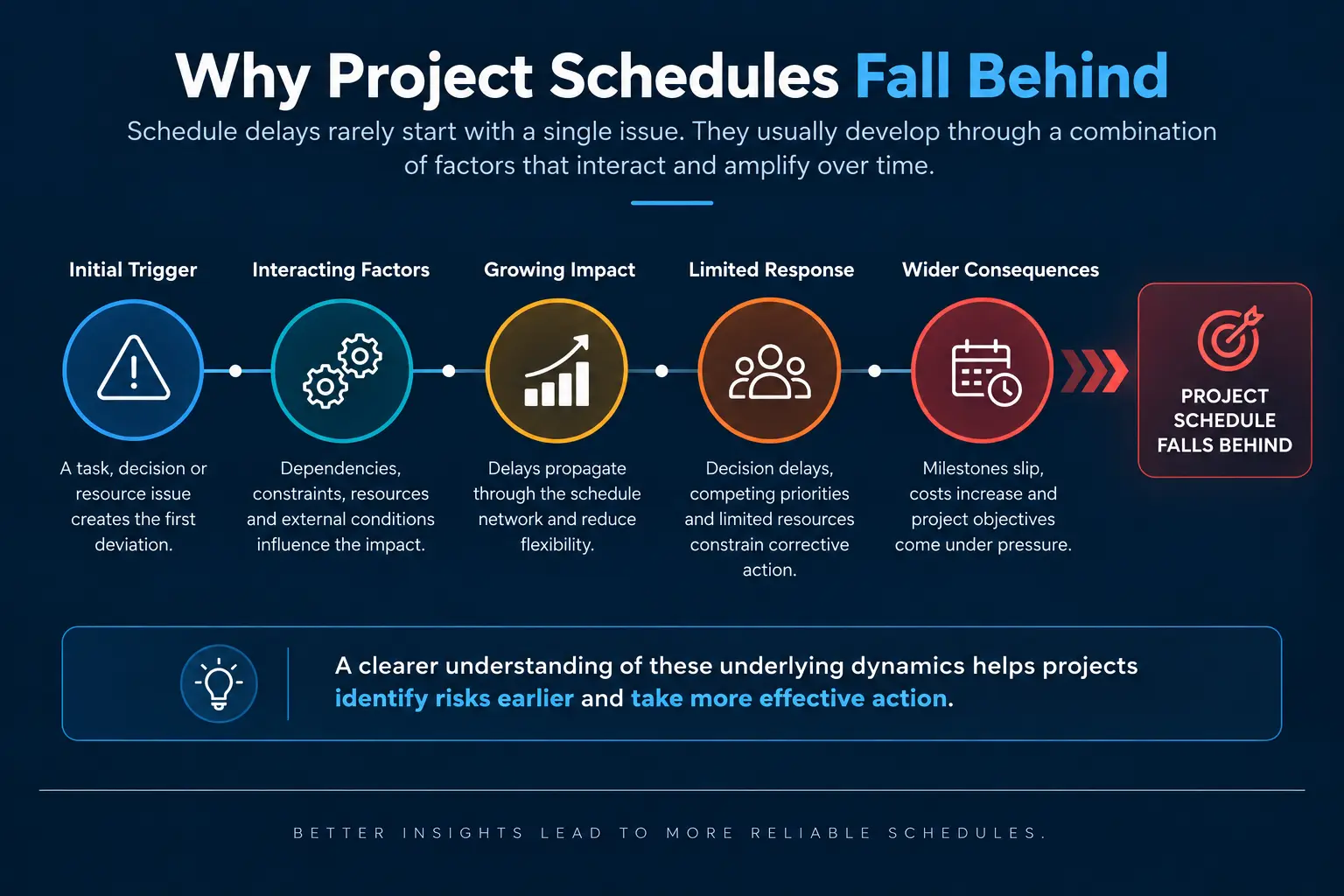
Project Schedules Fall Behind when actual project conditions diverge from the assumptions behind the schedule. However, a schedule can remain well structured while resources, decisions, dependencies, information, or execution conditions change around it. As a result, small deviations can consume flexibility, propagate through connected work, and gradually increase schedule exposure. This Insight examines why schedules fall behind, why professionals can miss the underlying pattern, and what they should reconsider when schedule performance begins to deteriorate.
Professional Insight · Project Planning & Scheduling
Introduction
A project schedule provides a structured view of planned activities, durations, dependencies, milestones, and expected completion. However, the schedule represents assumptions about how work will progress under expected project conditions.
Those conditions can change quickly. Resources may become unavailable, decisions may take longer, information may arrive late, dependencies may shift, and rework may introduce additional activities. As a result, actual execution can gradually diverge from the schedule without one obvious cause.
Project Schedules Fall Behind when these deviations interact with the schedule network faster than the project can absorb or respond to them. Therefore, a delay should not always be viewed as an isolated activity problem.
Research on project delays shows that causes vary across industries, project types, locations, delivery models, and lifecycle stages. Moreover, research on schedule networks demonstrates that disruptions can propagate through connected activities and create effects beyond their original point of occurrence.
This Insight examines what happens beneath visible schedule slippage. It explores how deviations propagate, how schedule flexibility becomes consumed, why professionals can miss emerging exposure, and what project teams should reconsider when schedule performance begins to deteriorate.
The Common Assumption
A Late Activity Means the Project Is Falling Behind
A late activity is an important signal, but it does not automatically mean the project has lost its delivery position. Its effect depends on dependencies, available flexibility, downstream work, and its relationship to key milestones.
Therefore, professionals should distinguish activity slippage from meaningful project-level exposure. A task can finish late without changing the required outcome, while a smaller deviation can affect a critical dependency.
The Schedule Tells Us What Will Happen
A schedule provides a model of expected execution rather than a guarantee of future performance. It depends on assumptions about durations, sequencing, resources, decisions, information, and external conditions.
However, teams can gradually treat planned dates as if they describe reality. As conditions change, new evidence may receive less attention than the existing schedule narrative.
More Schedule Monitoring Will Prevent Delay
Frequent monitoring can improve visibility, but visibility alone does not remove the conditions causing delay. A project can identify deterioration without having sufficient authority, capacity, or information to change it.
As a result, monitoring frequency should not become a substitute for understanding what schedule information means or what response it requires.
Each Delay Can Be Managed Independently
Project teams often assign individual owners to individual delays. That approach creates accountability, but it can hide interactions between problems.
For example, a design delay may affect procurement, which may affect installation, which may then affect testing. Consequently, Project Schedules Fall Behind through connected effects rather than one isolated cause.
Float Means the Project Has Spare Time
Float can provide useful schedule flexibility, but it does not represent unrestricted spare capacity. Its availability depends on the network, relationships, calendars, constraints, and assumptions within the schedule.
Moreover, several activities can consume flexibility at the same time. Therefore, a project can lose practical schedule resilience before a major milestone variance becomes visible.
The Latest Forecast Is the Most Likely Future
A forecast represents current expectations using available information and assumptions. It can therefore support decision-making without becoming a certainty.
When Project Schedules Fall Behind, the latest forecast may change repeatedly as new information arrives. That movement itself can reveal uncertainty or instability that deserves examination.
Rebaselining Solves Schedule Slippage
A revised baseline can provide a legitimate reference when approved scope, strategy, or delivery conditions change. However, changing the baseline does not remove the conditions that caused previous schedule performance.
Instead, professionals should distinguish between changing the reference point and changing the project’s ability to deliver. A new baseline can improve control, but it cannot substitute for understanding schedule exposure.
What Is Really Happening?
The Schedule Is a Network of Dependencies, Not a List of Dates
A project schedule connects activities through relationships, constraints, resources, calendars, and milestones. Therefore, the effect of a deviation depends partly on what other work relies on the affected activity.
This network structure makes relationships visible and provides a basis for analysing schedule exposure. However, the schedule remains a model of expected execution rather than a complete representation of project reality.
When Project Schedules Fall Behind, the important question is therefore not simply which activity is late. It is what the late activity changes elsewhere in the project.
Small Deviations Can Become Larger Through Propagation
A small delay can affect downstream activities when those activities have limited flexibility or strong dependencies. Research on large-scale engineering projects has shown how disruptions can propagate across connected activity networks.
However, propagation does not occur in the same way on every project. Network structure, dependency strength, available flexibility, and execution conditions influence the eventual effect.
The Project Can Consume Its Schedule Flexibility Before Missing a Milestone
Schedule flexibility can absorb some variation without immediately changing a required completion date. Yet that flexibility remains finite within a given schedule configuration.
Consequently, repeated small deviations can reduce the project’s ability to absorb later disruption. The visible milestone problem may appear only after the project’s underlying resilience has already weakened.
Execution Conditions Can Differ From Schedule Logic
A schedule can contain technically sound relationships while actual execution faces conditions that the model does not fully represent. Productivity, access, approvals, learning curves, supplier behaviour, workface readiness, and coordination can change how planned activities progress.
Therefore, schedule logic should remain connected to execution evidence rather than operate as a separate planning system.
Changes Create More Than One Delay
A change can affect design, procurement, approvals, resources, sequencing, testing, and handover. Consequently, its schedule effect may extend beyond the activity where the change first appears.
This is why Project Schedules Fall Behind through combinations of conditions rather than a simple one-to-one relationship between cause and delay.
Information Delay Can Become Schedule Delay
Teams often need information before they can make decisions or start work. When information arrives late, the resulting schedule effect may appear later than its original cause.
Moreover, incomplete information can create waiting, rework, or repeated coordination. Therefore, information flow can become a schedule dependency even when the schedule does not describe it explicitly.
Decisions Can Become Schedule Dependencies
Some work cannot proceed until a technical, commercial, design, governance, or stakeholder decision occurs. A decision can therefore function like a hidden predecessor to multiple activities.
As a result, a schedule may show the visible work while underrepresenting the decision conditions required to release that work.
Resource Competition Can Change the Practical Sequence
Two activities may appear independent in schedule logic while competing for the same specialist, facility, equipment, or work area. Therefore, resource conditions can change the practical sequence of execution.
Resource-constrained scheduling research continues to examine how uncertainty, multiple projects, and changing resource conditions affect scheduling decisions. The broader lesson is that time and resource conditions cannot always be analysed independently.
The Project Learns About Its Schedule While Executing It
Initial schedule assumptions rarely contain complete knowledge about future execution. As work progresses, the project learns about productivity, dependencies, uncertainty, constraints, and actual durations.
Therefore, Project Schedules Fall Behind partly because execution reveals information that was unavailable when the original schedule was developed. The schedule becomes an evolving representation of what the project has learned.
The Schedule Can Fall Behind Faster Than the Management System Can Adapt
A project may identify a deviation only after several reporting steps have occurred. By then, the underlying condition may have changed again.
This creates a gap between what has changed, what the project knows, what it believes the change means, and what it can do about it. That gap can determine whether a schedule deviation remains manageable or develops into broader schedule deterioration.
Why Do Professionals Miss the Problem?
The Project Watches Dates Instead of Schedule Exposure
Dates are visible, familiar, and easy to report. However, schedule exposure often develops through relationships, assumptions, constraints, and future dependencies that current dates do not fully reveal.
Therefore, Project Schedules Fall Behind can remain difficult to understand when reporting focuses mainly on current variance rather than what the variance may affect next.
Small Variances Do Not Look Serious in Isolation
A few days of movement may appear manageable when viewed against one activity. Yet several modest deviations can occur across connected work at the same time.
As a result, professionals can underestimate the combined effect of changes that appear insignificant individually.
Float Can Create False Comfort
Float can legitimately absorb some variation. However, teams may interpret available float as evidence that schedule risk remains low without examining how quickly that flexibility is being consumed.
Moreover, changes elsewhere in the network can alter the significance of previously available flexibility. A project can therefore become more exposed before the reported milestone changes.
The Schedule Update Can Arrive After the Condition Has Changed
Schedule updates create a structured reporting cycle. Yet execution continues between reporting points, and important conditions can change before the next update captures them.
Consequently, a formally accurate update can still describe conditions that no longer represent the current project situation.
Teams Explain Delays Locally
Local explanations can be useful because teams understand their immediate work. However, a local explanation may not reveal how that condition interacts with other project areas.
Therefore, Project Schedules Fall Behind can appear to have many unrelated causes when several causes actually reinforce one another.
The Current Forecast Can Become the New Project Story
Once a forecast becomes the accepted expectation, teams may begin managing toward it. That expectation can influence decisions, communications, and perceptions of urgency.
However, a forecast should remain an evidence-based expectation rather than a fixed narrative. Repeated movement can itself become useful information about predictability.
Historical Performance Is Not Fully Used
Previous schedule performance can reveal recurring patterns in estimating, productivity, procurement, approvals, interfaces, and execution. Yet teams often focus more heavily on the current reporting period.
As a result, the project may encounter similar schedule conditions repeatedly without treating recurrence as evidence that its assumptions need examination.
Schedule Metrics Are Treated as the Whole Evidence Base
Schedule metrics provide important quantitative evidence. Nevertheless, they do not capture every condition affecting future execution.
Qualitative information about readiness, coordination, decision quality, supplier conditions, workforce capability, or emerging constraints can add important context. Conflicting evidence should prompt examination rather than automatic dismissal.
Repeated Delay Can Become Normal Project Behaviour
Repeated small delays can gradually become accepted as normal. Once that happens, the project may stop treating them as evidence that its assumptions or operating conditions have changed.
Consequently, Project Schedules Fall Behind without every individual deviation receiving serious attention. The problem may become less visible precisely because it has become familiar.
Professionals React to Delay Instead of Studying Delay Patterns
Teams often respond quickly to visible slippage because immediate action feels productive. However, repeated reactive responses can leave the underlying pattern unexplained.
A more useful question is not simply “What caused this delay?” It is also “Why does this type of delay keep appearing, and what does that pattern tell us?”
What Happens If It Continues?
Schedule Flexibility Is Gradually Consumed
Repeated deviations can consume available float and other forms of schedule flexibility. Therefore, the project can become increasingly sensitive to new disruption before a major milestone changes.
This creates an important transition because the project may appear stable while its ability to absorb further change continues to decline.
Local Delays Become Project-Level Delays
A delay becomes more consequential when downstream work depends on the affected activity. As a result, a local performance problem can become a milestone or completion problem.
Research on interconnected engineering activity networks demonstrates how disruptions can propagate across downstream activities rather than remain isolated. However, the extent of propagation depends on the structure and conditions of each project.
Dependencies Begin to Queue Behind Delayed Work
When prerequisite work remains incomplete, dependent teams may wait, resequence, or start partial work. Consequently, the project can accumulate waiting time, coordination pressure, and additional interface activity.
When Project Schedules Fall Behind, these dependencies can create secondary effects that were not present when the original delay emerged.
Resource Utilization Becomes More Disrupted
Schedule disruption can cause resources to move, wait, resequence, or work around incomplete inputs. However, these responses can create additional coordination requirements and reduce planned resource efficiency.
Therefore, schedule deterioration can create resource effects beyond the activity where the original delay appeared.
Rework and Concurrent Work Can Increase
Schedule pressure can encourage teams to overlap activities or proceed before all information becomes stable. Sometimes this approach can recover time.
However, concurrent work can also increase coordination and rework exposure when important dependencies remain unresolved. The project may therefore exchange schedule pressure for additional execution risk.
Forecast Confidence Declines
Repeated movement in dates and durations can reduce confidence in the schedule’s ability to represent future performance. Consequently, stakeholders may begin questioning both individual forecasts and the wider planning process.
Forecast movement should therefore become information for analysis rather than merely another reporting statistic. When Project Schedules Fall Behind repeatedly, changing forecasts can reveal persistent uncertainty or declining predictability.
Management Attention Becomes More Reactive
As schedule pressure increases, management may focus more heavily on immediate milestones and short-term recovery actions. However, reactive attention can reduce the time available for understanding structural causes.
As a result, the project can become increasingly busy without becoming more predictable or more capable of absorbing future disruption.
Cost and Commercial Pressure Increase
Schedule slippage can create additional labour, equipment, supervision, overhead, financing, or contractual exposure. The effects vary by project, but extended delivery can increase pressure across cost and commercial arrangements.
Therefore, schedule deterioration should not remain isolated within the planning function. Its consequences can extend into financial, contractual, and operational decisions.
Stakeholder and Commercial Commitments Become Harder to Maintain
A changing schedule can affect customer commitments, supplier arrangements, regulatory activities, operational readiness, and linked projects. Therefore, schedule changes can create consequences outside the immediate delivery team.
The wider the dependency network, the more important it becomes to understand these connections before they create additional schedule pressure.
The Project Loses the Ability to Distinguish Delay From Structural Deterioration
A project can experience isolated delays without losing control. However, repeated delays across connected areas may indicate that assumptions, capacity, governance, information, or execution conditions have changed.
When Project Schedules Fall Behind repeatedly, the professional question therefore shifts from “How do we recover this date?” to “What is changing in the system that keeps producing this schedule behaviour?”
What Should Project Professionals Reconsider?
Distinguish Activity Slippage From Project Delay
Not every late activity changes the project’s required outcome. Therefore, professionals should examine its dependencies, available flexibility, downstream effects, and relationship to key milestones.
The size of a delay matters less than what the delay can affect. This distinction helps prevent attention from concentrating on visible variance while more consequential exposure develops elsewhere.
Treat Schedule Flexibility as a Project Resource
Float and other forms of schedule flexibility can absorb variation. However, that flexibility has practical value only while it remains available and relevant to future work.
- How much flexibility remains?
- Where is flexibility already being consumed?
- What future event could remove that flexibility?
Therefore, when Project Schedules Fall Behind, professionals should examine both current variance and the project’s remaining capacity to absorb further change.
Look for Delay Propagation, Not Just Delay Magnitude
A small delay can matter more than a larger delay when it affects highly connected or constrained work. Consequently, professionals should examine relationships between delayed activities and their potential downstream consequences.
Delay magnitude describes what happened; propagation helps explain what could happen next. This moves schedule analysis from isolated variance toward network behaviour.
Connect the Schedule to Execution Conditions
The schedule should remain connected to what teams actually experience during delivery. Therefore, professionals should consider readiness, productivity, resources, approvals, information, access, suppliers, and other conditions influencing execution.
A schedule that ignores important execution conditions can remain mathematically coherent while becoming less useful as a representation of delivery reality.
Treat Uncertainty as Something That Evolves
Schedule uncertainty changes as the project learns more about its work. Some uncertainty reduces through execution, while other uncertainty emerges through changes, interfaces, constraints, or new information.
Therefore, uncertainty should not become a fixed project characteristic. The schedule should reflect what the project has learned, not only what it believed at the beginning.
Separate the Baseline, Forecast, and Expected Outcome
The baseline describes an approved reference position. The forecast describes current expectations, while the expected outcome reflects what the project now believes it can realistically achieve.
- Baseline: What the project previously approved as its reference.
- Forecast: What current evidence suggests may happen.
- Expected outcome: What the project currently believes it can realistically achieve.
As a result, Project Schedules Fall Behind can be analysed without confusing historical commitment with current expectation.
Use Historical Evidence Without Treating It as a Prediction
Historical performance can reveal patterns in estimating, productivity, procurement, approvals, interfaces, and execution. However, previous performance does not guarantee future performance.
Instead, professionals should use historical evidence to challenge assumptions, identify recurring conditions, and strengthen current judgement. History should inform the forecast without becoming the forecast.
Interpret Schedule Information Alongside Other Evidence
Schedule data provides important quantitative evidence, but it does not capture every condition affecting future performance. Therefore, professionals should connect schedule information with risk, resources, decisions, technical readiness, commercial conditions, and stakeholder information.
When evidence conflicts, that difference can itself become informative. Conflicting signals deserve examination rather than automatic dismissal.
Treat Forecast Movement as Information
A changing forecast does not automatically mean that forecasting has failed. It can indicate that the project is receiving new information or that its assumptions remain unstable.
However, repeated movement deserves examination because it can reveal persistent uncertainty, unstable assumptions, or declining predictability.
Reduce Response Latency, Not Merely Reporting Frequency
More frequent reporting does not necessarily create faster intervention. The project also needs timely interpretation, decision authority, resources, and mechanisms for changing course.
Therefore, when Project Schedules Fall Behind, professionals should examine the complete path from signal → interpretation → decision → action → effect. Improving that response path can matter more than simply producing schedule information more frequently.
A Practical Professional Lens
A useful schedule perspective should help professionals interpret change without turning schedule analysis into another scoring exercise. Instead, this lens connects six questions that help explain what schedule movement may mean for the project’s future.
DEVIATION — What Has Changed?
Start with the observable change. Ask what moved, what duration changed, what became unavailable, or which assumption no longer holds.
Separate the observed change from the explanation of why it happened. This prevents an early interpretation from becoming an unquestioned conclusion.
PROPAGATION — What Could This Affect?
Examine downstream activities, milestones, resources, decisions, interfaces, and external commitments. Moreover, consider whether the deviation can create secondary effects that the current schedule does not immediately show.
When Project Schedules Fall Behind, understanding propagation can be more useful than measuring the original deviation alone.
FLEXIBILITY — What Can Still Absorb It?
Consider float, alternative sequencing, resource options, decision windows, contingency, and other forms of practical flexibility. Therefore, ask not only how much delay exists but also how much capacity remains to absorb further change.
- What flexibility remains?
- Where is flexibility already being consumed?
- What future event could remove that flexibility?
Flexibility is valuable because it gives the project room to respond. Once that room narrows, the same deviation can produce a very different consequence.
CONDITION — What Is Driving the Deviation?
Look beyond the visible schedule variance. The underlying condition may involve resources, information, decisions, design, procurement, productivity, stakeholders, technical uncertainty, or several interacting factors.
Therefore, professionals should ask whether the deviation represents an isolated event, a recurring pattern, or evidence of a changing project condition.
RESPONSE — How Quickly Can the Project Adapt?
A project may understand a schedule problem but still respond slowly. Examine decision authority, available resources, escalation routes, information quality, and the time required to implement a response.
As a result, when Project Schedules Fall Behind, response capability can determine whether the project absorbs the deviation or allows it to propagate.
TRAJECTORY — What Is the Project Becoming?
Finally, examine the direction of travel. Is the project becoming more predictable, more constrained, more flexible, or more exposed?
The mental model is:
DEVIATION → PROPAGATION → FLEXIBILITY → CONDITION → RESPONSE → TRAJECTORY ↺
This creates three levels of professional attention:
- Level 1 — Detection: Something changed.
- Level 2 — Interpretation: We understand what the change means.
- Level 3 — Adaptation: The project changes its response based on what it learned.
A project can perform well at detection while remaining weak at interpretation or adaptation. The objective is not to eliminate every schedule deviation. Instead, it is to understand which deviations matter, how they can propagate, how much flexibility remains, and whether the project is becoming more or less capable of absorbing change.
Key Takeaways
Project schedules rarely deteriorate because of one late activity alone. Instead, schedule performance can weaken as assumptions, dependencies, resources, decisions, information, and execution conditions interact.
- A late activity is not automatically a project-level delay. Its significance depends on dependencies, flexibility, downstream effects, and required outcomes.
- Delays can propagate through the schedule network. A relatively small deviation can become more consequential when it affects constrained or highly connected work.
- Schedule flexibility is finite. Float and other available capacity can be consumed before a major milestone variance becomes visible.
- The schedule is a model, not a guarantee. It should be interpreted alongside evidence from execution, resources, risks, decisions, and other project conditions.
- Forecast movement is useful information. Repeated changes can reveal evolving uncertainty, unstable assumptions, or declining predictability.
- Response capability matters as much as reporting. Effective adaptation requires timely interpretation, decision authority, resources, and the ability to implement change.
- Repeated delay patterns deserve systemic examination. When Project Schedules Fall Behind repeatedly, professionals should investigate the conditions producing the pattern rather than treating every delay as an isolated event.
The central question is not simply whether the schedule is late. It is whether the project understands what has changed, what that change can affect, what flexibility remains, and how effectively the project can adapt.
References
Academic & Research Literature
- Uncovering the Fragility of Large-Scale Engineering Projects — Santolini, Ellinas & Nicolaides (2021).
- Causes of Delays on Construction Projects: A Comprehensive List (2019).
- Causes of Delay in the Global Construction Industry: A Meta-Analytical Review (2022).
- An Integrative Literature Review on the Causes of Delays in Construction Projects: Evidence from Developing Countries — Selcuk, Turkoglu, Polat & Hajdu (2024).
- Schedule Delay Leading Indicators in Precast Concrete Construction Projects — Cho et al. (2021).
- Dynamic Prediction of Delays in Software Projects Using Delay Patterns and Bayesian Modeling — Kula et al.
- A Comparison of Forecasting Methods for Project Duration — Vandevoorde & Vanhoucke (2006).
Professional Standards & Practice Guidance
- Practice Standard for Scheduling – Third Edition — Project Management Institute (2019).
- GAO Schedule Assessment Guide: Best Practices for Project Schedules — U.S. Government Accountability Office (2015).
- Pulse of the Profession® 2026: Driving Success in Complex Projects — From Navigating Tasks to Navigating Systems — Project Management Institute (2026).
Related Kleios Resources
Understanding why schedules deteriorate is only one part of effective schedule management. The following Kleios resources provide practical methods and structured tools for examining the conditions that influence schedule performance.
Guides
- How to Develop a Project Schedule Basis — Establish the assumptions, methods, calendars, constraints, and planning principles that underpin the project schedule.
- How to Review and Validate a Project Schedule — Examine schedule logic, relationships, durations, constraints, and other characteristics that influence schedule reliability.
- How to Manage Schedule Baseline Changes — Understand how approved changes can alter the schedule reference position while preserving visibility of historical performance.
- How to Identify Schedule Constraints — Identify conditions that restrict sequencing, timing, resources, or execution flexibility and may influence schedule performance.
Templates
- Project Schedule Basis Template — Structure and document the assumptions, methods, calendars, constraints, and other foundations supporting a project schedule.
- Project Schedule Review Checklist — Apply a structured review approach to identify schedule weaknesses and potential sources of future exposure.
- Schedule Baseline Change Template — Structure proposed schedule baseline changes and document the information needed to support controlled change.
- Schedule Constraints Identification Checklist — Capture and examine schedule constraints systematically so that important limitations remain visible during planning and execution.
Together, these resources connect the Insight’s interpretation of schedule deterioration with the planning, validation, baseline management, and constraint identification practices professionals use to understand and manage schedule exposure.
FEATURED PROJECT PLANNING AND SCHEDULING INSIGHTS
Professional Perspectives on the Challenges Plans and Schedules Face
Our featured Project Planning and Scheduling Insights examine recurring schedule challenges, estimation assumptions, changing critical paths, forecast movement, resource pressures, and planning complexity. Moreover, they encourage professionals to look beyond visible schedule problems and consider what may be happening underneath.
Why Are Project Duration Estimates Too Optimistic?
Examine why planned durations can remain optimistic despite experience, historical information, and established estimation practices. However, uncertainty, assumptions, dependencies, and estimation behaviour can still affect duration reliability.
Why Does the Critical Path Change?
Explore why the critical path changes as activities progress, durations shift, and project conditions evolve. Therefore, examine how dependencies, constraints, progress, and emerging conditions can alter schedule exposure.
Why Do Project Forecasts Keep Changing?
Examine why project forecasts keep changing and what repeated movement can reveal about schedule predictability. Moreover, consider how progress information, assumptions, uncertainty, and changing conditions influence forecast reliability.
MORE PROJECT PLANNING AND SCHEDULING RESOURCE TYPES
Continue Your Project Planning and Scheduling Learning
Planning and scheduling knowledge becomes more valuable when professionals can understand the concepts, apply structured tools, and examine their practical use. Explore our other Project Planning and Scheduling resources to complement the analytical perspectives provided by these Insights.
Guides
Explore clear guidance to understand common challenges, evaluate situations, and apply effective approaches throughout project delivery.
Downloads
Access useful project planning & scheduling materials and reference resources to support your learning and day-to-day project work.
Career Roadmaps
Follow structured learning paths to develop project management knowledge, practical skills, and capabilities for your professional growth.
Templates
Use project planning & scheduling templates to structure planning, management, reporting, and other project activities.
Case Studies
Explore realistic project situations, decisions, challenges, and outcomes to understand how project management practices work in practice.
Glossary
Find clear explanations of project planning, scheduling, project controls, schedule management, and related professional terminology.
Looking for more project management resources? Explore the Kleios Technologies Resources Hub to discover our complete collection of guides, templates, downloads, career roadmaps, case studies, glossary resources, and insights.
RELATED KNOWLEDGE DOMAINS
Continue Your Learning Across Related Knowledge Domains
Project Management is closely connected with specialized disciplines that support successful planning, execution, governance, performance measurement, and professional growth. Explore related knowledge domains to expand your expertise, develop complementary skills, and access practical resources across the complete project management ecosystem.
Expand your expertise one domain at a time and build a well-rounded project management skill set.
Why Explore Related Domains?
- Develop cross-functional project management expertise
- Discover specialized knowledge beyond core project management
- Access practical resources across interconnected disciplines
- Build a complete professional learning pathway
- Strengthen career readiness through continuous learning
Each knowledge domain complements your Project Management expertise, helping you build broader capabilities and solve real-world project challenges with greater confidence.
Project Management
Practical project management knowledge, practices, and professional resources.
Project Controls
Performance measurement, forecasting, and project control best practices.
PMO
Governance, portfolio management, and organizational project excellence.
Risk Management
Risk identification, assessment, mitigation, and monitoring resources.
Primavera P6
Professional planning, scheduling, resource management, and reporting.
Microsoft Project
Project scheduling, tracking, reporting, and collaboration resources.
Power BI
Interactive dashboards, reporting, visualization, and project analytics.
PMI Certifications
Certification guidance, exam preparation, and professional development resources.