
PROJECT PLANNING & SCHEDULING GUIDE
How to Identify Schedule Constraints
Identifying schedule constraints requires more than finding fixed dates in a project schedule. This guide provides a practical approach to identify schedule constraints, understand their causes, classify and validate restrictions, assess their impact on activities and milestones, assign ownership, and resolve them before they develop into project delays.
Practical Guide · Project Management
The Challenges of Identifying Schedule Constraints
Identifying schedule constraints is not simply a matter of checking fixed dates in Primavera P6 or Microsoft Project. Many constraints originate outside the schedule and become visible only when engineering, procurement, resources, approvals, site conditions, and project interfaces are examined together.
Constraints Exist Outside the Schedule
A schedule may show an activity starting on a particular date without explaining why that date is important. The actual restriction may come from a permit, design release, material delivery, shutdown window, site access, vendor commitment, or client decision.
This requires planners to gather information from contracts, engineering records, procurement schedules, risk registers, site teams, and stakeholder discussions.
Confusing Constraints With Targets
Not every required date is a genuine constraint. A contractual milestone, management target, preferred start date, forecast, and hard external restriction can have very different meanings.
Treating every important date as a fixed constraint can make the schedule artificially rigid and prevent it from showing how delays would actually affect the project.
Incomplete or Unreliable Information
Constraint identification often happens while project information is still developing. Drawings may not be approved, procurement dates may be preliminary, permits may be pending, and resource availability may not be confirmed.
As a result, planners must distinguish between confirmed restrictions and assumptions that may change.
Hidden Constraints in Schedule Logic
Some restrictions are not entered through the formal constraint field. They may be created through:
- Excessive lags
- Activity relationships
- Calendars
- Resource limitations
- Artificial sequencing
- External dependencies
A schedule can therefore appear to have few constraints while still containing significant restrictions that affect float and critical-path analysis.
Resource and Material Constraints
An activity may have a complete predecessor relationship but still be impossible to execute because the required labour, equipment, specialist resources, or materials are unavailable.
This becomes more difficult when several work fronts compete for the same crane, specialist crew, fabrication facility, or limited material supply.
Interface Constraints
Large projects depend on multiple organizations working together. Engineering may depend on the client, procurement may depend on engineering, construction may depend on procurement, and commissioning may depend on several construction teams.
These interfaces can create constraints that are difficult to identify because the cause and affected activity may belong to different organizations.
Interacting Constraints
Constraints rarely operate independently. A delayed design approval can delay procurement, equipment delivery, installation, testing, and commissioning.
If the planning team identifies only the immediate restriction, it may underestimate the constraint’s effect on critical activities, milestones, and project completion.
Changing Project Conditions
A constraint identified during baseline development may later disappear, while another restriction may become critical because project conditions change.
Regular reviews are therefore necessary to determine whether constraints remain valid, have been resolved, or require escalation.
Lack of Ownership
Identifying a constraint does not remove it. If nobody is responsible for resolving the restriction, it can remain open until it becomes an actual delay.
Effective constraint management requires a clear owner, required resolution date, action, status, and escalation path.
The Core Challenge
The real challenge is not simply finding constrained dates. It is determining what is restricting project execution, why the restriction exists, how it affects the schedule, who controls it, and whether it has been represented correctly.
A reliable constraint-identification process therefore connects project information, execution knowledge, schedule analysis, and proactive follow-up rather than relying on scheduling software alone.
Why Schedule Constraint Identification Goes Wrong
Identifying schedule constraints can fail even when the planning team regularly reviews the project schedule. The underlying problem is often not a lack of scheduling knowledge, but a disconnect between actual project conditions and how those conditions are identified, validated, and represented in the schedule.
1. Starting With the Schedule Instead of the Project
Planning teams may begin by checking constraint fields, dates, and relationships in Primavera P6 or Microsoft Project.
This can miss restrictions that originate outside the schedule, such as permits, design approvals, material deliveries, access limitations, or shutdown windows.
The team should review the schedule alongside project records and execution information. Understanding the actual project condition first helps planners determine why an activity is restricted before deciding how that restriction should appear in the schedule.
2. Treating Every Fixed Date as a Constraint
Not every important date is a genuine schedule constraint. A date may represent a management target, preferred date, contractual milestone, forecast, or external requirement.
Treating all these dates as equally restrictive can make the schedule unnecessarily rigid and reduce its ability to show the effects of delays.
Before applying a constraint, planners should establish why the date cannot move, who controls it, and what evidence supports treating it as a genuine restriction.
3. Using Hard Constraints to Protect Target Dates
Hard constraints can sometimes be used to make a schedule appear capable of achieving a required completion date.
For example, a planner may introduce fixed dates when the calculated schedule produces an unacceptable forecast. However, this does not resolve underlying problems such as unrealistic durations, incomplete logic, resource shortages, or unresolved dependencies.
The result can be a schedule that appears compliant but provides a weaker basis for forecasting. A hard constraint should represent a genuine external restriction, not protect an unrealistic target.
4. Failing to Document the Reason
A constraint without a documented reason becomes difficult to validate, challenge, or maintain.
A planner may see a Start No Earlier Than date but have no information explaining whether it resulted from a permit, vendor commitment, shutdown window, access restriction, or planning assumption.
Over time, the original reason may be forgotten while the constraint remains active. Significant constraints should therefore have a clear reason, source, responsible party, and supporting evidence.
5. Hiding Constraints in Schedule Logic
Restrictions do not always appear in formal schedule constraint fields. They can also be hidden within long lags, artificial relationships, restricted calendars, resource limitations, or external dependencies.
A schedule can therefore appear to have few formal constraints while still containing significant restrictions affecting its flexibility.
A proper review should examine logic, lags, calendars, resources, and interfaces, rather than checking only the constraint settings within the scheduling software.
6. Incomplete Schedule Logic
Constraint analysis becomes unreliable when the schedule contains missing or weak relationships.
If an activity has no meaningful successor, a delay may not flow through the network and its downstream effect may remain invisible. Similar problems occur when interfaces between work packages are not properly connected.
Before assessing constraint impact, planners should validate the schedule network. A genuine constraint needs to be evaluated within a complete and logically connected network so that its consequences can be traced accurately.
7. Ignoring Resource Constraints
Schedule reviews often focus on dates and relationships while giving insufficient attention to resource availability.
An activity may appear ready to start because its predecessor is complete, but the required crane, specialist crew, equipment, or material may not actually be available.
Resource restrictions can also affect several work fronts at the same time. Planners should compare planned requirements with actual or committed resource availability to determine whether activities are genuinely executable.
8. Missing Interface Constraints
Large projects involve multiple contractors, disciplines, suppliers, consultants, and stakeholders.
Engineering may depend on the client, procurement may depend on engineering, and construction may depend on procurement. These interfaces can create restrictions that are difficult to identify because the affected work and responsible party may belong to different organizations.
Effective constraint identification therefore requires cross-functional coordination and clear ownership. Otherwise, important interface restrictions can remain unresolved because each party assumes another organization controls the issue.
9. Looking at Constraints Individually
Schedule constraints rarely operate independently.
A late design approval can delay procurement, which can delay equipment delivery, installation, testing, and commissioning. Recording only the immediate restriction can therefore underestimate the wider schedule exposure.
Planning teams should trace significant constraints through downstream activities, milestones, critical paths, and near-critical paths. This helps identify the original cause, understand the chain of consequences, and determine whether the restriction could ultimately affect project completion.
10. Failing to Reassess Constraints
Project conditions change continuously during execution.
A constraint may disappear when a permit is approved, additional resources become available, or a supplier improves its delivery date. Conversely, a previously minor restriction can become critical after another delay.
If constraints are reviewed only during baseline development, the schedule can quickly become disconnected from actual conditions. Teams should therefore reassess significant constraints during schedule updates and lookahead reviews.
11. Identifying Constraints Without Assigning Ownership
A constraint register provides limited value when it only records problems.
Every significant constraint should have an identified owner responsible for taking action or coordinating its resolution. The record should normally include the required action, target resolution date, affected work, current status, and escalation requirement.
Clear ownership turns constraint identification into an active management process. Without it, an unresolved restriction can remain on reports for weeks and eventually become an actual project delay.
12. Failing to Connect Constraints With Risk
Some constraints are certain restrictions, while others represent conditions that may create a future restriction.
For example, uncertain permit approval, potential material shortages, or an unconfirmed vendor delivery date may initially be treated as risks rather than confirmed constraints.
Failing to distinguish between the two can create confusion in the schedule. Planning teams should connect significant uncertainties with the project risk process and update the schedule representation as the situation becomes clearer.
The Underlying Problem
Schedule constraint identification ultimately goes wrong when teams focus on finding restricted dates instead of understanding the conditions that restrict project execution.
A reliable process connects the actual condition with its evidence, schedule impact, responsible owner, and resolution action.
The objective is not to add more constraints to the schedule. It is to identify genuine restrictions early, represent them correctly, and remove or manage them before they become project delays.
What Should You Do?
Identifying schedule constraints should be a proactive planning and control process, not a one-time review of the schedule. The planning team should look beyond fixed dates, understand the conditions affecting execution, validate each restriction, assess its schedule impact, and ensure that responsible teams take action before the constraint becomes a delay.
The following 8-step approach provides a practical framework for identifying and managing schedule constraints.
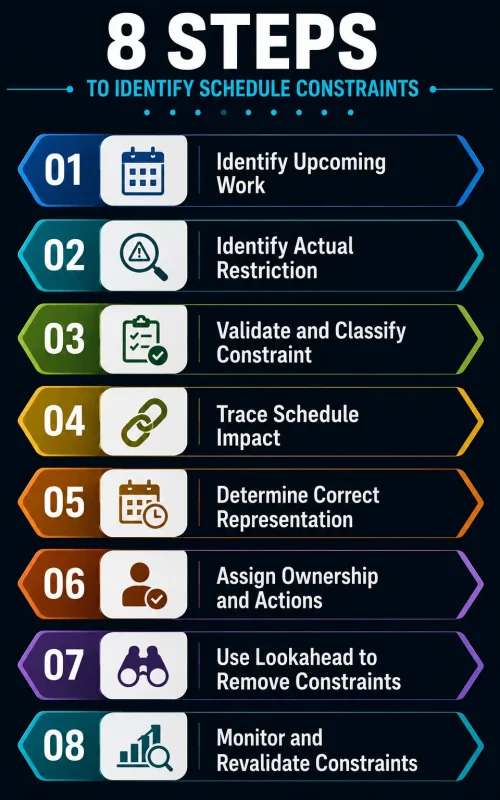
1. Identify Upcoming Work
Start by reviewing the activities planned for the next several weeks or months. The objective is to understand what work is approaching and what must be ready before it can begin.
Look beyond activity dates and review the requirements for each major work package. Consider engineering deliverables, materials, labour, equipment, permits, access, predecessor work, inspections, approvals, and subcontractor readiness.
A short lookahead review with the execution team can reveal restrictions that may not yet appear in the schedule. Construction, engineering, procurement, and commissioning teams often have practical information about upcoming problems that is not visible in the planning system.
For each upcoming activity, ask:
- What must be available before work starts?
- Which activities or decisions must be completed first?
- Is the required resource available?
- Are approvals and information available?
- Is the work area accessible?
- Is another organization or contractor involved?
The aim is to identify potential restrictions before they prevent the planned work from becoming executable, giving the project team time to investigate and resolve them.
2. Identify the Actual Restriction
Once upcoming work has been reviewed, determine what is actually preventing or limiting the activity from proceeding. Avoid recording a general statement such as “procurement issue” or “approval pending” without understanding the underlying condition.
Ask what is required, why it is required, who controls it, when it is needed, and what happens if it is not available. This helps distinguish a genuine constraint from a planning assumption or routine dependency.
For example, instead of recording:
“Equipment delivery constraint.”
define the condition more precisely:
“Transformer installation cannot start until the approved transformer is delivered to site and the foundation inspection is completed.”
Also consider whether the restriction affects one activity or several downstream activities. A clear description makes the constraint easier to validate, assign, monitor, and resolve.
The objective is to identify the actual execution condition, not simply the activity or date that appears to be affected.
3. Validate and Classify the Constraint
After identifying the actual restriction, validate it with the relevant project team and supporting information. Do not assume that every reported restriction should immediately become a schedule constraint.
Check the source of the restriction and confirm whether it is supported by a contract, approved document, technical requirement, resource commitment, regulatory requirement, supplier information, or project decision.
Then classify the constraint according to its nature. It may be:
- Contractual
- Technical
- Resource-related
- Procurement-related
- Regulatory
- Operational
- Access-related
- Interface-related
- External
Also determine whether it is a hard constraint, soft constraint, temporary restriction, or uncertain condition.
For example, a regulatory shutdown window may represent a genuine hard constraint, while a preferred management start date may be a soft target.
This distinction is important because unnecessary hard constraints can restrict schedule flexibility and distort the way the project responds to delays. The objective is to ensure that every significant constraint is genuine, supported by evidence, correctly classified, and represented according to its actual level of control.
4. Trace the Schedule Impact
After validating the constraint, determine how far its impact can travel through the schedule. Do not focus only on the activity directly affected by the restriction.
Trace the sequence from the constraint through the relevant activities, dependencies, milestones, and completion dates.
For example:
Design approval
→ Equipment procurement
→ Equipment delivery
→ Installation
→ Testing
→ Commissioning
A delay in the design approval may therefore affect several downstream activities rather than only the engineering activity.
Review the available float and determine whether the affected activities are on the critical path or near-critical paths. Also consider whether other work fronts can continue or whether the constraint creates an interface between multiple teams.
Where appropriate, assess different scenarios, such as the effect of a one-week or two-week delay.
The objective is to understand the full schedule exposure created by the constraint. This allows the planning team to distinguish between a local restriction with sufficient float and a constraint that could ultimately affect a key milestone or project completion date.
5. Determine the Correct Schedule Representation
Once the constraint and its schedule impact are understood, determine how the restriction should be represented in the project schedule. Not every constraint should be entered as a hard date constraint.
Consider whether the condition is better represented through:
- Activity relationships
- A predecessor or successor activity
- A milestone
- A procurement or approval activity
- A resource limitation
- A calendar
- An external interface
- A genuine date constraint
For example, if equipment cannot be installed until delivery is complete, it may be more appropriate to model procurement and delivery activities with logical relationships rather than simply applying a fixed start date to installation.
Similarly, a planned shutdown window may require a specific calendar or milestone relationship.
The objective is to represent the real project condition, not simply force the activity to a particular date.
Before applying a hard constraint, ask whether the restriction is genuinely immovable and whether another scheduling method would provide a more transparent representation of the execution logic.
6. Assign Ownership and Resolution Actions
Once a constraint has been validated and its schedule impact is understood, assign clear ownership for resolving it. A constraint should not remain as a planning observation without someone responsible for taking action.
Record the key information in a constraint register or lookahead plan, including:
- Constraint description
- Responsible owner
- Required action
- Target resolution date
- Affected activities
- Current status
- Escalation requirement
For example, if an approved drawing is required before equipment installation, the engineering manager may be responsible for coordinating the drawing release by an agreed date.
Ownership should be assigned to the person or organization capable of influencing the outcome, rather than automatically assigning it to the planner.
The planning team should then monitor the agreed action and raise unresolved constraints during coordination meetings and schedule reviews.
The objective is to convert a constraint from a reported problem into an actionable commitment, with a clear owner and deadline for resolution.
7. Use Lookahead Planning to Remove Constraints
Use regular lookahead planning to identify and resolve constraints before upcoming activities become ready for execution. The focus should be on work that is approaching rather than problems that have already caused delays.
For each upcoming work package, review whether the required drawings, materials, labour, equipment, permits, access, inspections, and predecessor activities will be available when needed.
Discuss unresolved restrictions with the responsible teams and agree on specific actions and target dates. The planning team should then track these commitments during weekly coordination and lookahead meetings.
For example, if a concrete pour is planned for the following week, confirm that the approved drawings, reinforcement, formwork, inspection, concrete supply, equipment, and work-front access will all be ready.
This approach helps the team remove constraints before they affect planned work.
The objective is to move constraint management from reactive delay reporting to proactive planning, ensuring that upcoming activities are genuinely ready for execution rather than simply appearing ready in the schedule.
8. Monitor, Escalate, and Revalidate
Constraint management should continue throughout project execution. After a constraint is recorded, regularly review whether it remains open, has been resolved, or has changed in its potential impact.
Monitor the agreed actions, owners, and resolution dates through weekly schedule updates, lookahead meetings, and project control reviews. If an important constraint remains unresolved, escalate it to the appropriate project authority before it affects a critical activity or milestone.
When the project condition changes, revalidate the schedule representation. A resolved constraint may no longer require a restriction, while a new constraint may require changes to logic, dates, resources, or calendars.
After significant changes, recalculate the schedule and review float, critical paths, milestones, and forecast completion.
The objective is to keep the constraint register, schedule, and actual project conditions aligned. Effective monitoring ensures that constraints do not become forgotten schedule entries and that emerging restrictions are identified early enough for the project team to respond.
Practical Example
Putting the Approach Into Practice
A major construction project is preparing to start structural works in a new work zone. The schedule shows the activities as ready to begin, but the planning team identifies several unresolved requirements involving approved drawings, site access, materials, and inspection availability.
Rather than waiting for these issues to delay the planned start, the project controls team applies the eight-step approach to identify and manage the constraints.
1. Identify Upcoming Work
The team reviews the next four weeks of planned construction activities.
Structural works, reinforcement, formwork, concrete pouring, and associated inspections are scheduled to begin across several work fronts.
The team identifies the activities that require specific conditions to be ready before execution can start.
This provides the basis for a focused lookahead constraint review.
2. Identify the Actual Restriction
The team examines each upcoming activity and identifies the conditions that could prevent execution.
They find that structural work in one zone cannot begin because the latest approved drawings have not yet been released.
A second work front is affected by restricted site access, while another requires reinforcement materials that have not yet been delivered.
The team records these as specific execution restrictions, rather than simply marking the activities as delayed.
3. Validate and Classify the Constraint
The planning team discusses the identified restrictions with engineering, construction, procurement, and site management.
They confirm that the drawing release is dependent on engineering approval, the access restriction is related to another contractor’s work, and the reinforcement delay is linked to procurement.
Each restriction is supported by project information and classified according to its source and level of control.
This helps the team distinguish genuine constraints from normal schedule dependencies.
4. Trace the Schedule Impact
The team traces each constraint through the schedule network.
The drawing delay affects structural works and subsequently impacts reinforcement, formwork, concrete, and inspection activities.
The access restriction affects only one work front, while the material delay has sufficient float and does not currently affect the project completion milestone.
The team therefore identifies the drawing approval as the most significant schedule constraint requiring immediate attention.
5. Determine the Correct Schedule Representation
The team reviews how each restriction should be represented in the schedule.
Instead of placing an arbitrary start-date constraint on the structural activity, the drawing approval is represented through a dedicated engineering activity linked logically to the construction work.
The access restriction is represented through the relevant interface and predecessor activities.
This provides a more transparent representation of why the work cannot start and allows the schedule to respond naturally when the restriction is removed.
6. Assign Ownership and Resolution Actions
Each open constraint is assigned to the person or organization responsible for resolving it.
Engineering is responsible for completing the drawing approval. Site management is responsible for coordinating access, while procurement is responsible for confirming the reinforcement delivery.
The team records the required action, responsible owner, target resolution date, affected activities, and current status.
This converts the constraint review from a reporting exercise into a clear action and accountability process.
7. Use Lookahead to Remove Constraints
During the weekly lookahead meeting, the planning team tracks progress against the agreed actions.
Engineering confirms the expected drawing release date, while site management coordinates the required access arrangement.
Procurement also provides an updated material delivery commitment.
The planning team checks whether these actions will be completed before the affected activities become ready for execution.
The objective is to remove the constraints before they become actual delays.
8. Monitor, Escalate, and Revalidate
The following week, the approved drawings are released and site access is confirmed.
The planning team updates the constraint register and recalculates the schedule to confirm that the affected activities can proceed as planned.
The material delivery remains under monitoring because its available float has reduced.
The team continues reviewing open constraints through weekly updates, escalating issues that could affect critical activities or milestones.
The Lesson
Effective schedule constraint management is not about adding more restrictions to the schedule.
A disciplined process should:
- Identify upcoming work and readiness requirements
- Determine the actual restriction
- Validate and classify genuine constraints
- Trace their impact through the schedule
- Represent restrictions correctly
- Assign clear ownership and actions
- Resolve constraints through lookahead planning
- Monitor, escalate, and revalidate changing conditions
“The best constraint is identified early, assigned clearly, and resolved before it becomes a project delay.”
Common Mistakes to Avoid
Identifying schedule constraints requires more than checking constraint fields in scheduling software. Weak validation, incomplete project information, poor ownership, and failure to understand the real execution conditions can cause genuine restrictions to remain hidden or create unnecessary constraints in the schedule.
Treating Every Fixed Date as a Constraint
Not every delay justifies rebaselining. Productivity problems, poor planning, resource shortages, or contractor underperformance may require corrective action instead.
First determine the cause of the variance and assess whether the project itself has materially changed. Rebaseline only when the existing baseline is no longer an appropriate reference.
Changing the Baseline Before Assessing Impact
Not every fixed date represents a genuine schedule constraint. Some dates are targets, forecasts, preferred dates, or management expectations.
Before classifying a date as a constraint, determine why it cannot move, who controls it, and what evidence supports it. This prevents unnecessary restrictions from being introduced into the schedule.
Starting With the Schedule Instead of the Work
Reviewing Primavera P6 or Microsoft Project without understanding upcoming project work can hide important restrictions.
Start with the activities approaching execution and identify what must be ready for each work package. This helps uncover constraints involving materials, approvals, resources, access, permits, information, and interfaces.
Using Hard Constraints to Protect Dates
Hard constraints can make an activity appear aligned with a required date even when the underlying plan cannot support it.
Using them to protect target dates can hide unrealistic durations, incomplete logic, resource shortages, or unresolved dependencies. Apply hard constraints only when the restriction is genuine and supported by evidence.
Failing to Identify the Actual Restriction
Recording a general statement such as “procurement issue” or “approval pending” does not explain what is actually preventing the work.
Define the specific condition, required action, responsible party, and affected activity. A precise constraint description makes the issue easier to validate, resolve, and monitor.
Relying Only on Scheduling Software
Scheduling software can identify formal constraints, calculate float, and show relationships, but it cannot determine whether a restriction is genuinely preventing execution.
Planners should combine software analysis with project records, field information, contractor input, engineering updates, procurement status, and management decisions to establish the actual project condition.
Ignoring Resource Constraints
An activity may appear ready to start because its predecessor is complete, while the required resources remain unavailable.
Review the availability of labour, equipment, specialist personnel, materials, and work fronts. Resource restrictions can affect several activities simultaneously and may become significant constraints even when the schedule logic appears technically correct.
Missing Interface Constraints
Many restrictions occur between organizations rather than within a single work package.
Engineering may depend on the client, procurement on engineering, and construction on procurement. If these interfaces are not actively reviewed, important constraints can remain hidden. Identify interface responsibilities, required inputs, handoffs, and decision dates clearly.
Ignoring External Constraints
Permits, regulatory approvals, shutdown windows, weather conditions, access restrictions, utility interfaces, and client decisions can significantly affect planned work.
These conditions may sit outside the direct control of the project planning team. Include relevant external stakeholders and evidence when identifying constraints so that external restrictions are not mistaken for internal planning problems.
Looking at Constraints in Isolation
A constraint affecting one activity may influence an entire sequence of work.
For example, a delayed design approval may affect procurement, delivery, installation, testing, and commissioning. Trace significant constraints through downstream activities, milestones, float, and critical paths rather than assessing only the immediately affected activity.
Failing to Connect Constraints With Risk
Some conditions are confirmed constraints, while others are uncertain events that could become constraints.
Treating both situations identically can distort the schedule. Connect uncertain conditions with the project risk process, then update their schedule representation when the uncertainty becomes a confirmed restriction or material schedule event.
Failing to Revalidate Constraints
Project conditions change continuously. A permit may be approved, a material may arrive, or an access restriction may be removed.
If constraints are not regularly revalidated, outdated restrictions can remain in the schedule while new ones go unnoticed. Review open constraints during schedule updates, lookahead meetings, and execution reviews.
Key Takeaways
Effective schedule constraint management is more than identifying fixed dates or adding restrictions to scheduling software. It provides a structured process for identifying genuine execution constraints, understanding their impact, assigning ownership, and removing restrictions before they become project delays.
- Start with upcoming work. Review near-term activities and determine what must be ready before each work package can begin.
- Identify the actual restriction. Define the specific condition preventing or limiting execution rather than recording a general issue such as “approval pending.”
- Validate the constraint. Confirm the restriction using project records, technical information, contractual requirements, resource information, or input from the responsible team.
- Classify the constraint correctly. Distinguish between contractual, technical, resource, procurement, regulatory, access, interface, and other types of restrictions.
- Assess the schedule impact. Trace the constraint through activities, dependencies, float, milestones, critical paths, and downstream work to understand its potential consequences.
- Use the right schedule representation. Do not automatically apply hard date constraints. Use activities, logic, milestones, calendars, resources, or genuine constraints according to the actual project condition.
- Assign clear ownership. Every significant constraint should have a responsible owner, required action, target resolution date, status, and escalation path.
- Use lookahead planning. Review upcoming work regularly and resolve restrictions before activities become ready for execution.
- Connect constraints with risks. Where a restriction is uncertain or may develop into a future constraint, connect it with the project risk process and update the schedule as conditions change.
- Monitor and revalidate. Constraints should be reviewed during schedule updates and lookahead meetings so that resolved restrictions are removed and emerging constraints are identified early.
Good constraint management identifies restrictions early, assigns responsibility, and removes them before they become project delays.
References
- GAO — Schedule Assessment Guide: Best Practices for Project Schedules — U.S. Government Accountability Office
- AACE International — 91R-16: Schedule Development — AACE International
- PMI — Practice Standard for Scheduling, Third Edition — Project Management Institute
- Scheduling 101 — The Basic of Best Practices — Project Management Institute
- Automating Look-Ahead Schedule Generation for Construction Using Linked-Data Based Constraint Checking and Reinforcement Learning — Automation in Construction
- Construction Schedule Augmentation with Implicit Dependency Constraints and Automated Generation of Lookahead Plan Revisions — Automation in Construction
- Constrained Resource Project Scheduling Subject to Material Constraints — Journal of Operations Management
- Resource-Constrained Project Management Using Enhanced Theory of Constraint — International Journal of Project Management
- Fuzzy Critical Chain Method for Project Scheduling Under Resource Constraints and Uncertainty — International Journal of Project Management
- GAO — How Long Will This Project Really Take? Schedule Assessment Guide — U.S. Government Accountability Office
- GAO — Schedule Assessment Guide: Best Practices for Project Schedules — U.S. Government Accountability Office, Full Report
- PMI — Practice Standard for Scheduling: Development and Good Practices — Project Management Institute
FEATURED PROJECT PLANNING & SCHEDULING GUIDES
Practical Guidance for Planning, Scheduling, and Schedule Control
Effective project planning and scheduling requires more than creating activities and assigning dates. Our featured guides focus on practical planning and scheduling activities, helping professionals structure projects, establish sound planning foundations, review schedules, and maintain schedule control.
How to Develop a Project Plan
Learn how to structure a project plan, define the planning approach, establish key project information, and create a practical foundation for project delivery.
How to Develop a Work Breakdown Structure (WBS)
Learn how to break project scope into manageable deliverables and work packages, creating a structured foundation for activity planning and scheduling.
How to Develop a Project Schedule Basis
Understand how to establish the assumptions, methodologies, calendars, durations, relationships, constraints, and other considerations that form the basis of a reliable project schedule.
MORE PROJECT PLANNING & SCHEDULING RESOURCE TYPES
Continue Your Project Planning & Scheduling Learning
Project planning and scheduling knowledge becomes more valuable when you can understand the concepts, apply structured approaches, and develop practical skills. Explore the other resources within the Project Planning & Scheduling collection to complement the guidance provided in these guides.
Templates
Use practical templates and checklists to organize planning information, document scheduling decisions, review schedules, and support schedule control activities.
Downloads
Access useful planning and scheduling materials and reference resources to support learning and day-to-day project planning and controls activities.
Career Roadmaps
Follow structured learning paths to develop project planning, scheduling, and project controls knowledge, practical skills, and professional capabilities.
Case Studies
Explore planning and scheduling situations, decisions, challenges, and outcomes to understand how planning and scheduling practices are applied in real projects.
Glossary
Find clear explanations of project planning, scheduling, project controls, schedule management, and related professional terminology.
Insights & Articles
Explore professional perspectives, practical insights, emerging practices, and deeper discussions relevant to project planning, scheduling, and project controls.
Looking for more project management resources? Explore the Kleios Technologies Resources Hub to discover our complete collection of guides, templates, downloads, career roadmaps, case studies, glossary resources, and insights.
RELATED KNOWLEDGE DOMAINS
Continue Your Learning Across Related Knowledge Domains
Project Management is closely connected with specialized disciplines that support successful planning, execution, governance, performance measurement, and professional growth. Explore related knowledge domains to expand your expertise, develop complementary skills, and access practical resources across the complete project management ecosystem.
Expand your expertise one domain at a time and build a well-rounded project management skill set.
Why Explore Related Domains?
- Develop cross-functional project management expertise
- Discover specialized knowledge beyond core project management
- Access practical resources across interconnected disciplines
- Build a complete professional learning pathway
- Strengthen career readiness through continuous learning
Each knowledge domain complements your Project Management expertise, helping you build broader capabilities and solve real-world project challenges with greater confidence.
Project Management
Practical project management knowledge, practices, and professional resources.
Project Controls
Performance measurement, forecasting, and project control best practices.
PMO
Governance, portfolio management, and organizational project excellence.
Risk Management
Risk identification, assessment, mitigation, and monitoring resources.
Primavera P6
Professional planning, scheduling, resource management, and reporting.
Microsoft Project
Project scheduling, tracking, reporting, and collaboration resources.
Power BI
Interactive dashboards, reporting, visualization, and project analytics.
PMI Certifications
Certification guidance, exam preparation, and professional development resources.