
PROJECT PLANNING AND SCHEDULING INSIGHT
Why Are Project Duration Estimates Too Optimistic?
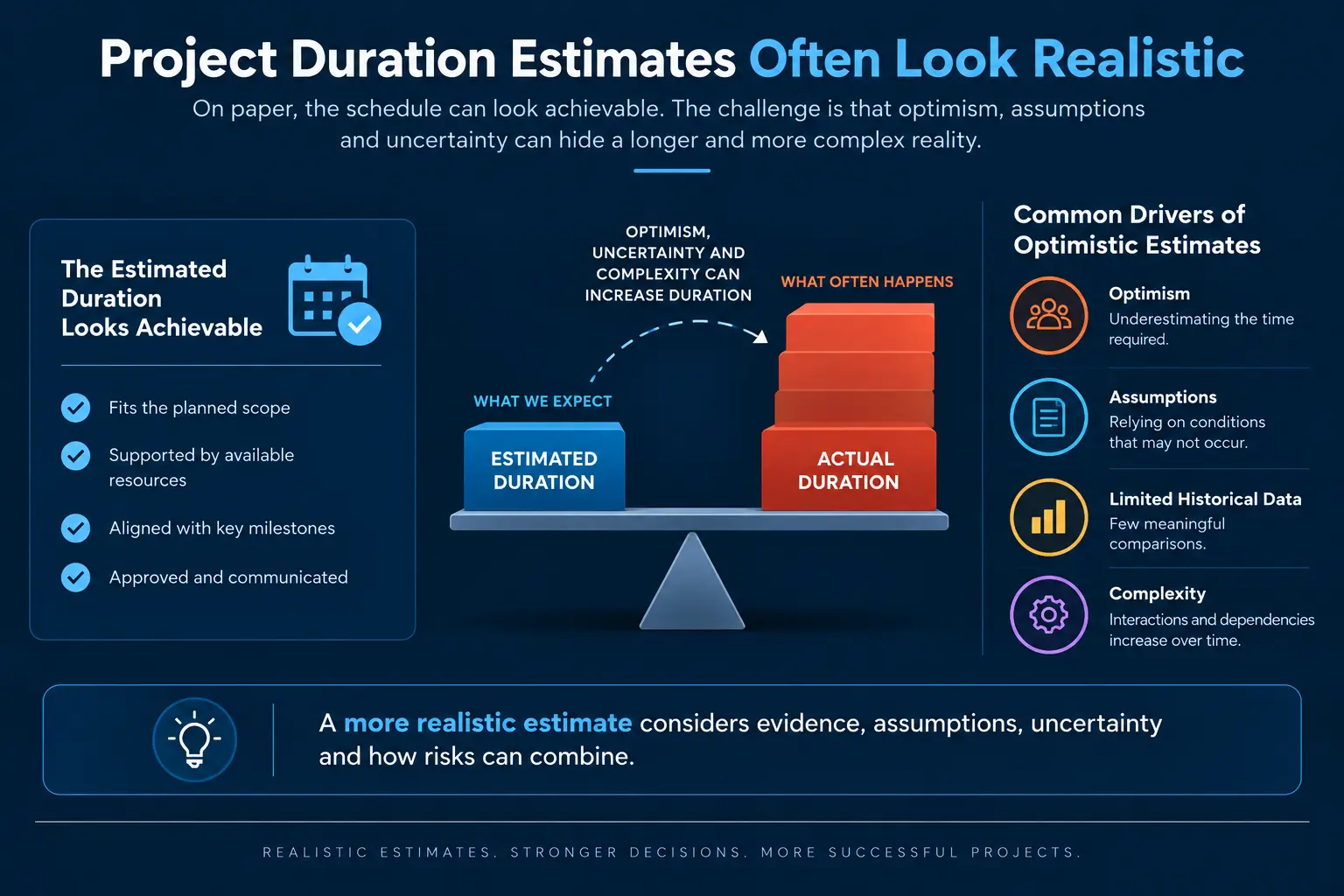
Project Duration Estimates Too Optimistic can appear reasonable when teams focus on intended execution, detailed plans, and target dates. However, estimates can underrepresent historical performance, execution conditions, uncertainty, dependencies, and delivery variability. As a result, apparently credible durations can become difficult to achieve as projects reveal new information.
This Insight examines why duration estimates become optimistic and why professionals can miss the underlying estimation problem. It also examines what happens when optimistic expectations persist. Finally, it identifies what professionals should reconsider when assessing duration credibility.
Professional Insight · Project Planning & Scheduling
Introduction
Project duration estimates often look reliable because they give the team a clear number and a planned finish date. However, a clear number does not always mean a realistic expectation. Project Duration Estimates Too Optimistic can develop when teams focus more on the planned work than on evidence from similar projects and past results.
The problem involves more than simply getting a number wrong. An estimate can assume that work will progress as planned, resources will be available, and decisions will happen on time. It can also give too little attention to delays, changes, dependencies, and other conditions that affect project duration.
Research on the planning fallacy shows that people can focus strongly on what they expect to happen. They may give less attention to what happened on similar tasks before. Research on anchoring also shows that an early estimate can influence later estimates.
Therefore, better estimating requires more than detailed calculations. It requires useful historical evidence, clear assumptions, realistic uncertainty, and regular learning from actual results. This Insight examines why optimistic estimates develop and why professionals can miss the warning signs.
The Common Assumption
The Duration Estimate Is Just a Number
A duration estimate may look like a simple number, such as 90 days or 12 months. However, that number represents many assumptions about how the project will progress. It reflects expected work, resources, dependencies, productivity, decisions, approvals, and project conditions. Project Duration Estimates Too Optimistic can hide these assumptions when teams focus only on the final date. Therefore, professionals should examine what must remain true for the estimate to hold.
More Detailed Estimates Are Automatically More Accurate
Breaking work into smaller activities can improve visibility and control. However, more detail does not automatically improve estimate quality. Research on project duration estimation shows that inaccurate activity estimates can have more impact than the choice of a particular probability distribution. A detailed estimate can still be precisely wrong when its basic assumptions remain weak. Therefore, teams should distinguish better detail from better evidence.
Experienced Professionals Naturally Estimate Better
Experience gives professionals useful knowledge about similar work and common project conditions. Yet, experience alone does not guarantee accurate estimates. Research on software effort estimation found that expert judgement can perform well in some situations. Experts can add value when they have relevant project information and understand the work.
However, stronger estimation also uses historical data, feedback, uncertainty assessment, and structured judgement. Experience becomes more valuable when professionals test it against evidence and learn from previous estimation errors. Otherwise, familiar estimating habits can continue without proper calibration.
Adding a Buffer Solves Optimism
Adding extra time can make a planned date later, but it does not automatically make the estimate more realistic. A generic buffer may hide uncertainty instead of explaining it. Professional guidance treats schedule contingency as time related to identified risks and uncertainties. Contingency should have a clear basis rather than become an automatic percentage added to every estimate.
This distinction also separates contingency from schedule float. Therefore, professionals should ask what evidence supports the additional time and what uncertainty it should absorb.
Three-Point Estimates Automatically Capture Uncertainty
Three-point estimation uses optimistic, most likely, and pessimistic values. This approach can make uncertainty easier to discuss and analyse. However, the method still depends on the quality of those inputs. Research on PERT and project networks shows that uncertainty in activity estimates can affect overall completion predictions.
Representing uncertainty in a calculation does not mean that the uncertainty has been estimated accurately. Therefore, teams should examine the evidence behind each point instead of relying on the method alone.
A Risk Register Makes the Duration Realistic
A risk register helps teams identify events that could affect project delivery. However, it does not capture every source of duration uncertainty. Some uncertainty comes from productivity, incomplete information, estimating error, or changing conditions rather than specific risk events.
Research in software estimation found that identifying more risks immediately before estimation could, under specific conditions, produce lower estimates and higher confidence. This finding does not mean risk management is harmful. Instead, it shows that risk identification and uncertainty estimation are related but different activities.
The Approved Duration Becomes the Realistic Duration
Once a duration becomes part of an approved plan, people may start treating it as an expected fact. It may also become linked to budgets, commitments, contracts, and stakeholder expectations. Research on anchoring in project duration estimation found that initial estimates can influence later estimates. Project Duration Estimates Too Optimistic can therefore persist when later evidence gets interpreted around an accepted date.
The important question is whether the date remains an evidence-based forecast after approval. If new evidence receives less attention, the original target can become stronger than the evidence supporting it.
What Is Really Happening?
The Estimate Starts With the Project’s Own Plan
Project teams usually know their own work well. Therefore, they naturally estimate from the plan they expect to execute. Research on the planning fallacy shows that people can focus strongly on expected future events when estimating completion times. Project Duration Estimates Too Optimistic can develop when the planned scenario receives more attention than past results.
The team’s view remains valuable because it reflects current scope, resources, methods, and conditions. However, it becomes weaker when teams do not compare it with evidence from similar work.
A Smooth Plan Can Feel Like a Likely Outcome
A project team can create a clear story about how the work should progress. That story may assume that resources arrive, decisions happen, and dependencies remain stable.
Because the story is logical, it can feel realistic. However, real projects can experience conditions that the smooth plan does not fully represent.
- Resources may arrive late or become unavailable.
- Approvals may take longer than expected.
- Requirements may change during execution.
- Suppliers may perform differently than planned.
- Rework may take more time than expected.
A realistic estimate considers both the intended plan and the conditions that can change it.
Past Project Results Can Receive Too Little Attention
Previous projects can provide useful evidence about actual delivery times. However, teams may focus more on the current plan than previous results. Reference-class forecasting brings comparable project outcomes into the discussion.
The comparison must still make sense. Useful factors can include:
- Project type, size, and scope.
- Complexity and delivery conditions.
- Methods, technology, and resources.
- Major dependencies and interfaces.
Research shows that reference-class results depend on how teams select similar projects. A broad group may contain weak comparisons. Conversely, a narrow group may contain too few useful examples.
The Scope May Look Clear While the Work Remains Uncertain
A project can have an approved scope and still contain uncertainty about the work required. The estimate may assume stable requirements, mature design, limited interfaces, or little rework.
These assumptions can remain hidden behind the planned activities. For example, an activity may allow ten days while assuming that all information and materials are ready.
A clearly defined activity can still have uncertain working conditions. This can make Project Duration Estimates Too Optimistic without creating an obvious error at first.
Working Conditions Can Change the Duration
The amount of work is only one part of a duration estimate. The conditions around that work can also affect completion time.
- Availability of skilled resources.
- Access to work areas or systems.
- Availability of materials and equipment.
- Approval and decision times.
- Supplier and external dependency performance.
- Productivity under actual conditions.
Current Australian government reporting identifies schedule pressure, resource constraints, capability gaps, external dependencies, and uncertainty among delivery concerns in major digital projects. These findings describe a specific project population.
Reasonable Activities Can Still Create a Difficult Finish Date
Teams often review activity durations separately. However, the project finish date depends on how activities connect through the schedule network.
Several paths may run together and later meet at one milestone. A delay on an important path can then affect the same completion point.
GAO identifies merge bias as one source of schedule underestimation. Research on PERT networks also shows that multiple paths can affect completion-time estimates.
Reasonable activity estimates do not automatically produce a reasonable project finish date.
The Estimate May Show More Confidence Than the Evidence Supports
Teams may provide a narrow duration range because they feel confident about the work. However, confidence and uncertainty are different concepts.
Research on software effort estimates found that judgement-based prediction ranges were often narrower than their stated confidence levels supported. This finding comes from software projects and needs careful interpretation.
- Point estimate: One expected duration.
- Range: A set of possible durations.
- Confidence: How strongly the evidence supports the range.
A narrow range can be appropriate when evidence supports it. However, it can also hide uncertainty that the team has not fully considered.
Better Estimating Tools Cannot Fix Weak Inputs
Teams can use three-point estimates, PERT, Monte Carlo simulation, formal models, or expert judgement. These approaches can help when their inputs reflect credible evidence.
However, calculations still depend on the assumptions entered into them. Research on PERT sensitivity found that inaccurate three-point estimates can have greater practical impact than the choice of distribution.
Better mathematics cannot replace better inputs. Project Duration Estimates Too Optimistic can persist even when the estimating method looks technically advanced.
The First Estimate Can Influence the Next Estimate
An early duration estimate can influence how people think about the project later. Research by Lorko and colleagues found anchoring effects in project duration estimation.
The pattern can become simple:
- The team creates an initial estimate.
- The estimate becomes an expected finish date.
- The date becomes part of project commitments.
- Later forecasts are compared with the original date.
The original estimate can become a reference point for later decisions. New evidence may then receive less influence than the established expectation.
The Project Learns, but Future Estimates May Not Improve
Every project creates new information about how work actually happens. The team may learn about productivity, approvals, suppliers, resources, rework, and dependencies.
However, this learning may not improve future estimates. Teams often focus on fixing the current problem instead of recording what it teaches them.
A useful learning cycle compares:
- Estimate: What did we expect?
- Actual: What really happened?
- Difference: How far apart were they?
- Reason: Why did the difference occur?
- Pattern: Have we seen this before?
- Improvement: What should change next time?
Research on estimation supports historical data, accuracy checks, uncertainty assessment, and feedback. The goal is not to make every future estimate longer. The goal is to make future estimates better informed by actual experience.
Why Do Professionals Miss the Problem?
The Estimate Looks Reasonable on Its Own
Professionals often review an estimate against the work they currently understand. Therefore, the number may look reasonable when viewed within the project’s own plan. The problem becomes harder to see when the team does not compare the estimate with actual results from similar work.
A duration can fit the planned scope, resources, and sequence while still being too short. Project Duration Estimates Too Optimistic can therefore pass an internal review without creating an obvious warning.
Detailed Schedules Can Create False Confidence
A detailed schedule gives professionals many numbers to review. It can show activities, relationships, resources, milestones, and dates.
However, detail can make an estimate feel more certain than the evidence supports. This happens when teams spend more effort checking the structure than testing the assumptions behind each duration.
- Are the planned productivity levels realistic?
- Are the required resources actually available?
- Are approval times based on evidence?
- Do similar projects support the planned durations?
A well-organised schedule can still contain optimistic assumptions. Therefore, schedule detail should not become a substitute for estimate challenge.
The Target Date Can Influence the Discussion
A project may have a target date because of business needs, contracts, funding, or other commitments. That target can become an important reference point during estimating.
Research on anchoring shows that an early estimate or external reference can influence later duration judgements. This effect can make it difficult to separate the question “When can we finish?” from “When must we finish?”
Project Duration Estimates Too Optimistic can remain accepted when the target becomes stronger than the evidence. Professionals may then explain why the plan can meet the date instead of testing whether the date remains realistic.
Past Performance Is Harder to Use Than It Sounds
Historical data can challenge an optimistic estimate, but only when professionals can find useful comparisons. Many organisations have records of previous projects without having consistent information about actual durations and project conditions.
For example, a previous project may have taken 14 months. That number alone does not show whether it provides a useful comparison.
- Was the scope similar?
- Were the working conditions similar?
- Did both projects use similar delivery methods?
- Were their resource and dependency conditions comparable?
Reference-class research shows that project similarity needs careful consideration. Therefore, the absence of useful comparisons can leave professionals relying mainly on judgement.
Forecast Changes Can Hide the Original Estimation Error
When new information appears, teams often update the project forecast. This is necessary because project conditions change. However, the revised forecast can receive more attention than the original estimate.
Consider a simple sequence:
- The project starts with a 12-month estimate.
- The forecast later moves to 14 months.
- The team explains the two-month movement.
- The original 12-month estimate receives less review.
The forecast may be corrected without asking why the original estimate was too optimistic. That difference matters because correction solves the current forecast problem, while learning can improve future estimates.
Small Errors Do Not Always Look Important
An estimate may be wrong by a few days or weeks without creating an immediate project crisis. Therefore, professionals may treat the difference as normal variation.
However, repeated small errors can reveal a consistent pattern. If similar activities repeatedly take longer than planned, the issue may involve the estimating assumptions rather than unusual events.
Experience Can Hide Familiar Estimating Habits
Experienced professionals bring valuable knowledge to duration estimates. However, experience can also reinforce familiar ways of judging similar work.
Research does not support treating expert judgement as automatically unreliable. Instead, research supports combining expert knowledge with historical data, uncertainty assessment, structured review, and feedback.
Experience becomes stronger when professionals test their judgement against what actually happened. Without that feedback, a familiar estimate can feel correct because it has been used many times.
Confidence Can Grow Without Better Evidence
Teams can become more confident as a plan becomes more detailed and familiar. However, greater familiarity does not necessarily reduce uncertainty.
Research on expert prediction intervals found that judgement-based ranges can be narrower than their stated confidence levels support. This finding comes from software estimation research, so it should not be treated as universal.
The Organisation May Measure Delay Better Than Estimate Accuracy
Project teams often track whether activities finish late and whether milestones move. However, they may not track how accurate the original duration estimates were.
That creates a missing feedback loop. The organisation knows that the project finished later, but it may not know which estimating assumptions repeatedly caused the difference.
- Compare planned duration with actual duration.
- Record the main reasons for differences.
- Look for repeated patterns across projects.
- Use those patterns when estimating similar work.
Professionals can miss the problem when the organisation controls schedule variance without building an effective learning system. That is how optimistic estimates can repeat across projects.
What Happens If It Continues?
Schedule Flexibility Gets Used Earlier
An optimistic duration leaves less room for normal variation. Therefore, small delays can use available schedule flexibility earlier than expected. The project may still appear on plan while its ability to absorb further delay becomes weaker.
Project Duration Estimates Too Optimistic can reduce practical flexibility before a major milestone shows visible delay. GAO guidance highlights the need to examine uncertainty across the schedule because activity variations can affect the overall completion date.
Recovery Actions Become More Frequent
When the original duration becomes difficult to achieve, teams often look for ways to recover time. These actions can include additional resources, overtime, resequencing, or overlapping work.
These actions can sometimes work well. However, repeated recovery can create additional pressure on the project.
- More resources may require additional coordination.
- Overtime may increase cost and fatigue.
- Resequencing may create new dependencies.
- Overlapping work may increase coordination and rework risk.
Recovery should not become the normal way of delivering a duration that was optimistic from the beginning.
Resource Pressure Can Increase
A shorter planned duration means the same work must fit into less time. Therefore, the project may need resources to work more intensively or for longer periods.
Pressure can affect specialist staff, equipment, supervision, suppliers, and support teams. Current Australian government reporting identifies resource constraints and capability gaps alongside schedule pressure in major digital projects.
These findings describe a specific project population. They should not be treated as proof that every optimistic estimate creates resource problems.
Work May Start to Overlap
Schedule pressure can encourage teams to perform activities at the same time. This approach can recover time when the work and conditions support it.
However, overlapping activities can increase coordination needs. It can also increase rework when one activity starts before the information from another activity is complete.
- Teams may work with incomplete information.
- Interfaces may require more coordination.
- Changes may affect work already in progress.
- Rework may reduce some of the time gained.
Schedule compression can exchange time pressure for greater execution complexity.
Decision Time Becomes More Valuable
An optimistic duration leaves less time between a problem appearing and the final delivery date. Therefore, delays in decisions, approvals, or technical reviews can become more important.
The project may need decisions about resources, design changes, suppliers, sequencing, or recovery actions. When the available time becomes shorter, slow decisions can consume a larger share of the remaining schedule.
Forecasts May Keep Moving
As actual information replaces early assumptions, the project forecast may change. That change is not automatically a problem because forecasts should respond to new evidence.
The concern appears when the forecast moves repeatedly because the original estimate did not reflect important uncertainty. Research on project forecasting supports using actual performance to improve completion estimates during execution.
A changing forecast can be useful when it reflects learning. It becomes more concerning when repeated changes reveal that the project keeps discovering its realistic duration too late.
Cost and Commercial Pressure Can Grow
A longer delivery period can create additional costs for labour, supervision, equipment, facilities, financing, and project management. The actual effect depends on the project’s structure and commercial arrangements.
Schedule changes can also affect contractual commitments and other commercial expectations. Therefore, Project Duration Estimates Too Optimistic can create consequences beyond the schedule itself when the planned finish date moves.
The Target and the Realistic Forecast Can Become Confused
A project may have a target date that remains important even when evidence suggests a later finish. Problems can arise when the target and forecast are treated as the same thing.
- Target: The date the project wants to achieve.
- Forecast: The date current evidence suggests.
- Commitment: The outcome the project has agreed to deliver.
These dates can be related but do not always have the same meaning. The UK Green Book recommends considering optimism bias and historical forecast errors when estimating project duration.
The Organisation May Learn the Wrong Lesson
When a project finishes later than expected, the simple response may be to add more time to future estimates. However, extra time does not explain why the original estimate was wrong.
The underlying cause may involve poor historical comparisons, optimistic productivity assumptions, hidden uncertainty, anchoring, or weak feedback.
- Was the original estimate based on useful evidence?
- Which assumptions proved incorrect?
- Did similar projects show the same pattern?
- Should the estimating approach change?
The goal is not simply to add more time. The goal is to understand why the estimate missed the actual outcome and improve future estimates.
What Should Project Professionals Reconsider?
Duration Is More Than a Number
A duration estimates how long work may take under specific conditions. Therefore, professionals should look beyond the final number. They should examine the evidence, assumptions, resources, dependencies, and conditions behind it.
A credible duration needs credible assumptions behind it. Project Duration Estimates Too Optimistic can remain hidden when teams review only the final date.
A Target Date Is Not the Same as an Estimate
A target describes the date a project wants to achieve. An estimate describes the date that current evidence supports.
These dates can be the same, but they do not have to be. Research on anchoring shows that early estimates and external references can influence later duration judgements.
- Target: What date do we want to achieve?
- Estimate: What date does the evidence support?
- Commitment: What date have we agreed to deliver?
Keeping these meanings clear helps teams discuss schedule pressure without changing an estimate simply to match a target.
The Project’s View Is Only Part of the Evidence
Project teams have valuable knowledge about their scope, methods, resources, and conditions. However, their view may not show how similar projects actually performed.
Research on the planning fallacy supports using relevant past experience alongside the current project view. The outside view should challenge the project team’s view, not replace it.
Historical Data Needs Meaningful Comparison
Historical data becomes useful when the comparison makes sense. A previous project with a similar name may still have very different conditions.
Useful comparison factors can include:
- Scope and project size.
- Complexity and delivery method.
- Resources and working conditions.
- Technology and major dependencies.
- Other factors that can affect duration.
Research on reference classes shows that similarity needs careful selection. A broad group may provide weak comparisons. Conversely, a narrow group may provide too few useful examples.
Every Duration Depends on Assumptions
Every duration estimate depends on conditions that may or may not occur. Professionals should make important assumptions visible before accepting the duration.
Useful questions include:
- What productivity level does the estimate assume?
- When will required resources become available?
- How long will approvals and decisions take?
- What information must be ready?
- How much rework does the estimate allow?
The most important assumption may be the one that could change the duration most. That assumption deserves closer attention than low-impact details.
Uncertainty Needs a More Honest Range
A single duration can hide a wide range of possible outcomes. A range can show uncertainty more clearly, but the range itself needs a sound basis.
Three-point estimates and probability-based methods can help teams explore variation. However, research shows that inaccurate inputs can strongly affect the results.
Better calculations do not automatically create better uncertainty estimates. Professionals should ask whether the range reflects evidence rather than personal confidence alone.
Activity Estimates Do Not Tell the Whole Project Story
Activity estimates do not exist independently. Their relationships can change how uncertainty affects the overall project duration.
Several paths can run in parallel and later meet at one milestone. Therefore, uncertainty across those paths can affect the project finish date.
GAO identifies merge bias as one source of schedule underestimation. Professionals should test the project network instead of judging every duration only at activity level.
Generic Buffers Do Not Explain Uncertainty
Adding extra time can provide useful protection when it has a clear basis. However, a standard percentage does not explain the uncertainty behind the duration.
Professional guidance distinguishes schedule contingency from normal schedule flexibility. Contingency should relate to risks and uncertainties rather than become an automatic addition.
The better question is not “How much extra time should we add?” It is “What uncertainty does the additional time need to address?”
Confidence Should Follow Evidence
A team may feel confident because the plan is detailed, familiar, and well understood. However, confidence should also reflect the quality of supporting evidence.
Research on expert prediction intervals found that judgement-based ranges can be narrower than their stated confidence levels support. This evidence comes from software estimation research and needs careful interpretation.
Confidence should follow evidence, not simply familiarity with the plan. This matters when Project Duration Estimates Too Optimistic appear repeatedly in similar work.
Estimate Errors Should Improve Future Estimates
An estimate becomes more valuable when the organisation compares it with what actually happened. Therefore, teams should examine both the result and the reason for the difference.
A useful review can ask:
- What did we estimate?
- What actually happened?
- Which assumptions changed?
- Was the difference unusual or repeated?
- What should change in future estimates?
Jørgensen’s research supports historical data, accuracy checks, uncertainty assessment, and feedback. The goal is not simply to correct today’s forecast, but to improve tomorrow’s estimate.
A Practical Professional Lens
Professionals need a simple way to test whether a duration estimate remains credible. The following lens connects evidence, assumptions, uncertainty, and project behaviour.
The aim is not to make every estimate longer. It is to understand what the estimate assumes and how well the evidence supports it.
EVIDENCE — What Do We Know?
Start with the information supporting the duration. Look beyond the current project plan and examine what actual evidence says.
- What happened on similar projects?
- How accurate were previous estimates?
- Which data supports the current duration?
Project Duration Estimates Too Optimistic often become difficult to detect when teams rely mainly on current plans and personal judgement.
ASSUMPTIONS — What Must Go Right?
Every estimate depends on assumptions. Some are obvious, while others remain hidden inside activity durations.
- Resources are available when required.
- Required information arrives on time.
- Approvals follow expected timelines.
- Productivity reaches the assumed level.
- Rework remains within the expected level.
An assumption deserves attention when changing it could materially change the duration. This helps teams focus on important uncertainty instead of reviewing every assumption equally.
UNCERTAINTY — What Could Change?
A duration estimate describes an expected outcome, but actual project conditions can vary. Professionals should identify where that variation could affect the estimate.
- Which activities have wide possible durations?
- Which conditions remain uncertain?
- Which risks could affect the finish date?
Three-point estimates and schedule risk analysis can help represent this variation. However, the quality of the result still depends on the quality of the inputs.
NETWORK — How Could Delays Combine?
An activity can have a reasonable duration while the overall project still has a difficult finish date. Therefore, professionals should examine how activities connect.
- Which paths can affect the same milestone?
- Where do parallel paths come together?
- Where could uncertainty affect several connected activities?
The project network can amplify the effect of individual duration errors. GAO’s work on merge bias illustrates why activity-level estimates do not always explain project-level completion risk.
CONFIDENCE — How Strong Is the Evidence?
A team may feel confident about a duration because the plan is detailed. However, confidence should reflect the quality of evidence rather than familiarity with the plan.
Ask whether the estimate has strong historical support, clear assumptions, and a realistic range. Project Duration Estimates Too Optimistic can survive review when confidence grows faster than evidence.
LEARNING — What Did the Project Teach Us?
Actual project results provide evidence for future estimates. Therefore, teams should compare what they expected with what actually happened.
- Record the original estimate.
- Record the actual duration.
- Identify the main reasons for the difference.
- Look for repeated patterns.
- Use the findings in future estimates.
This creates a feedback loop that can gradually improve estimation quality. Jørgensen’s research supports historical data, accuracy checks, uncertainty assessment, and feedback.
The Professional Question
The strongest question is not simply, “How long will this project take?”
Ask instead: “What evidence supports this duration, what could change it, and what have we learned from similar work?”
This creates a practical thinking sequence:
- EVIDENCE → What do we know?
- ASSUMPTIONS → What must remain true?
- UNCERTAINTY → What could change?
- NETWORK → How could changes combine?
- CONFIDENCE → How strong is our evidence?
- LEARNING → What should improve next time?
Used consistently, this lens helps professionals move from simply producing a duration to understanding its credibility.
Key Takeaways
Project duration estimates can appear credible while still relying on optimistic assumptions and limited evidence.
- A duration is more than a number. It reflects assumptions about resources, productivity, dependencies, decisions, and working conditions.
- Target dates and estimates have different meanings. A required date should not automatically become the evidence-based forecast.
- Historical evidence can challenge the project view. Useful comparisons can reveal patterns that current planning may overlook.
- More detail does not guarantee accuracy. Advanced estimating methods still depend on credible inputs and assumptions.
- Uncertainty should be visible. A narrow range can create false confidence when the supporting evidence is weak.
- Project Duration Estimates Too Optimistic can affect more than the finish date. They can reduce flexibility and increase pressure on resources, decisions, and delivery.
- Estimate accuracy should create organisational learning. Comparing planned and actual durations can improve future estimates.
The central question is not simply how long the project should take. It is whether the duration is supported by evidence, assumptions, uncertainty, and experience.
References
- Buehler, R., Griffin, D., & Ross, M. (1994). Exploring the “Planning Fallacy”: Why People Underestimate Their Task Completion Times.
- Lorko, M., Servátka, M., & Zhang, L. (2019). Anchoring in Project Duration Estimation.
- Servranckx, T., Vanhoucke, M., & Aouam, T. (2021). Practical Application of Reference Class Forecasting for Cost and Time Estimations: Identifying the Properties of Similarity.
- Jørgensen, M. (2004). A Review of Studies on Expert Estimation of Software Development Effort.
- Jørgensen, M., Teigen, K. H., & Moløkken-Østvold, K. (2004). Better Sure Than Safe? Over-Confidence in Judgement Based Software Development Effort Prediction Intervals.
- Hajdu, M., & Bokor, O. (2016). Sensitivity Analysis in PERT Networks: Does Activity Duration Distribution Matter?.
Professional Standards & Guidance
- Project Management Institute. (2019). Practice Standard for Scheduling — Third Edition.
- U.S. Government Accountability Office. (2015). GAO Schedule Assessment Guide: Best Practices for Project Schedules.
- HM Treasury. (2026). The Green Book 2026.
- AACE International. 70R-12: Principles of Schedule Contingency Management.
Related Kleios Resources
Project Planning & Scheduling Guides
- How to Develop a Project Schedule Basis — Establishes the assumptions, methods, calendars, constraints, and rules that support a credible schedule.
- How to Review and Validate a Project Schedule — Helps professionals examine schedule quality, logic, durations, relationships, constraints, and forecast credibility.
- How to Manage Schedule Baseline Changes — Explains how changes to approved schedule expectations should be assessed, controlled, and documented.
- How to Identify Schedule Constraints — Helps identify conditions that can restrict sequencing, flexibility, and achievable project durations.
Project Planning & Scheduling Templates
- Project Schedule Basis Template — Provides a structured way to document the assumptions and planning foundations behind a project schedule.
- Project Schedule Review Checklist — Supports a consistent review of schedule structure, logic, durations, constraints, and overall schedule quality.
- Schedule Baseline Change Template — Helps structure the assessment and documentation of proposed changes to an approved schedule baseline.
- Schedule Constraints Identification Checklist — Provides a practical checklist for identifying constraints that may affect planned project durations and sequencing.
Use the guides to strengthen the planning approach, then use the templates to apply that thinking consistently.
FEATURED PROJECT PLANNING AND SCHEDULING INSIGHTS
Professional Perspectives on the Challenges Plans and Schedules Face
Our featured Project Planning and Scheduling Insights examine recurring schedule challenges, estimation assumptions, changing critical paths, forecast movement, resource pressures, and planning complexity. Moreover, they encourage professionals to look beyond visible schedule problems and consider what may be happening underneath.
Why Does the Critical Path Change?
Explore why the critical path changes as activities progress, durations shift, and project conditions evolve. Therefore, examine how dependencies, constraints, progress, and emerging conditions can alter schedule exposure.
Why Do Project Forecasts Keep Changing?
Examine why project forecasts keep changing and what repeated movement can reveal about schedule predictability. Moreover, consider how progress information, assumptions, uncertainty, and changing conditions influence forecast reliability.
Why Do Resources Disrupt Project Schedules?
Explore how resource availability, productivity, skills, competing demands, and resource interactions can disrupt planned work. As a result, examine why schedule performance can change even when the underlying plan remains unchanged.
MORE PROJECT PLANNING AND SCHEDULING RESOURCE TYPES
Continue Your Project Planning and Scheduling Learning
Planning and scheduling knowledge becomes more valuable when professionals can understand the concepts, apply structured tools, and examine their practical use. Explore our other Project Planning and Scheduling resources to complement the analytical perspectives provided by these Insights.
Guides
Explore clear guidance to understand common challenges, evaluate situations, and apply effective approaches throughout project delivery.
Downloads
Access useful project planning & scheduling materials and reference resources to support your learning and day-to-day project work.
Career Roadmaps
Follow structured learning paths to develop project management knowledge, practical skills, and capabilities for your professional growth.
Templates
Use project planning & scheduling templates to structure planning, management, reporting, and other project activities.
Case Studies
Explore realistic project situations, decisions, challenges, and outcomes to understand how project management practices work in practice.
Glossary
Find clear explanations of project planning, scheduling, project controls, schedule management, and related professional terminology.
Looking for more project management resources? Explore the Kleios Technologies Resources Hub to discover our complete collection of guides, templates, downloads, career roadmaps, case studies, glossary resources, and insights.
RELATED KNOWLEDGE DOMAINS
Continue Your Learning Across Related Knowledge Domains
Project Management is closely connected with specialized disciplines that support successful planning, execution, governance, performance measurement, and professional growth. Explore related knowledge domains to expand your expertise, develop complementary skills, and access practical resources across the complete project management ecosystem.
Expand your expertise one domain at a time and build a well-rounded project management skill set.
Why Explore Related Domains?
- Develop cross-functional project management expertise
- Discover specialized knowledge beyond core project management
- Access practical resources across interconnected disciplines
- Build a complete professional learning pathway
- Strengthen career readiness through continuous learning
Each knowledge domain complements your Project Management expertise, helping you build broader capabilities and solve real-world project challenges with greater confidence.
Project Management
Practical project management knowledge, practices, and professional resources.
Project Controls
Performance measurement, forecasting, and project control best practices.
PMO
Governance, portfolio management, and organizational project excellence.
Risk Management
Risk identification, assessment, mitigation, and monitoring resources.
Primavera P6
Professional planning, scheduling, resource management, and reporting.
Microsoft Project
Project scheduling, tracking, reporting, and collaboration resources.
Power BI
Interactive dashboards, reporting, visualization, and project analytics.
PMI Certifications
Certification guidance, exam preparation, and professional development resources.