
PROJECT PLANNING & SCHEDULING GUIDE
How to Develop a Project Schedule Basis
Developing a project schedule basis requires more than documenting the dates and activities in a project schedule. This guide provides a practical approach to define planning inputs, establish scheduling methods, document assumptions and constraints, develop reliable duration estimates, address risks and uncertainty, and validate the basis used to build a credible project schedule.
Practical Guide · Project Management
The Schedule Basis Challenge
A project schedule is only as reliable as the planning information and decisions behind it. A schedule basis provides the foundation for understanding how the schedule was developed, why the planned dates and durations are considered achievable, and what assumptions and conditions must remain valid for the plan to work.
In practice, developing this basis can be difficult because project teams are often required to establish a schedule while important project information is still developing. Scope may continue to evolve, engineering information may be incomplete, procurement strategies may change, resources may not yet be confirmed, and execution methods may still be under discussion.
Turning Project Information Into a Defensible Schedule
The planning team must bring together information from multiple sources and convert it into a consistent scheduling approach. This includes scope, WBS, milestones, execution strategy, calendars, resources, productivity, procurement information, interfaces, constraints, and risks.
The challenge is not simply collecting this information. The team must determine which information is reliable enough to support schedule decisions and which information still depends on assumptions or further validation.
Establishing Realistic Durations and Dates
Every schedule contains estimates. Activity durations may be based on quantities, productivity rates, historical performance, supplier information, specialist judgement, or other evidence.
However, these inputs can vary considerably between teams and projects. If the basis for important estimates is unclear, planned dates may appear precise without being sufficiently defensible.
A credible schedule basis therefore needs to explain why important durations and dates are reasonable, rather than simply recording the final values entered into scheduling software.
Managing Assumptions, Constraints, and Dependencies
Projects depend on conditions that may not be fully within the planning team’s control. Design releases, approvals, material deliveries, site access, resource availability, third-party activities, and contractual milestones can all influence the schedule.
These conditions need to be identified and documented because a schedule can be logically constructed while still depending on assumptions that are unrealistic or poorly understood.
Integrating Risk and Uncertainty
A schedule represents an expected sequence of future work, but future conditions cannot be known with certainty. Risks can affect durations, relationships, resources, procurement, and key milestones.
The challenge is therefore to distinguish between the planned outcome and the confidence that the planned outcome can actually be achieved.
Creating a Basis That Others Can Challenge
A schedule basis should not belong only to the planner who developed the schedule. Engineering, procurement, construction, contractors, commercial teams, commissioning teams, and project management may all hold information that can improve or challenge the planning assumptions.
The schedule basis should therefore provide a common reference that allows stakeholders to understand, question, and validate the reasoning behind the schedule.
The Core Challenge
The real challenge is not simply documenting how a schedule was created.
It is establishing a clear, evidence-based, traceable, and reviewable foundation that explains why the schedule is achievable, what conditions it depends on, what could affect it, and how those assumptions should be managed as the project progresses.
Why Schedule Basis Development Goes Wrong
Schedule basis development rarely goes wrong because of one isolated mistake. A weak schedule basis is often the result of incomplete project information, unsupported estimates, unclear planning assumptions, inconsistent scheduling practices, weak risk integration, limited stakeholder involvement, and insufficient validation.
Understanding these underlying causes helps the planning team identify where the schedule basis is becoming unreliable before it is used to establish, approve, and control the project schedule.
1. The Schedule Basis Is Developed After the Schedule
A common weakness is building the schedule first and documenting its basis afterward.
When assumptions, estimating methods, calendars, constraints, and planning rules are documented only after the schedule has been created, the basis can become a description of the schedule rather than the foundation for developing it.
The schedule basis should explain the reasoning behind the schedule, not simply record what was entered into scheduling software.
2. The Project Is Not Defined Enough
A schedule basis depends on the quality and maturity of the project information available.
If scope, design, procurement strategy, execution methods, contractual requirements, or interfaces are still developing, the planning team may have to establish dates and durations using incomplete information.
The problem occurs when this uncertainty is not clearly reflected in the schedule basis.
The basis should distinguish between confirmed information, assumptions, estimates, and information that still requires validation.
3. Planning Inputs Are Not Properly Identified or Controlled
A schedule may depend on hundreds of inputs from engineering, procurement, contracts, construction, suppliers, and other functions.
Problems arise when the planning team does not clearly identify:
- Which information was used
- Where it came from
- Which revision was used
- When it was available
- Whether it was confirmed or preliminary
- What limitations apply
Without this traceability, it becomes difficult to understand why particular dates, durations, or relationships were established.
4. Durations Are Based Mainly on Judgement
Planner experience is valuable, but important schedule durations should not depend entirely on individual judgement.
A duration may be based on historical productivity, quantities, supplier information, resource assumptions, specialist input, or comparable projects.
If the basis for the estimate is not documented, a planned duration can appear precise while having little supporting evidence.
The question should not simply be “Who estimated the duration?” but “What evidence supports the duration?”
5. Scheduling Rules Are Not Clearly Defined
Different planners can develop different schedules from the same project information if there are no agreed scheduling rules.
Differences may occur in:
- Activity definition
- Calendars
- Relationship types
- Lag usage
- Constraints
- Milestone treatment
- Duration conventions
- Resource loading
- Progress measurement
- Critical-path methodology
A schedule basis should establish these rules so that the schedule is developed consistently rather than according to individual planner preferences.
6. Assumptions Are Hidden Inside the Schedule
Every schedule contains assumptions.
The problem occurs when assumptions are not explicitly documented and therefore appear to stakeholders as confirmed dates or commitments.
For example, a schedule may assume that:
- Design information will be released on a particular date
- Equipment will arrive within a stated lead time
- Resources will be available when required
- Approvals will be received within a defined period
- Site access will be available
If these conditions materially affect the schedule, they should be visible and managed as assumptions rather than remaining hidden inside activity dates.
7. Constraints Are Used Without Proper Justification
Constraints can be necessary, particularly where contractual, regulatory, operational, or external requirements impose dates on the project.
However, unnecessary or poorly justified constraints can distort the schedule and hide the true logic of the work.
The planning team should understand why a constraint exists, who imposed it, what requirement supports it, and what happens if it cannot be maintained.
A constrained date should not automatically be treated as an achievable date.
8. Dependencies and Interfaces Are Incomplete
A schedule can contain all the major activities and still fail to represent how the project will actually be delivered.
Engineering may need to release information before procurement can proceed. Procurement may need to deliver equipment before construction can start. Construction may need to complete installation before testing and commissioning can begin.
If these interfaces are not understood when the schedule basis is developed, the schedule can contain apparently reasonable activities but an unrealistic overall sequence.
9. Risks and Uncertainty Are Separated From the Schedule
A risk register may identify potential delays, but simply listing a risk does not explain its effect on the schedule.
The planning team needs to understand:
- Which activities could be affected?
- Which milestones are exposed?
- What assumptions are involved?
- What mitigation is planned?
- What schedule contingency is appropriate?
- How could the risk affect the critical or near-critical path?
Schedule risk and uncertainty should therefore be considered as part of schedule development rather than treated as completely separate activities.
10. The Execution Team Is Not Sufficiently Involved
Project controls teams may develop the schedule basis using available documentation and planning expertise, but the people performing the work often have critical knowledge about actual execution conditions.
Construction teams may understand productivity limitations. Procurement may know realistic supplier lead times. Engineering may understand design maturity. Commissioning teams may identify interfaces that are not visible in the high-level plan.
Without this input, the schedule basis can be technically structured but practically unrealistic.
11. The Schedule Basis Is Not Properly Challenged
A schedule can pass a basic review while the assumptions behind it remain weak.
A meaningful review should challenge questions such as:
- Are the durations achievable?
- Are the resources actually available?
- Are the calendars realistic?
- Are the relationships technically valid?
- Are constraints justified?
- Are assumptions reasonable?
- Are important interfaces represented?
- What information could invalidate the planned dates?
- How confident are we in the completion milestone?
The objective is to test the basis before the project tests the schedule during execution.
12. The Schedule Basis Becomes Outdated
A schedule basis is sometimes treated as complete once the baseline is approved.
Projects, however, continue to change. Scope develops, designs mature, procurement conditions change, resources become constrained, risks materialize, and execution strategies are revised.
If these changes materially alter the assumptions or methodology behind the schedule, the schedule basis may no longer represent the schedule being used.
The basis should therefore be maintained through appropriate change control rather than treated as a one-time document.
The Underlying Problem
Most schedule-basis problems can ultimately be traced to one fundamental issue:
“The team focuses on documenting the schedule instead of establishing and maintaining the reasoning behind it.”
A strong schedule basis is not simply a supporting document. It is a traceable foundation that explains how the schedule was developed, why its estimates and relationships are considered reasonable, what assumptions and constraints it depends on, what risks could affect it, and how its credibility will be maintained throughout project delivery.
What Should You Do?
Developing a reliable schedule basis is not simply a matter of documenting the activities, dates, and assumptions used in a schedule. The objective is to create a clear, evidence-based foundation that explains how the schedule was developed and why its planned outcomes are considered achievable.
A practical schedule-basis process helps the planning team establish the information behind the schedule, define the scheduling methodology, develop defensible estimates, document assumptions and constraints, connect risks and interfaces to the schedule, and validate the basis with the people responsible for delivering the work.
Use the following 8-step approach when developing a project schedule basis:
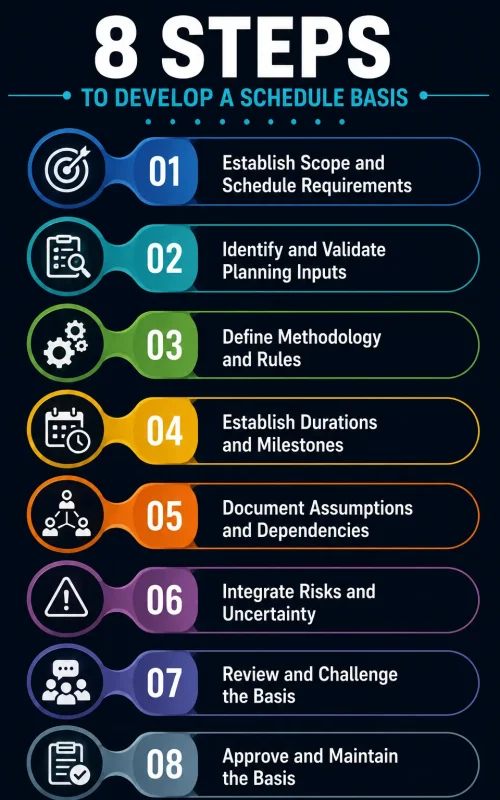
1. Establish the Project Scope, Objectives, and Schedule Requirements
Before developing the schedule basis, establish a clear understanding of what the schedule needs to represent, control, and achieve. Start by confirming the approved project scope, major deliverables, contractual requirements, key milestones, and required completion dates.
Confirm the Schedule Purpose
Clarify how the schedule will be used:
- Execution and coordination
- Progress measurement
- Project controls and reporting
- Forecasting
- Contractual management
- Schedule performance analysis
The intended purpose will influence the required level of detail, structure, and scheduling methodology.
Establish the Schedule Requirements
Identify the requirements that will govern schedule development, including:
- Planning and reporting periods
- Required milestones
- Working calendars
- Contractual schedule requirements
- Update frequency
- Progress measurement requirements
- Required schedule outputs and reports
Connect the Schedule to the Project Scope
The schedule should represent the work required to deliver the approved project scope. Confirm the relationship between the scope, WBS, deliverables, and planned work before developing detailed activities.
Avoid starting with dates simply because a contractual completion date already exists. First establish the work and requirements that must support that date.
The objective of this step is to establish a clear planning framework against which the schedule basis can be developed, reviewed, and ultimately validated.
2. Identify and Validate the Planning Inputs
A reliable schedule basis depends on the quality of the information used to develop the schedule. Before establishing activities, durations, and relationships, identify the key planning inputs and verify whether they are sufficiently reliable for scheduling.
Identify the Key Inputs
Typical inputs include:
- Project scope and WBS
- Contract requirements
- Engineering and design information
- Procurement strategy and lead times
- Construction or execution methodology
- Quantities and work estimates
- Resource requirements and availability
- Supplier and subcontractor information
- Site conditions and access requirements
- Required approvals and interfaces
- Project milestones and constraints
- Historical project and productivity data
Check the Information Quality
Do not assume that every available document represents confirmed information. Check the source, revision, date, status, and level of maturity of important inputs.
Clearly distinguish between:
- Confirmed information
- Preliminary information
- Estimates
- Assumptions
- Information awaiting validation
For example, a preliminary equipment delivery date should not be treated in the schedule basis as a confirmed procurement commitment.
Establish Traceability
For important schedule inputs, record where the information came from and how it was used. This allows the planning team to explain the reasoning behind key schedule assumptions and revisit them when the project develops.
The objective is to ensure that the schedule is built from relevant, current, and traceable information rather than assumptions that appear to be facts.
3. Define the Scheduling Methodology and Rules
A schedule basis should clearly explain how the project schedule will be developed and managed. Without agreed scheduling rules, different planners may interpret the same project information differently, resulting in inconsistent activities, relationships, calendars, and performance measures.
Establish the Scheduling Approach
Define the methodology that will be used for developing the schedule, including:
- Activity definition and coding
- WBS and schedule structure
- Scheduling logic and relationship types
- Working calendars
- Activity duration conventions
- Milestone treatment
- Critical path methodology
- Constraints and lag usage
- Progress measurement
- Schedule update and forecasting methods
The methodology should reflect the project’s size, complexity, execution strategy, contract requirements, and control needs rather than simply copying practices from another project.
Define Consistent Rules
Establish clear rules for areas that could otherwise be interpreted differently. For example, determine how non-working periods, approval activities, procurement lead times, testing, commissioning, and external interfaces will be represented.
Avoid unnecessary constraints and artificial logic simply to make planned dates align with required milestones.
Document the Methodology
Record the agreed scheduling rules in the schedule basis so that planners, project managers, contractors, and other stakeholders have a common reference.
The objective is to create a consistent scheduling framework in which the schedule logic, dates, durations, and performance measures can be understood and reproduced by others.
4. Establish the Basis for Durations and Milestones
Once the scheduling methodology is established, the next step is to determine how the planned durations and key dates will be developed and justified. A schedule basis should make important estimates understandable and defensible rather than relying only on individual planner judgement.
Develop Evidence-Based Durations
Where possible, use relevant evidence such as:
- Historical project performance
- Productivity rates
- Quantities and work volumes
- Resource assumptions
- Supplier and subcontractor information
- Engineering requirements
- Construction methodology
- Specialist estimates
- Lessons learned from similar projects
For major activities, document the reasoning behind the selected duration and identify any conditions that could significantly affect it.
Establish the Basis for Key Dates
Major milestones should also have a clear basis. Distinguish between dates that are contractually required, externally imposed, estimated from the work sequence, or dependent on assumptions.
For example, a contractual completion date should not automatically be treated as proof that the underlying work can realistically achieve that date.
Challenge the Estimates
Review important durations with the people responsible for executing the work. Ask whether the assumed productivity, resources, working conditions, and sequence are realistic.
The objective is to create durations and milestones that can be explained, challenged, and supported by evidence—not simply dates that make the schedule appear achievable.
5. Document Assumptions, Constraints, Dependencies, and Interfaces
A schedule is built on a set of conditions that must be understood before its planned dates can be considered reliable. These conditions should be clearly documented in the schedule basis rather than remaining hidden within activity dates or logic.
Identify Key Assumptions
Document assumptions that materially influence the schedule, such as:
- Design and engineering release dates
- Resource availability
- Procurement lead times
- Approval periods
- Productivity expectations
- Site access
- Third-party deliverables
For each important assumption, consider who owns it, how it will be validated, and what happens if it proves incorrect.
Separate Constraints From Assumptions
Identify contractual, regulatory, operational, environmental, or externally imposed constraints separately. A required completion date, for example, may be a contractual constraint rather than evidence that the planned work can actually achieve it.
Map Dependencies and Interfaces
Identify dependencies between engineering, procurement, construction, testing, commissioning, contractors, suppliers, and other parties. Pay particular attention to handoffs where one party’s output becomes another party’s input.
An important interface should not depend only on informal communication. Its schedule impact should be visible and understood.
The objective is to make the conditions behind the schedule visible, traceable, and manageable so that stakeholders understand what the planned dates depend upon.
6. Integrate Risks and Schedule Uncertainty
A schedule basis should recognize that planned dates are not equally certain. Even when the scope, durations, and logic appear reasonable, risks and uncertainties can affect the sequence, resources, productivity, and completion dates.
Connect Risks to the Schedule
Review the project risk register and identify risks that could directly affect scheduled work. For significant risks, determine:
- Which activities may be affected
- Potential duration or sequence impact
- Milestones that may be exposed
- Required mitigation measures
- Responsible risk owner
- Assumptions associated with the risk
For example, a risk involving late delivery of critical equipment should be connected to the procurement activity, affected construction activities, and relevant project milestones.
Consider Uncertainty
Not every schedule uncertainty should automatically become additional duration or contingency. First understand its source and potential impact.
Where appropriate, use historical data, three-point estimates, sensitivity analysis, or quantitative schedule risk analysis to understand the range of possible outcomes.
Reflect the Findings in the Basis
Document significant schedule risks, uncertainty ranges, mitigation strategies, and any agreed contingency or allowance. This helps stakeholders understand not only the planned date, but also the confidence and conditions behind it.
The objective is to ensure that schedule uncertainty is understood and managed rather than hidden behind precise-looking dates.
7. Review and Challenge the Schedule Basis
A schedule basis should be tested before it is accepted as the foundation for the project schedule. A document can appear complete while still containing unrealistic durations, unsupported assumptions, missing interfaces, or constraints that have not been properly understood.
Conduct a Cross-Functional Review
Involve the people who understand how the work will actually be delivered, such as:
- Engineering
- Procurement
- Construction or operations
- Project controls
- Commercial
- Contractors and subcontractors
- Commissioning teams
- Project management
Each discipline can challenge assumptions that may not be visible to the planning team.
Test the Basis
Ask practical questions:
- Are the planned durations achievable?
- Are the assumed resources available?
- Are the calendars realistic?
- Are the dependencies technically valid?
- Are constraints properly justified?
- Are important interfaces represented?
- Are key assumptions supported by evidence?
- What could invalidate the planned milestones?
Do not limit the review to checking whether information has been documented. Challenge the reasoning behind the information.
Resolve Significant Findings
Record important review comments, determine their impact, and revise the schedule basis where necessary. Unresolved issues should have clear owners and actions.
The objective is to test the schedule basis against real project conditions before it becomes the accepted foundation for schedule development and control.
8. Approve, Baseline, and Maintain the Schedule Basis
Once the schedule basis has been developed and challenged, it should be formally agreed and established as the reference for schedule development and control. Approval should confirm that the key assumptions, methodologies, estimates, constraints, and planning inputs are understood by the relevant project stakeholders.
Establish the Agreed Basis
Record the important elements of the approved basis, including:
- Planning inputs and their status
- Scheduling methodology and rules
- Duration and milestone assumptions
- Calendars and working conditions
- Constraints and dependencies
- Key interfaces
- Schedule risks and uncertainties
- Review findings and agreed actions
This creates a clear reference for understanding how the schedule was developed.
Control Changes to the Basis
Approval does not mean that the basis can never change. Scope changes, design development, procurement conditions, resource constraints, execution strategy changes, and emerging risks may invalidate important assumptions.
When significant conditions change, assess whether the schedule basis needs to be revised and whether the schedule itself requires corresponding changes.
Keep the Basis Traceable
Maintain appropriate revision history so that significant changes can be understood and linked to approved project decisions.
The objective is to maintain a schedule basis that remains an accurate, controlled, and traceable reference throughout project delivery—not simply a document produced before the baseline schedule.
Practical Example
Putting the Approach Into Practice
A construction project is preparing to establish the baseline schedule for a major industrial facility. The project team has a defined scope, but several planning inputs are still developing, including engineering release dates, procurement lead times, productivity assumptions, subcontractor availability, working calendars, and access constraints.
The project manager asks the planning team to develop a Schedule Basis that clearly explains how the project schedule has been developed and what assumptions, methods, and planning information support it.
1. Define the Schedule Purpose and Scope
The planning team first establishes what the schedule is intended to represent and how it will be used.
They confirm the project scope, contractual milestones, key completion requirements, schedule objectives, reporting requirements, and the activities or phases that need to be covered.
This provides a clear boundary for schedule development and prevents different team members from working from different interpretations of the schedule’s purpose.
2. Establish the Planning Inputs
The team gathers the information required to develop the schedule, including the scope documents, drawings, specifications, procurement information, contract requirements, resource information, project calendars, historical data, and execution strategies.
They classify information as confirmed, estimated, assumed, or still subject to validation.
This helps prevent preliminary information from being presented as established fact within the schedule.
3. Define Assumptions and Constraints
The team documents important assumptions that influence the schedule.
For example, they may assume that major design packages will be released by specific dates, critical materials will be available within expected lead times, and planned resources will be available when required.
They also identify constraints such as contractual completion dates, restricted working hours, site access limitations, permitting requirements, and fixed commissioning windows.
Each significant assumption and constraint is linked to the part of the schedule it can affect.
4. Establish Calendars and Working Conditions
The planning team defines the working calendars that will be used to develop activity durations and dates.
They consider working days, shifts, holidays, planned shutdowns, weather restrictions, access limitations, and other project-specific working conditions.
For example, structural construction may operate on a six-day working week while certain commissioning activities may be restricted to normal working hours.
Documenting these conditions makes the schedule calculations easier to understand and reproduce.
5. Define Estimating and Scheduling Methods
The team establishes how activity durations, resources, relationships, and milestones will be developed.
Duration estimates are based where possible on productivity data, historical project performance, supplier information, specialist input, quantities, and expected resource levels.
The team also defines the scheduling methodology, relationship types, activity conventions, and level of detail to be applied.
This creates consistency across the schedule rather than allowing each discipline to develop estimates using different approaches.
6. Document Logic and Execution Strategy
The team explains how the planned work is expected to progress from project start through completion.
Major interfaces between engineering, procurement, construction, testing, commissioning, and handover are identified.
For example, equipment installation may depend on engineering release, procurement completion, delivery to site, foundation readiness, and availability of installation resources.
The Schedule Basis therefore explains not only what the schedule contains, but also why the work has been sequenced in that manner.
7. Assess Uncertainty and Schedule Risk
The team reviews the assumptions and planning inputs to identify areas that could materially affect the schedule.
Potential issues include uncertain design releases, long-lead equipment, productivity uncertainty, resource shortages, approval delays, and restricted site access.
The planning team records the relevant risks and considers their potential impact on key activities and milestones.
This helps management understand where the schedule is relatively reliable and where greater uncertainty remains.
8. Review, Agree, and Approve the Schedule Basis
The completed Schedule Basis is reviewed with planning, engineering, procurement, construction, commercial, project management, and other relevant stakeholders.
The review identifies an overly optimistic equipment delivery assumption and an incorrect working calendar for one construction area.
The team corrects these inputs and updates the schedule before establishing the baseline.
The approved Schedule Basis is then retained as the reference for understanding how the schedule was developed and for assessing future changes.
The Lesson
A Schedule Basis is not simply supporting documentation for a project schedule.
It provides a transparent explanation of the information, assumptions, constraints, methods, calendars, logic, and planning decisions that support the schedule.
A reliable Schedule Basis helps the project team understand how the schedule was developed, how realistic its assumptions are, where uncertainty exists, and what should be considered when the schedule is reviewed or changed.
Common Mistakes to Avoid
Developing a Schedule Basis can appear straightforward, but weaknesses in assumptions, data, estimating methods, logic, and documentation can make the schedule difficult to defend, update, or use for project control.
Starting Without Sufficient Project Definition
Developing the Schedule Basis before scope, execution strategy, milestones, and key requirements are sufficiently understood can create unstable assumptions. As project information develops, the basis may require repeated revisions, reducing consistency and making it difficult to establish a reliable foundation for schedule development.
Treating the Schedule Basis as a Formality
A Schedule Basis should explain how the schedule was developed and why its assumptions are reasonable. Treating it simply as a required document can result in missing methodologies, unclear assumptions, unsupported estimates, and insufficient explanation of the factors that influence schedule credibility.
Using Unverified Schedule Inputs
Preliminary quantities, unconfirmed dates, assumed resources, incomplete engineering information, or outdated procurement data can weaken the Schedule Basis. Inputs should be identified according to their maturity and reliability, with important uncertainties clearly documented rather than presented as confirmed project information.
Building the Basis Around Required Dates
Starting with a contractual completion date and forcing durations, resources, and sequencing to achieve it can create unrealistic assumptions. The Schedule Basis should demonstrate how the planned completion is supported by scope, quantities, productivity, resources, logic, calendars, constraints, and execution requirements.
Using Unsupported Duration Estimates
Duration estimates based mainly on individual judgement can be difficult to defend. Where possible, estimates should consider historical project performance, productivity rates, supplier information, quantities, benchmarks, specialist input, and execution conditions. The basis should explain the reasoning behind significant duration assumptions.
Failing to Document Key Assumptions
Important assumptions about design releases, procurement lead times, productivity, resource availability, approvals, site access, working conditions, or construction methods can significantly affect the schedule. If these assumptions are not documented, later changes may appear unexpected and the original schedule logic becomes difficult to understand.
Ignoring Constraints and External Dependencies
Schedule development can overlook constraints such as permits, approvals, contractual milestones, access restrictions, procurement requirements, shutdown windows, interfaces, and resource limitations. The Schedule Basis should identify significant constraints and explain how they have been considered when establishing sequencing, durations, calendars, and planned dates.
Not Explaining the Scheduling Methodology
The Schedule Basis should describe important scheduling rules and methodologies, including calendars, sequencing principles, activity development, progress measurement, coding structures, and schedule logic. Without this information, users may understand the dates but not understand how those dates were established or how the schedule should be interpreted.
Developing the Basis Without the Execution Team
Planning teams may not fully understand practical construction, engineering, procurement, commissioning, or operational requirements. Involving experienced execution personnel helps validate productivity, durations, sequencing, resources, constraints, and assumptions, making the Schedule Basis more realistic and aligned with actual delivery conditions.
Failing to Connect Risks to the Schedule
A risk register alone does not explain schedule exposure. Significant schedule risks should be connected to affected activities, milestones, assumptions, and potential responses. This allows the project team to understand how uncertainty could influence planned completion dates and where additional schedule analysis may be required.
Not Defining the Level of Schedule Detail
Different parts of a project may be developed at inconsistent levels of detail if no clear planning criteria exist. The Schedule Basis should explain the intended schedule hierarchy, activity development approach, and level of detail required to support planning, monitoring, forecasting, reporting, and project control.
Failing to Review and Validate the Basis
A Schedule Basis should be challenged before the schedule is approved. The project team should review assumptions, estimates, logic, calendars, resources, constraints, milestones, and methodology. Independent or cross-functional review can identify unrealistic conditions before they become embedded in the baseline schedule.
Key Takeaways
A strong Schedule Basis is more than supporting documentation for a project schedule. It provides a clear, evidence-based explanation of how the schedule was developed, what assumptions support it, and how its planned dates can be evaluated and controlled.
- Start with a clear project definition. Understand the scope, objectives, milestones, execution strategy, and key requirements before developing schedule assumptions.
- Use reliable planning inputs. Base durations, quantities, resources, calendars, and dates on the best available information and clearly identify information that remains uncertain.
- Document the planning assumptions. Make important assumptions about design, procurement, productivity, resources, approvals, and execution conditions visible and traceable.
- Use evidence to support estimates. Where possible, use historical performance, productivity data, benchmarks, supplier information, and specialist knowledge rather than unsupported judgement.
- Explain the scheduling methodology. Clearly establish how activities, logic, calendars, milestones, progress measurement, and other important scheduling parameters were developed.
- Consider constraints, risks, and dependencies. Connect factors that could affect schedule performance to the relevant work, milestones, assumptions, and planned outcomes.
- Involve the people who will execute the work. Engineering, procurement, construction, commissioning, contractors, and other specialists can validate whether planning assumptions reflect actual project conditions.
- Test schedule achievability. Challenge durations, resources, sequencing, constraints, assumptions, and required completion dates before the schedule becomes the project baseline.
- Keep the basis aligned with the schedule. The Schedule Basis and schedule should remain consistent so that changes in assumptions, scope, or execution conditions can be understood and controlled.
- Maintain and update the basis when required. Approved changes and significant developments should be documented through appropriate change-control processes.
A good Schedule Basis does not guarantee that the project will finish on time. It provides a transparent, evidence-based, and defensible foundation for understanding how the schedule was developed, assessing its credibility, and controlling schedule performance.
References
- AACE International — 38R-06: Documenting the Schedule Basis
- NASA — PP&C Glossary: Schedule Basis of Estimate
- Federal Transit Administration — Project and Construction Management Guidelines: Schedule Basis Report
- U.S. GAO — Schedule Assessment Guide: Best Practices for Project Schedules
- Long International — Schedule Basis Memorandum: CPM Documentation & Best Practices
- Long International — Schedule Basis Memorandum: Types of Information to Include
- Planners Place — Good Practice: Schedule Basis, Assumption, Narrative or Memorandum
- Indian Infrastructure Body of Knowledge — Baseline Schedule Development and Schedule Basis Memorandum
- U.S. National Science Foundation — Construction Stage and Implementation Planning: Schedule Basis and Estimating Plan
- City of Edmonton — Construction Schedule Requirements and Schedule Basis
- Association for Project Management — Planning, Scheduling, Monitoring and Control
- Flyvbjerg — Top Ten Behavioral Biases in Project Management: An Overview
FEATURED PROJECT PLANNING & SCHEDULING GUIDES
Practical Guidance for Planning, Scheduling, and Schedule Control
Effective project planning and scheduling requires more than creating activities and assigning dates. Our featured guides focus on practical planning and scheduling activities, helping professionals structure projects, establish sound planning foundations, review schedules, and maintain schedule control.
How to Review and Validate a Project Schedule
Learn how to assess schedule structure, logic, durations, constraints, milestones, float, and other schedule characteristics to determine whether a schedule is complete, logical, and fit for purpose.
How to Manage Schedule Baseline Changes
Understand how to assess proposed changes to an approved schedule baseline, evaluate their impacts, obtain appropriate approval, and maintain proper baseline control.
How to Identify Schedule Constraints
Learn how to identify conditions that restrict planned activities, document their effects, assess their implications, and manage constraints throughout project delivery.
MORE PROJECT PLANNING & SCHEDULING RESOURCE TYPES
Continue Your Project Planning & Scheduling Learning
Project planning and scheduling knowledge becomes more valuable when you can understand the concepts, apply structured approaches, and develop practical skills. Explore the other resources within the Project Planning & Scheduling collection to complement the guidance provided in these guides.
Templates
Use practical templates and checklists to organize planning information, document scheduling decisions, review schedules, and support schedule control activities.
Downloads
Access useful planning and scheduling materials and reference resources to support learning and day-to-day project planning and controls activities.
Career Roadmaps
Follow structured learning paths to develop project planning, scheduling, and project controls knowledge, practical skills, and professional capabilities.
Case Studies
Explore planning and scheduling situations, decisions, challenges, and outcomes to understand how planning and scheduling practices are applied in real projects.
Glossary
Find clear explanations of project planning, scheduling, project controls, schedule management, and related professional terminology.
Insights & Articles
Explore professional perspectives, practical insights, emerging practices, and deeper discussions relevant to project planning, scheduling, and project controls.
Looking for more project management resources? Explore the Kleios Technologies Resources Hub to discover our complete collection of guides, templates, downloads, career roadmaps, case studies, glossary resources, and insights.
RELATED KNOWLEDGE DOMAINS
Continue Your Learning Across Related Knowledge Domains
Project Management is closely connected with specialized disciplines that support successful planning, execution, governance, performance measurement, and professional growth. Explore related knowledge domains to expand your expertise, develop complementary skills, and access practical resources across the complete project management ecosystem.
Expand your expertise one domain at a time and build a well-rounded project management skill set.
Why Explore Related Domains?
- Develop cross-functional project management expertise
- Discover specialized knowledge beyond core project management
- Access practical resources across interconnected disciplines
- Build a complete professional learning pathway
- Strengthen career readiness through continuous learning
Each knowledge domain complements your Project Management expertise, helping you build broader capabilities and solve real-world project challenges with greater confidence.
Project Management
Practical project management knowledge, practices, and professional resources.
Project Controls
Performance measurement, forecasting, and project control best practices.
PMO
Governance, portfolio management, and organizational project excellence.
Risk Management
Risk identification, assessment, mitigation, and monitoring resources.
Primavera P6
Professional planning, scheduling, resource management, and reporting.
Microsoft Project
Project scheduling, tracking, reporting, and collaboration resources.
Power BI
Interactive dashboards, reporting, visualization, and project analytics.
PMI Certifications
Certification guidance, exam preparation, and professional development resources.