
PROJECT PLANNING & SCHEDULING TEMPLATE
Schedule Constraints Identification Checklist
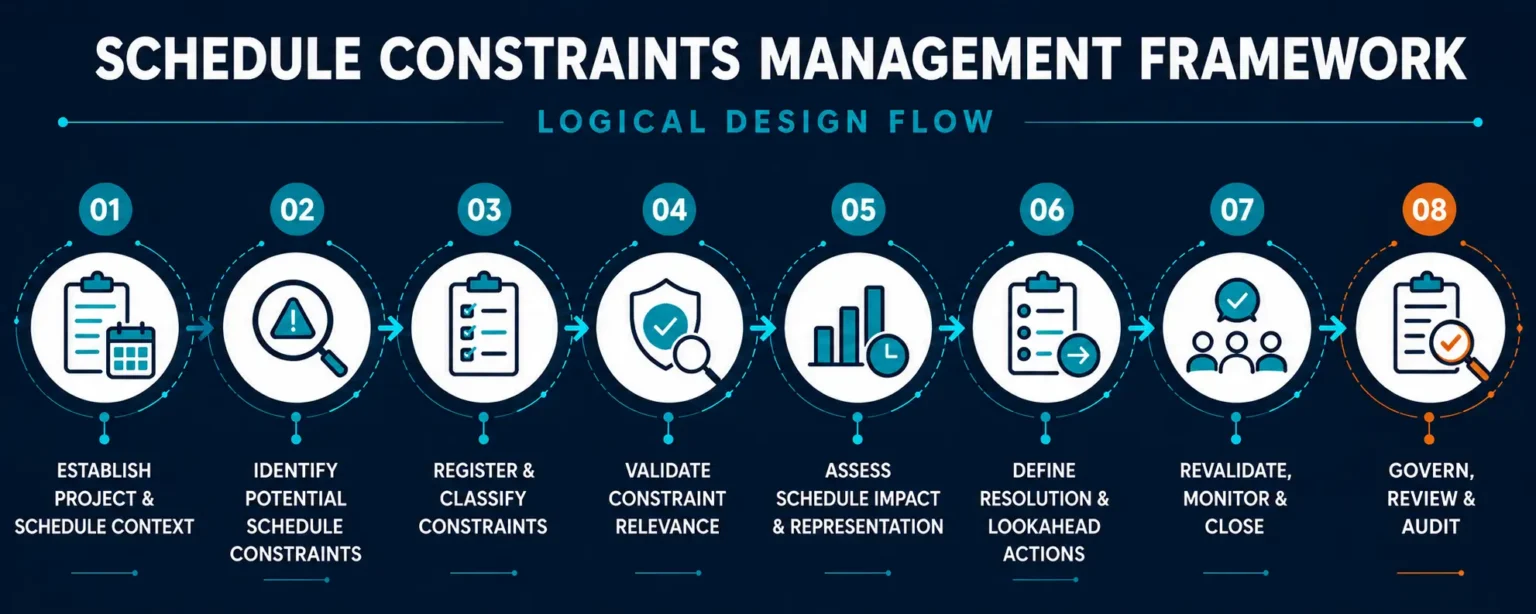
Identifying schedule constraints requires more than recording conditions that may affect planned work. This Schedule Constraints Identification Checklist provides a structured framework to establish schedule context, identify potential constraints, validate their relevance, assess schedule impact, define appropriate schedule representation, manage resolution actions, revalidate conditions, and maintain governance throughout the constraint lifecycle.
Excel Checklist · Project Planning & Scheduling
ABOUT THE CHECKLIST
A Structured Framework for Identifying and Managing Schedule Constraints
The Schedule Constraints Identification Checklist is an Excel-based project-controls resource designed to help project professionals establish schedule context, identify potential restrictions, validate whether they are genuine schedule constraints, and assess their relevance to planned work.
The checklist supports the constraint-management process from identifying potential conditions through schedule-impact assessment, appropriate schedule representation, resolution actions, lookahead monitoring, revalidation, closure, and governance.
Establish Schedule Context
Capture project, schedule, planning period, work, activities, milestones, responsibilities, and other information needed to establish the context for identifying schedule constraints.
Identify & Validate Constraints
Identify potential restrictions affecting planned work, classify the conditions, assess available evidence, and validate whether each condition genuinely qualifies as a schedule constraint.
Assess Impact & Manage Actions
Assess affected work, timing, schedule exposure, and appropriate schedule representation, then define resolution actions, owners, required dates, and lookahead requirements.
Revalidate, Close & Govern
Monitor constraint status, verify whether resolution actions were effective, revalidate remaining exposure, close or escalate constraints, and maintain review, accountability, and auditability.
WHAT’S INCLUDED
Everything You Need to Identify & Manage Schedule Constraints
The workbook connects schedule context, work identification, constraint validation, impact assessment, resolution actions, monitoring, revalidation, and governance into one structured constraint-management framework. Each section supports a specific stage of the constraint lifecycle.
01
Project Profile & Setup
Establish the project and schedule context by recording project details, schedule platform, schedule version, data date, planning stage, reporting period, and lookahead period.
02
Schedule Context & Work
Identify the activities, milestones, work packages, WBS elements, work areas, disciplines, responsibilities, and execution windows being examined for potential schedule restrictions.
03
Constraint Identification
Systematically identify potential restrictions across engineering, approvals, permits, materials, procurement, access, resources, equipment, interfaces, vendors, shutdowns, and external dependencies.
04
Constraint Register
Record identified constraints in a controlled register with constraint IDs, descriptions, categories, affected work, required dates, owners, priorities, status, sources, and supporting references.
05
Constraint Validation
Determine whether identified conditions genuinely qualify as schedule constraints by checking evidence, affected work, timing requirements, execution restrictions, existing schedule treatment, and distinctions from risks, issues, and dependencies.
06
Impact & Representation
Assess affected work, timing, potential schedule exposure, and appropriate schedule treatment through logic, milestones, calendars, resources, interfaces, activity constraints, or other suitable mechanisms.
07
Resolution & Lookahead
Define the actions required to remove or control constraints, assign owners and required dates, establish follow-up requirements, and manage actions through lookahead planning.
08
Revalidation & Monitoring
Monitor constraint conditions and verify whether actions were effective, required dates remain valid, schedule exposure has changed, further action is needed, or the constraint can be closed.
09
Governance, Review & Audit
Review significant constraints, exceptions, decisions, accountability, recurring issues, management actions, evidence, and overall constraint-management performance for traceability and governance.
HOW TO USE THE CHECKLIST
From Schedule Context to Controlled Constraint Management
The checklist is designed to be used progressively. Start by establishing the project and schedule context, identify the work being examined, record potential restrictions, validate genuine constraints, assess their schedule relevance, manage resolution actions, and verify the outcome before closure.
1. Establish the Schedule Context
Start by defining the project, schedule version, data date, planning period, lookahead window, and specific review purpose. This ensures that constraint identification is based on the correct schedule and current project conditions.
2. Select the Work to Review
Identify the activities, milestones, work packages, or execution areas that require attention during the review period. Focus on upcoming or strategically important work where unresolved conditions could affect planned execution.
3. Examine Conditions Affecting Work
Review the selected work systematically and look beyond the schedule itself. Consider information from engineering, procurement, construction, operations, meetings, approvals, vendors, interfaces, and other project functions to identify conditions that may restrict execution.
4. Question & Validate Each Condition
Check whether the condition is supported by evidence, affects specific planned work, has a relevant timing requirement, and genuinely limits execution rather than representing a risk, issue, dependency, assumption, or normal schedule relationship.
5. Assess the Potential Schedule Exposure
For confirmed constraints, determine how and when the restriction could affect planned work. Consider the affected activity or milestone, required date, potential consequences, schedule exposure, and whether the condition is already appropriately represented within the schedule.
6. Plan the Resolution Before the Impact
Define what needs to happen to remove or control the constraint before it affects execution. Assign clear ownership, target dates, follow-up actions, and lookahead requirements, and coordinate the necessary actions with the responsible project functions.
7. Recheck the Condition Before Closing
Do not assume that completing an action means the constraint has been resolved. Revalidate the underlying condition, confirm that the required information, access, approval, resource, material, or other requirement is actually available, and determine whether any schedule exposure remains.
8. Continue, Close, Escalate or Reopen
Use the latest evidence to determine the appropriate next status. Close constraints that are genuinely resolved, continue those requiring further action, escalate material unresolved conditions, or reopen previously closed constraints when the restriction returns or the expected resolution proves ineffective.
Identify, Validate, Resolve & Verify
The checklist is most effective when used as a recurring project-controls process, not as a one-time exercise. Apply it during schedule reviews, lookahead planning, updates, and major execution stages to maintain visibility of constraints and ensure that reported closure reflects the actual project condition.
SCHEDULE CONSTRAINT ASSESSMENT FRAMEWORK
Evaluate the Key Dimensions of a Schedule Constraint
A schedule constraint should be assessed in context rather than simply recorded as a condition affecting planned work. The checklist provides a structured basis for examining the work, validating potential restrictions, assessing schedule exposure, determining appropriate treatment, managing resolution, and verifying the outcome.
Project & Schedule Context
Review the project, schedule version, data date, planning period, lookahead window, and work under examination so that constraint identification is based on current schedule information and the correct execution context.
Work & Execution Context
Examine upcoming activities, milestones, work packages, WBS elements, work areas, and execution windows to understand which planned work could be restricted and where closer constraint attention may be required.
Constraint Identification
Systematically examine the selected work for conditions involving engineering, approvals, permits, materials, access, resources, equipment, interfaces, vendors, shutdowns, regulations, or external dependencies that may restrict execution.
Constraint Validation
Assess each identified condition using available evidence and determine whether it genuinely restricts planned work, has a relevant timing requirement, and should be treated as a constraint rather than a risk, issue, dependency, or assumption.
Impact & Exposure
Evaluate the affected work, timing, potential consequences, and schedule exposure, then determine whether the condition is already represented appropriately through logic, milestones, calendars, resources, interfaces, or another schedule mechanism.
Resolution & Lookahead
Define the actions required to remove or control the constraint, assign responsible owners and target dates, and coordinate follow-up through lookahead planning so resolution occurs before the restriction affects planned execution.
Revalidation & Closure
Recheck the underlying condition after actions are completed and confirm that the required outcome has actually been achieved, the schedule exposure is understood, and sufficient evidence exists to support continued monitoring or closure.
Governance & Escalation
Use the latest information to close genuinely resolved constraints, continue unresolved items, escalate material exposure, or reopen conditions that return, while maintaining clear evidence, accountability, decisions, and traceability.
SCHEDULE CONSTRAINT MANAGEMENT STATUS
Use Constraint Status to Track the Constraint Lifecycle
The checklist uses structured status classifications to help project teams track a potential constraint from initial identification through validation, active resolution, verification, and closure. Status should reflect the current condition of the constraint, while revalidation decisions determine whether it should remain open, be updated, closed, reopened, or escalated.
Identified
Condition Recorded
A potential schedule constraint has been identified and recorded, but it has not yet completed the validation process required to determine whether it genuinely restricts planned work.
Under Validation
Constraint Being Assessed
The identified condition is being assessed using available evidence, affected work, timing requirements, and classification criteria to determine whether it qualifies as a schedule constraint.
Confirmed / Open
Constraint Validated
The condition has been confirmed as a schedule constraint and remains open for impact assessment, resolution planning, monitoring, or other actions required to control the restriction.
In Resolution
Resolution Underway
Actions are being carried out to remove or control the confirmed constraint, with responsible owners, target dates, and follow-up requirements being monitored through the project.
Pending Verification
Resolution Being Verified
Resolution actions have been completed or substantially addressed, but the underlying condition still requires verification before the constraint can be considered fully resolved and closed.
Closed
Constraint Resolved
The underlying restriction has been adequately addressed and the available evidence confirms that the constraint no longer requires active management or monitoring.
Reopened
Restriction Returned
A previously closed constraint has returned, remained unresolved, or become relevant again, requiring renewed assessment, action, monitoring, or escalation.
No Longer Applicable
Constraint Discontinued
The identified condition is no longer relevant to the affected work or schedule and therefore does not require continued constraint management.
FROM POTENTIAL CONDITION TO CONTROLLED CONSTRAINT
Turn Schedule Restrictions Into Controlled Project Action
A schedule constraint becomes useful to manage when the underlying condition is identified against specific work, validated as a genuine restriction, assessed for schedule relevance, and connected to appropriate resolution actions. The checklist links schedule context with constraint identification, validation, impact assessment, resolution, revalidation, and governance.
Schedule Context
Establish What Work Is Being Reviewed
The checklist establishes the context for constraint assessment by identifying the project, schedule, planning period, affected activities, milestones, work packages, work areas, and execution windows. This creates a clear reference point for understanding where a potential restriction may affect planned work.
This ensures that constraints are assessed against actual project work and current schedule information rather than being recorded as isolated conditions without a clear relationship to execution.
Identify Potential Conditions
Examine the selected work for conditions involving engineering, approvals, permits, materials, access, resources, equipment, interfaces, vendors, shutdowns, regulations, or other factors that may restrict planned execution.
Validate the Constraint
Assess the identified condition using available evidence, affected work, timing requirements, and relevant classification considerations to determine whether it genuinely qualifies as a schedule constraint.
Assess Schedule Exposure
Determine the affected work, timing, potential consequences, and schedule exposure, then consider whether the condition is appropriately represented through schedule logic, milestones, calendars, resources, interfaces, or another suitable mechanism.
From Constraint to Verified Outcome
Connect Constraint Management With Schedule Control
Identifying a constraint is only the beginning of the management process. The checklist provides a structured path from confirming the restriction to defining resolution actions, monitoring progress, verifying the underlying condition, and determining whether the constraint should be closed, continued, reopened, or escalated.
Define Resolution Actions
Translate the confirmed constraint into specific actions, responsible owners, target dates, and follow-up requirements needed to remove or control the underlying restriction before it affects planned execution.
Monitor Through Lookahead
Track resolution actions against required dates and upcoming work so that unresolved conditions remain visible and can be addressed before they create greater schedule exposure.
Revalidate the Condition
Confirm whether the underlying restriction still exists, whether the resolution action was effective, whether the required outcome has been achieved, and whether additional action or schedule attention remains necessary.
Close, Reopen or Escalate
Use the latest evidence to determine the appropriate outcome: close genuinely resolved constraints, continue unresolved conditions, reopen restrictions that return, or escalate material constraints requiring management attention.
DESIGNED FOR FLEXIBLE USE
Adapt the Schedule Constraint Framework to Your Project Environment
Projects differ in their work types, execution conditions, interfaces, planning cycles, schedule structures, and sources of constraints. The checklist provides a consistent constraint-management framework while allowing constraint categories, review practices, ownership, resolution actions, and governance requirements to be adapted to each project.
Construction & Infrastructure
Apply the checklist to workfront access, drawings, permits, materials, equipment, subcontractors, site conditions, interfaces, approvals, utilities, traffic restrictions, and other execution constraints affecting planned work.
Engineering, EPC & Manufacturing
Adapt the framework to engineering deliverables, vendor information, procurement, fabrication, inspections, approvals, production windows, equipment availability, technical interfaces, commissioning, and other schedule restrictions.
IT & Digital Projects
Apply the checklist to requirements, approvals, environments, integrations, vendors, resources, client decisions, deliverables, deployment windows, dependencies, and other conditions that may restrict planned project work.
Energy & Oil & Gas
Use the framework for shutdown windows, permits, engineering approvals, equipment availability, materials, access, regulatory requirements, operational interfaces, contractor dependencies, and other conditions affecting execution.
Understand Schedule Constraints. Apply a Structured Control Process.
Learn how to identify potential schedule constraints, validate whether they genuinely restrict planned work, assess their schedule impact, determine appropriate schedule representation, define resolution and lookahead actions, and revalidate conditions before closure. Then apply the same structured process using the Excel checklist.
Schedule Constraints Identification Checklist FAQs
What is a Schedule Constraints Identification Checklist?
It is a structured project-controls tool for identifying, validating, assessing, managing, monitoring, and closing conditions that may restrict planned work or affect schedule execution.
Who can use the Schedule Constraints Identification Checklist?
Project managers, planners, planning engineers, schedulers, project controls professionals, construction managers, engineering teams, PMO professionals, and other project team members involved in schedule planning and control can use it.
What does the checklist include?
The workbook includes 10 sheets covering project and schedule setup, work identification, constraint identification, constraint registration, validation, schedule impact and representation, resolution and lookahead actions, revalidation and monitoring, and governance and audit review.
Does the checklist automatically identify schedule constraints?
No. It provides a structured process for identifying and evaluating potential constraints, but professional judgement is required to determine whether a condition genuinely qualifies as a schedule constraint.
Does the checklist replace Primavera P6 or Microsoft Project?
No. The checklist complements scheduling software by helping teams identify and manage constraints before and during schedule maintenance. It does not create or automatically modify a project schedule.
Can I customize the checklist for my project?
Yes. The checklist can be adapted to suit your project structure, constraint categories, reporting requirements, review process, terminology, and governance arrangements while retaining the core identification, validation, impact assessment, resolution, revalidation, and closure workflow.
Can the checklist be used across different industries?
Yes. The framework can be adapted for construction, infrastructure, EPC, engineering, manufacturing, energy, oil & gas, IT, technology, digital transformation, and professional services. The underlying constraint-management process remains consistent while project-specific categories and requirements can be adjusted.
Learn & Apply
Understand the Approach. Apply It to Your Project.
Use the related guide to understand the principles and process behind schedule-constraint identification, then apply that approach through the structured Excel checklist to establish context, validate constraints, assess schedule exposure, manage resolution actions, and maintain traceability through closure.
Learn with the Guide
How to Identify Schedule Constraints
Learn how to systematically identify potential schedule constraints, distinguish them from risks and dependencies, assess their effect on planned work, select appropriate schedule treatment, and manage them through resolution and revalidation.
Apply with the Template
Schedule Constraints Identification Checklist
Use the Excel-based framework to establish schedule context, identify potential constraints, validate their relevance, assess schedule impact, define resolution and lookahead actions, revalidate conditions, and maintain governance and auditability.
FEATURED PROJECT PLANNING & SCHEDULING TEMPLATES
Templates for Common Planning & Scheduling Activities
Our featured templates provide practical starting points for common planning and scheduling activities. Each resource helps structure planning information, develop schedules, identify constraints, review schedule quality, or manage controlled changes.
Schedule Baseline Change Template
Document proposed schedule baseline changes, including reasons, impacts, justification, approvals, effective dates, and revised information to maintain controlled and traceable schedule records.
Project Schedule Review Checklist
Review schedule quality across activities, logic, relationships, durations, constraints, calendars, milestones, critical paths, and other conditions before relying on schedule information for control.
Project Schedule Basis Template
Document assumptions, methodologies, calendars, constraints, milestones, sequencing principles, exclusions, and other planning considerations that establish a clear basis for the project schedule.
MORE PROJECT PLANNING & SCHEDULING RESOURCE TYPES
Continue Your Project Planning & Scheduling Learning
Project planning and scheduling knowledge becomes more valuable when you can understand the concepts, apply structured approaches, and develop practical skills. Explore the other resources within the Project Planning & Scheduling collection to complement the guidance provided in these guides.
Guides
Learn practical approaches to develop project plans, structure schedules, identify constraints, review schedule quality, and strengthen schedule control practices.
Downloads
Access useful planning and scheduling materials and reference resources to support learning and day-to-day project planning and controls activities.
Career Roadmaps
Follow structured learning paths to develop project planning, scheduling, and project controls knowledge, practical skills, and professional capabilities.
Case Studies
Explore planning and scheduling situations, decisions, challenges, and outcomes to understand how planning and scheduling practices are applied in real projects.
Glossary
Find clear explanations of project planning, scheduling, project controls, schedule management, and related professional terminology.
Insights & Articles
Explore professional perspectives, practical insights, emerging practices, and deeper discussions relevant to project planning, scheduling, and project controls.
Looking for more project management resources? Explore the Kleios Technologies Resources Hub to discover our complete collection of guides, templates, downloads, career roadmaps, case studies, glossary resources, and insights.
RELATED KNOWLEDGE DOMAINS
Continue Your Learning Across Related Knowledge Domains
Project Management is closely connected with specialized disciplines that support successful planning, execution, governance, performance measurement, and professional growth. Explore related knowledge domains to expand your expertise, develop complementary skills, and access practical resources across the complete project management ecosystem.
Expand your expertise one domain at a time and build a well-rounded project management skill set.
Why Explore Related Domains?
- Develop cross-functional project management expertise
- Discover specialized knowledge beyond core project management
- Access practical resources across interconnected disciplines
- Build a complete professional learning pathway
- Strengthen career readiness through continuous learning
Each knowledge domain complements your Project Management expertise, helping you build broader capabilities and solve real-world project challenges with greater confidence.
Project Management
Practical project management knowledge, practices, and professional resources.
Project Controls
Performance measurement, forecasting, and project control best practices.
PMO
Governance, portfolio management, and organizational project excellence.
Risk Management
Risk identification, assessment, mitigation, and monitoring resources.
Primavera P6
Professional planning, scheduling, resource management, and reporting.
Microsoft Project
Project scheduling, tracking, reporting, and collaboration resources.
Power BI
Interactive dashboards, reporting, visualization, and project analytics.
PMI Certifications
Certification guidance, exam preparation, and professional development resources.