
PROJECT PLANNING & SCHEDULING TEMPLATE
Schedule Baseline Change Template
Managing changes to an approved schedule baseline requires a controlled process for documenting the proposed change, assessing schedule impact, evaluating recovery alternatives, obtaining authorization, implementing the approved change, and monitoring its outcome. This Schedule Baseline Change Template provides a structured framework to maintain traceability from the original change request through impact assessment, decision, implementation, revised baseline version, and ongoing monitoring.
Excel Template · Project Planning & Scheduling
ABOUT THE TEMPLATE
A Structured Framework for Controlling Schedule Baseline Changes
The Schedule Baseline Change Template is an Excel-based project-controls workbook designed to provide a structured and traceable method for managing proposed changes to an approved project schedule baseline. It helps project teams distinguish baseline changes from normal schedule updates and forecast movements, assess whether a baseline revision is justified, and maintain appropriate governance throughout the change lifecycle.
The template connects project and baseline context with change identification, schedule impact assessment, recovery and alternative evaluation, decision and approval, controlled implementation, new baseline versioning, and ongoing monitoring. This creates a clear record of why a baseline change was proposed, what its schedule consequences were, what alternatives were considered, who authorized it, what was implemented, and how the resulting baseline is monitored.
Establish Baseline Governance
Define the project context, current baseline, ownership, approval authority, change thresholds, documentation requirements, version controls, and governance rules that establish how schedule baseline changes should be controlled.
Assess Proposed Changes
Document the proposed change, its reason and affected scope, then assess potential effects on completion dates, milestones, critical path, float, logic, interfaces, resources, contractual dates, and other relevant schedule characteristics.
Authorize Controlled Revisions
Evaluate recovery measures and alternatives before determining whether a baseline revision is justified, then record the decision, approved scope, conditions, authority, required actions, and formal authorization.
Implement & Monitor Changes
Implement only the approved change, retain the previous baseline, establish the controlled new baseline version, validate implementation, monitor schedule effects, track actions, and maintain traceability through closure.
WHAT’S INCLUDED
Everything You Need to Control Schedule Baseline Changes
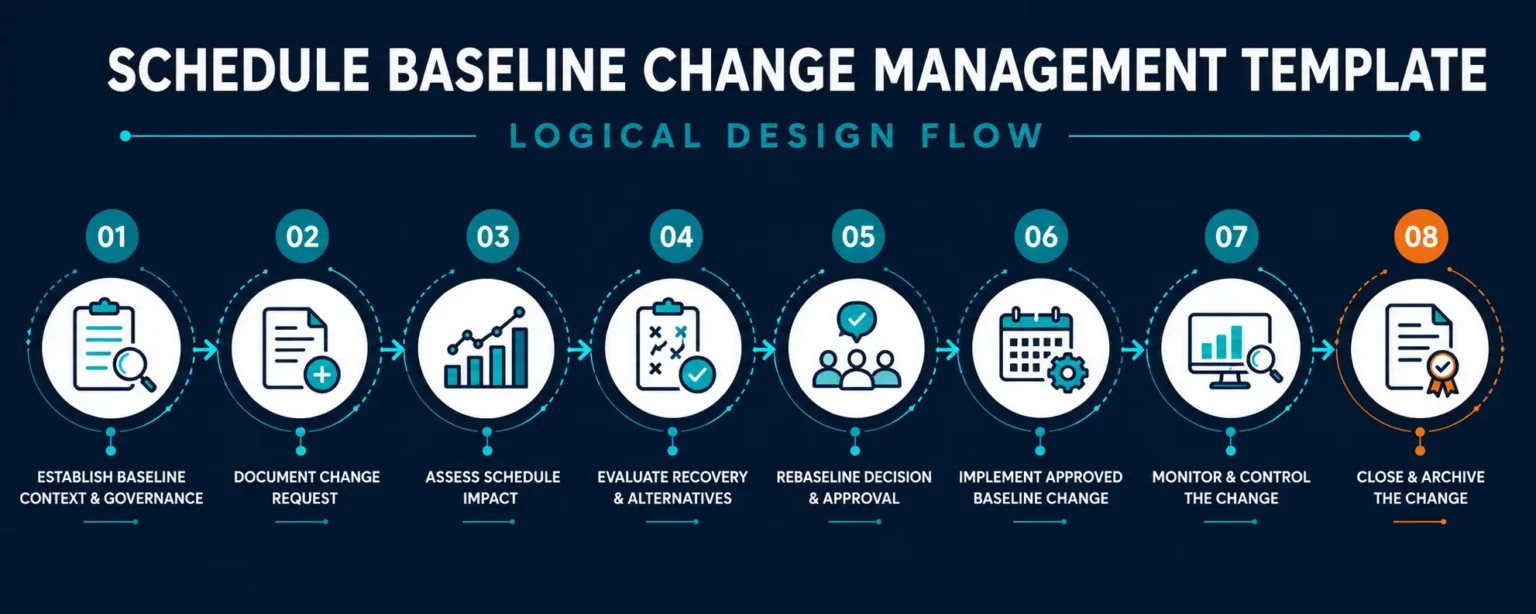
The workbook brings project context, baseline governance, change identification, schedule impact assessment, recovery analysis, approval, implementation, version control, and monitoring into one connected schedule-control framework. Each section supports a defined stage of managing a proposed baseline change from initiation through closure.
01
Project Profile
Establish the project, contractual, organizational, scheduling, and baseline context required to consistently manage and evaluate schedule baseline changes throughout the project lifecycle.
02
Baseline Governance
Define baseline ownership, approval authority, change classifications, thresholds, documentation requirements, version controls, retention requirements, and project-specific governance rules for controlling baseline changes.
03
Change Request
Document each proposed baseline change using a unique Change ID, capturing its source, reason, affected scope, supporting evidence, initial schedule context, and information required for formal assessment.
04
Schedule Impact Assessment
Assess the proposed change against the applicable baseline and data date, considering completion dates, milestones, critical path, float, logic, durations, constraints, interfaces, resources, and other schedule effects.
05
Recovery & Alternatives
Evaluate practical recovery measures and alternative approaches before revising the baseline, considering schedule benefits, resource and cost implications, risks, feasibility, constraints, and preferred options.
06
Rebaseline Decision & Approval
Record the formal decision by connecting the change request, impact assessment, recovery analysis, governance review, approved scope, conditions, required actions, decision authority, and authorization.
07
Baseline Implementation
Control the implementation of an approved change by recording implementation details, previous and new baseline versions, schedule references, validation checks, approved scope, effective dates, and identified deviations.
08
Change Register & Monitoring
Maintain the central change record by tracking status, owners, decisions, implementation, current baseline version, outstanding actions, schedule effects, monitoring information, closure, and historical traceability.
HOW TO USE THE TEMPLATE
From Proposed Change to Controlled Baseline
The template should be used as a controlled workflow rather than as a collection of independent forms. Start by establishing the project and baseline context, define the applicable governance rules, document the proposed change, assess its schedule consequences, evaluate recovery options, obtain authorization, implement the approved revision, and continue monitoring the change through its lifecycle.
1. Establish the Baseline Context
Begin with the Project Profile and confirm which project, schedule, data date, and baseline version are being assessed. Ensure the key project and scheduling information is current before recording a proposed baseline change.
2. Confirm the Governance Rules
Review the Baseline Governance requirements before evaluating the change. Confirm the applicable approval authority, change thresholds, documentation requirements, classification rules, version controls, and other project-specific requirements that govern baseline revisions.
3. Record the Proposed Change
Use the Change Request sheet when a potential baseline change is identified. Assign a unique Change ID and document the reason, source, affected scope, supporting information, and initial details without treating the request as an approved baseline revision.
4. Assess the Schedule Consequences
Complete the Schedule Impact Assessment using the appropriate baseline version and data date. Examine the potential effect on completion, milestones, critical path, float, logic, durations, interfaces, resources, contractual dates, and other relevant schedule characteristics.
5. Evaluate Recovery Options
Use Recovery & Alternatives to consider whether the schedule impact can be managed without changing the baseline. Compare practical recovery measures and alternatives, including their potential benefits, consequences, risks, feasibility, and remaining schedule exposure.
6. Obtain a Controlled Decision
Use Rebaseline Decision & Approval to document the formal decision based on the completed assessment and alternatives review. Clearly record whether the change is approved, rejected, deferred, or subject to conditions, together with the authorized scope and required actions.
7. Implement the Approved Revision
Only implement a baseline change after the required authorization has been obtained. Use Baseline Implementation to record what was implemented, retain the previous baseline, establish the new baseline version, reference the schedule file, and complete the required validation checks.
8. Monitor the Change Lifecycle
Maintain the Change Register & Monitoring throughout implementation and subsequent project control. Track status, actions, schedule effects, responsible owners, current baseline version, monitoring information, and closure, while reopening or initiating change control when conditions materially change.
Control the Change, Preserve the Baseline History
A schedule baseline remains useful when its changes are controlled rather than overwritten. Use the template to maintain a clear connection between the original change request, schedule assessment, recovery analysis, authorization, implementation, revised baseline version, and subsequent monitoring. This preserves the history needed for effective project controls, management review, and auditability.
SCHEDULE BASELINE CHANGE CONTROL
Evaluate the Key Dimensions of a Controlled Baseline Change
A schedule baseline change needs to connect governance, change justification, schedule analysis, recovery options, authorization, implementation, and monitoring into one controlled process. The template provides a structured basis for evaluating whether a proposed change warrants baseline revision and for maintaining traceability from the original request through the resulting baseline.
Baseline Context & Governance
Consider the current baseline, schedule version, data date, baseline ownership, approval authority, change thresholds, documentation requirements, version controls, and other governance conditions that establish the framework for controlling baseline changes.
Change Request & Justification
Examine the proposed change, its source, reason, affected scope, supporting evidence, initial schedule context, and other information needed to understand why a baseline revision is being requested and what requires formal assessment.
Schedule Impact Assessment
Assess the proposed change against the applicable baseline by considering completion dates, milestones, critical path, float, activity logic, durations, constraints, interfaces, resources, contractual dates, and other schedule characteristics that may be affected.
Recovery & Alternative Analysis
Evaluate practical recovery measures and alternative approaches before recommending a baseline revision, considering schedule benefits, resource and cost implications, risks, feasibility, constraints, and whether the impact can be managed without changing the baseline.
Decision & Authorization
Review the change request, schedule impact, recovery analysis, governance requirements, and supporting evidence before documenting the decision, approved scope, conditions, required actions, decision authority, and formal authorization for the proposed baseline change.
Baseline Implementation
Establish a controlled implementation process for the authorized change by retaining the previous baseline, recording implementation details, referencing the applicable schedule file, creating the new baseline version, completing validation checks, and documenting any implementation deviations.
Monitoring & Change Control
Monitor the implemented change through its lifecycle by tracking current status, schedule effects, outstanding actions, responsible owners, monitoring dates, baseline version, and other information required to determine whether further action or change control is necessary.
Traceability & Baseline History
Maintain the relationship between the Change ID, impact assessment, recovery analysis, decision, implementation, and baseline versions so that the project team can understand why the change occurred, what was approved, what was implemented, and how the resulting baseline is being managed.
SCHEDULE BASELINE CHANGE STATUS
Use Change Status to Track the Baseline Change Lifecycle
The template uses structured status classifications to help project teams understand where each proposed baseline change stands, identify outstanding actions, confirm decision requirements, track implementation, and determine whether the change can be closed or requires further control.
Identified
Change Recorded
The potential schedule baseline change has been identified and recorded, with initial change details captured for review. The request has not yet completed the required assessment, recovery review, or governance decision by the designated project authority.
Under Assessment
Impact Being Assessed
The proposed baseline change is being evaluated for schedule impact, affected scope, recovery options, alternatives, supporting evidence, and other information needed to determine whether a baseline revision is appropriate for formal approval and implementation.
Pending Decision
Decision Required
The required change assessment and supporting reviews have been completed, and the proposed baseline change is awaiting formal review and decision from the designated project authority or change-control body before implementation can proceed.
Approved
Change Authorised
The proposed baseline change has received the required authorization, with its approved scope, conditions, implementation requirements, required actions, and decision details formally established for controlled execution within the applicable project baseline.
Rejected
Change Not Approved
The proposed baseline change has been reviewed but has not been authorized for implementation. The decision, rationale, supporting assessment, and relevant records should be retained within the change history for future reference.
Implemented
Baseline Revised
The approved change has been incorporated into the schedule, the new baseline version has been established, the previous baseline has been retained, and implementation has been validated against the approved scope.
Monitoring
Change Being Monitored
The approved change has been implemented and is being monitored for resulting schedule effects, outstanding actions, deviations, and conditions that may require further review or additional change control by the project team.
Closed
Change Complete
The change lifecycle has been completed, implementation and monitoring records are maintained, outstanding actions are addressed, and no further action is currently required for the approved baseline change within the project.
FROM CHANGE REQUEST TO CONTROLLED BASELINE
Turn a Proposed Schedule Change Into a Controlled Baseline Revision
A schedule baseline change requires more than updating dates in a project schedule. The template connects the proposed change with baseline governance, schedule impact assessment, recovery alternatives, formal decision-making, controlled implementation, revised baseline versioning, and ongoing monitoring.
Establish Baseline Context
Understand the Baseline Before Change
The template establishes the foundation for baseline change control by bringing together the project profile, schedule information, current baseline version, data date, baseline ownership, approval authority, change thresholds, and other governance requirements that determine how a proposed revision should be evaluated.
This creates a clear reference point before the proposed change is assessed and helps ensure that the correct baseline, schedule version, and project-specific control requirements are used throughout the change process.
Confirm the Change Request
Document the proposed change, Change ID, source, reason, affected scope, supporting evidence, and initial schedule information before assessing whether a baseline revision is required and establishing the information needed for subsequent impact assessment.
Assess the Schedule Impact
Evaluate the proposed change against the applicable baseline by reviewing completion dates, milestones, critical path, float, activity logic, durations, constraints, interfaces, resources, contractual dates, and other relevant schedule effects that may influence the baseline-change decision.
Evaluate Recovery & Alternatives
Review practical recovery measures and alternative approaches before recommending a baseline change, considering potential schedule benefits, feasibility, resources, risks, constraints, implementation requirements, and consequences associated with each available option.
From Assessment to Baseline Control
Connect the Change With Controlled Implementation
A baseline change becomes controlled when the assessment, recovery analysis, decision, authorization, implementation, and monitoring stages remain connected. The template provides a structured path from evaluating the proposed change to establishing a controlled new baseline while preserving the previous baseline and maintaining traceability.
Evaluate Recovery & Alternatives
Consider recovery measures and alternative approaches before recommending a baseline revision, including schedule benefits, resource and cost implications, risks, feasibility, constraints, and remaining schedule exposure.
Decide & Authorize the Change
Connect the change request, impact assessment, recovery analysis, and governance requirements to document the decision, approved scope, conditions, required actions, decision authority, and formal authorization.
Implement & Establish Baseline
Implement only the approved change, retain the previous baseline, record the implementation details, establish the new baseline version, reference the controlled schedule file, and complete the required validation checks.
Monitor & Maintain Traceability
Track the implemented change, current baseline version, schedule effects, outstanding actions, monitoring information, and closure while preserving the relationship between the original request, decision, implementation, and baseline history.
DESIGNED FOR FLEXIBLE USE
Adapt Schedule Baseline Change Control to Your Project Environment
Projects differ in their delivery methods, schedule structures, contractual requirements, governance arrangements, approval authorities, change thresholds, and control practices. The template provides a consistent baseline change-management framework while allowing assessment, approval, implementation, monitoring, and version-control practices to be adapted to each project.
Construction & Infrastructure
Apply the framework to construction schedules, work packages, sequencing, milestones, site constraints, procurement, interfaces, contractual dates, recovery measures, approvals, and controlled baseline revisions across project delivery.
Engineering, EPC & Manufacturing
Adapt the framework for engineering deliverables, procurement, fabrication, production, technical interfaces, commissioning, milestones, contractual requirements, recovery options, schedule impacts, approvals, and controlled baseline revisions across project delivery.
IT & Digital Projects
Use the framework for software delivery, technology implementation, development phases, testing, integrations, releases, dependencies, milestones, schedule impacts, approved changes, implementation controls, and revised baseline versions.
Professional & Corporate Projects
Apply the framework to consulting engagements, business initiatives, organisational changes, internal projects, strategic programmes, milestone plans, governance requirements, schedule changes, approval processes, implementation controls, and ongoing monitoring.
Learn the Approach and Apply It to Your Project
Understand how to establish baseline context and governance, document a proposed schedule change, assess its schedule impact, evaluate recovery alternatives, obtain the required decision and approval, implement an authorized baseline revision, and monitor the resulting change through closure using the structured workbook.
Schedule Baseline Change Template FAQs
What is a Schedule Baseline Change Template?
It is a structured project-controls workbook for documenting, assessing, approving, implementing, monitoring, and closing proposed changes to an approved schedule baseline.
Who can use the Schedule Baseline Change Template?
Project managers, planners, schedulers, project controls professionals, PMO teams, change-control teams, and other project stakeholders responsible for schedule governance and baseline management can use it.
What does the template include?
The workbook includes Project Profile, Baseline Governance, Change Request, Schedule Impact Assessment, Recovery & Alternatives, Rebaseline Decision & Approval, Baseline Implementation, and Change Register & Monitoring sheets.
Does the template automatically change the schedule baseline?
No. The template provides the documentation, assessment, approval, and implementation framework. The approved change must be incorporated into the project schedule using the organization’s designated scheduling software and procedures.
Does the template help assess the impact of a proposed baseline change?
Yes. It provides a structured basis for reviewing schedule effects such as completion dates, milestones, critical path, float, logic, durations, constraints, interfaces, resources, contractual dates, and other relevant schedule considerations.
Can I customize the template for my project?
Yes. The workbook can be adapted to project-specific baseline rules, approval authorities, change thresholds, governance requirements, schedule structures, documentation practices, and contractual procedures.
Can the template be used across different industries?
Yes. The framework can be adapted for construction, infrastructure, engineering, EPC, manufacturing, energy, oil and gas, IT, digital projects, professional services, and other project environments requiring controlled schedule baseline management.
Learn & Apply
Understand the Process. Control Your Baseline.
Learn the principles of schedule baseline change management through the related guide, then apply the structured workbook to document proposed changes, assess schedule impacts, evaluate recovery alternatives, obtain approval, implement controlled revisions, and monitor the resulting baseline.
Learn with the Guide
How to Manage Schedule Baseline Changes
Learn how to distinguish forecast movement from genuine baseline change, assess the impact of proposed revisions, evaluate recovery options, establish approval controls, and maintain baseline integrity throughout project delivery.
Apply with the Template
Schedule Baseline Change Template
Use the Excel-based framework to establish baseline governance, document change requests, assess schedule impacts, evaluate alternatives, record approval decisions, implement revised baselines, and maintain change history.
FEATURED PROJECT PLANNING & SCHEDULING TEMPLATES
Templates for Common Planning & Scheduling Activities
Our featured templates provide practical starting points for common planning and scheduling activities. Each resource helps structure planning information, develop schedules, identify constraints, review schedule quality, or manage controlled changes.
Project Plan Development Template
Structure project planning information, including objectives, scope, deliverables, assumptions, constraints, responsibilities, execution requirements, and supporting plans for effective project delivery.
Project Schedule Review Checklist
Review schedule quality across activities, logic, relationships, durations, constraints, calendars, milestones, critical paths, and other conditions before relying on schedule information for control.
Project Schedule Basis Template
Document assumptions, methodologies, calendars, constraints, milestones, sequencing principles, exclusions, and other planning considerations that establish a clear basis for the project schedule.
MORE PROJECT PLANNING & SCHEDULING RESOURCE TYPES
Continue Your Project Planning & Scheduling Learning
Project planning and scheduling knowledge becomes more valuable when you can understand the concepts, apply structured approaches, and develop practical skills. Explore the other resources within the Project Planning & Scheduling collection to complement the guidance provided in these guides.
Guides
Learn practical approaches to develop project plans, structure schedules, identify constraints, review schedule quality, and strengthen schedule control practices.
Downloads
Access useful planning and scheduling materials and reference resources to support learning and day-to-day project planning and controls activities.
Career Roadmaps
Follow structured learning paths to develop project planning, scheduling, and project controls knowledge, practical skills, and professional capabilities.
Case Studies
Explore planning and scheduling situations, decisions, challenges, and outcomes to understand how planning and scheduling practices are applied in real projects.
Glossary
Find clear explanations of project planning, scheduling, project controls, schedule management, and related professional terminology.
Insights & Articles
Explore professional perspectives, practical insights, emerging practices, and deeper discussions relevant to project planning, scheduling, and project controls.
Looking for more project management resources? Explore the Kleios Technologies Resources Hub to discover our complete collection of guides, templates, downloads, career roadmaps, case studies, glossary resources, and insights.
RELATED KNOWLEDGE DOMAINS
Continue Your Learning Across Related Knowledge Domains
Project Management is closely connected with specialized disciplines that support successful planning, execution, governance, performance measurement, and professional growth. Explore related knowledge domains to expand your expertise, develop complementary skills, and access practical resources across the complete project management ecosystem.
Expand your expertise one domain at a time and build a well-rounded project management skill set.
Why Explore Related Domains?
- Develop cross-functional project management expertise
- Discover specialized knowledge beyond core project management
- Access practical resources across interconnected disciplines
- Build a complete professional learning pathway
- Strengthen career readiness through continuous learning
Each knowledge domain complements your Project Management expertise, helping you build broader capabilities and solve real-world project challenges with greater confidence.
Project Management
Practical project management knowledge, practices, and professional resources.
Project Controls
Performance measurement, forecasting, and project control best practices.
PMO
Governance, portfolio management, and organizational project excellence.
Risk Management
Risk identification, assessment, mitigation, and monitoring resources.
Primavera P6
Professional planning, scheduling, resource management, and reporting.
Microsoft Project
Project scheduling, tracking, reporting, and collaboration resources.
Power BI
Interactive dashboards, reporting, visualization, and project analytics.
PMI Certifications
Certification guidance, exam preparation, and professional development resources.