
PROJECT PLANNING & SCHEDULING GUIDE
How to Review and Validate Project Schedule
Reviewing and validating a project schedule requires more than checking activities, dates, and relationships. This guide provides a practical approach to assess scope coverage, schedule structure, logic, durations, resources, critical path, risks, interfaces, and forecast reliability, and to determine whether the schedule provides a credible basis for project execution and control.
Practical Guide · Project Management
The Project Schedule Review Challenge
Reviewing and validating a project schedule is more than checking whether activities have been entered correctly or whether the software reports a healthy schedule. The real challenge is determining whether the schedule provides a credible representation of how the project can actually be executed.
In practice, project schedules are often developed by different teams, contractors, disciplines, and organizations using different assumptions, planning methods, data sources, and levels of detail. The reviewer must therefore determine whether these different inputs have been brought together into one coherent execution model.
Determining Whether the Schedule Covers the Complete Scope
A schedule can contain thousands of activities and still omit important project work. Missing engineering deliverables, procurement activities, approvals, testing, commissioning, interfaces, or handover requirements can create gaps that may not become visible until execution.
The review must therefore establish traceability between the approved scope, WBS, deliverables, milestones, and scheduled work.
Determining Whether the Logic Represents Reality
A technically valid schedule is not necessarily a realistic schedule. Activities may have relationships, but those relationships may not accurately represent how work will actually flow.
Reviewers need to examine dependencies, sequencing, constraints, lags, interfaces, and handoffs between teams and organizations. The challenge becomes greater when several contractors or disciplines contribute to the same execution sequence.
Testing Whether Durations Are Defensible
Activity durations are frequently based on estimates rather than demonstrated performance. Optimistic productivity assumptions, incomplete design information, uncertain quantities, or unavailable resources can make a schedule appear achievable when it is not.
A meaningful review therefore asks why each important duration is achievable, what evidence supports it, and whether the required resources will be available when needed.
Understanding What Actually Drives Completion
The critical path generated by scheduling software should not automatically be accepted as the project’s true completion-driving path.
The reviewer needs to examine critical and near-critical paths, float, constraints, milestones, and dependencies to determine whether the schedule correctly identifies the work that can actually influence project completion.
Connecting the Schedule With Risk and Uncertainty
A baseline schedule normally represents a planned execution scenario. Actual project conditions may be different.
Procurement delays, design development, approvals, resource shortages, contractor performance, access restrictions, and other risks can affect the forecast. The challenge is determining whether the schedule and risk information are sufficiently connected to understand these potential impacts.
Obtaining Confidence From the Execution Team
Schedule analytics alone cannot reveal every practical problem. Engineers, procurement teams, construction personnel, commissioning teams, contractors, and other specialists may identify unrealistic assumptions or missing interfaces that are not obvious from schedule data.
The strongest reviews therefore combine schedule analysis with professional judgement and execution knowledge.
The Core Challenge
The challenge is not simply finding errors in a schedule.
It is determining whether the schedule is complete, logically sound, realistically estimated, risk-informed, and consistent with the way the project can actually be delivered.
A schedule should ultimately provide more than dates and forecasts. It should provide the project team with a credible and continuously validated model for understanding, executing, monitoring, and controlling project delivery.
Why Project Schedule Review and Validation Goes Wrong
Schedule review problems rarely come from one isolated error. They usually develop when the review process focuses on technical schedule checks without sufficiently testing whether the schedule reflects the actual project execution strategy.
1. The Review Starts With the Schedule Instead of the Scope
A schedule should first be checked against the approved scope, WBS, deliverables, milestones, and execution strategy.
Starting directly with activities and dates can hide:
- Missing work
- Duplicated scope
- Incomplete deliverables
- Missing approvals or handovers
The reviewer should first establish what the project must deliver and then confirm whether the schedule provides complete and traceable coverage.
2. The Schedule Is Treated as Correct Because It Runs
A schedule that calculates successfully in scheduling software is not necessarily reliable.
It may still contain:
- Weak relationships
- Unrealistic durations
- Excessive constraints
- Missing activities
- Artificial logic
Successful calculation only confirms that the software can process the schedule.
The real question is whether the schedule represents a credible execution model.
3. Reviewers Focus Only on Schedule Health Metrics
Schedule health checks can identify useful warning signs such as open ends, excessive lags, constraints, and unusual float.
However, passing these checks does not prove that the project can achieve its planned dates.
The reviewer should therefore use health metrics as a starting point, followed by deeper examination of:
- Logic
- Assumptions
- Durations
- Resources
- Execution conditions
4. Activity Durations Are Accepted Without Evidence
Important duration estimates should have a reasonable and explainable basis.
Reviewers should consider:
- Quantities
- Productivity rates
- Crew sizes
- Working calendars
- Historical performance
- Supplier information
- Resource availability
Where evidence is weak, the duration should be challenged with the responsible team.
The objective is not to eliminate professional judgement. It is to ensure that important estimates are reasonable, defensible, and evidence-based.
5. The Critical Path Is Accepted Without Testing
The software-generated critical path should not automatically be accepted as the path controlling project completion.
Reviewers should:
- Trace the path from the completion milestone
- Check predecessor relationships
- Examine near-critical paths
- Review available float
- Investigate constraints
The execution team should also confirm whether the identified path reflects actual delivery conditions.
The objective is to determine what truly controls completion, not simply what the software identifies as critical.
6. Risks and Constraints Are Reviewed Separately
A risk register may identify procurement delays, design changes, resource shortages, or approval risks while the schedule continues to show an unchanged completion forecast.
This creates a disconnect between risk management and schedule forecasting.
Reviewers should connect significant risks and constraints to the activities, milestones, interfaces, and dates they could affect.
The objective is to ensure that the schedule forecast reflects known project exposure, rather than an isolated deterministic plan.
7. The Execution Team Is Not Involved
Planning teams may identify technical schedule problems but miss practical execution issues.
Engineers, procurement teams, construction personnel, commissioning teams, contractors, and subcontractors can provide important information about:
- Productivity
- Access
- Sequencing
- Interfaces
- Technical constraints
A strong review therefore combines schedule analysis with execution knowledge.
8. Different Schedules Are Not Properly Integrated
Large projects may contain separate schedules for engineering, procurement, construction, commissioning, suppliers, and contractors.
Poor integration can hide interface dependencies and create conflicting dates.
The review should check:
- Major handoffs
- Interface milestones
- Cross-schedule dependencies
- Calendars
- Common milestones
- Responsibility boundaries
The objective is to create one coherent project execution model, rather than several schedules that work independently but do not work together.
9. The Review Is Performed Only Once
A schedule may be reliable when initially approved but become unreliable as project conditions change.
Actual progress, design development, approved changes, procurement performance, resource availability, and emerging risks can all affect the original assumptions.
Schedule validation should therefore continue through:
- Regular updates
- Schedule health checks
- Critical-path reviews
- Forecast analysis
- Review of significant changes
The schedule must remain relevant, credible, and aligned with current project conditions.
The Underlying Problem
The fundamental mistake is treating schedule review as a compliance exercise rather than a credibility assessment.
A schedule can pass technical checks and still produce an unreliable forecast.
The real test is:
“Does the schedule provide a credible, evidence-based representation of how the project can actually be delivered?”
That is the standard the review process should ultimately establish.
What Should You Do?
Reviewing a project schedule should go beyond checking dates, relationships, and schedule-health metrics. A structured validation process helps determine whether the schedule represents the approved scope, realistic execution logic, achievable estimates, credible critical paths, known risks, and actual project conditions.
Use these eight steps to assess schedule reliability before and during execution.
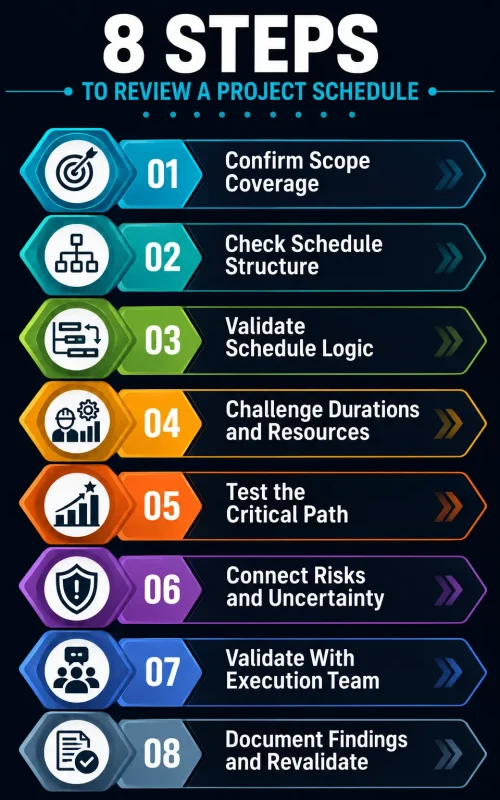
1. Confirm Scope Coverage
Before reviewing individual activities, establish whether the schedule represents the complete approved project scope. A schedule cannot be considered reliable if important work is missing, even when its existing activities are logically connected.
Start by comparing the schedule with the:
- Approved scope statement
- Work Breakdown Structure (WBS)
- Major deliverables
- Contract requirements
- Key milestones
- Execution strategy
Look specifically for missing engineering, procurement, construction, testing, commissioning, approvals, handovers, and closeout activities where applicable.
Also check whether activities have been included that fall outside the approved scope.
The review should establish traceability from project scope to scheduled work. Major deliverables should be identifiable within the schedule, and important work packages should have corresponding activities.
Do not assume that a large number of activities means the schedule is comprehensive. A detailed schedule can still contain significant scope gaps.
The key question is:
“Does the schedule contain all the work required to achieve the approved project objectives?”
Only after scope coverage is established should the review move into detailed schedule analysis.
2. Check Schedule Structure
Once scope coverage is confirmed, review whether the schedule has a clear, consistent, and usable structure. A well-structured schedule makes it easier to understand the project, trace work to the WBS, assign responsibility, and analyze performance.
Review the overall schedule hierarchy, including:
- WBS and activity structure
- Activity IDs and naming
- Activity coding
- Work packages
- Milestones
- Calendars
- Responsible organizations
- Schedule levels and summaries
Check whether the structure is applied consistently across different disciplines, contractors, and project areas. Look for duplicate activities, inconsistent coding, inappropriate activity types, and unnecessary fragmentation.
The review should also confirm that summary activities and milestones accurately represent the underlying detailed work.
Pay particular attention to whether the schedule can support progress measurement, reporting, forecasting, and project control.
A schedule may contain correct activities but still be difficult to manage if its structure is inconsistent or poorly organized.
The key question is:
“Is the schedule structured clearly enough to provide traceability, consistent analysis, and effective project control?”
A sound structure creates the foundation for the deeper logic and credibility checks that follow.
3. Validate Schedule Logic
After confirming the schedule structure, examine whether the logic and sequencing accurately represent how the project will be executed. A schedule can contain all required activities but still produce an unreliable forecast if the relationships between those activities are incorrect.
Review the:
- Predecessor and successor relationships
- Finish-to-Start, Start-to-Start, and other relationship types
- Leads and lags
- Open-ended activities
- Excessive constraints
- Cross-discipline dependencies
- Major interfaces and handoffs
Do not assume that every activity needs a relationship simply to satisfy a schedule-health check. The relationship should represent a real dependency between items of work.
For example, equipment installation should reflect its genuine dependency on equipment availability, required engineering information, site readiness, and other relevant conditions.
Also trace important paths toward major milestones to determine whether the sequence makes practical sense.
The key question is:
“Does the schedule logic accurately represent how the work must flow to achieve the planned milestones?”
A strong logic review should combine schedule analysis with input from the people responsible for executing the work.
4. Challenge Durations and Resources
Once the schedule logic has been validated, examine whether the planned durations and resource requirements are realistic and properly supported. A logically connected schedule can still produce an unreliable forecast if activities have been given optimistic durations or resources that will not actually be available.
For important activities, review the basis behind the duration, including:
- Work quantities and scope
- Productivity assumptions
- Crew composition
- Working calendars
- Historical project performance
- Supplier or subcontractor information
- Equipment availability
- Resource constraints
Compare planned productivity with historical performance or other reliable benchmarks where suitable. Significant deviations should be explained rather than accepted without review.
Also check whether resources are available during the periods in which the schedule assumes they will be required. A duration may appear achievable with a particular crew size but become unrealistic if those resources are already committed elsewhere.
The key question is:
“Are the planned durations and resources supported by realistic evidence and actual project conditions?”
The objective is not to make every activity conservative. It is to ensure that the schedule forecast is defensible, achievable, and based on reasonable planning assumptions.
5. Test the Critical Path
After reviewing durations and resources, examine whether the schedule correctly identifies the work that can drive project completion. The critical path should not be accepted simply because scheduling software has identified it automatically.
Start from the key completion milestone and trace the activities that determine its earliest achievable date. Review:
- Critical activities and relationships
- Near-critical paths
- Total and free float
- Constraints affecting float
- Excessive or unusual float
- Multiple paths to completion
- Major interface dependencies
Pay particular attention to activities with very little float. A near-critical path can become critical quickly when delays occur.
The reviewer should also investigate whether constraints, artificial relationships, or incomplete logic are influencing the calculated critical path. Where necessary, discuss the path with the execution team to confirm that it reflects the actual work sequence that can control completion.
The key question is:
“Does the identified critical path genuinely represent the work that can determine the project completion date?”
A strong review looks beyond the software output and combines Critical Path Method (CPM) analysis with practical execution knowledge.
6. Connect Risks and Uncertainty
A schedule represents a planned execution scenario, but project conditions rarely remain completely certain. Review whether identified risks, assumptions, constraints, and external dependencies could affect the planned sequence or completion dates.
Start by comparing the schedule with the project’s:
- Risk and opportunity register
- Assumption log
- Constraint register
- Procurement risks
- Design and approval dependencies
- Resource constraints
- External interfaces
For significant risks, identify the activities, milestones, and completion dates that could be affected. A risk such as delayed equipment delivery should be connected to the relevant procurement, installation, testing, and commissioning activities rather than remaining only in the risk register.
Where appropriate, use schedule risk analysis to understand the effect of uncertainty on key completion dates and identify activities that contribute significantly to schedule exposure.
The key question is:
“Does the schedule realistically reflect the risks and uncertainties that could affect project delivery?”
The objective is not to add every possible risk into the schedule. It is to ensure that material project uncertainty is understood and considered when assessing schedule credibility.
7. Validate With the Execution Team
A schedule can pass technical checks and still contain assumptions that are difficult to achieve in practice. The people responsible for delivering the work can provide important information that may not be visible in the schedule data.
Review the schedule with relevant:
- Engineering teams
- Procurement teams
- Construction teams
- Commissioning teams
- Contractors and subcontractors
- Technical specialists
- Operations representatives
Ask these teams to challenge sequencing, durations, resources, interfaces, access requirements, assumptions, and key milestones.
For example, a construction team may identify that two activities shown as sequential could actually overlap, while a procurement team may identify a supplier lead time that is longer than the schedule assumption.
The purpose is not to allow every stakeholder to modify the schedule independently. The review should identify practical issues that require correction, clarification, or formal agreement.
The key question is:
“Does the schedule reflect how the people responsible for delivery believe the work can actually be performed?”
Combining schedule analysis with execution knowledge makes the validation process considerably more reliable.
8. Document Findings and Revalidate
The final step is to turn the schedule review into a controlled improvement and validation process. Identified issues should not remain as informal comments or discussions.
Document important findings such as:
- Scope gaps or duplication
- Logic deficiencies
- Unsupported durations
- Resource conflicts
- Critical-path concerns
- Risk and constraint impacts
- Unresolved assumptions
- Interface problems
Each significant finding should have a clear action, responsible owner, and agreed resolution. Where a finding affects milestones or the completion forecast, its potential impact should also be recorded.
After corrections are made, the schedule should be recalculated and reviewed again. Fixing one relationship or duration can change float, critical paths, milestones, and forecast dates elsewhere in the schedule.
Schedule validation should also continue during execution. Approved scope changes, actual progress, emerging risks, procurement developments, and resource changes can all affect the schedule’s credibility.
The key question is:
“Have identified issues been resolved, documented, and incorporated into an ongoing schedule-control process?”
A validated schedule should remain a living management tool, not a document that is reviewed once and then left unchanged.
Practical Example
Putting the Approach Into Practice
A construction project is approaching the start of a major building package. The baseline schedule has been developed and approved, but the project manager wants to confirm that it is realistic, logically sound, and suitable for project control before execution progresses further.
The planning team conducts a structured schedule review using the eight-step approach.
1. Confirm Scope Coverage
The team compares the schedule against the approved WBS, contract scope, major deliverables, and key milestones.
They identify that most engineering, procurement, construction, testing, and commissioning work is included. However, several approval and handover activities are missing.
These activities are added and linked to the relevant deliverables.
2. Check Schedule Structure
The team reviews the WBS hierarchy, activity coding, calendars, milestones, and responsibility assignments.
They find inconsistent coding between the civil and MEP sections and correct the structure so that progress reporting and responsibility tracking can be applied consistently.
3. Validate Schedule Logic
The team reviews relationships between engineering, procurement, construction, and commissioning activities.
They identify several activities using excessive lags and one important interface with missing logic.
The relationships are revised to represent the actual execution sequence.
4. Challenge Durations and Resources
The team reviews major construction durations against quantities, productivity assumptions, historical project information, and planned crew availability.
One concrete activity has been given an optimistic duration based on a larger crew than the contractor can actually provide.
The duration is revised to reflect the realistic resource level.
5. Test the Critical Path
The team traces the critical path from the contractual completion milestone.
The review shows that equipment delivery and subsequent installation are controlling the commissioning milestone.
A second near-critical path involving MEP works is also identified and flagged for closer monitoring.
6. Connect Risks and Uncertainty
The risk register identifies a potential delay in the delivery of critical equipment.
The team connects this risk to the relevant procurement, installation, testing, and commissioning activities and assesses its potential effect on project completion.
This provides a clearer understanding of schedule exposure.
7. Validate With the Execution Team
The revised schedule is reviewed with engineering, procurement, construction, commissioning, and contractor representatives.
The construction team identifies a site-access restriction that prevents two planned work fronts from progressing simultaneously.
The sequence is adjusted before the issue becomes an execution delay.
8. Document Findings and Revalidate
The planning team records the findings, actions, responsible owners, and agreed changes.
After corrections, the schedule is recalculated and reviewed again.
The final schedule now provides a more credible basis for execution, progress measurement, forecasting, and project control.
The Lesson
A schedule review should not simply confirm that activities, dates, and relationships have been entered correctly.
A reliable validation process tests whether the schedule:
- Covers the approved scope
- Represents realistic execution logic
- Uses defensible durations and resources
- Identifies genuine critical paths
- Reflects material risks and uncertainty
- Has been challenged by the execution team
- Can support effective project control
“The purpose of schedule validation is not to prove that the schedule is correct. It is to identify and resolve weaknesses before those weaknesses become project delays.”
Common Mistakes to Avoid
Reviewing and validating a project schedule can appear straightforward, but weaknesses in scope, logic, durations, resources, risks, and review methods can allow an unreliable schedule to pass as credible.
Reviewing the Schedule Without Confirming Scope
A schedule may contain thousands of activities but still miss important project scope. If the review starts directly with activity logic, scope gaps can remain hidden.
Compare the schedule against the approved scope, WBS, deliverables, contract requirements, and major milestones before beginning detailed schedule analysis.
Checking Logic Without Understanding Execution
A schedule can pass technical relationship checks while still representing an unrealistic execution sequence.
Review dependencies with the people responsible for delivering the work. Confirm that relationships, interfaces, handoffs, and sequencing reflect how the project will actually be executed.
Accepting Durations Without Challenging the Basis
Activity durations should not be accepted simply because they were provided by a planner, contractor, or previous schedule.
Challenge significant durations using quantities, productivity assumptions, historical performance, supplier information, resource availability, and actual execution conditions.
Relying Only on Schedule Software Checks
Automated schedule-health reports can identify missing logic, excessive constraints, negative float, and other technical issues.
However, software cannot determine whether the planned sequence is practical or whether a duration reflects realistic site conditions.
Use software checks as evidence for review, not as a substitute for professional judgement.
Treating the Critical Path as Automatically Correct
The software-generated critical path may be influenced by constraints, incomplete logic, artificial relationships, or other scheduling practices.
Trace the path manually and review near-critical paths to confirm that they genuinely represent the work capable of controlling project completion.
Ignoring Near-Critical Activities
Focusing only on activities with zero or negative float can create a false sense of security.
Activities with limited float may become critical after relatively small delays. Review near-critical paths and understand which activities could quickly affect key milestones.
Reviewing the Schedule in Isolation
A schedule should not be reviewed separately from the information that influences it.
Compare it with the WBS, risk register, procurement information, resource plans, contracts, engineering status, assumptions, and major project constraints.
This helps identify inconsistencies that may not be visible within the schedule itself.
Failing to Consider Risks and Uncertainty
A schedule based entirely on deterministic dates may provide an overly confident completion forecast.
Identify material risks and uncertainties that could affect important activities and milestones. Where appropriate, use schedule risk analysis to understand potential effects on project completion.
Not Involving the Execution Team
Planning teams may identify technical schedule issues but miss practical problems involving access, work fronts, productivity, construction methods, procurement, or resource availability.
Ask engineering, procurement, construction, commissioning, contractors, and other relevant specialists to challenge the schedule.
Making Changes Without Revalidation
Correcting one schedule problem can create another.
Changing a duration, relationship, constraint, or calendar may alter float, critical paths, milestones, and forecast dates.
After significant changes, recalculate and review the schedule again rather than assuming the correction has solved the problem.
Failing to Document Review Findings
Schedule reviews often produce useful observations that are lost because they are discussed verbally but not formally recorded.
Document significant findings, required actions, responsible owners, decisions, and unresolved issues so that the review process remains traceable.
Focusing on Compliance Instead of Credibility
A schedule may satisfy technical requirements and still provide an unrealistic forecast.
The real objective of validation is to determine whether the schedule provides a credible representation of how the project can be executed and completed, supported by sound scope, logic, durations, resources, assumptions, and project evidence.
Key Takeaways
A strong project schedule review is more than checking whether activities and dates have been entered correctly. It provides a structured assessment of whether the schedule is complete, logically sound, realistic, and suitable for project control.
- Confirm scope coverage. Make sure the schedule represents the approved scope, WBS, deliverables, milestones, and required project work.
- Check the schedule structure. Review the WBS, activity structure, coding, calendars, milestones, and responsibility assignments for consistency and usability.
- Validate the schedule logic. Confirm that relationships, dependencies, interfaces, leads, lags, and constraints represent the actual execution sequence.
- Challenge durations and resources. Test whether planned durations and resource requirements are supported by realistic quantities, productivity, historical data, and resource availability.
- Test the critical path. Trace the path to project completion and review near-critical paths to determine whether they genuinely represent schedule-driving work.
- Consider risks and uncertainty. Identify how material risks, assumptions, constraints, procurement issues, and external dependencies could affect planned dates and milestones.
- Involve the execution team. Use input from engineering, procurement, construction, commissioning, contractors, and other specialists to challenge practical assumptions.
- Document review findings. Record significant issues, required actions, responsible owners, decisions, and unresolved matters so that the review remains traceable.
- Revalidate after changes. Recalculate and review the schedule after significant corrections because changes can affect float, critical paths, milestones, and forecast dates.
- Continue validation during execution. Schedule credibility can change as actual progress, approved changes, risks, resources, procurement, and project conditions develop.
A good schedule review does not simply confirm that a schedule is technically correct. It determines whether the schedule provides a credible, realistic, and defensible representation of how the project can be executed and completed, providing a reliable basis for monitoring, forecasting, and control.
References
- U.S. GAO — Schedule Assessment Guide: Best Practices for Project Schedules
- NASA — Schedule Management Overview
- NASA — Program Planning & Control Guidance Documents and Schedule Management Handbook
- U.S. GAO — Schedule Best Practices Provide Opportunity to Enhance Missile Defense Agency Accountability and Program Execution
- Association for Project Management (APM) — Project Schedule, Quality and Risks: A Brief Guide
- Bragadin & Kähkönen — Schedule Health Assessment of Construction Projects
- Bragadin & Kähkönen — Schedule Quality Evaluation for Construction Project Management
- Bragadin & Kähkönen — Safety, Space and Structure Quality Requirements in Construction Scheduling
- Son, Han, Khwaja & O’Brien — Assessment of Schedule Quality Problems from the DOT Schedule Reviewers’ Perspective: Case of TxDOT
- Jung, Amer & Golparvar-Fard — Feasibility of an Integrated Heuristic and Machine Learning Approach for Schedule Health Monitoring in Construction
- Amer, Hockenmaier & Golparvar-Fard — Learning and Critiquing Pairwise Activity Relationships for Schedule Quality Control via Deep Learning-Based Natural Language Processing
- Cost and Schedule Risk Analysis of Bridge Construction in Pakistan: Establishing Risk Guidelines
FEATURED PROJECT PLANNING & SCHEDULING GUIDES
Practical Guidance for Planning, Scheduling, and Schedule Control
Effective project planning and scheduling requires more than creating activities and assigning dates. Our featured guides focus on practical planning and scheduling activities, helping professionals structure projects, establish sound planning foundations, review schedules, and maintain schedule control.
How to Identify Schedule Constraints
Learn how to identify conditions that restrict planned activities, document their effects, assess their implications, and manage constraints throughout project delivery.
How to Manage Schedule Baseline Changes
Understand how to assess proposed changes to an approved schedule baseline, evaluate their impacts, obtain appropriate approval, and maintain proper baseline control.
How to Develop a Project Plan
Learn how to structure a project plan, define the planning approach, establish key project information, and create a practical foundation for project delivery.
MORE PROJECT PLANNING & SCHEDULING RESOURCE TYPES
Continue Your Project Planning & Scheduling Learning
Project planning and scheduling knowledge becomes more valuable when you can understand the concepts, apply structured approaches, and develop practical skills. Explore the other resources within the Project Planning & Scheduling collection to complement the guidance provided in these guides.
Templates
Use practical templates and checklists to organize planning information, document scheduling decisions, review schedules, and support schedule control activities.
Downloads
Access useful planning and scheduling materials and reference resources to support learning and day-to-day project planning and controls activities.
Career Roadmaps
Follow structured learning paths to develop project planning, scheduling, and project controls knowledge, practical skills, and professional capabilities.
Case Studies
Explore planning and scheduling situations, decisions, challenges, and outcomes to understand how planning and scheduling practices are applied in real projects.
Glossary
Find clear explanations of project planning, scheduling, project controls, schedule management, and related professional terminology.
Insights & Articles
Explore professional perspectives, practical insights, emerging practices, and deeper discussions relevant to project planning, scheduling, and project controls.
Looking for more project management resources? Explore the Kleios Technologies Resources Hub to discover our complete collection of guides, templates, downloads, career roadmaps, case studies, glossary resources, and insights.
RELATED KNOWLEDGE DOMAINS
Continue Your Learning Across Related Knowledge Domains
Project Management is closely connected with specialized disciplines that support successful planning, execution, governance, performance measurement, and professional growth. Explore related knowledge domains to expand your expertise, develop complementary skills, and access practical resources across the complete project management ecosystem.
Expand your expertise one domain at a time and build a well-rounded project management skill set.
Why Explore Related Domains?
- Develop cross-functional project management expertise
- Discover specialized knowledge beyond core project management
- Access practical resources across interconnected disciplines
- Build a complete professional learning pathway
- Strengthen career readiness through continuous learning
Each knowledge domain complements your Project Management expertise, helping you build broader capabilities and solve real-world project challenges with greater confidence.
Project Management
Practical project management knowledge, practices, and professional resources.
Project Controls
Performance measurement, forecasting, and project control best practices.
PMO
Governance, portfolio management, and organizational project excellence.
Risk Management
Risk identification, assessment, mitigation, and monitoring resources.
Primavera P6
Professional planning, scheduling, resource management, and reporting.
Microsoft Project
Project scheduling, tracking, reporting, and collaboration resources.
Power BI
Interactive dashboards, reporting, visualization, and project analytics.
PMI Certifications
Certification guidance, exam preparation, and professional development resources.