
PROJECT PLANNING AND SCHEDULING INSIGHT
Why Do Project Forecasts Keep Changing?
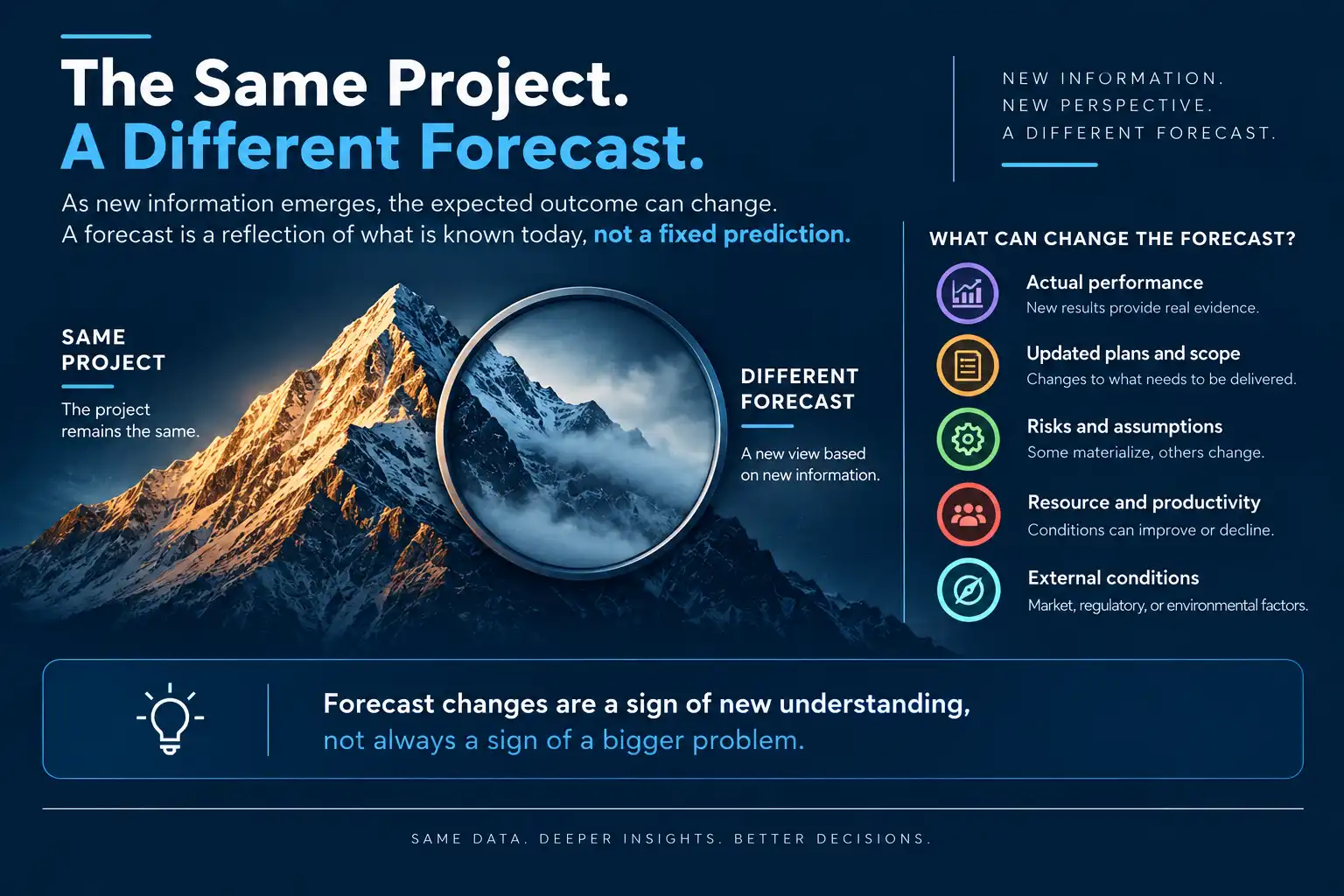
Project Forecasts Keep Changing because actual performance, remaining work, assumptions, risks, resources, scope, and external conditions evolve. However, forecast movement does not automatically indicate poor project performance.
Instead, a forecast represents a current view of the project’s future based on the information available at that point. As conditions change, the expected outcome can change as well.
Therefore, this Insight examines why forecasts move, why professionals can miss what the movement reveals, and how repeated changes can affect confidence and decision-making. It also presents a practical lens for interpreting forecast movement.
Professional Insight · Project Planning & Scheduling
Introduction
Project forecasts rarely remain unchanged from the first estimate to project completion. As execution progresses, teams gain evidence about actual performance, remaining work, risks, and changing conditions.
Therefore, Project Forecasts Keep Changing because the information used to predict the future keeps developing. A forecast may move when productivity differs from expectations, scope changes, risks materialize, or assumptions become clearer.
However, forecast movement does not automatically indicate poor performance or unreliable estimating. A changing forecast can reflect better information and a more realistic understanding of what remains.
The concern arises when teams cannot explain why forecasts change, repeatedly revise expectations without improving their understanding, or treat every new number as equally credible.
This Insight examines why forecasts move, why professionals can miss the signals within that movement, and what repeated changes can mean for project decision-making. It then presents a practical lens for evaluating forecast evidence, assumptions, uncertainty, and trajectory.
The Common Assumption
Professionals Expect the Original Forecast to Stay Stable
Many professionals expect the original forecast to remain reasonably stable after the project begins. However, project conditions change as execution progresses.
Actual performance, remaining work, risks, resources, and assumptions continue to develop. Therefore, Project Forecasts Keep Changing because the information used to predict the future also changes.
Forecast stability should come from better information, not from forcing the number to remain unchanged.
A Changing Forecast Means Poor Project Performance
A forecast change does not automatically mean that project performance has become worse. A team may revise its forecast after gaining better information about the work that remains.
Conversely, repeated unfavourable changes may indicate emerging performance or risk issues. Therefore, ask why the forecast changed before judging the project.
The Latest Forecast Is Automatically the Most Accurate
Teams often give the latest forecast greater credibility because it is newer. However, a new forecast can still depend on weak assumptions, incomplete information, or an unexplained methodology change.
The latest number is not automatically the most credible number. Professionals should examine the evidence and assumptions behind the revision.
Forecast Changes Are Mainly Caused by Delays
Delays can change a forecast, but they are not the only cause. Productivity, scope, resources, risks, work sequencing, and external conditions can also change the expected outcome.
As a result, review more than schedule slippage when investigating forecast movement.
More Detailed Forecasts Are Always More Reliable
More detail can make a forecast easier to examine, but detail alone does not make it more reliable. A detailed forecast can still depend on uncertain assumptions.
In some cases, excessive detail can create a false sense of precision. Therefore, match forecast detail to the decision it needs to support.
One Forecasting Method Should Be Used Throughout the Project
The information available at different project stages can vary significantly. Early forecasts may depend heavily on estimates, while later forecasts can use actual performance and better-defined remaining work.
Therefore, the forecasting method may evolve as information improves. Make methodology changes visible and explain their effect on the forecast.
Actual Performance Automatically Produces a Better Forecast
Actual performance provides valuable evidence, but it does not automatically predict future performance. Completed work and remaining work may face different conditions.
Therefore, professionals should consider actual performance alongside remaining work, current conditions, and future risks. This distinction matters when Project Forecasts Keep Changing.
Forecast Accuracy Can Be Judged Only at Completion
Final completion provides the clearest comparison between forecast and actual outcome. However, waiting until completion provides little opportunity to improve the current forecast.
Teams can examine forecast movement during execution. Use forecast history to learn whether revisions are becoming better supported.
A Forecast Should Stay Close to the Baseline
The baseline provides a reference for approved project expectations. However, the baseline and forecast serve different purposes.
The baseline provides a reference point, while the forecast represents the current expected outcome. Therefore, use the baseline for comparison, not as a number the forecast must protect.
Forecast Changes Are Mainly a Reporting Issue
Forecast movement can appear to be a reporting issue when teams focus only on producing the latest number. However, the deeper purpose is to understand what may happen next.
A useful forecast should explain what changed, why it changed, and what the change means for future decisions.
Do not try to keep forecasts stable simply because movement looks uncomfortable. Investigate material changes and confirm that they are supported by evidence, clear assumptions, realistic remaining work, and an understandable forecasting method.
What Is Really Happening?
The Forecast Is Recalculated From a New Information Set
A forecast reflects the information available when the team prepares it. As new information arrives, the expected outcome can change.
Therefore, Project Forecasts Keep Changing because the information set behind the forecast does not remain fixed.
The change may come from actual results, updated plans, new risks, revised assumptions, or changes in project conditions.
Actual Performance Replaces Earlier Expectations
Once work starts, actual performance provides evidence that was not available during initial planning.
Productivity, completed quantities, actual costs, and achieved progress can differ from earlier expectations. Consequently, the forecast may need to reflect what the project has actually experienced.
Actual performance should inform the forecast, but it should not automatically determine the future. The team must also consider what conditions will apply to the remaining work.
Remaining Work Becomes Better Defined
Early forecasts often contain uncertainty about the effort, sequence, productivity, and resources required to complete the work.
As execution progresses, teams usually understand the remaining work more clearly. Therefore, the forecast can change even when completed work has not changed significantly.
The remaining work deserves separate attention. Past performance alone cannot explain what the project still needs to accomplish.
Assumptions Become Evidence—or Fail
Every forecast depends on assumptions about future conditions. These may include productivity, resource availability, approvals, procurement, productivity rates, or work sequencing.
As the project progresses, some assumptions become supported by evidence. Others become unrealistic or require revision.
As a result, forecast changes can reflect the replacement of assumptions with better evidence, rather than a simple deterioration in performance.
Risks Are Realized, Retired, or Reassessed
Risk conditions can change the expected outcome even when current performance appears acceptable.
Some risks become actual issues, while others are reduced or closed. New risks can also emerge as the project moves into different phases.
Therefore, the forecast should reflect the risks that still matter to the remaining work, rather than carrying every earlier risk unchanged.
Scope and Requirements Can Change the Future Work
Changes in scope, requirements, specifications, or deliverables can alter the work that remains.
Even a well-performing project can therefore require a different forecast when the expected work changes. Consequently, professionals should distinguish performance changes from changes in the work itself.
Resource and Productivity Conditions Change
Forecasts often depend on assumptions about people, equipment, materials, productivity, and availability.
When these conditions change, the expected effort or duration can change as well. Therefore, resource conditions should be treated as forecast inputs, not background information.
External Conditions Change the Forecast Inputs
Projects operate within conditions that teams cannot always control. Market conditions, supplier performance, regulatory requirements, weather, access, and other external factors can affect future work.
As these conditions change, the assumptions behind the forecast may no longer hold. Therefore, forecast reviews should consider relevant external changes rather than relying only on internal project data.
Forecasting Methods Make Different Assumptions
Different forecasting approaches can produce different results from the same project information.
One method may place greater weight on recent performance, while another may use broader historical evidence or explicit risk assumptions.
Therefore, a forecast change may result from the method used, not only from a change in project conditions. Professionals should make this distinction visible.
The Forecast Can Change Because the Model Changes
Sometimes the project has not changed as much as the forecasting model has changed.
A revised calculation, updated planning logic, new risk treatment, or different forecasting basis can produce a different result.
This matters because professionals may otherwise interpret a numerical change as a project change. Always separate changes in the project from changes in how the project is being forecast.
Taken together, these factors show why Project Forecasts Keep Changing. The forecast moves because the project’s evidence, remaining work, assumptions, risks, conditions, or forecasting approach can change.
Why Do Professionals Miss the Problem?
Professionals Watch the Number More Than Its Movement
Forecast reviews often focus on the current number. However, the movement between forecasts can reveal more useful information.
A forecast that changes slightly for clear reasons may be more informative than one that stays unchanged without strong evidence. Therefore, review the forecast as a history of changing expectations, not as a series of isolated numbers.
The Baseline Becomes an Unintended Forecast Anchor
The approved baseline provides an important reference point. However, teams can become reluctant to move the forecast too far from the original expectation.
This can encourage teams to protect the original number instead of reflecting current evidence. Therefore, use the baseline to understand variance, not to constrain the current forecast.
Forecast Changes Are Reported Without Explaining Their Cause
A revised forecast often appears in a report as a new date or cost. Yet the number alone does not explain what changed.
When Project Forecasts Keep Changing, the reason for each material revision should remain visible. A simple change explanation can identify the evidence, assumption, risk, or condition behind the movement.
Actual Performance and Remaining Work Are Blended Together
Teams may use past performance to explain the entire forecast. However, completed work and remaining work can have different conditions.
Professionals should therefore separate:
- What has actually happened.
- What remains to be completed.
- What is expected to happen next.
This separation makes it easier to determine whether the forecast reflects current evidence or simply extends past performance forward.
Assumptions Are Hidden Inside the Forecast
A forecast can appear objective while depending on several assumptions. These assumptions may concern productivity, resources, approvals, procurement, or future work conditions.
If those assumptions remain hidden, professionals may challenge the number without understanding its basis. Therefore, make important forecast assumptions visible and review them when conditions change.
Risk and Uncertainty Are Treated as the Same Thing
Risk and uncertainty both affect forecasting, but they are not identical. A risk describes a potential event or condition, while uncertainty can remain even when specific risks are not identified.
Therefore, removing known risks does not automatically make a forecast certain. Professionals should consider both identified risks and the uncertainty that remains around the forecast.
The Point Forecast Hides the Range Around It
A single forecast number is easy to report and compare. However, it can hide the uncertainty surrounding the expected outcome.
For decisions affected by significant uncertainty, professionals may need to understand a reasonable range rather than rely only on one point estimate.
Use a range when the decision requires visibility of uncertainty. The level of analysis should match the importance and uncertainty of the decision.
Forecast Method Changes Are Not Made Visible
A forecast can change because the project changed, but the calculation method can also change. If that distinction remains hidden, users may misread the movement.
Therefore, record material changes in forecasting method alongside changes in the forecast itself. This helps reviewers understand whether the number changed because of new evidence or a different calculation approach.
Internal Evidence Is Not Challenged by an Outside View
Project teams naturally focus on their own information and experience. However, internal assumptions can sometimes remain unchallenged.
Comparable historical projects, reference classes, or external evidence can provide another perspective. Therefore, use relevant external evidence to challenge important assumptions when practical.
Repeated Forecast Changes Become Normalized
Frequent revisions can eventually become part of the normal reporting cycle. Teams may accept the movement without asking whether the forecast is becoming more informative.
This creates an important distinction. Forecast movement is not the problem; unexplained or uninformative movement is.
When Project Forecasts Keep Changing, professionals should examine whether each revision improves understanding, reduces uncertainty, or simply replaces one unsupported number with another.
What Happens If It Continues?
Forecast Confidence Can Decline
Frequent forecast changes can reduce confidence when teams cannot explain the reasons behind them. However, the number of revisions matters less than their quality.
When Project Forecasts Keep Changing without a clear evidence trail, stakeholders may begin to question both the forecast and the process behind it.
The goal should not be fewer forecast changes. The goal should be more explainable forecast changes.
Management Can Start Reacting to the Latest Number
When forecasts move frequently, management may focus heavily on the latest figure. However, the latest number may not show the full trend.
A single revision can look serious when viewed alone. Therefore, decision-makers should examine the forecast history and the evidence behind the movement.
Recovery Decisions Can Become Short-Term
Frequent forecast changes can encourage teams to focus on immediate recovery actions. However, short-term actions may not address the conditions driving the forecast movement.
For example, a team may repeatedly add resources without understanding whether productivity, scope, sequencing, or another factor caused the change.
Recovery decisions should address the cause of forecast movement, not only the latest forecast position.
Risk Can Become Hidden Inside Repeated Reforecasting
Repeated revisions can gradually absorb emerging risks into the forecast without clearly showing what caused the change.
This can make the forecast look current while reducing visibility of the risks still affecting the outcome. Therefore, keep material risks visible alongside the forecast.
Baseline Performance Can Become Difficult to Interpret
Frequent forecast revisions can make it harder to understand how actual performance differs from the original plan.
The baseline may remain unchanged while the forecast moves repeatedly. Consequently, teams can lose sight of the relationship between the approved plan and the current expectation.
Keep baseline, previous forecast, and current forecast visible together when reviewing significant movement.
Cost and Schedule Decisions Can Drift Apart
Projects often forecast cost and schedule separately. However, changes in one can affect the other.
A schedule recovery action may increase cost, while a cost reduction action may affect duration or resources. Therefore, review important forecast changes across cost, schedule, scope, and resources.
Contingency Can Be Consumed Without Clear Learning
Forecast changes may gradually consume cost or schedule contingency. However, repeated use of contingency does not automatically improve the forecast process.
If teams do not record why contingency changed, they may repeat the same forecasting weaknesses. Therefore, connect significant contingency movements with their underlying causes and lessons.
Forecast Ranges Can Become Artificially Narrow
Teams sometimes narrow forecast ranges to present greater confidence. However, reducing the range without stronger evidence does not reduce uncertainty.
When Project Forecasts Keep Changing, professionals should ask whether the uncertainty is genuinely reducing or simply being presented more narrowly.
Teams Can Lose the Ability to Explain Variance
A long sequence of forecast revisions can make the original reasons for movement difficult to reconstruct. Over time, this weakens the team’s ability to explain how expectations changed.
Therefore, preserve a simple history of material forecast changes and their reasons. This creates a useful record for current decisions and future learning.
The Forecast Can Become a Reporting Ritual Instead of a Decision Tool
Forecasting loses value when teams update the number because the reporting cycle requires it. The process can continue even when nobody examines what changed.
A forecast should support decisions about what happens next. Therefore, each material revision should lead to a useful question about evidence, risk, remaining work, or required action.
If Project Forecasts Keep Changing, the professional response should be to improve the explanation and decision process, not simply demand greater stability.
What Should Project Professionals Reconsider?
Forecast movement becomes useful when professionals stop asking only whether the number changed. Instead, they should ask what the change reveals about the project’s future.
When Project Forecasts Keep Changing, the review process should focus on evidence, assumptions, remaining work, risks, and uncertainty.
Treat the Forecast as a Current View, Not a Permanent Number
A forecast represents the team’s current expectation based on available information. It should therefore change when material evidence changes the expected outcome.
However, this does not mean that teams should revise forecasts whenever a small variation appears. Change the forecast when the underlying expectation has meaningfully changed.
Track Why the Forecast Changed, Not Only How Much
The size of a forecast change tells only part of the story. The reason behind the change often provides more useful information for management.
For each material revision, capture a short explanation covering the main driver and its effect. A practical record can include:
- What changed?
- Why did it change?
- What evidence supports the change?
- What does the change mean for the expected outcome?
This simple history helps distinguish informed revisions from unexplained movement.
Separate Actual Performance From Remaining-Work Expectations
Actual performance tells the team what has happened. The forecast must also explain what the remaining work is expected to require.
Therefore, professionals should avoid extending past performance into the future without examining current conditions.
Review completed work and remaining work separately before confirming a major forecast revision.
Review the Forecast Basis Before Challenging the Number
A forecast can look unreasonable when its supporting assumptions remain hidden. Yet the number may make sense once the basis becomes clear.
Before challenging the result, review the assumptions, remaining work, productivity expectations, resource conditions, risks, and calculation method.
Challenge the forecast basis first, then challenge the forecast number.
Make Forecast Uncertainty Visible
A point forecast provides a single expected outcome. However, some decisions require visibility into the uncertainty around that outcome.
Professionals do not need complex probabilistic analysis for every forecast. Instead, they should use a level of uncertainty analysis that matches the project’s risk and decision needs.
Where uncertainty is significant, show a reasonable range or clearly state the conditions that could move the forecast.
Compare Forecasts Across Time, Not Only Against the Baseline
The baseline remains an important reference, but it does not show the complete forecast story.
A stronger review compares the baseline, previous forecast, and current forecast. This makes the direction and pattern of movement easier to see.
Therefore, review forecast trajectory alongside baseline variance. A series of small movements can sometimes reveal more than one large revision.
Make Forecast Methodology Visible
Different forecasting methods can produce different results from similar information. Therefore, a forecast review should identify the method or basis used.
If the method changes, explain why it changed and how the change affected the result. This prevents a methodology change from appearing to be a project performance change.
Keep material methodology changes visible in the forecast history.
Challenge the Forecast With Historical Evidence
Project teams naturally rely on their own project information. However, relevant historical evidence can provide a useful external challenge.
Comparable projects, reference classes, or previous organizational experience can test whether current assumptions appear reasonable.
However, the comparison must be relevant. Use historical evidence to challenge assumptions, not to replace project-specific analysis blindly.
Connect Cost, Schedule, Scope, Risk, and Resources
Forecast changes rarely exist in complete isolation. A change in scope can affect schedule, resources, and cost at the same time.
Similarly, a schedule recovery decision can affect cost or resource requirements. Therefore, review material forecast changes across the connected project dimensions.
Preserve Forecast Lineage
A useful forecast history should show how the current expectation developed from earlier forecasts. This creates what Kleios describes as forecast lineage.
Forecast lineage connects material revisions with their evidence, assumptions, risks, and methodology. It helps professionals understand not only where the forecast stands, but how it got there.
Preserve the reason for significant forecast changes while the evidence is still available.
Use Forecast Changes to Create Learning
Forecast revisions provide information about the quality of earlier assumptions and the behaviour of the project.
Teams should therefore review completed forecast cycles and identify recurring causes of error or uncertainty.
When Project Forecasts Keep Changing, the objective should be more than producing another revised number. Each revision should improve the team’s understanding of what is likely to happen next.
A Practical Professional Lens
A forecast review becomes more useful when professionals examine the evidence behind the number. The following Kleios lens provides a simple way to do that.
It moves from what the team knows to what has happened, what remains, what could change, and how the forecast is moving over time.
EVIDENCE — What Do We Know Now?
Start with the information currently available. This may include actual progress, cost data, schedule information, updated quantities, resource information, and confirmed changes.
Ask whether the forecast uses current and relevant evidence. A forecast is only as useful as the information supporting it.
PERFORMANCE — What Has Actually Happened?
Next, examine actual project performance. Look at completed work, productivity, actual costs, achieved progress, and other reliable measures.
However, avoid treating past performance as a complete prediction of the future. Use actual performance as evidence, then assess what it means for the remaining work.
REMAINING WORK — What Still Has to Happen?
The forecast must explain the work that remains, not only the work already completed. Review the remaining quantities, activities, resources, sequence, and expected conditions.
Therefore, ask whether the remaining work differs from the assumptions used in the previous forecast. This often explains why Project Forecasts Keep Changing.
ASSUMPTIONS — What Must Be True?
Every forecast contains assumptions about future conditions. These may involve productivity, resources, approvals, procurement, sequencing, or access.
Review the assumptions behind the current forecast and identify which ones have strong evidence. Make important assumptions visible rather than leaving them hidden inside the number.
RISK — What Could Still Change It?
Even a well-supported forecast can face future risks. Review the risks that could materially affect cost, duration, resources, scope, or remaining work.
However, do not treat every identified risk as a guaranteed outcome. Distinguish between what is expected and what could still change the expectation.
RANGE — How Certain Is the Number?
A point forecast gives one expected outcome. It may not show how much uncertainty surrounds that outcome.
Where uncertainty matters to the decision, consider a reasonable range or clear conditions that could move the forecast. Do not present false precision when the evidence does not support it.
TRAJECTORY — Is the Forecast Becoming More Stable or Less Stable?
Finally, look at how the forecast has moved over time. A single forecast cannot show whether the project is learning, drifting, or becoming more predictable.
For practical analysis, Kleios can describe forecast trajectory as:
- Converging: Changes are reducing as evidence improves and uncertainty resolves.
- Stable: The forecast remains reasonably consistent with current evidence.
- Drifting: The forecast continues moving without a clear stabilising pattern.
- Worsening: Evidence increasingly supports a less favourable expected outcome.
- Unclear: The forecast changes, but its underlying basis cannot be explained confidently.
These are Kleios analytical categories, not formal industry classifications. Their purpose is to make forecast movement easier to discuss.
Putting the Seven Steps Together
The seven steps work as a connected review rather than seven separate checks.
Start with evidence and actual performance. Then examine remaining work, assumptions, risks, and uncertainty before reviewing the forecast trajectory.
When Project Forecasts Keep Changing, this sequence helps professionals move beyond the question, “What is the latest number?”
The more useful question is: “Has the latest forecast merely changed the number, or has it improved our understanding of the future?”
That question brings forecasting back to its practical purpose: supporting better decisions with the best available understanding of what may happen next.
Key Takeaways
Project forecasts should change when the project’s understanding changes. Forecast movement is not automatically a sign of poor performance.
- Focus on the reason for change. Review the evidence, assumptions, risks, and conditions that caused the forecast to move.
- Separate actual performance from remaining work. Past results provide evidence, but the future also depends on current conditions and what remains.
- Do not confuse the baseline with the forecast. Use the baseline as a reference while allowing the current forecast to reflect the latest evidence.
- Make uncertainty visible. Where the decision requires it, show a reasonable range or explain the conditions that could change the expected outcome.
- Track forecast movement over time. Comparing the baseline, previous forecast, and current forecast can reveal whether expectations are stabilising or drifting.
- Keep the forecast basis visible. Record important assumptions and methodology changes so reviewers can understand why the number changed.
- Use relevant historical evidence. Comparable project information can challenge internal assumptions, but it should complement project-specific analysis.
- Preserve forecast lineage. A clear history of material changes helps teams understand how the current forecast developed.
When Project Forecasts Keep Changing, the professional response should not be to demand greater stability.
The better question is whether each revision improves understanding of the future. A useful forecast should support decisions, reveal uncertainty, and become more informative as project evidence develops.
References
The following references informed the analysis of forecast updating, estimating, schedule uncertainty, forecasting bias, and evidence-based decision-making.
- Practice Standard for Project Estimating – Second Edition — Project Management Institute (PMI), 2020.
- Cost Estimating and Assessment Guide — U.S. Government Accountability Office (GAO), 2020.
- Schedule Assessment Guide — U.S. Government Accountability Office (GAO), 2015.
- NASA Cost Estimating Handbook — NASA, Version 4.0.
- A Comparison of Different Project Duration Forecasting Methods Using Earned Value Metrics — Vandevoorde & Vanhoucke, 2006.
- Evaluation of Deterministic State-of-the-Art Forecasting Approaches for Project Duration — Batselier & Vanhoucke.
- Timid Choices and Bold Forecasts — Kahneman & Lovallo, 1993.
- From Nobel Prize to Project Management: Getting Risks Right — Flyvbjerg, 2006.
- The Green Book 2026 — HM Treasury, 2026.
- Project Schedule Risk Analysis — David T. Hulett, PMI.
These sources support the Insight’s emphasis on forecast refinement, remaining work, uncertainty, risk, forecasting methods, historical evidence, and forecast interpretation.
Related Kleios Resources
Forecast quality depends on the quality of the planning information behind it. These Kleios resources provide practical support for strengthening that foundation.
Project Planning & Scheduling Guides
- How to Develop Project Schedule Basis — Establishes the assumptions, methods, and information supporting a project schedule.
- How to Review and Validate Project Schedule — Provides a structured approach for assessing schedule quality and reliability.
- How to Manage Schedule Baseline Changes — Helps distinguish approved baseline changes from changes in the current project forecast.
- How to Identify Schedule Constraints — Helps identify conditions that can affect planned and forecast project performance.
Project Planning & Scheduling Templates
- Project Schedule Basis Template — Provides a structured way to document the basis supporting schedule development.
- Project Schedule Review Checklist — Supports consistent review of schedule structure, logic, assumptions, and quality.
- Schedule Baseline Change Template — Helps document and assess changes to the approved schedule baseline.
- Schedule Constraints Identification Checklist — Helps teams identify and document constraints that may influence schedule outcomes.
Together, these resources help connect forecast interpretation with the planning information, assumptions, constraints, and schedule controls that support it.
FEATURED PROJECT PLANNING AND SCHEDULING INSIGHTS
Professional Perspectives on the Challenges Plans and Schedules Face
Our featured Project Planning and Scheduling Insights examine recurring schedule challenges, estimation assumptions, changing critical paths, forecast movement, resource pressures, and planning complexity. Moreover, they encourage professionals to look beyond visible schedule problems and consider what may be happening underneath.
Why Do Resources Disrupt Project Schedules?
Explore how resource availability, productivity, skills, competing demands, and resource interactions can disrupt planned work. As a result, examine why schedule performance can change even when the underlying plan remains unchanged.
Finding the Right Level of Planning Detail
Examine how the right level of planning detail improves project understanding and control without creating unnecessary complexity, maintenance effort, or false precision. Consider how professionals can determine whether planning detail remains useful for project decisions, coordination, and control.
Why Do Project Schedules Fall Behind?
Explore why project schedules fall behind despite established plans, dependencies, and monitoring practices. Therefore, examine how constraints, decisions, rework, resources, and changing conditions can combine to create wider schedule pressure.
MORE PROJECT PLANNING AND SCHEDULING RESOURCE TYPES
Continue Your Project Planning and Scheduling Learning
Planning and scheduling knowledge becomes more valuable when professionals can understand the concepts, apply structured tools, and examine their practical use. Explore our other Project Planning and Scheduling resources to complement the analytical perspectives provided by these Insights.
Guides
Explore clear guidance to understand common challenges, evaluate situations, and apply effective approaches throughout project delivery.
Downloads
Access useful project planning & scheduling materials and reference resources to support your learning and day-to-day project work.
Career Roadmaps
Follow structured learning paths to develop project management knowledge, practical skills, and capabilities for your professional growth.
Templates
Use project planning & scheduling templates to structure planning, management, reporting, and other project activities.
Case Studies
Explore realistic project situations, decisions, challenges, and outcomes to understand how project management practices work in practice.
Glossary
Find clear explanations of project planning, scheduling, project controls, schedule management, and related professional terminology.
Looking for more project management resources? Explore the Kleios Technologies Resources Hub to discover our complete collection of guides, templates, downloads, career roadmaps, case studies, glossary resources, and insights.
RELATED KNOWLEDGE DOMAINS
Continue Your Learning Across Related Knowledge Domains
Project Management is closely connected with specialized disciplines that support successful planning, execution, governance, performance measurement, and professional growth. Explore related knowledge domains to expand your expertise, develop complementary skills, and access practical resources across the complete project management ecosystem.
Expand your expertise one domain at a time and build a well-rounded project management skill set.
Why Explore Related Domains?
- Develop cross-functional project management expertise
- Discover specialized knowledge beyond core project management
- Access practical resources across interconnected disciplines
- Build a complete professional learning pathway
- Strengthen career readiness through continuous learning
Each knowledge domain complements your Project Management expertise, helping you build broader capabilities and solve real-world project challenges with greater confidence.
Project Management
Practical project management knowledge, practices, and professional resources.
Project Controls
Performance measurement, forecasting, and project control best practices.
PMO
Governance, portfolio management, and organizational project excellence.
Risk Management
Risk identification, assessment, mitigation, and monitoring resources.
Primavera P6
Professional planning, scheduling, resource management, and reporting.
Microsoft Project
Project scheduling, tracking, reporting, and collaboration resources.
Power BI
Interactive dashboards, reporting, visualization, and project analytics.
PMI Certifications
Certification guidance, exam preparation, and professional development resources.