
PROJECT PLANNING & SCHEDULING IN PRACTICE
Project Planning and Scheduling Insights
Practical Analysis of What Really Happens Behind Project Plans and Schedules
Project Planning and Scheduling Insights examine the gap between planned project performance and what actually happens during execution. Rather than repeating standard planning and scheduling practices, these Insights explore the assumptions, uncertainties, dependencies, estimation challenges, resource conditions, and changing schedule dynamics that can influence project outcomes. As a result, professionals can understand why planning and scheduling problems develop, recognize patterns earlier, and make better-informed project decisions.
Browse by Resource Type
Explore Practical Project Planning and Scheduling Insights
Discover professional perspectives on the challenges that can affect schedule performance, duration estimates, critical paths, forecasts, resources, and planning detail.
WHY THESE INSIGHTS MATTER
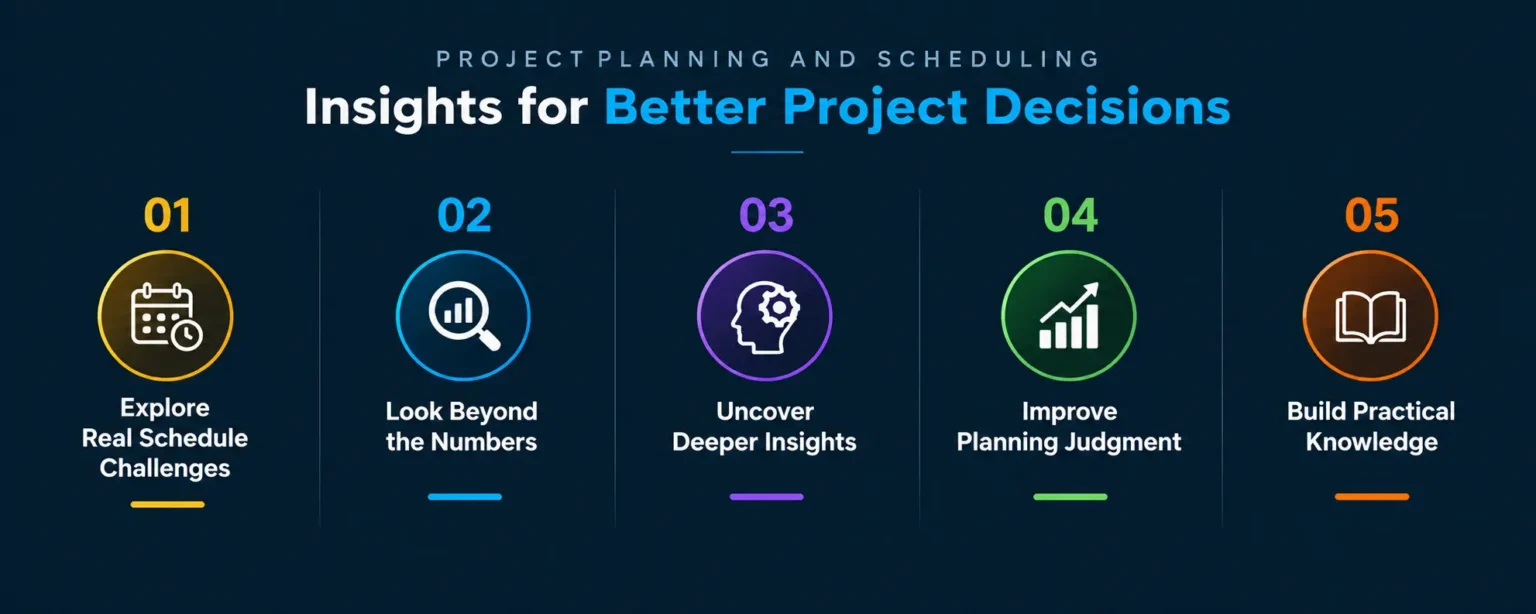
Understand the Reality Behind Project Plans and Schedules
A project plan or schedule can look complete while important assumptions, uncertainties, dependencies, and resource conditions remain unresolved.
Project Planning and Scheduling Insights examine what happens behind the dates, durations, logic, and forecasts. Rather than simply explaining established planning practices, they explore why schedules fall behind, estimates become optimistic, critical paths change, forecasts move, resources disrupt planned work, and planning detail can become excessive.
Therefore, each Insight helps professionals look beyond the schedule as a static plan. It encourages them to examine changing conditions, recognize patterns, question assumptions, and understand what project information may be telling them.
Whether you develop schedules, manage projects, lead project controls, coordinate resources, or make delivery decisions, these Insights support stronger professional judgement and more informed planning decisions.
Understand Schedule Behaviour
Look beyond planned dates and activities to understand how dependencies, resources, uncertainty, and changing conditions influence schedule performance.
Challenge Planning Assumptions
Examine why estimates, durations, forecasts, and planning information can remain unreliable even when established planning practices are followed.
Recognize Changing Project Exposure
Understand how critical paths, resource conditions, dependencies, and forecasts can change as project execution progresses.
Improve Planning Judgement
Use research-informed analysis to interpret planning and scheduling information, question established thinking, and make better-informed project decisions.
KNOWLEDGE AREAS
Explore Project Planning and Scheduling Insights
Explore Project Planning and Scheduling Insights across the factors that influence planning quality, schedule performance, forecasting, and project delivery. Rather than simply explaining planning techniques, these Insights examine why schedules behave differently from expectations and what professionals can learn from those patterns.
Schedule Performance & Delays
Examine why project schedules fall behind and how delays can spread through dependencies, rework, decisions, constraints, and changing conditions. As a result, professionals can better understand the factors that turn individual delays into wider schedule pressure.
Duration Estimation & Uncertainty
Explore why project duration estimates can remain optimistic despite experience, historical data, and established estimation practices. However, uncertainty, assumptions, estimation behaviour, and expectations can still influence how realistic planned durations become.
Critical Path & Schedule Dynamics
Understand why the critical path can change as progress, dependencies, constraints, durations, and project conditions evolve. Therefore, professionals can examine changing schedule exposure rather than treating the critical path as a permanent project characteristic.
Forecasting & Project Predictability
Examine why project forecasts keep changing and what repeated movement can reveal about assumptions, execution conditions, uncertainty, and expectations. Moreover, forecast changes can provide useful evidence about how predictable the project actually remains.
Resources & Schedule Interaction
Explore how resource availability, productivity, skills, competing demands, and resource interactions can disrupt planned work. Meanwhile, resource conditions can change schedule behaviour even when the underlying activities and logic remain unchanged.
Planning Detail & Complexity
Examine when additional planning detail improves understanding and control and when it creates excessive complexity, maintenance effort, or false precision. Instead, professionals can consider how much detail is genuinely useful for the decisions the plan must support.
REAL-WORLD PROJECT CHALLENGES
Explore Insights into the Situations Plans and Schedules Face
Project plans and schedules rarely perform exactly as expected. Therefore, professionals need to look beyond visible variances and understand the conditions shaping planning and schedule outcomes.
Project Planning and Scheduling Insights examine recurring schedule challenges, estimation gaps, changing conditions, resource pressures, and planning assumptions. Moreover, they encourage professionals to question established planning practices and consider what project information may reveal beneath the schedule.
Projects Falling Behind
Examine why project schedules lose momentum, how delays develop, and which conditions influence schedule performance. Furthermore, explore how dependencies, constraints, decisions, and changing conditions can amplify schedule pressure.
Optimistic Duration Estimates
Explore why planned durations can remain optimistic despite experience, historical information, and established estimation practices. However, uncertainty, assumptions, dependencies, and estimation behaviour can still affect the reliability of planned durations.
Changing Critical Paths
Examine why the critical path can change as activities progress, durations shift, and project conditions evolve. Therefore, consider how dependencies, constraints, and emerging schedule conditions can change the project’s delivery exposure.
Changing Project Forecasts
Explore why schedule forecasts keep moving and what repeated changes can reveal about project predictability. Moreover, examine how assumptions, progress information, uncertainty, and changing conditions influence forecast reliability.
Resource-Driven Schedule Disruption
Examine how resource availability, productivity, skills, competing demands, and resource interactions can disrupt planned work. As a result, understand how resource conditions can affect schedule performance even when the original plan remains unchanged.
Excessive Planning Detail
Explore when additional planning detail improves understanding and when it creates complexity, maintenance effort, or false precision. Instead, examine how professionals can judge whether planning detail remains useful for project decisions and control.
FEATURED PROJECT PLANNING AND SCHEDULING INSIGHTS
Professional Perspectives on the Challenges Plans and Schedules Face
Planning and scheduling involve more than creating activities, durations, logic, and dates. Instead, professionals must understand why well-structured plans can still produce unexpected schedule outcomes.
Our featured Project Planning and Scheduling Insights examine recurring schedule challenges, estimation assumptions, changing critical paths, forecast movement, resource pressures, and planning complexity. Moreover, they encourage professionals to look beyond visible schedule problems and consider what may be happening underneath.
Insights Focused on Deeper Planning and Scheduling Understanding
Each Insight examines a specific planning or scheduling challenge and explores the factors that shape it. Therefore, professionals can question assumptions, recognize patterns, and strengthen their judgment when interpreting project plans and schedule information.
Why Do Project Schedules Fall Behind?
Explore why project schedules fall behind despite established plans, dependencies, and monitoring practices. Therefore, examine how constraints, decisions, rework, resources, and changing conditions can combine to create wider schedule pressure.
Why Are Project Duration Estimates Too Optimistic?
Examine why planned durations can remain optimistic despite experience, historical information, and established estimation practices. However, uncertainty, assumptions, dependencies, and estimation behaviour can still affect duration reliability.
Why Does the Critical Path Change?
Explore why the critical path changes as activities progress, durations shift, and project conditions evolve. Therefore, examine how dependencies, constraints, progress, and emerging conditions can alter schedule exposure.
Why Do Project Forecasts Keep Changing?
Examine why project forecasts keep changing and what repeated movement can reveal about schedule predictability. Moreover, consider how progress information, assumptions, uncertainty, and changing conditions influence forecast reliability.
Why Do Resources Disrupt Project Schedules?
Explore how resource availability, productivity, skills, competing demands, and resource interactions can disrupt planned work. As a result, examine why schedule performance can change even when the underlying plan remains unchanged.
Finding the Right Level of Planning Detail
Examine how the right level of planning detail improves project understanding and control without creating unnecessary complexity, maintenance effort, or false precision. Consider how professionals can determine whether planning detail remains useful for project decisions, coordination, and control.
FROM INSIGHT TO ACTION
Turn Planning and Schedule Observations Into Better Decisions
An Insight should do more than describe a planning or scheduling problem. Instead, it should help professionals examine what the information means and determine what deserves attention.
01
Observe the Schedule
Identify what is changing in the plan, schedule, estimates, forecasts, or resource conditions. Then, examine the surrounding dependencies and conditions to understand how they may influence project performance.
02
Question the Assumptions
Examine the assumptions, expectations, estimates, and planning decisions shaping the current schedule situation. However, question whether these assumptions remain valid as project conditions change.
03
Interpret the Signals
Connect schedule information, trends, dependencies, resources, and changing conditions to identify meaningful signals. Furthermore, examine what these signals reveal about emerging schedule exposure and project predictability.
04
Determine the Response
Evaluate available choices, potential consequences, dependencies, and project priorities before selecting an appropriate response. Therefore, choose actions that address the underlying situation while supporting realistic planning and delivery decisions.
Planning and scheduling Insights create the thinking layer between project information and informed delivery decisions.
MORE PROJECT PLANNING AND SCHEDULING RESOURCE TYPES
Continue Your Project Planning and Scheduling Learning
Planning and scheduling knowledge becomes more valuable when professionals can understand the concepts, apply structured tools, and examine their practical use. Explore our other Project Planning and Scheduling resources to complement the analytical perspectives provided by these Insights.
Guides
Explore clear guidance to understand common challenges, evaluate situations, and apply effective approaches throughout project delivery.
Downloads
Access useful project planning & scheduling materials and reference resources to support your learning and day-to-day project work.
Career Roadmaps
Follow structured learning paths to develop project management knowledge, practical skills, and capabilities for your professional growth.
Templates
Use project planning & scheduling templates to structure planning, management, reporting, and other project activities.
Case Studies
Explore realistic project situations, decisions, challenges, and outcomes to understand how project management practices work in practice.
Glossary
Find clear explanations of project planning, scheduling, project controls, schedule management, and related professional terminology.
Looking for more project management resources? Explore the Kleios Technologies Resources Hub to discover our complete collection of guides, templates, downloads, career roadmaps, case studies, glossary resources, and insights.
RELATED KNOWLEDGE DOMAINS
Continue Your Learning Across Related Knowledge Domains
Project Management is closely connected with specialized disciplines that support successful planning, execution, governance, performance measurement, and professional growth. Explore related knowledge domains to expand your expertise, develop complementary skills, and access practical resources across the complete project management ecosystem.
Expand your expertise one domain at a time and build a well-rounded project management skill set.
Why Explore Related Domains?
- Develop cross-functional project management expertise
- Discover specialized knowledge beyond core project management
- Access practical resources across interconnected disciplines
- Build a complete professional learning pathway
- Strengthen career readiness through continuous learning
Each knowledge domain complements your Project Management expertise, helping you build broader capabilities and solve real-world project challenges with greater confidence.
Project Management
Practical project management knowledge, practices, and professional resources.
Project Controls
Performance measurement, forecasting, and project control best practices.
PMO
Governance, portfolio management, and organizational project excellence.
Risk Management
Risk identification, assessment, mitigation, and monitoring resources.
Primavera P6
Professional planning, scheduling, resource management, and reporting.
Microsoft Project
Project scheduling, tracking, reporting, and collaboration resources.
Power BI
Interactive dashboards, reporting, visualization, and project analytics.
PMI Certifications
Certification guidance, exam preparation, and professional development resources.
Frequently Asked Questions
Find answers to common questions about the purpose, approach, and professional value of Project Planning and Scheduling Insights available through Kleios Technologies.
What are the Project Planning and Scheduling Insights from Kleios Technologies?
Our Project Planning and Scheduling Insights examine common challenges involving plans, schedules, estimates, forecasts, resources, and changing schedule conditions. Rather than simply explaining established techniques, they explore why planning problems develop and what professionals should consider when interpreting them.
How are these Insights different from general project planning and scheduling articles?
These Insights focus on the underlying assumptions, behaviours, conditions, and patterns that can influence planning and schedule outcomes. Instead, they provide deeper professional perspectives that complement practical planning methods without simply repeating them.
Who can benefit from Project Planning and Scheduling Insights?
The Insights can support planners, schedulers, project managers, project controls professionals, engineers, analysts, consultants, and other delivery professionals. Moreover, they can help anyone who needs to interpret planning information and understand its implications for project decisions.
Are the Insights useful for beginners?
Yes, the Insights introduce complex planning and scheduling issues through clear explanations and practical professional perspectives. However, beginners can use them alongside foundational planning resources to gradually develop stronger judgement.
Do the Insights cover different project planning and scheduling disciplines?
The Insights cover connected areas such as schedule performance, duration estimation, critical path behaviour, forecasting, resource interaction, and planning detail. Therefore, they provide perspectives across different aspects of project planning and scheduling without treating each area as an isolated discipline.
Can I use an Insight when I face a project planning or scheduling problem?
Yes, an Insight can help you understand the broader conditions behind a planning or scheduling problem before deciding how to respond. However, practical Guides and Templates can provide more structured support when you need to perform the planning or scheduling work itself.
How can I find the right Project Planning and Scheduling Insight for my situation?
Start by identifying the main issue you are experiencing, such as schedule delay, optimistic durations, critical path changes, forecast movement, resource disruption, or excessive planning detail. Then, select the Insight that most closely matches the situation to explore the underlying factors and questions that may deserve attention.
Continue Your Professional Journey
Ready to move beyond self-learning? Explore our professional training programs or partner with our consultants to achieve better project outcomes.