
PROJECT PLANNING AND SCHEDULING INSIGHT
Why Does the Critical Path Change?
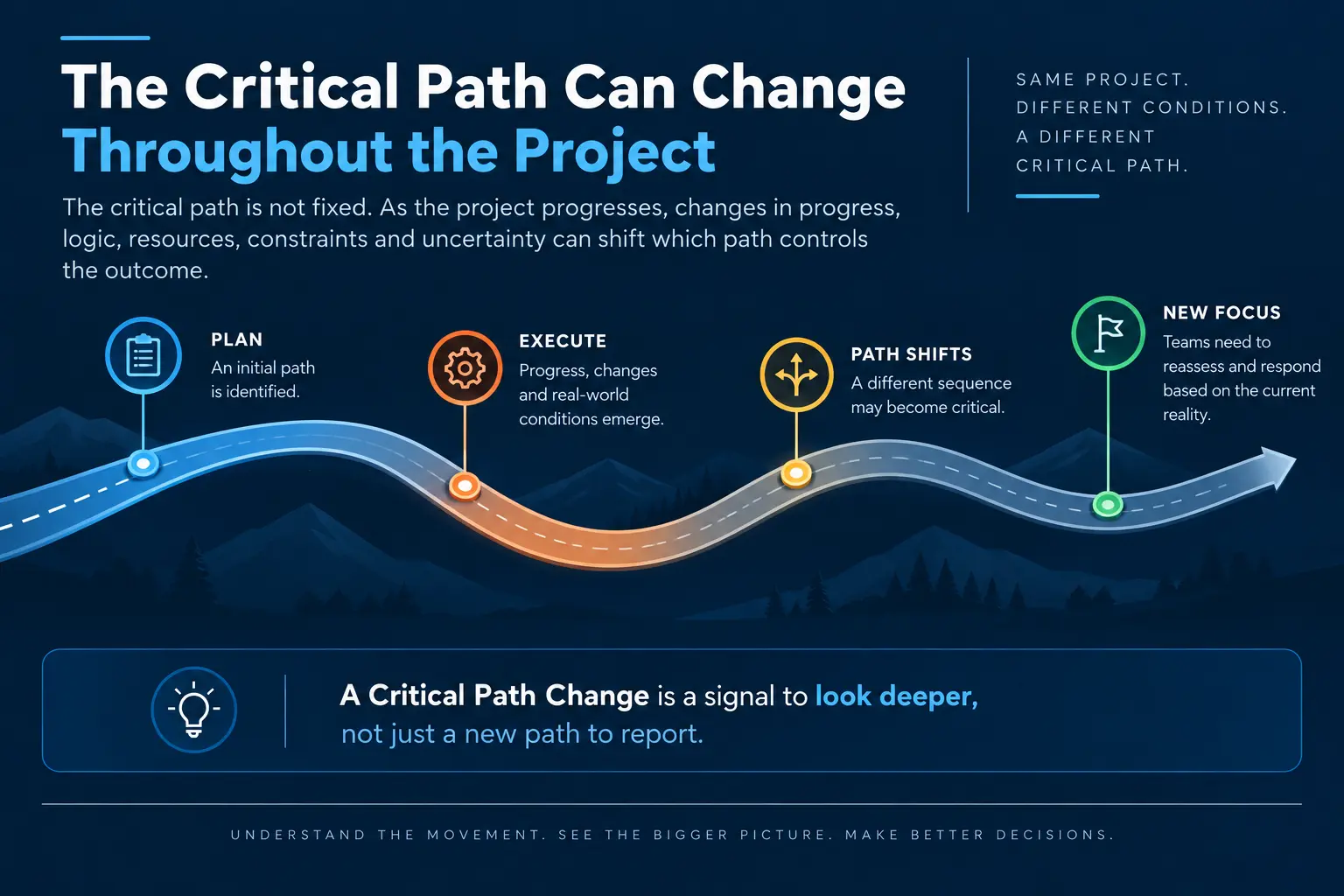
A Critical Path Change can occur when durations, logic, progress, constraints, resources, or assumptions change. However, critical-path movement does not automatically indicate a schedule problem. The current critical path reflects the conditions represented in the schedule model at that point in time.
As a result, a path that controls project completion today may differ from the path identified in the baseline or previous update. Float consumption, competing paths, and changing execution conditions can gradually shift which path controls the outcome.
This Insight examines why the critical path changes and why professionals can miss what the movement reveals. It also examines what repeated path changes can indicate about schedule flexibility, uncertainty, and model quality. Finally, it identifies what professionals should reconsider when interpreting critical-path movement.
Professional Insight · Project Planning & Scheduling
Introduction
The critical path can change when project conditions alter which sequence of activities controls the planned outcome. However, this movement does not automatically indicate a schedule problem. A Critical Path Change can reflect changes in durations, progress, logic, constraints, resources, or schedule assumptions.
The important issue is not simply that the critical path changed. Professionals need to understand why it changed and what the movement reveals about the remaining work. For example, one path may consume float while another path gains flexibility. As a result, a previously secondary path may become the sequence controlling project completion.
The change can also result from correcting the schedule model. Missing relationships, unrealistic constraints, incorrect status, or other model issues can alter the calculated critical path. Therefore, a calculated path requires professional interpretation before it supports management decisions.
A useful review compares the baseline path, previous update, and current path. It also examines float, near-critical paths, assumptions, and emerging uncertainty. This Insight examines why the critical path changes and what professionals should understand when its movement becomes significant.
The Common Assumption
The Critical Path Is Fixed Once the Schedule Is Approved
The approved schedule can make the critical path appear like a fixed project characteristic. However, the critical path depends on the current schedule model and its conditions. As work progresses, durations, relationships, progress, constraints, and other inputs can change. A Critical Path Change therefore does not necessarily mean that the project has developed a new problem.
The baseline path remains important because it shows the original planning position. However, it should not replace the current forecast when professionals assess present conditions.
The Critical Path Is Always the Most Important Work
Critical activities control a defined schedule outcome under the current model. However, other activities can remain important for safety, quality, cost, interfaces, or future work. Criticality describes schedule control, not overall project importance. Therefore, professionals should avoid treating the critical path as a complete list of the project’s most important activities.
Only Delays on the Critical Path Matter
A non-critical path can consume its available float without immediately affecting the completion date. However, continued float consumption can bring that path closer to criticality. Consequently, focusing only on today’s critical path can hide developing schedule exposure. Near-critical paths can become important before they become critical.
A Critical Path Change Means the Project Is in Trouble
Critical-path movement can follow deteriorating performance, but it can also result from improved progress or better schedule information. For example, correcting missing logic can change the calculated path without creating an execution delay. Therefore, professionals should understand the cause before interpreting the movement.
The change itself provides information, but its meaning depends on what caused the change. A professional review should distinguish execution changes from planning changes and model corrections.
The Critical Path Is Always the Longest Original Path
The path that controlled completion during initial planning may not control completion later. Changes in remaining durations, relationships, progress, or constraints can alter the relative length of competing paths. As a result, another sequence may become more restrictive than the original controlling path.
Therefore, professionals should compare current path conditions with previous updates instead of assuming that the original path remains dominant.
Near-Critical Paths Can Be Ignored
A path with limited float may sit close to the current critical path. Small changes can reduce its remaining flexibility and bring it into control. Float consumption can therefore provide an earlier signal than a Critical Path Change.
Professionals should monitor paths that approach criticality, not only paths that have already reached it. This wider view can reveal changing schedule sensitivity earlier.
One Project Should Have Only One Critical Path
A schedule can contain multiple critical paths when different sequences have the same controlling duration. Different milestones can also have different controlling paths. Therefore, professionals should define the relevant outcome before discussing which path is critical.
Asking “critical to which outcome?” can provide more useful information than asking for one project-wide path. This distinction becomes important when several major milestones have different controlling sequences.
The Scheduling Software Is Always Correct
Scheduling software calculates criticality from the information contained in the schedule model. However, the software does not independently confirm whether that information represents project reality. Missing relationships, unrealistic constraints, incorrect status, or weak assumptions can affect the calculated path.
A precise calculation cannot compensate for an unreliable schedule model. Therefore, professionals should establish model credibility before relying heavily on critical-path movement.
A Baseline Critical Path Represents the Current Reality
The baseline shows what the team originally expected to control project completion. The current schedule shows the forecast based on updated information. These views answer different questions. The baseline path provides historical context, while the current path describes present schedule conditions.
Comparing both views can reveal how the project has changed. However, professionals should not expect the current path to remain identical throughout execution.
Critical-Path Movement Is Mainly a Scheduling Issue
A changing critical path can reflect wider project conditions rather than scheduling activity alone. Progress, decisions, resources, constraints, scope changes, uncertainty, and execution performance can influence the schedule model. Therefore, a Critical Path Change can provide a useful signal about broader project conditions.
The professional question should not stop at identifying the new path. Instead, teams should ask what changed, what flexibility was consumed, and what the movement reveals about the remaining work.
What Is Really Happening?
The Critical Path Reflects the Current Schedule Model
The critical path reflects the relationships and conditions represented in the current schedule model. These conditions can include:
- Activity durations and remaining durations
- Logical relationships between activities
- Actual progress and status information
- Calendars and schedule constraints
- Resource conditions when the schedule models resource effects
The critical path is a current-state result, not a permanent characteristic of the project. Therefore, a Critical Path Change should be understood against the schedule update that produced it.
Competing Paths Can Move Closer Together
Projects often contain several paths that can influence the same completion milestone. One path may have substantial float while another has limited flexibility. However, changes in either path can alter their relative position.
For example, one path may recover time while another consumes float. As the difference between their remaining durations decreases, the second path can become more influential. Criticality can therefore move between competing paths without changing the overall project scope.
Float Can Be Consumed Before the Path Changes
A path does not need to become critical before its schedule position changes. It can gradually consume available float while remaining non-critical. Consequently, float movement can provide an earlier indication of increasing schedule sensitivity.
Watching only whether float has reached zero can hide the trend that developed beforehand. Professionals should therefore examine float changes across updates, especially on near-critical paths.
Duration Changes Can Shift Path Dominance
Activity durations influence the time required along connected paths. When remaining durations change, the relative length of competing paths can also change. A small duration difference can matter when two paths have limited separation.
Therefore, professionals should examine which activities changed and how those changes affected the controlling sequence. The important question is not only which duration changed, but which path relationship changed because of it.
Logic Changes Can Reshape the Network
Schedule relationships determine how activities connect and influence one another. Adding, removing, or correcting relationships can therefore change the paths through the network. A revised relationship may make one sequence longer or remove a previously controlling connection.
This distinction matters during schedule reviews. A Critical Path Change caused by corrected logic may improve the model rather than indicate worsening project performance. Professionals should identify logic changes before attributing movement to execution.
Actual Progress Changes the Remaining Network
As activities complete, the schedule no longer represents the same remaining work that existed at the start. Actual starts, finishes, remaining durations, and current relationships change the conditions used to calculate future completion.
Consequently, the current critical path can differ from the original path even when the project scope remains unchanged. Progress updates change the scheduling problem because completed work no longer controls the remaining forecast.
Constraints Can Redirect the Controlling Path
Constraints can restrict when activities may start or finish. Some restrictions represent genuine project conditions, while others may come from how the schedule was constructed. Their effect can therefore alter which sequence controls a milestone.
Professionals should distinguish real project restrictions from artificial schedule constraints. Otherwise, the calculated path may reflect a modelling choice rather than the actual sequence driving completion.
Resources Can Matter When the Model Includes Them
Traditional critical path analysis focuses mainly on network logic and activity durations. However, resource availability can affect activity timing when the schedule models resource constraints or resource-dependent relationships.
Therefore, professionals should not assume that resource effects always change the critical path. When resource constraints alter activity timing, they can also change which sequence controls the outcome.
Uncertainty Can Produce More Than One Potential Critical Path
A deterministic schedule identifies criticality from the current assumptions and durations. However, uncertain durations can change which path controls completion under different scenarios. A path that is non-critical today may therefore have substantial potential criticality.
Professionals can examine this wider exposure through schedule risk analysis, including methods such as Monte Carlo simulation. The analysis can identify paths that may become critical under different combinations of uncertain outcomes.
- Current critical path: the path controlling the selected outcome under current schedule conditions.
- Near-critical paths: paths with limited remaining flexibility that may become controlling.
- Potential critical paths: paths that show material criticality across uncertain schedule outcomes.
The current critical path and potential criticality provide different views of schedule exposure. Professionals should use the appropriate view for the decision they need to make.
The Critical Path Can Change Because the Model Was Wrong
Not every path movement originates from a change in project execution. Schedule reviews can identify missing dependencies, incorrect progress, unrealistic constraints, or other modelling problems.
- Missing or incorrect logical relationships
- Unrealistic or inappropriate constraints
- Incorrect activity status or remaining duration
- Unreasonable float caused by incomplete network logic
Correcting these issues can produce a Critical Path Change without a corresponding execution deterioration. Professionals should therefore validate the schedule before interpreting what its critical path means.
Why Do Professionals Miss the Problem?
Professionals Watch the Current Path More Than Its Movement
Schedule reviews often focus on the activities currently shown as critical. However, the current path provides only a snapshot of schedule conditions. The movement between updates can reveal changes in flexibility, competing paths, and remaining work.
A Critical Path Change becomes more informative when professionals compare where control moved from and where it moved to. Therefore, the review should examine the baseline, previous update, and current schedule position.
Near-Critical Paths Can Look Less Important Than They Are
A path with remaining float may appear less urgent than the current critical path. However, limited float can disappear quickly when activities experience delays or other changes. Consequently, a path that receives little attention today can become a controlling sequence later.
This issue becomes harder to see when reporting focuses only on zero-float activities. Professionals should examine paths approaching criticality alongside the current critical path.
Float Consumption Can Stay Invisible Until the Path Becomes Critical
Float provides flexibility within the schedule. However, reports may show the current float without highlighting how quickly that flexibility has changed. A path can therefore lose significant float across several updates while remaining outside the critical path.
The first critical update may not be the first warning. A trend of declining float can show that schedule flexibility was already reducing before the path became critical.
The Baseline Path Can Become an Analytical Anchor
The baseline provides an important reference for measuring schedule change. However, professionals can give the original critical path more attention than the current evidence warrants. Research on anchoring provides a useful explanation for why an initial estimate can influence later judgements.
This does not mean that professionals always remain attached to the baseline path. Instead, the baseline should provide context rather than determine how current schedule conditions are interpreted. New evidence should receive appropriate attention.
Schedule Updates Can Show the Change Without Explaining It
A schedule update can calculate a different critical path after new information enters the model. However, the calculation does not explain why the path changed. Professionals still need to trace the changes in durations, progress, relationships, constraints, and other schedule inputs.
Therefore, a report that states only the new path can leave an important management question unanswered. The useful explanation connects the path movement to the specific changes that produced it.
Different Outcomes Can Have Different Controlling Paths
A project can contain several important milestones with different preceding networks. Therefore, the path controlling one milestone may differ from the path controlling another milestone. A single project-level critical-path statement can hide this distinction.
Professionals should identify the outcome before interpreting criticality. This approach makes the analysis more precise and avoids treating one path as the universal controller of every project outcome.
A Calculated Critical Path Can Still Be Misleading
Scheduling software can calculate criticality consistently from the information provided. However, the result can mislead professionals when the underlying model contains missing logic, inappropriate constraints, incorrect status, or unrealistic assumptions.
For example, excessive float can sometimes indicate incomplete relationships rather than genuine schedule flexibility. Professionals therefore need to establish schedule-model credibility before treating path movement as a reliable management signal.
Criticality and Risk Do Not Mean the Same Thing
The deterministic critical path shows which sequence currently controls the selected schedule outcome. Schedule risk analysis addresses how uncertainty can affect different paths and completion outcomes.
As a result, a path outside the current critical path can still carry material schedule risk. A Critical Path Change does not provide the complete risk picture by itself. Professionals may need risk analysis to understand potential criticality under uncertain conditions.
Resource Effects Can Sit Outside the Traditional Critical-Path View
Traditional CPM analysis primarily examines network relationships and durations. However, resource availability can affect activity timing when resource constraints form part of the scheduling model.
This effect can remain less visible when professionals review only traditional network criticality. Therefore, teams should consider whether resource conditions materially affect the schedule before interpreting path movement.
Repeated Path Changes Can Become Normal Without Being Understood
Critical-path movement can occur naturally as project information improves and work progresses. However, repeated movement without a clear explanation can make schedule behaviour harder to interpret.
Teams may begin treating each new path as another reporting result instead of investigating the pattern behind the changes. When path movement becomes routine but unexplained, professionals can lose an important opportunity to learn about changing schedule conditions.
A useful review therefore asks whether the movement reflects execution, planning, modelling, constraints, resources, or uncertainty. This creates a stronger basis for understanding what the schedule is communicating.
What Happens If It Continues?
Schedule Flexibility Can Become Harder to See
If professionals repeatedly overlook path movement, they can lose visibility of changing schedule flexibility. A path may continue consuming float while remaining outside the current critical path. However, reports may continue to show only the activities that currently control completion.
When flexibility declines without clear attention, the schedule can become more sensitive to further disruption. Therefore, professionals should examine both current criticality and changes in available float.
Near-Critical Paths Can Become Immediate Problems
A near-critical path may have limited flexibility before it becomes critical. If professionals ignore its movement, they may recognize the exposure only after the path reaches the controlling position.
This does not mean every near-critical path will become critical. However, continued float consumption can reduce the time available to respond when conditions change. Monitoring the trend can therefore provide earlier management information.
Management Attention Can Become Reactive
If teams respond only after a new critical path appears, management attention can become increasingly reactive. Actions may focus on the latest controlling activities rather than the sequence of changes that produced them.
The issue is not that every response will be reactive. Instead, repeated unexplained movement can make it harder to distinguish emerging exposure from normal schedule evolution.
Recovery Efforts Can Follow the Latest Critical Path
A changing critical path can influence where teams consider recovery actions. However, the latest path may reflect only the current schedule position. It may not explain which conditions caused flexibility to decline.
Therefore, recovery decisions based only on the latest path can overlook other sequences that remain sensitive. Professionals should understand the cause of path movement before deciding where recovery effort can provide value.
Resource Allocation Can Become More Reactive
Critical-path movement can change which activities receive management attention. When resource constraints affect schedule performance, teams may need to reconsider resource allocation as conditions change.
However, the critical path alone does not determine the best resource decision. Professionals should consider resource availability, activity dependencies, recovery options, and competing paths together.
Forecast Confidence Can Decline When Path Movement Is Not Explained
Forecasts naturally change as projects receive new information. However, unexplained changes can make it harder for stakeholders to understand why the forecast moved. A new critical path without a clear explanation may therefore provide limited decision value.
Confidence should come from understanding the forecast, not from keeping the same critical path. Professionals should explain material movement through changes in progress, durations, logic, constraints, resources, or assumptions.
Different Schedule Views Can Create Different Critical-Path Stories
A project can contain different milestones, schedule levels, and reporting views. Each view can represent a different outcome or part of the network. Therefore, professionals may see different controlling paths without the schedule necessarily containing an error.
Confusion can arise when teams compare these paths without defining the outcome each one controls. A Critical Path Change should therefore be interpreted within its specific schedule and milestone context.
Milestone Risk Can Become Harder to Interpret
The current critical path identifies the sequence controlling an outcome under current schedule conditions. However, uncertainty can affect several paths differently. A path outside the current critical path can therefore carry meaningful future exposure.
If professionals treat the current path as the complete risk picture, they may overlook this wider uncertainty. Schedule risk analysis can provide additional insight into which paths may become critical under uncertain conditions.
Repeated Path Movement Can Hide Structural Problems
Repeated path movement does not prove that the schedule contains a structural problem. However, unexplained movement can justify closer examination of recurring changes in logic, durations, constraints, progress, or other assumptions.
For example, the same type of duration adjustment may repeatedly move control between competing paths. That pattern can provide useful evidence for reviewing the assumptions behind the schedule.
The Project Can Lose Sight of What Really Controls Completion
The critical path should help professionals understand what currently controls a defined project outcome. If teams report the path without explaining its movement, the information can become a reporting label rather than a management insight.
The risk lies in losing the explanation behind the path, not simply in seeing the path change. Professionals need to connect path movement with flexibility, competing sequences, causes, and future exposure.
If this interpretation becomes part of every schedule update, a Critical Path Change can provide more than a new list of activities. It can help teams understand how the remaining schedule is evolving.
What Should Project Professionals Reconsider?
The Critical Path Is a Current-State Indicator
Project professionals should treat the critical path as a view of the schedule’s current condition. It shows which sequence currently controls a defined outcome under the model’s present assumptions. Therefore, its meaning can change as the project develops.
A Critical Path Change becomes more useful when professionals study the movement behind it. Instead of looking only at today’s path, compare it with earlier schedule updates.
- Which path controlled the outcome at baseline?
- Which path controlled it in the previous update?
- Which path controls it now?
- What changed between those updates?
Path Movement Needs an Explanation
A schedule update can show that the critical path changed. However, the new path does not explain why control moved. Professionals should trace the changes that altered the relative position of competing paths.
The cause may sit in different parts of the project or schedule model:
- Execution: actual progress or performance changed the remaining work.
- Planning: durations or planned sequencing changed.
- Logic: relationships were added, removed, or corrected.
- Constraints: restrictions changed activity timing.
- Resources: resource conditions affected timing where the model represents them.
- Model correction: schedule errors were identified and corrected.
- Uncertainty: changing assumptions altered potential schedule outcomes.
The purpose is not to find someone responsible for the change. The purpose is to understand what changed and what the movement means.
Float Should Be Read as Changing Flexibility
Professionals should look beyond whether an activity currently has float. They should also examine how quickly that float is being consumed or restored. This trend can show changing flexibility before a path becomes critical.
For example, a path can lose several days of float across successive updates while remaining non-critical. Conversely, increasing float can indicate greater flexibility under the current model. Float is therefore more useful when professionals read its movement, not just its current value.
Unusually high float also deserves attention. It can sometimes indicate incomplete relationships or other network issues rather than genuine schedule flexibility.
Near-Critical Paths Deserve Attention
The current critical path does not show every path that could become important. Near-critical paths may have limited flexibility and can become controlling after relatively small changes.
A practical review should consider:
- Paths with low remaining float
- Paths that have consumed significant float
- Paths that repeatedly move toward criticality
- Paths exposed to significant schedule uncertainty
Attention should follow changing schedule exposure, not only activities with zero float.
Baseline and Forecast Paths Have Different Meanings
The baseline path shows what the approved plan originally expected to control the outcome. The current forecast path reflects updated information and present conditions. These two views answer different questions.
The baseline explains where the schedule started, while the current path explains where it stands. Comparing both can show how the project’s schedule position has changed over time.
Criticality Depends on the Outcome Being Examined
Professionals should identify the outcome before discussing the critical path. A project can have different controlling sequences for different milestones. Multiple critical paths can also exist for the same outcome.
Ask “Which path controls this outcome?” rather than assuming one path controls the entire project. This makes schedule communication more precise and easier to act on.
Model Quality Comes Before Critical-Path Interpretation
Professionals should establish schedule-model credibility before drawing strong conclusions from path movement. Scheduling software can calculate criticality correctly from the information provided. However, the model itself may contain incomplete or unrealistic information.
A practical review should consider:
- Logical completeness and reasonable relationships
- Appropriate constraints and calendars
- Accurate actual and remaining progress
- Reasonable duration assumptions
- Reasonable and explainable float
Model credibility should come before critical-path interpretation. Otherwise, professionals may spend time explaining a path that does not represent project reality accurately.
Resource Effects Need the Right Scheduling Model
Traditional CPM mainly examines network relationships and activity durations. However, resource availability can affect activity timing when the schedule models resource constraints.
Therefore, professionals should determine whether resource conditions materially affect the schedule before interpreting path movement. Resource effects matter when they change the timing or sequence represented in the model.
Uncertainty Requires More Than One Path View
The current critical path reflects one set of schedule conditions. However, uncertain durations and other variables can change which path controls completion across possible outcomes.
Professionals should distinguish between three related views:
- Current criticality: which path controls the selected outcome now.
- Near-critical exposure: which paths have limited remaining flexibility.
- Potential criticality: which paths may control completion under uncertain outcomes.
A Critical Path Change should therefore be considered alongside schedule-risk information when uncertainty materially affects the forecast.
Repeated Path Changes Should Create Learning
Repeated movement provides an opportunity to examine whether the same assumptions or conditions keep changing. The pattern may involve durations, productivity, constraints, logic, resources, or progress.
Professionals should ask what these repeated changes are teaching the team about its schedule assumptions. The goal is not simply to explain the latest update. The goal is to improve future forecasting and schedule understanding.
When teams consistently examine path movement, float, competing paths, causes, and uncertainty, the critical path becomes a useful management signal rather than a reporting label.
A Practical Professional Lens
A changing critical path becomes more useful when professionals examine the movement systematically. The aim is not to react to every path change. Instead, the aim is to understand what the change reveals about the remaining schedule.
Kleios recommends a six-step professional lens: PATH, MOVEMENT, FLEXIBILITY, COMPETITION, CAUSE, and TRAJECTORY. The sequence moves from identifying the current controlling path to understanding what its movement means for future schedule conditions.
PATH — Which Path Controls the Outcome Now?
Start by identifying the path that currently controls the outcome being examined. The outcome might be project completion, a major milestone, or another defined schedule objective.
Before accepting the result, ask:
- Which path currently controls the selected outcome?
- Is the path valid under the current schedule model?
- Are multiple critical paths present?
- Which milestone or outcome does the path control?
The output should be a clear statement of the current controlling path and the outcome it controls.
MOVEMENT — What Changed?
Next, compare the current path with the previous update and the baseline. This comparison shows whether the controlling sequence remained stable or changed over time.
Look for changes such as:
- Activities entering or leaving the critical path
- Paths gaining or losing float
- Changes in milestone dates or path duration
- New relationships or changed schedule logic
This step describes the movement before the team tries to explain it. A Critical Path Change becomes easier to understand when professionals first establish exactly what moved.
FLEXIBILITY — What Float Was Consumed?
After identifying the movement, examine how much schedule flexibility changed. Float can show whether competing paths are becoming closer to the controlling position.
The review should consider both the current float and its trend. A path that repeatedly loses float may deserve attention even before it becomes critical. Conversely, a path that gains float may have more flexibility under the current model.
Useful questions include:
- Which paths lost float?
- How quickly did they lose it?
- Is the remaining float reasonable?
- Could unusual float indicate missing logic?
The purpose is to understand whether schedule flexibility is increasing, stable, or being consumed.
COMPETITION — Which Other Paths Are Close?
The current critical path should not be reviewed in isolation. Other paths may sit close to criticality and could become controlling after realistic changes.
Pay particular attention to paths that:
- Have low remaining float
- Have consumed significant float recently
- Contain uncertain durations or conditions
- Have moved toward criticality across several updates
This step expands the review from today’s critical path to the paths that may influence tomorrow’s schedule position. It helps professionals see competition for schedule control before that competition becomes obvious.
CAUSE — Why Did the Path Change?
Once the movement and competing paths are understood, identify the cause. A path can change because project conditions changed or because the schedule model changed.
Classify the cause where practical:
- Execution: actual performance changed the remaining work.
- Duration: remaining activity durations changed.
- Logic: relationships changed or were corrected.
- Constraint: a restriction altered activity timing.
- Resource: resource conditions affected timing where modeled.
- Model correction: an identified schedule issue was corrected.
- Uncertainty: changing assumptions altered potential outcomes.
This classification helps separate project performance changes from changes in the schedule representation. That distinction can materially affect how professionals interpret the movement.
TRAJECTORY — What Does the Change Tell Us?
The final step considers what the movement says about the schedule’s direction. This is not a formal industry classification. It is a practical Kleios analytical lens for discussing changing schedule conditions.
The trajectory can be described as:
- Improving: the controlling path recovered time or gained flexibility.
- Stable: the controlling path remains consistent with reasonable flexibility.
- Tightening: several paths are losing float or moving closer to criticality.
- Unstable: the controlling path changes repeatedly as conditions or assumptions change.
- Unclear: path movement exists, but the model cannot explain it reliably.
These categories should support discussion rather than replace detailed schedule analysis. They help translate path movement into a clearer conversation about future flexibility and schedule exposure.
Putting the Six Steps Together
The six steps work as one review rather than six separate checks. Each step adds context to the previous one and reduces the chance of reacting to the path alone.
A professional review can therefore move through this sequence:
- PATH: identify which path controls the selected outcome now.
- MOVEMENT: establish what changed from earlier schedule positions.
- FLEXIBILITY: examine float consumption and remaining flexibility.
- COMPETITION: identify other paths approaching criticality.
- CAUSE: determine why the controlling position changed.
- TRAJECTORY: interpret what the movement indicates about future schedule conditions.
For example, a professional might conclude: “The controlling path moved because the previous path recovered while another path consumed most available float.”
The review can then identify whether other paths have limited flexibility or significant uncertainty. This provides more useful information than reporting the new path alone.
The goal is not to prevent every Critical Path Change. The goal is to understand the movement well enough to make better schedule and project decisions.
Key Takeaways
The main professional lessons from this Insight are:
- The critical path is a current-state indicator. It reflects the schedule model and conditions represented in the current update, not a permanent project characteristic.
- A Critical Path Change is not automatically a problem. The meaning depends on the cause of the movement and its effect on the remaining schedule.
- Path movement should be explained, not simply reported. Professionals should compare the current path with the previous update and baseline to understand what changed.
- Float provides important context. Consumed float can show tightening flexibility before another path becomes critical, while unusual float can indicate model weaknesses.
- Near-critical paths deserve attention. A path does not need to be critical today to become important as durations, progress, logic, constraints, or other conditions change.
- Criticality depends on the outcome being examined. Different milestones or completion outcomes can have different controlling paths.
- Model quality comes before interpretation. Missing logic, inappropriate constraints, inaccurate progress, unrealistic durations, or weak assumptions can distort the calculated critical path.
- Uncertainty requires a broader path view. Current criticality, near-critical exposure, and potential future criticality can provide different perspectives on schedule risk.
- Repeated path movement should create learning. Teams should examine why paths repeatedly gain or lose control and whether the schedule model represents execution reality.
- The objective is understanding, not preventing every change. The practical question is which path controls the outcome now, why it changed, what flexibility remains, and what the movement reveals about the schedule’s trajectory.
References
This Insight draws on established scheduling guidance, foundational research, and professional literature on critical paths, float, schedule quality, and uncertainty.
- Practice Standard for Scheduling — Third Edition — Project Management Institute (2019).
- GAO Schedule Assessment Guide: Best Practices for Project Schedules — U.S. Government Accountability Office.
- GAO Schedule Assessment Guide — U.S. Government Accountability Office (2012).
- Determining the K Most Critical Paths in PERT Networks — Dodin, B. (1984), Operations Research.
- Approximating the Criticality Indices of the Activities in PERT Networks — Dodin, B., & Elmaghraby, S. E. (1985), Management Science.
- Basics of Monte Carlo Simulation Risk Identification — Project Management Institute.
- Formalizing a Path-Float-Based Approach to Determine and Interpret Total Float in Project Scheduling Analysis — Lu, M., Liu, R., & Ji, L. (2017).
- Resource-Dependent Critical Path Method — Nisar, T., Yamamoto, K., & Suzuki, Y. (2013).
- Project Scheduling with Resource Constraints: A Review of Models and Extensions — Hartmann, S., & Briskorn, D. (2022).
- Manage Your Project’s Critical Path — Microsoft Support.
Related Kleios Resources
Understanding critical-path movement becomes more useful when it connects with the practices used to build, validate, control, and interpret project schedules.
Project Planning & Scheduling Guides
- How to Develop Project Schedule Basis — Establish the assumptions, methodologies, calendars, constraints, and other foundations behind the schedule model.
- How to Review and Validate Project Schedule — Review logic, relationships, durations, constraints, and other factors that influence schedule credibility.
- How to Manage Schedule Baseline Changes — Understand how approved baseline changes affect the reference used for schedule performance assessment.
- How to Identify Schedule Constraints — Examine constraints that can influence dates, flexibility, sequencing, and the resulting schedule path.
Project Planning & Scheduling Templates
- Project Schedule Basis Template — Document the assumptions and scheduling parameters that provide context for interpreting schedule behaviour.
- Project Schedule Review Checklist — Apply a structured review when validating the schedule model and investigating unexpected path movement.
- Schedule Baseline Change Template — Structure the documentation and assessment of approved changes to the schedule baseline.
- Schedule Constraints Identification Checklist — Identify and document constraints that may influence schedule dates, flexibility, and path behaviour.
FEATURED PROJECT PLANNING AND SCHEDULING INSIGHTS
Professional Perspectives on the Challenges Plans and Schedules Face
Our featured Project Planning and Scheduling Insights examine recurring schedule challenges, estimation assumptions, changing critical paths, forecast movement, resource pressures, and planning complexity. Moreover, they encourage professionals to look beyond visible schedule problems and consider what may be happening underneath.
Why Do Project Forecasts Keep Changing?
Examine why project forecasts keep changing and what repeated movement can reveal about schedule predictability. Moreover, consider how progress information, assumptions, uncertainty, and changing conditions influence forecast reliability.
Why Do Resources Disrupt Project Schedules?
Explore how resource availability, productivity, skills, competing demands, and resource interactions can disrupt planned work. As a result, examine why schedule performance can change even when the underlying plan remains unchanged.
Finding the Right Level of Planning Detail
Examine how the right level of planning detail improves project understanding and control without creating unnecessary complexity, maintenance effort, or false precision. Consider how professionals can determine whether planning detail remains useful for project decisions, coordination, and control.
MORE PROJECT PLANNING AND SCHEDULING RESOURCE TYPES
Continue Your Project Planning and Scheduling Learning
Planning and scheduling knowledge becomes more valuable when professionals can understand the concepts, apply structured tools, and examine their practical use. Explore our other Project Planning and Scheduling resources to complement the analytical perspectives provided by these Insights.
Guides
Explore clear guidance to understand common challenges, evaluate situations, and apply effective approaches throughout project delivery.
Downloads
Access useful project planning & scheduling materials and reference resources to support your learning and day-to-day project work.
Career Roadmaps
Follow structured learning paths to develop project management knowledge, practical skills, and capabilities for your professional growth.
Templates
Use project planning & scheduling templates to structure planning, management, reporting, and other project activities.
Case Studies
Explore realistic project situations, decisions, challenges, and outcomes to understand how project management practices work in practice.
Glossary
Find clear explanations of project planning, scheduling, project controls, schedule management, and related professional terminology.
Looking for more project management resources? Explore the Kleios Technologies Resources Hub to discover our complete collection of guides, templates, downloads, career roadmaps, case studies, glossary resources, and insights.
RELATED KNOWLEDGE DOMAINS
Continue Your Learning Across Related Knowledge Domains
Project Management is closely connected with specialized disciplines that support successful planning, execution, governance, performance measurement, and professional growth. Explore related knowledge domains to expand your expertise, develop complementary skills, and access practical resources across the complete project management ecosystem.
Expand your expertise one domain at a time and build a well-rounded project management skill set.
Why Explore Related Domains?
- Develop cross-functional project management expertise
- Discover specialized knowledge beyond core project management
- Access practical resources across interconnected disciplines
- Build a complete professional learning pathway
- Strengthen career readiness through continuous learning
Each knowledge domain complements your Project Management expertise, helping you build broader capabilities and solve real-world project challenges with greater confidence.
Project Management
Practical project management knowledge, practices, and professional resources.
Project Controls
Performance measurement, forecasting, and project control best practices.
PMO
Governance, portfolio management, and organizational project excellence.
Risk Management
Risk identification, assessment, mitigation, and monitoring resources.
Primavera P6
Professional planning, scheduling, resource management, and reporting.
Microsoft Project
Project scheduling, tracking, reporting, and collaboration resources.
Power BI
Interactive dashboards, reporting, visualization, and project analytics.
PMI Certifications
Certification guidance, exam preparation, and professional development resources.