
PROJECT MANAGEMENT IN PRACTICE
Project Management Templates
Tools for Managing Real-World Projects
Project work involves planning, coordination, decisions, stakeholder management, performance reviews, and unexpected challenges. Our practical Project Management Templates provide structured starting points that can be adapted to different projects, industries, organizations, and ways of working. Whether you are leading a project, supporting a project team, or managing project activities as part of your wider role, these resources can help you organize information, assess situations, and turn project needs into clear actions.
Browse by Resource Type
Explore Practical Project Management Templates
Choose a practical template to help structure common project activities, from assessing project health and managing stakeholders to planning recovery actions and making important project decisions.
WHY THESE TEMPLATES MATTER
Built for the Realities of Project Delivery
Projects involve many activities that require clear thinking and organized information. You may need to assess project health, identify early warning signs, manage stakeholder expectations, define success, plan recovery actions, or make an important project decision.
Starting these activities from a blank page can take time, and a generic template may not provide the right structure for the situation.
Our Project Management Templates provide practical starting frameworks for common project activities and challenges. Each template is designed around the purpose of the activity it supports, helping you organize relevant information, focus discussions, define actions, and maintain a clear record of important project work.
Whether you are leading a project, supporting a project team, coordinating activities, or managing projects as part of a wider role, the templates can be adapted to suit your project, organization, industry, and way of working.
Start with a Useful Framework
Begin with a practical structure instead of creating project documents from scratch. Each template provides relevant areas to organize information and guide your project activity.
Adapt to Your Project
Adjust the fields, terminology, level of detail, and review criteria to suit your project’s requirements, industry, organization, and way of working.
Apply to Real Project Situations
Use the templates during project reviews, planning sessions, stakeholder discussions, decision-making activities, recovery planning, and other project activities.
Turn Information Into Action
Use the information captured in the templates to identify priorities, assign responsibilities, document decisions, define actions, and support effective project follow-up.
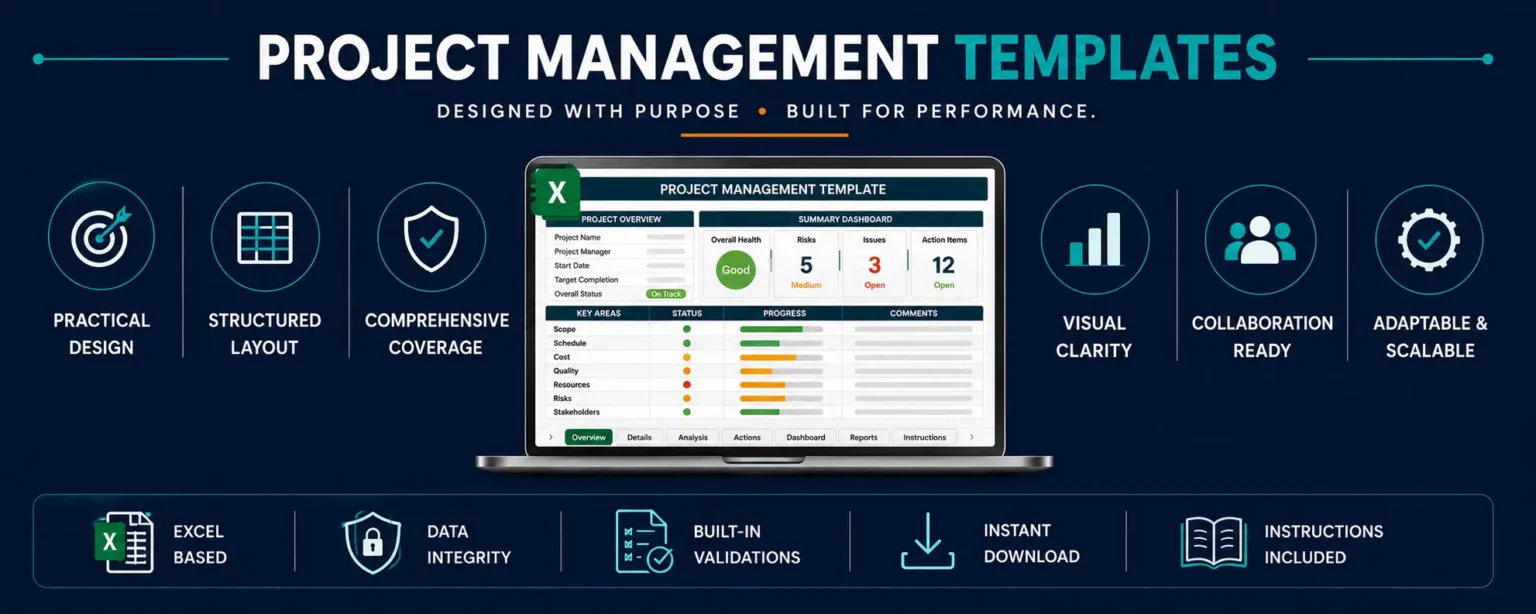
HOW THE TEMPLATES ARE DESIGNED
Structured for Project Use
A useful project management template should provide enough structure to guide the work without becoming so rigid that it limits how a project team operates. Our templates are therefore designed around the practical workflow, decisions, information, and actions involved in the specific project activity they support.
Rather than applying the same format to every situation, each template is structured according to its purpose. This helps users focus on what matters, organize relevant information, and move from assessment and discussion toward clear actions and follow-up.
Capture What Matters
Focus on the information that is relevant to the project activity, helping users organize important details, observations, decisions, responsibilities, and actions without unnecessary complexity or excessive documentation.
Follow a Logical Flow
Arrange information in a practical sequence so users can move from understanding the situation through assessment and consideration to action and follow-up, making the template easier to understand and use.
Keep It Adaptable
Provide a flexible framework that can be adjusted for different project sizes, industries, organizational processes, governance requirements, reporting practices, project complexities, and levels of detail.
Support Better Decisions
Structure information in a way that helps project teams identify priorities, clarify responsibilities, evaluate options, document outcomes, and determine appropriate actions with greater clarity and consistency.
HOW TO USE THE TEMPLATES
Support Throughout Project Delivery
Project management templates can be useful at different points throughout a project’s lifecycle. They can help you prepare for important discussions, organize project information, assess current conditions, identify areas requiring attention, and create a clear record of decisions and actions.
You do not need to use every section of a template or follow it in exactly the same way for every project. Start with the areas that are relevant to your situation, adapt the structure where necessary, and use the template as a practical working tool that supports your project’s needs.
Prepare for Important Project Activities
Use the templates before project reviews, stakeholder meetings, decision-making sessions, recovery discussions, or other activities where having organized information can improve preparation and focus.
Assess Current Project Conditions
Use relevant templates to review project performance, identify emerging concerns, understand stakeholder situations, or examine whether project objectives and expectations remain clear and achievable.
Structure Discussions and Decisions
Use the templates as working documents during project meetings and discussions. They can help teams organize different perspectives, compare options, clarify responsibilities, record decisions, and agree on appropriate actions.
Track Actions and Follow Up
Use the information captured in a template to establish actions, responsibilities, target dates, and follow-up points. Templates can also be adapted into repeatable project-management practices for ongoing monitoring and review.
FEATURED PROJECT MANAGEMENT TEMPLATES
Templates for Common Project Challenges
Our featured templates provide practical starting points for some of the common situations project teams encounter during project delivery. Each resource is designed to help you structure information, assess a situation, plan appropriate actions, or support better project decisions.
Start with the template that matches your current project need, then adapt it to your project’s size, complexity, industry, organizational processes, and way of working. As the Kleios Project Management Templates library grows, additional resources will be added to support a wider range of project activities and challenges.
Templates Designed for Flexible Use
Each template provides a structured starting point for a specific project activity, helping users organize information, assess situations, define actions, and support project decisions. The structure can be adapted to suit different projects, industries, organizations, and ways of working.
Project Health Check Template
Assess key areas of project performance, identify concerns that require attention, and organize findings to support a clear view of the project’s current condition.
Project Recovery Plan Template
Structure recovery actions when a project is falling behind, including key issues, corrective measures, responsibilities, priorities, and target completion dates.
Project Early Warning Signs Checklist
Identify emerging signals across key project areas and determine when further investigation, corrective action, or escalation may be required to protect project outcomes.
Project Stakeholder Management Template
Organize stakeholder information, expectations, influence, concerns, engagement approaches, and communication needs to support stronger project relationships.
Project Objectives & Success Criteria Template
Define clear project objectives and success criteria, helping teams establish shared expectations about what the project should achieve and how success will be measured.
Project Decision-Making Template
Structure important project decisions by organizing the situation, available options, impacts, recommendations, decision ownership, and required follow-up actions.
DESIGNED FOR FLEXIBLE USE
Adapt the Framework to Your Project
Projects can differ significantly in their objectives, size, complexity, stakeholders, delivery methods, and organizational requirements. A project in construction may require different information from an IT implementation, manufacturing initiative, business transformation program, or professional services engagement.
The underlying project-management activities, however, often have common foundations. Projects still need clear objectives, informed decisions, stakeholder coordination, performance assessment, early identification of problems, and appropriate corrective action.
Our templates provide a structured starting point for these activities while allowing you to adapt the content to your own project environment. You can modify terminology, fields, review criteria, responsibilities, and level of detail to reflect how your project or organization operates.
Construction & Infrastructure
Adapt project reviews, recovery actions, stakeholder information, and performance assessments to suit site activities, schedules, costs, contracts, resources, procurement, and delivery requirements.
Engineering, EPC & Manufacturing
Use the templates to structure project information around engineering deliverables, procurement activities, production requirements, interfaces, milestones, resources, risks, and operational priorities.
IT, Technology & Digital Projects
Adapt the templates for software delivery, technology implementations, digital transformation, dependencies, resources, scope changes, stakeholder expectations, risks, and delivery milestones.
Business & Professional Services
Apply the frameworks to internal initiatives, consulting engagements, business improvements, organizational changes, and other projects where objectives, responsibilities, decisions, and outcomes need clear structure.
GUIDES + TEMPLATES
Learn the Approach. Apply It to Your Project.
Understanding a project-management challenge is the first step. Applying that understanding to a real project requires a clear way to organize information, evaluate the situation, and determine what needs to happen next.
Our Project Management Guides explain the thinking and approaches behind common project situations, while the corresponding templates provide a structured framework that you can adapt and use in your own work.
Use the guides to understand the challenge, then use the templates to help apply that approach to your project.
Learn with the Guide
Understand the challenge, explore key considerations, and learn approaches for handling real project situations effectively.
How to Set Clear Project Objectives
Learn how to establish clear project objectives when expectations, priorities, and definitions of success differ across project stakeholders and teams.
How to Take Control of a Project That Is Falling Behind
Understand why a project is falling behind, assess the underlying situation, and identify actions to stabilize delivery and regain control effectively.
How to Manage Difficult Project Stakeholders
Learn how to handle conflicting expectations, difficult conversations, delayed decisions, and stakeholder pressure while keeping project objectives and delivery focused.
How to Make Better Project Decisions
Understand how to assess project situations, evaluate options, involve the right people, and make timely decisions with greater confidence and clarity.
How to Identify Early Warning Signs in a Project
Recognize emerging signals of project problems, understand their potential impact, and determine when investigation, corrective action, or escalation may be needed.
How to Conduct a Project Health Check
Assess the overall condition of a project, identify emerging concerns, and determine where attention or corrective action is needed to protect project outcomes.
Apply with the Template
Use a structured starting point to organize information, define actions, and apply the approach to your project with greater clarity.
Project Objectives & Success Criteria Template
Define project objectives, success criteria, expected outcomes, and measures that create a shared understanding of what successful project delivery means.
Project Recovery Plan Template
Structure recovery actions, responsibilities, priorities, target dates, and follow-up activities to help bring a troubled project back under control.
Project Stakeholder Management Template
Organize stakeholder information, expectations, influence, concerns, engagement approaches, and communication needs to support project relationships.
Project Decision-Making Template
Structure important decisions by documenting the situation, options, impacts, recommendations, ownership, outcomes, and follow-up actions for clear project records.
Project Early Warning Signs Checklist
Review key project areas for emerging warning signs and identify situations that may require further investigation, corrective action, or timely escalation.
Project Health Check Template
Review key areas of project performance, organize findings, identify priority concerns, and establish actions to support the project’s overall health.
Build Your Project Management Resource Path
Your project work can lead to deeper learning and professional support. Explore related guides, training programs, and consulting resources to strengthen your project management capabilities.
MORE PROJECT MANAGEMENT RESOURCESE TYPES
Continue Your Project Management Learning
Project management knowledge becomes more valuable when you can apply it, see it in practice, and continue developing your capabilities. Explore our other resources to complement the practical guidance provided in these guides.
Guides
Explore focused guidance on common project challenges, decisions, stakeholder situations, performance concerns, and approaches to real project delivery.
Downloads
Access useful project management materials and reference resources to support your learning and day-to-day project work.
Career Roadmaps
Follow structured learning paths to develop project management knowledge, practical skills, and capabilities for your professional growth.
Case Studies
Explore realistic project situations, decisions, challenges, and outcomes to understand how project management practices work in practice.
Glossary
Find clear explanations of project management terminology, concepts, abbreviations, and commonly used professional language.
Insights
Explore professional perspectives, practical insights, emerging practices, and deeper discussions relevant to project management.
Looking for more project management resources? Explore the Kleios Technologies Resources Hub to discover our complete collection of guides, templates, downloads, career roadmaps, case studies, glossary resources, and insights.
RELATED KNOWLEDGE DOMAINS
Continue Your Learning Across Related Knowledge Domains
Project management connects with specialized disciplines, tools, and professional practices that support successful project delivery. Explore related knowledge domains to expand your expertise, develop complementary skills, and discover deeper resources beyond the Project Management Guides.
Expand your expertise one domain at a time and build a well-rounded project management skill set.
Why Explore Related Domains?
- Develop cross-functional project management expertise
- Discover specialized knowledge beyond core project management
- Access practical resources across interconnected disciplines
- Build a well-rounded professional learning pathway
- Strengthen your ability to address real-world project challenges
Each knowledge domain complements the practical guidance in our Project Management Guides, helping you build broader capabilities and address real-world project challenges with greater confidence.
Project Planning & Scheduling
Planning techniques, scheduling methods, and timeline management resources.
Project Controls
Performance measurement, forecasting, and project control best practices.
PMO
Governance, portfolio management, and organizational project excellence.
Risk Management
Risk identification, assessment, mitigation, and monitoring resources.
Primavera P6
Professional planning, scheduling, resource management, and reporting.
Microsoft Project
Project scheduling, tracking, reporting, and collaboration resources.
Power BI
Interactive dashboards, reporting, visualization, and project analytics.
PMI Certifications
Certification guidance, exam preparation, and professional development resources.
Frequently Asked Questions
Find answers to common questions about the purpose, structure, adaptability, and use of the Project Management Templates available through Kleios Technologies.
What are the Project Management Templates from Kleios Technologies?
Our templates provide structured starting points for common project activities and challenges. They help users organize information, assess situations, define actions, document decisions, and support project follow-up.
Who can use these Project Management Templates?
The templates can be used by anyone involved in planning, managing, supporting, or delivering projects. This includes project managers, coordinators, planners, engineers, PMO teams, business professionals, consultants, team leads, and others who manage project activities as part of their role.
Are these templates suitable for different industries?
Yes. The templates are designed as adaptable frameworks rather than industry-specific forms. They can be adjusted for construction, infrastructure, engineering, EPC, manufacturing, energy, IT, digital, professional services, business transformation, and other project environments.
Can I customize the templates for my project?
Yes. You can modify the fields, terminology, review criteria, responsibilities, level of detail, and other elements to suit your project’s requirements, organizational processes, governance practices, and industry environment.
How should I use a Project Management Template?
Start by selecting a template that matches your current project need. Review the structure, adapt the relevant sections, add your project information, and use the completed template to support discussions, decisions, actions, reviews, or follow-up.
Are the templates useful for beginners?
Yes. The templates provide a structured starting point for people who may be new to a particular project-management activity. They can also be used by experienced professionals as a starting framework that can be adapted to more complex project environments.
How are the templates connected to the Project Management Guides?
The Guides explain approaches for understanding and handling common project situations, while the Templates provide a structure for applying those approaches. You can use a related guide to understand the challenge and then use the corresponding template to organize and apply the work.
Continue Your Professional Journey
Ready to move beyond self-learning? Explore our professional training programs or partner with our consultants to achieve better project outcomes.