
PROJECT MANAGEMENT GUIDE
How to Identify Early Warning Signs in a Project
Projects rarely develop major problems without some indication beforehand. Delayed decisions, declining productivity, repeated missed commitments, cost pressures, communication gaps, and changing forecasts can signal that a project is beginning to move off track.
This guide provides a practical approach to establish project baselines, identify meaningful warning signals, recognize trends, validate emerging problems, take timely corrective action, and monitor the response before small concerns become major project issues.
Practical Guide · Project Management
The Project Warning-Sign Challenge
Project problems rarely appear without warning. A major delay, cost overrun, quality failure, stakeholder conflict, or resource crisis is often preceded by smaller signals that indicate the project is beginning to move away from its expected condition. The difficulty is recognizing those signals early enough to do something meaningful about them.
Research and published case studies across construction, infrastructure, IT, healthcare, energy, and public-sector projects show that warning signs are often weak, scattered, and difficult to interpret. A single missed commitment may not indicate a serious problem, but repeated missed commitments, declining productivity, delayed decisions, increasing rework, and constantly changing forecasts can reveal a deteriorating trend.
Project teams also tend to focus heavily on lagging indicators such as actual cost, schedule variance, and missed milestones. By the time these measures clearly show a major problem, the underlying causes may already be well established. At the same time, qualitative signals such as declining stakeholder confidence, poor communication, team conflict, or reluctance to report bad news can remain invisible in formal dashboards.
There is another challenge: seeing a warning does not always lead to action. Organizational pressure, optimism bias, groupthink, fear of escalation, unclear accountability, and reluctance to challenge earlier decisions can cause teams to ignore or underestimate warning signs.
The result is a dangerous cycle:
Weak Signal → Delayed Recognition → Growing Problem → Limited Options → Crisis
Effective early-warning management therefore requires more than monitoring a dashboard. Project teams need to establish healthy baselines, identify meaningful leading indicators, watch trends and patterns, listen to people close to the work, validate warning signals, and take corrective action while options are still available.
The goal is not to predict every project failure. It is to recognize deterioration early enough to understand it, respond to it, and protect the project’s ability to succeed.
Why Project Warning Signs Are Missed
Project warning signs are often present, but teams may fail to recognize, interpret, or act on them early enough. The causes are usually a combination of weak monitoring, unreliable information, human behaviour, organizational pressure, and fragmented project management practices.
1. Over-Reliance on Lagging Indicators
Many project teams primarily monitor actual cost, completed activities, missed milestones, and reported schedule variance. These measures are important, but they often show what has already happened rather than what is beginning to go wrong.
By the time a major cost or schedule variance appears, the underlying problem may have existed for weeks or months. Teams need leading indicators such as productivity trends, declining float, repeated missed commitments, unresolved risks, and forecast movement to identify deterioration earlier.
Looking only at past performance can make the project appear healthy until the problem is already significant.
2. Poor-Quality or Delayed Project Information
Early warning depends on having reliable and timely information. When progress data is late, incomplete, inconsistent, or manually prepared, the project team may not see the developing problem in time.
Different teams may also maintain different versions of schedules, cost information, progress records, or risk registers. This creates uncertainty about which information represents the actual project condition.
If the information is unreliable, early-warning decisions will also be unreliable.
3. Focusing on Individual Variances Instead of Trends
A single missed activity or small cost variance does not necessarily indicate a serious problem. The danger is failing to notice when small deviations repeat or combine into a pattern.
For example, one delayed approval may be normal. Repeated approval delays, increasing design clarifications, and growing procurement impacts together may indicate a much larger problem.
Early warning is often about recognizing patterns rather than reacting to isolated events.
4. Warning Signs Are Spread Across Different Areas
Project problems rarely stay within one discipline. A supplier issue may eventually affect procurement, resources, schedule, cost, quality, and stakeholder relationships.
If each function monitors only its own area, the project team may miss the connection between these signals.
The project needs an integrated view rather than isolated departmental reporting.
5. Reluctance to Report Bad News
People may hesitate to report negative information because they fear blame, conflict, criticism, or damage to their reputation.
This can result in problems being softened in reports or escalated only after they become difficult to hide.
In some environments, teams may continue reporting that activities are progressing while operational evidence suggests otherwise.
A project cannot respond to warning signs that people are afraid to communicate.
6. Optimism Bias and Overconfidence
Project teams can become overly confident about their forecasts, especially when they are committed to achieving an approved completion date or budget.
Warning signs may be interpreted as temporary setbacks rather than evidence that the original forecast needs to change.
Teams may repeatedly assume that productivity will improve, delayed work will recover, or a supplier will meet the next promised date.
Confidence becomes dangerous when it prevents the team from testing whether its assumptions are still valid.
7. Pressure to Maintain a Positive Project Status
Senior management, clients, sponsors, and other stakeholders may expect the project to remain on track.
This can create pressure to avoid reporting an amber or red status until the evidence becomes overwhelming.
As a result, the project can remain apparently healthy in formal reporting while its underlying condition continues to deteriorate.
A warning system is ineffective when reporting good news is valued more than reporting accurate news.
8. Warning Signs Are Not Clearly Defined
Teams cannot consistently identify warning signs if they have not agreed on what they should actually watch for.
A project may have hundreds of possible indicators, but only a smaller group will provide meaningful early insight.
Without defined thresholds, baselines, leading indicators, and escalation criteria, each project manager may interpret the same signal differently.
Early-warning management requires knowing what abnormal behaviour looks like for the specific project.
9. Risk Registers Are Treated as Static Documents
A risk register can identify important threats, but it may not capture how those risks are evolving.
A risk that was considered low probability during initiation may become much more likely as project conditions change.
If risks are reviewed only during scheduled meetings without examining current evidence, emerging warning signs can be missed.
Risk management should identify changing conditions, not simply maintain a list of risks.
10. Decisions and Escalations Are Delayed
A warning becomes less useful when action is repeatedly postponed.
Teams may wait for more information, wait for management approval, or hope the situation will correct itself.
During that time, the available recovery options can become more expensive or less effective.
Early detection creates value only when the organization is capable of acting on what it detects.
11. Project Teams Ignore Qualitative Signals
Not every warning appears as a number.
Experienced project professionals may notice:
- Stakeholders becoming less engaged
- Increased tension between teams
- Suppliers becoming less responsive
- Managers avoiding difficult discussions
- Team members working excessive hours
- People becoming reluctant to raise concerns
These signals can be difficult to measure but may provide important information about the project’s health.
Project reporting should combine quantitative evidence with informed human observation.
12. No Clear Ownership for Early Warning
Even when a warning is identified, uncertainty may remain about who should investigate it, who should decide the response, and who is accountable for corrective action.
A warning can therefore move from one meeting to another without meaningful intervention.
Clear ownership, escalation routes, response times, and follow-up responsibilities are essential.
Detecting a warning is only the first step; someone must own the response.
How to Identify Early Warning Signs?
Identifying an early warning sign is not about waiting for a project metric to turn red. It is about establishing what healthy performance looks like, monitoring meaningful signals, recognizing patterns, investigating changes, and acting while recovery options are still available.
The following seven-step approach provides a practical method for identifying and responding to emerging project problems.
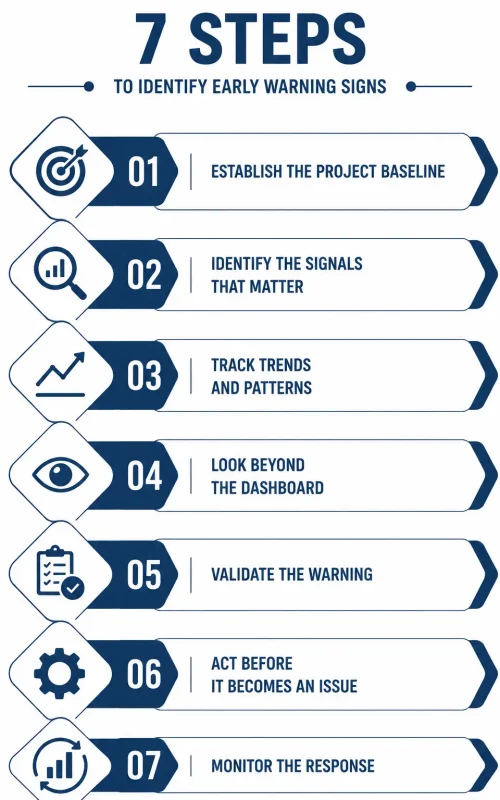
1. Establish the Project Baseline
You cannot identify deterioration unless you first understand what healthy project performance looks like. A baseline provides the reference point against which changes, deviations, and emerging trends can be recognized.
Define the Expected Condition
Establish clear expectations for the areas that matter most, including:
- Schedule and key milestones
- Cost and financial performance
- Scope and requirements
- Quality and productivity
- Resources and capacity
- Risk exposure
- Critical dependencies
Use approved project plans, budgets, schedules, resource plans, risk assessments, and performance targets to establish these reference points.
Identify Important Assumptions
Document the assumptions and dependencies that the project relies on. A change in an important assumption can become an early warning sign even before it creates a measurable variance.
For example, if a project depends on a supplier delivering critical equipment within ten weeks, that delivery commitment becomes something worth monitoring closely.
The baseline does not need to contain hundreds of measures. It should focus on the conditions that are most important to successful delivery.
A baseline gives the project team a clear reference for recognizing when performance is beginning to move away from expectations.
2. Identify the Signals That Matter
Once the baseline is established, determine which signals can provide an early indication that the project is moving away from its expected condition. Not every project metric is useful as an early warning indicator, and monitoring too many measures can make important signals harder to see.
Focus on Leading Indicators
Look for indicators that can reveal emerging problems before they affect major milestones or final outcomes. Depending on the project, these may include:
- Repeated missed commitments
- Declining productivity
- Loss of schedule float
- Increasing rework
- Delayed decisions and approvals
- Growing unresolved risks
- Frequent forecast changes
- Resource over-allocation
- Deteriorating supplier performance
- Increasing stakeholder concerns
The right indicators depend on the project’s objectives, risks, complexity, dependencies, and delivery environment.
For example, supplier reliability may be a critical indicator on a construction project with long-lead materials, while requirements volatility may be more important on a software implementation.
Keep the Signal Set Focused
The purpose is not to create another large dashboard filled with metrics. Select a manageable set of indicators that can provide useful information early enough to support action.
Define what normal performance looks like, what level of change deserves investigation, and who is responsible for monitoring each signal.
Monitor the signals that can tell you something important before the final project outcome is affected.
3. Track Trends and Patterns
An individual deviation does not always indicate a serious project problem. A missed commitment, small cost variance, or delayed activity may be temporary. The greater concern is when small deviations repeat, worsen, or begin appearing across different areas of the project.
Look for Direction, Not Just Status
Review performance across multiple reporting periods and ask:
- Is performance improving or deteriorating?
- Are the same deviations happening repeatedly?
- Are forecasts moving further away from the baseline?
- Are several indicators changing at the same time?
- Is the frequency or impact of the deviation increasing?
For example, one delayed approval may require monitoring. Repeated approval delays combined with increasing design clarifications and procurement impacts may indicate a developing schedule problem.
Connect Related Signals
Warning signs can become more meaningful when viewed together.
Declining productivity + increasing overtime + missed commitments may indicate a resource or execution problem.
Increasing changes + repeated clarification requests + growing rework may indicate an underlying requirements problem.
Trend analysis helps the team identify deterioration before a major milestone is missed or a significant variance becomes visible.
Use charts, rolling trends, variance analysis, forecast movement, and period-to-period comparisons where appropriate.
Early warning is often about recognizing a pattern that individual reports cannot reveal.
4. Look Beyond the Dashboard
Project dashboards are valuable for monitoring performance, but not every warning sign appears in a report or KPI. Some of the earliest signals can be found in conversations, behaviour, and changes in how people are working together.
Listen to the People Closest to the Work
Regularly engage with:
- Project team members
- Site and engineering teams
- Planners and cost controllers
- Suppliers and contractors
- Users and operational teams
- Key stakeholders
Ask what is becoming difficult, what is taking longer than expected, and where teams are relying on workarounds.
You may hear concerns such as increasing coordination problems, delayed supplier responses, repeated informal changes, uncertainty about decisions, or reluctance to raise issues.
Combine Data With Observation
Qualitative information should not automatically be treated as evidence of a project problem. Instead, use it as a signal that requires investigation.
For example, if a project team reports that a supplier is becoming less responsive, compare that observation with delivery commitments, procurement records, quality data, and current schedule dependencies.
This creates a more complete picture of project health.
The dashboard shows what the numbers are telling you. Conversations can reveal what is happening behind those numbers.
A strong early-warning process therefore combines quantitative project data with informed observations from people who understand the work at ground level.
5. Validate the Warning
Not every deviation is an early warning sign. Before taking corrective action, the project team should investigate the signal, understand its cause, and assess its potential impact.
Understand What Changed
When a warning appears, ask:
- What has changed?
- Why has it changed?
- Is the change temporary or continuing?
- Are other indicators showing the same pattern?
- Which project objectives could be affected?
- Are existing assumptions still valid?
- Has an identified risk started to materialize?
This prevents the team from reacting to normal project variation while ensuring genuine deterioration receives appropriate attention.
Assess the Potential Impact
Consider the warning in the context of the wider project.
For example, a supplier may report a two-week delay. On its own, this may not create a significant problem if sufficient schedule float exists and alternative delivery arrangements are available.
However, the same delay could become critical if the equipment is required for a critical-path activity, has no replacement option, or affects subsequent testing and commissioning.
Validation should therefore consider probability, impact, dependencies, timing, and available recovery options.
Do not ignore a warning because it appears small, and do not escalate every deviation as a crisis. Investigate the signal and understand what it means before deciding how to respond.
6. Act Before It Becomes an Issue
Identifying and validating an early warning sign creates an opportunity to take action while recovery options are still available. Waiting until the warning becomes a confirmed issue can significantly increase the impact, cost, and effort required to recover.
Choose a Proportionate Response
Depending on the warning and its potential impact, the project team may need to:
- Reallocate resources
- Resequence activities
- Escalate a delayed decision
- Strengthen supplier or contractor management
- Update forecasts
- Increase monitoring
- Address emerging quality problems
- Implement a risk response
- Engage stakeholders earlier
The response should address the underlying cause, not simply the visible symptom.
For example, repeatedly adding resources to a delayed activity may provide temporary relief, but if the real problem is an unresolved design issue, additional resources may not solve the underlying constraint.
Assign Ownership
Every significant response should have a clear owner, action, deadline, and expected result. Establish how the response will be tracked and when it should be reviewed.
Escalate when the potential impact exceeds the authority or capability of the project team.
The objective is not to react to every warning with immediate escalation. It is to act early, proportionately, and deliberately while meaningful recovery choices remain available.
The value of an early warning lies in the action it enables—not simply in the fact that it was detected.
7. Monitor the Response
Taking corrective action does not mean the warning has disappeared. The project team needs to verify whether the response is actually improving the project condition and whether the original warning is reducing.
Check Whether the Trend Is Improving
Define what improvement should look like and continue monitoring the relevant indicators.
For example, if declining productivity triggered a recovery action, compare productivity across the following reporting periods. If the trend improves, continue monitoring until performance returns to an acceptable and stable level.
If the indicator remains unchanged or deteriorates further, the team should reassess the underlying cause rather than simply repeating the same action.
Keep Ownership and Escalation Clear
Track:
- What action was taken
- Who owns the response
- When improvement is expected
- Which indicator will demonstrate improvement
- What happens if the situation does not improve
This creates a feedback loop:
Warning → Action → Measurement → Review → Further Action
The team should also capture important lessons about what the warning looked like, how it was detected, what caused it, and whether the response was effective.
Over time, these lessons can improve the project’s early-warning process and help future teams recognize similar conditions earlier.
An early-warning process is complete only when the project confirms that the underlying condition has improved—or takes further action when it has not.
Practical Example
Putting the Approach Into Practice
The seven-step approach becomes most useful when the project team applies it to real project information and connects early signals to practical action.
Consider a construction project involving the delivery and installation of critical equipment. The project is currently reporting that the overall schedule is on track, but several smaller signals are beginning to appear.
Establish the Baseline
The project schedule shows that equipment delivery is required before installation and commissioning can begin. The procurement plan also identifies the supplier as a critical dependency.
Identify the Signals
The team begins monitoring supplier commitment dates, manufacturing progress, inspection status, delivery forecasts, and schedule float around the installation activities.
Track the Trend
The supplier initially confirms the planned delivery date. A few weeks later, the manufacturing completion date moves by one week. The following update shows another delay.
Individually, these changes may appear manageable. The trend is becoming more concerning.
Look Beyond the Dashboard
During a supplier meeting, the project team learns that additional quality inspections are required and that the supplier is experiencing resource constraints.
This information is not yet fully reflected in the formal project report.
Validate the Warning
The planner checks the schedule and discovers that the available float is rapidly reducing. A further supplier delay could affect installation and subsequently commissioning.
The warning is now supported by both qualitative information and schedule evidence.
Act Early
The project manager brings the supplier, procurement team, engineering team, and planner together. Recovery options are assessed, including expediting selected activities and resequencing related work.
Monitor the Response
The team tracks manufacturing progress and delivery commitments during subsequent reporting periods. If the trend improves, monitoring continues. If it deteriorates further, additional escalation and recovery action are triggered.
The project did not wait for the installation milestone to be missed. The early warning was identified while there were still practical options to protect the schedule.
Common Mistakes to Avoid
Identifying early warning signs is only effective when the project team responds to them appropriately. Several common practices can cause teams to overlook signals, misinterpret them, or act too late.
Monitoring Only Cost and Schedule
Cost and schedule are important, but they do not provide a complete picture of project health.
Monitor leading indicators across risk, quality, resources, scope, stakeholders, productivity, and dependencies as well.
Reacting to Individual Variances
One small deviation does not necessarily indicate a developing problem.
Look for repeated deviations, worsening trends, and combinations of signals.
Creating Too Many KPIs
A dashboard containing dozens of indicators can make important information difficult to identify.
Focus on a manageable set of indicators that are directly connected to project risks and objectives.
Ignoring Qualitative Warning Signs
Changes in communication, team behaviour, stakeholder confidence, and supplier responsiveness may appear before formal metrics deteriorate.
Combine project data with information from people closest to the work.
Waiting for Complete Certainty
Teams sometimes delay action because they want more evidence before responding.
Validate the warning, but act proportionately when the potential impact justifies early intervention.
Treating the Risk Register as the Early-Warning System
A risk register records known risks, but it may not show how project conditions are changing.
Monitor the signals that indicate whether existing risks are becoming more likely or more severe.
Reporting Bad News Too Late
Delaying escalation gives the problem more time to grow and reduces the available recovery options.
Create an environment where emerging concerns can be raised early without automatically creating blame.
Focusing on Symptoms Instead of Causes
Adding resources to a delayed activity may not solve the underlying problem if the real cause is an unresolved design issue, poor coordination, or a supplier constraint.
Investigate the root cause before selecting corrective action.
Assuming Corrective Action Has Worked
Taking action does not guarantee that the project condition has improved.
Define expected improvement and monitor the relevant indicators after the intervention.
Failing to Learn From Previous Warnings
If lessons from earlier projects are not captured, teams may repeatedly encounter the same warning signs.
Record what the warning looked like, how it was detected, what caused it, and which response worked.
Key Takeaways
Early warning management is about recognizing changes early, understanding what they mean, and acting before the project loses its ability to recover effectively.
- Establish a clear baseline. Know what healthy project performance looks like before trying to identify deterioration.
- Focus on meaningful signals. Monitor indicators that are directly connected to the project’s objectives, risks, dependencies, and delivery environment.
- Watch trends, not isolated events. Repeated deviations and combinations of small signals can reveal problems earlier than a single major variance.
- Look beyond project dashboards. Conversations with project teams, suppliers, contractors, users, and stakeholders can reveal warning signs that formal reports may not capture.
- Validate before reacting. Investigate the cause, duration, dependencies, and potential impact of a warning before deciding how serious it is.
- Act while options remain. Early intervention can provide more recovery choices and reduce the potential impact of emerging problems.
- Assign clear ownership. Every significant response should have an accountable owner, action, deadline, and expected result.
- Monitor corrective action. Confirm whether the response is improving the underlying condition rather than assuming that the problem has been resolved.
- Create an open reporting environment. People should be able to raise emerging concerns without fear of blame or unnecessary escalation.
- Learn from warning signs. Capture recurring patterns and effective responses so future projects can recognize similar conditions earlier.
The purpose of early-warning management is not to eliminate uncertainty or predict every project failure. It is to give the project team enough visibility and time to make better decisions while meaningful recovery options are still available.
References
- Project Management Journal — A Review on Possible Approaches for Detecting Early Warning Signs in Projects
- EDPACS — Early Warning Signs of IT Project Failure: The Dominant Dozen
- Journal of Global Operations and Strategic Sourcing — Early Warning Signs of Failure in Offshore-Outsourced Software Projects
- Project Management Journal — Early Warning Signals for R&D Projects: An Empirical Study
- International Journal of Project Management — The London Ambulance Service Computer Aided Dispatch Project
- Association for Project Management — Making Project Assurance Work
- McKinsey & Company — Increasing Transparency in Megaproject Execution
- McKinsey & Company — Mitigating Risk in IT Megaprojects
- U.S. Government Accountability Office — Denver International Airport: Baggage Handling, Contracting, and Other Issues
- UK National Audit Office — The National Programme for IT in the NHS
- Edinburgh Tram Inquiry — Official Report and Findings
- Bent Flyvbjerg — Top Ten Behavioral Biases in Project Management
- ResearchGate — Why Project Managers Fail to Act Upon Early Warning Signs
- Research Portal — Performance Measurement as an Early Warning System in Projects
- ResearchGate — Identification of Early Warning Signs in the Front-End Stage of Projects
FEATURED PROJECT MANAGEMENT GUIDES
Practical Guidance for the Challenges Project Professionals Face
Managing projects requires more than knowing established processes and concepts. Our featured guides focus on practical situations, challenges, and decisions that project professionals encounter, providing clear guidance to help them respond effectively.
How to Set Clear Project Objectives
Establish clear and aligned project objectives when stakeholders have different expectations, priorities, or interpretations of what successful project delivery should achieve.
How to Take Control of a Project That Is Falling Behind
Understand why a project is falling behind, assess the underlying situation, and determine practical actions to stabilize delivery and regain control.
How to Conduct a Project Health Check
Assess the overall condition of a project, identify emerging concerns, and determine where attention or corrective action is needed to protect project outcomes.
MORE PROJECT MANAGEMENT RESOURCESE TYPES
Continue Your Project Management Learning
Project management knowledge becomes more valuable when you can apply it, see it in practice, and continue developing your capabilities. Explore our other resources to complement the practical guidance provided in these guides.
Templates
Use practical project management templates to structure planning, management, reporting, and other project activities.
Downloads
Access useful project management materials and reference resources to support your learning and day-to-day project work.
Career Roadmaps
Follow structured learning paths to develop project management knowledge, practical skills, and capabilities for your professional growth.
Case Studies
Explore realistic project situations, decisions, challenges, and outcomes to understand how project management practices work in practice.
Glossary
Find clear explanations of project management terminology, concepts, abbreviations, and commonly used professional language.
Insights & Articles
Explore professional perspectives, practical insights, emerging practices, and deeper discussions relevant to project management.
RELATED KNOWLEDGE DOMAINS
Continue Your Learning Across Related Knowledge Domains
Project Management is closely connected with specialized disciplines that support successful planning, execution, governance, performance measurement, and professional growth. Explore related knowledge domains to expand your expertise, develop complementary skills, and access practical resources across the complete project management ecosystem.
Expand your expertise one domain at a time and build a well-rounded project management skill set.
Why Explore Related Domains?
- Develop cross-functional project management expertise
- Discover specialized knowledge beyond core project management
- Access practical resources across interconnected disciplines
- Build a complete professional learning pathway
- Strengthen career readiness through continuous learning
Project Planning & Scheduling
Planning techniques, scheduling methods, and timeline management resources.
Project Controls
Performance measurement, forecasting, and project control best practices.
PMO
Governance, portfolio management, and organizational project excellence.
Risk Management
Risk identification, assessment, mitigation, and monitoring resources.
Primavera P6
Professional planning, scheduling, resource management, and reporting.
Microsoft Project
Project scheduling, tracking, reporting, and collaboration resources.
Power BI
Interactive dashboards, reporting, visualization, and project analytics.
PMI Certifications
Certification guidance, exam preparation, and professional development resources.