
PROJECT MANAGEMENT TEMPLATE
Project Recovery Plan Template
Projects can fall behind when schedule, cost, scope, resources, risks, quality, or stakeholder expectations move away from plan. This Project Recovery Plan Template provides a structured framework to assess troubled projects, identify root causes, develop recovery strategies, assign corrective actions, track recovery targets, and monitor progress toward restoring project control.
Excel Template · Project Management
ABOUT THE TEMPLATE
A Structured Framework for Project Recovery
The Project Recovery Plan Template is an Excel-based management workbook designed to help project professionals assess troubled projects, understand underlying problems, develop appropriate recovery strategies, manage corrective actions, and track progress toward restoring project control.
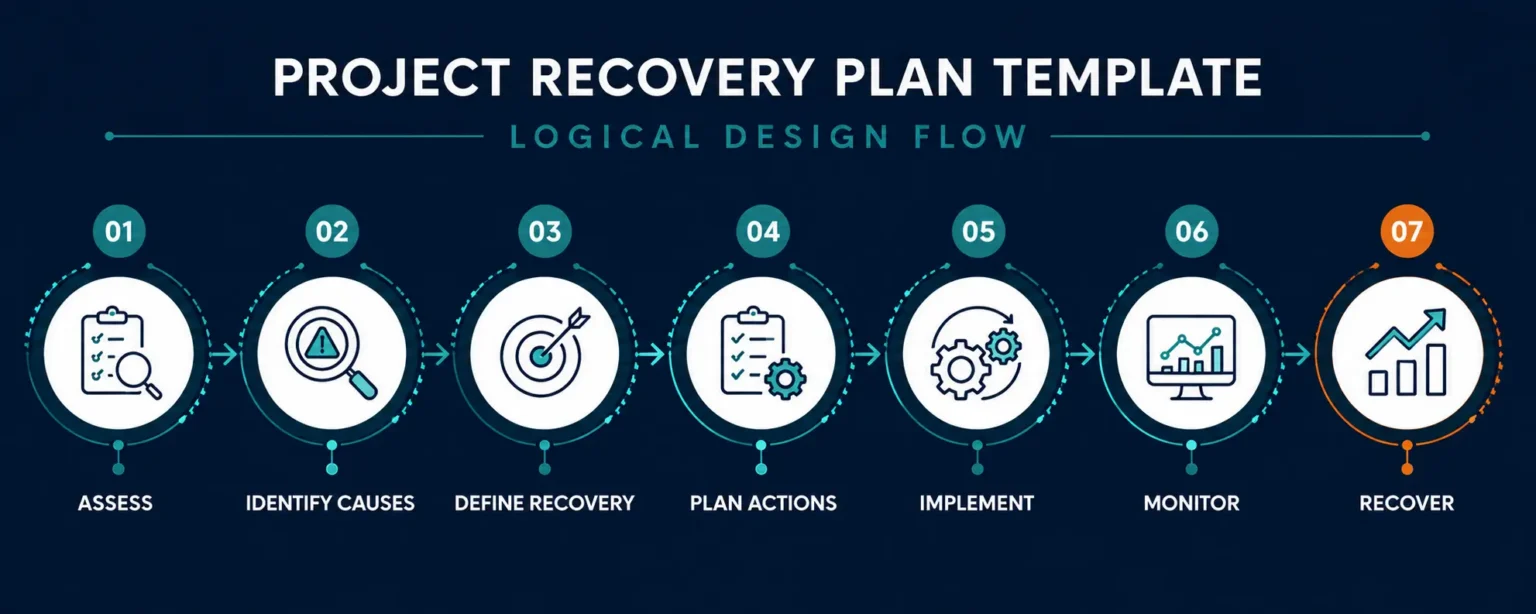
The template supports the recovery process from establishing the recovery context and assessing project condition to identifying root causes, evaluating recovery options, defining targeted actions, setting measurable recovery targets, monitoring progress, and determining whether the project is ready to exit formal recovery and return to normal project controls.
Assess Recovery Conditions
Review key areas of project performance using available evidence to understand the current condition, recovery triggers, significant problems, and areas requiring management attention.
Identify Root Causes
Document significant findings, supporting evidence, underlying causes, potential consequences, and recovery implications to distinguish fundamental problems from visible project symptoms.
Develop Recovery Strategy
Evaluate recovery options, consider potential impacts and risks, select an appropriate approach, and establish recovery objectives, assumptions, actions, and governance requirements.
Execute Recovery Actions
Convert the recovery strategy into defined actions, measurable targets, responsible ownership, and follow-up reviews to monitor progress and determine whether recovery is achieving its intended outcomes.
WHAT’S INCLUDED
Everything You Need for a Structured Project Recovery
The workbook brings recovery context, assessment, root-cause analysis, strategy development, action management, recovery targets, reporting, and follow-up into one connected framework. Each section supports a different stage of the recovery process, from diagnosing project problems through execution, monitoring, and recovery exit.
01
Recovery Profile
Establish the recovery context, trigger, objectives, scope, boundaries, governance, ownership, decision authority, reporting requirements, and key recovery stakeholders.
02
Recovery Assessment
Evaluate important areas of project condition using structured questions, available evidence, health status, confidence levels, recovery implications, and relevant management considerations.
03
Root Causes & Findings
Document significant findings, supporting evidence, underlying root causes, potential consequences, recovery needs, priorities, ownership, escalation requirements, and management responses.
04
Recovery Strategy
Evaluate alternative recovery options, compare potential impacts and risks, select an appropriate approach, and document the rationale, objectives, assumptions, and approval requirements.
05
Recovery Action Plan
Convert the approved recovery strategy into defined actions with expected outcomes, responsible owners, priorities, target dates, dependencies, progress, evidence, and escalation requirements.
06
Recovery Targets
Define measurable recovery targets, establish current and desired performance levels, assign target dates and owners, and monitor whether recovery outcomes are being achieved.
07
Recovery Dashboard
Review overall recovery status, assessment results, priority findings, action progress, target performance, and emerging concerns through a consolidated management-level view.
08
Recovery Follow-Up
Review recovery progress over time, evaluate action effectiveness, assess target performance, identify remaining concerns, and determine whether continued recovery intervention is required.
09
Configuration
Maintain the controlled values, classifications, status options, and supporting settings used throughout the workbook to promote consistent data entry and interpretation.
HOW TO USE THE TEMPLATE
From Recovery Assessment to Project Recovery
The template follows a structured recovery workflow that helps you establish the recovery context, assess the project’s condition, identify root causes, develop a recovery strategy, execute corrective actions, measure results, and determine whether the project is ready to exit formal recovery.
1. Establish the Recovery Context
Start with the Recovery Profile and document why recovery is required, the current project situation, recovery objectives, scope, governance, ownership, decision authority, and key stakeholders. Establishing this context creates a common understanding of what the recovery effort is expected to achieve.
2. Assess Project Condition
Use the Recovery Assessment to review important areas of project performance using available project reports, records, evidence, and stakeholder information. Record the relevant health status, confidence, recovery implications, and considerations to establish an evidence-based view of the current situation.
3. Identify Root Causes
Review the assessment results and document significant findings, supporting evidence, underlying causes, potential consequences, and recovery needs. Focus on understanding the problems behind visible symptoms so that recovery actions address the factors contributing to poor project performance.
4. Develop the Recovery Strategy
Use the Recovery Strategy sheet to evaluate potential recovery options, consider their project schedule, cost, resource, quality, risk, and stakeholder implications, and select an appropriate recovery approach. Document the rationale, expected outcomes, assumptions, risks, governance requirements, and necessary approvals.
5. Execute Recovery Actions
Convert the approved recovery strategy into defined actions using the Recovery Action Plan. Assign responsible owners, priorities, target dates, dependencies, expected outcomes, progress, evidence, and escalation requirements so that recovery work remains visible and accountable.
6. Measure Recovery Performance
Use Recovery Targets to define measurable indicators of improvement and compare current performance with desired outcomes. Track target values, dates, status, trends, and supporting evidence to determine whether the recovery actions are producing meaningful project improvement.
7. Monitor & Follow Up
Use the Recovery Dashboard and Recovery Follow-Up sheets to review recovery performance, action progress, remaining concerns, emerging problems, and target achievement. Regular follow-up helps determine whether the recovery strategy remains effective or requires adjustment, escalation, or intervention.
8. Determine Recovery Exit
Use the follow-up information to determine whether the project has achieved sufficient and sustainable improvement. Recovery may be continued, revised, escalated, formally rebaselined, or closed and returned to normal project controls based on the approved recovery criteria.
Use Evidence, Not Assumptions
Project recovery decisions should be based on reliable and relevant information wherever possible. Record the evidence supporting assessments and findings, indicate confidence where required, and use the available project data to support recovery decisions rather than relying only on opinions or assumptions.
PROJECT RECOVERY ASSESSMENT
Assess Eight Key Areas of Project Recovery
A troubled project can experience problems across several connected areas rather than a single point of failure. The template provides a structured assessment across eight key dimensions, helping recovery teams examine evidence, identify concerns, and understand where intervention may be required.
Recovery Context & Objectives
Assess the reason for formal recovery, understand its consequences, define measurable recovery objectives, and confirm alignment with intended project outcomes and business needs.
Scope & Requirements
Review scope clarity, requirements, changes, assumptions, and recovery boundaries to determine whether the current scope remains achievable and supports the proposed recovery approach.
Schedule & Delivery
Examine schedule performance, forecast dates, critical activities, constraints, dependencies, and recovery targets to determine whether the proposed delivery outcome remains realistically achievable.
Cost & Financial Position
Review actual costs, commitments, forecasts, variances, recovery costs, and funding availability to determine whether financial conditions support the proposed recovery strategy and objectives.
Resources & Capability
Assess people, skills, capacity, responsibilities, and decision authority to determine whether the resources and capabilities required to execute the recovery are available and sufficient.
Risk, Issues & Dependencies
Review significant risks, issues, root causes, external dependencies, supplier constraints, and potential recovery risks to determine whether important threats are understood and controlled.
Quality, Technical & Delivery Readiness
Assess quality, technical, design, testing, readiness, and acceptance conditions to determine whether the recovery approach can achieve required outcomes without creating unacceptable technical or quality risks.
Governance, Stakeholders & Controls
Review governance authority, stakeholder alignment, project controls, reporting, escalation, and decision-making mechanisms to determine whether the project has sufficient support to execute recovery effectively.
ASSESSMENT STATUS
Use Evidence to Assess Recovery Conditions
The template uses a clear status classification to help recovery teams communicate the condition of each assessment area. It also captures confidence in the assessment, helping distinguish between supported findings and areas where reliable evidence is not yet available.
Green
Generally Controlled
The area is generally controlled, supported by sufficient evidence, and does not currently present a material concern requiring recovery action or management escalation.
Amber
Recovery Attention
A concern exists that requires recovery attention, monitoring, or corrective action. The situation remains manageable but should receive appropriate response and continued oversight.
Red
Urgent Recovery Action
A material threat, weakness, or performance concern requires prompt recovery intervention, management action, or escalation because it may significantly affect recovery objectives.
Grey
Insufficient Evidence
Reliable information is not sufficient to make a confident assessment. Use Grey when evidence is incomplete or uncertain rather than assuming the recovery condition is acceptable.
FROM ASSESSMENT TO ACTION
Turn Recovery Findings Into a Controlled Recovery Response
A recovery assessment becomes valuable when it leads to a clear understanding of the problems and an appropriate management response. The template connects assessment evidence with findings, root causes, recovery options, actions, measurable targets, and follow-up to help teams manage recovery as a controlled process.
Assessment Confidence
Understand the Strength of Your Assessment
Recovery decisions should be supported by reliable and relevant project information rather than assumptions or incomplete observations. The template records confidence alongside each assessment to help users understand the strength of the available evidence, identify areas where uncertainty remains, and determine when additional validation, investigation, or stakeholder input may be required before making important recovery decisions.
High Confidence
Reliable and sufficient evidence supports the assessment and provides a strong basis for understanding the project’s current recovery condition.
Medium Confidence
Some uncertainty exists, and additional evidence, validation, or discussion may be useful before reaching a stronger recovery judgement.
Low Confidence
The assessment relies on limited or uncertain information and may require further investigation before important recovery decisions are made.
From Findings to Recovery Strategy
Convert Problems Into a Recovery Response
Significant findings should lead to a defined recovery response. The template provides a structured path for identifying root causes, evaluating recovery options, selecting an appropriate strategy, and translating the approved approach into controlled recovery actions.
Identify the Finding
Document the problem, supporting evidence, underlying root cause, potential consequence, and recovery need.
Evaluate the Options
Consider alternative recovery approaches and compare their schedule, cost, resource, scope, risk, quality, stakeholder, and feasibility implications.
Select the Strategy
Document the selected recovery approach, rationale, expected outcome, key constraints, and required governance approval before execution.
Execute & Measure
Convert the approved strategy into owned actions and measurable recovery targets, then monitor performance to determine whether recovery is producing the intended improvement.
DESIGNED FOR FLEXIBLE USE
Adapt the Recovery Framework to Your Project Environment
Projects differ in their delivery models, complexity, contractual structures, stakeholders, governance requirements, and recovery challenges. The template provides a consistent recovery framework while allowing assessment areas, recovery actions, targets, and considerations to be adapted to the specific needs of each project environment.
Construction & Infrastructure
Adapt the recovery framework to schedule delays, contractor performance, procurement constraints, site productivity, resources, safety, quality, interfaces, commissioning, and other delivery challenges common to complex projects.
Engineering, EPC & Manufacturing
Adjust the recovery approach for engineering deliverables, procurement, production, technical interfaces, supplier constraints, milestones, resources, quality, dependencies, and operational challenges affecting project recovery.
IT & Digital Projects
Adapt the recovery framework for delayed implementations, software delivery, technology dependencies, scope changes, technical constraints, vendor performance, resources, testing, stakeholder expectations, and delivery milestones.
Professional & Corporate Projects
Apply the recovery framework to consulting engagements, business initiatives, transformation programs, organizational changes, internal projects, and other environments requiring structured intervention and measurable recovery outcomes.
Learn the Approach and Apply It to Your Project
Understand how to assess a troubled project, identify root causes, develop a recovery strategy, manage corrective actions, and monitor recovery progress before applying the structured template to your own project.
Project Recovery Plan Template FAQs
What is a Project Recovery Plan Template?
It is a structured management tool for assessing troubled projects, identifying root causes, developing recovery strategies, managing corrective actions, and tracking recovery progress.
Who can use the Project Recovery Plan Template?
Project managers, project controls professionals, PMOs, project directors, recovery managers, consultants, and project delivery teams can adapt it to their recovery needs.
What does the template include?
The workbook includes recovery assessment, root causes and findings, recovery strategy, action planning, recovery targets, dashboard monitoring, follow-up, and configuration sheets.
Can I customize the template for my project?
Yes. The core recovery framework can be adapted to suit your project’s objectives, delivery environment, governance requirements, recovery criteria, and specific management needs.
Can the template be used across different industries?
Yes. It can be adapted for construction, infrastructure, engineering, EPC, manufacturing, IT, digital, professional services, corporate projects, and other delivery environments.
Learn & Apply
Understand the Approach. Apply It to Your Project.
Understand the project recovery process through the related guide, then use the structured template to assess project conditions, identify root causes, develop recovery actions, establish targets, and monitor progress.
Learn with the Guide
How to Take Control of a Project That Is Falling Behind
Learn how to assess why a project is falling behind, understand the underlying problems, evaluate recovery options, establish corrective actions, and regain greater control over project delivery.
Apply with the Template
Download Project Recovery Plan Template
Use the Excel-based framework to assess troubled projects, identify root causes, develop recovery strategies, assign corrective actions, track recovery targets, and monitor progress toward recovery.
FEATURED PROJECT MANAGEMENT TEMPLATES
Templates for Common Project Challenges
Our featured templates provide practical starting points for some of the common situations project teams encounter during project delivery. Each resource is designed to help you structure information, assess a situation, plan appropriate actions, or support better project decisions.
Project Health Check Template
Assess key areas of project performance, identify concerns that require attention, and organize findings to support a clear view of the project’s current condition.
Project Early Warning Signs Checklist
Identify emerging signals across key project areas and determine when further investigation, corrective action, or escalation may be required to protect project outcomes.
Project Objectives & Success Criteria Template
Define clear project objectives and success criteria, helping teams establish shared expectations about what the project should achieve and how success will be measured.
MORE PROJECT MANAGEMENT RESOURCESE TYPES
Continue Your Project Management Learning
Project management knowledge becomes more valuable when you can apply it, see it in practice, and continue developing your capabilities. Explore our other resources to complement the practical guidance provided in these guides.
Project Management Guides
Explore focused guidance on common project challenges, decisions, stakeholder situations, performance concerns, and approaches to real project delivery.
Downloads
Access useful project management materials and reference resources to support your learning and day-to-day project work.
Career Roadmaps
Follow structured learning paths to develop project management knowledge, practical skills, and capabilities for your professional growth.
Case Studies
Explore realistic project situations, decisions, challenges, and outcomes to understand how project management practices work in practice.
Glossary
Find clear explanations of project management terminology, concepts, abbreviations, and commonly used professional language.
Insights & Articles
Explore professional perspectives, practical insights, emerging practices, and deeper discussions relevant to project management.
Looking for more project management resources? Explore the Kleios Technologies Resources Hub to discover our complete collection of guides, templates, downloads, career roadmaps, case studies, glossary resources, and insights.
RELATED KNOWLEDGE DOMAINS
Continue Your Learning Across Related Knowledge Domains
Project management connects with specialized disciplines, tools, and professional practices that support successful project delivery. Explore related knowledge domains to expand your expertise, develop complementary skills, and discover deeper resources beyond the Project Management Guides.
Expand your expertise one domain at a time and build a well-rounded project management skill set.
Why Explore Related Domains?
- Develop cross-functional project management expertise
- Discover specialized knowledge beyond core project management
- Access practical resources across interconnected disciplines
- Build a well-rounded professional learning pathway
- Strengthen your ability to address real-world project challenges
Each knowledge domain complements the practical guidance in our Project Management Guides, helping you build broader capabilities and address real-world project challenges with greater confidence.
Project Planning & Scheduling
Planning techniques, scheduling methods, and timeline management resources.
Project Controls
Performance measurement, forecasting, and project control best practices.
PMO
Governance, portfolio management, and organizational project excellence.
Risk Management
Risk identification, assessment, mitigation, and monitoring resources.
Primavera P6
Professional planning, scheduling, resource management, and reporting.
Microsoft Project
Project scheduling, tracking, reporting, and collaboration resources.
Power BI
Interactive dashboards, reporting, visualization, and project analytics.
PMI Certifications
Certification guidance, exam preparation, and professional development resources.