
PROJECT MANAGEMENT GUIDE
How to Conduct a Project Health Check
A project can appear to be on track while problems are developing across governance, scope, schedule, cost, risk, resources, quality, or stakeholder alignment. This guide provides a practical approach to assess the overall health of a project, examine the evidence, identify underlying weaknesses, prioritize corrective actions, and determine whether the project remains capable of achieving its objectives.
Practical Guide · Project Management
The Project Health Check Challenge
A project can appear to be healthy while significant problems are developing beneath the surface. Regular reports may show acceptable cost, schedule, and milestone performance, while weaknesses in governance, risk management, stakeholder alignment, resources, quality, decision-making, or supplier performance remain unnoticed.
The challenge is that project health is multidimensional. A project is not healthy simply because it is within budget or currently meeting its planned dates. Its ability to achieve the intended objectives depends on the combined condition of its management practices, delivery controls, people, dependencies, risks, and business environment.
Why Is This Difficult?
Project teams commonly face several challenges:
- Limited visibility — important information may be incomplete, delayed, inconsistent, or spread across different systems.
- Too much focus on KPIs — teams may concentrate on cost and schedule while overlooking less visible health indicators.
- Checklist-based reviews — health checks can become exercises in answering questions rather than understanding underlying conditions.
- Lack of independence — teams may find it difficult to objectively assess their own performance or challenge established assumptions.
- Unclear root causes — visible problems such as schedule delays may be symptoms of deeper issues involving scope, resources, governance, or decision-making.
- Stakeholder hesitation — people may be reluctant to disclose concerns when they fear blame or escalation.
- Complexity — large projects involve interconnected technical, commercial, organizational, and stakeholder factors that cannot be assessed in isolation.
- Weak follow-through — health-check findings may be documented but not converted into clearly owned corrective actions.
A meaningful health check therefore needs to go beyond asking whether the project is on track. It should examine the evidence, challenge assumptions, listen to the people involved, identify root causes, and determine whether the project remains capable of achieving its objectives.
The real purpose of a project health check is not to produce a score or report. It is to provide an evidence-based diagnosis that helps project leaders understand where the project stands, what needs attention, and what action should be taken before emerging weaknesses become major delivery problems.
Why Project Health Checks Fail to Provide a Clear Picture
A project health check can provide valuable insight, but only when it examines the real conditions influencing project delivery. Several recurring problems can make a health check incomplete, subjective, or ineffective.
1. The Purpose of the Health Check Is Not Clear
A health check should begin with a clear reason for conducting it. Without a defined purpose, the assessment can become a general status review rather than a diagnostic exercise.
The team should understand whether the health check is intended to identify early warning signs, assess recovery, support a major decision, review governance, or evaluate overall delivery confidence.
The assessment should also establish what decisions the findings need to support. This keeps the review focused on relevant evidence rather than collecting information simply because it is available.
A clear purpose determines what to assess, what evidence to collect, and how the findings should be used.
2. Health Is Defined Too Narrowly
Project health is often judged mainly through cost, schedule, and scope. These measures are important, but they do not represent the complete condition of a project.
Governance weaknesses, unresolved risks, resource constraints, stakeholder concerns, quality problems, supplier issues, or delayed decisions can develop while headline performance still appears acceptable.
A meaningful health check should therefore consider the wider delivery environment and examine whether the project has the capability, controls, resources, and stakeholder alignment required to achieve its objectives.
A project is healthy when its overall delivery conditions support successful outcomes—not simply when its headline KPIs are green.
3. The Assessment Becomes a Checklist Exercise
A structured checklist can improve consistency, but completing questions does not automatically produce a meaningful diagnosis.
Teams may become focused on obtaining Green, Amber, or Red ratings rather than understanding what is happening behind the rating. This can create a detailed report without identifying the conditions that are actually affecting delivery.
Questions should therefore guide investigation, evidence gathering, discussion, and professional judgement rather than replace them.
The assessment should also allow reviewers to explore unexpected findings instead of forcing every project condition into a predetermined question.
A checklist should support the health check—not become the health check.
4. Information Is Incomplete or Unreliable
A health check depends on the quality of the evidence available to the assessment team. Delayed progress information, outdated risk registers, inconsistent forecasts, fragmented reporting, and inaccurate performance data can produce a misleading picture of project health.
The reviewer should therefore examine whether important information is current, consistent, traceable, and supported by evidence.
Where different project functions provide conflicting information, the discrepancy itself may be an important finding that requires investigation.
A strong assessment cannot compensate for fundamentally unreliable project information.
5. People Are Reluctant to Share Concerns
Some of the most important health indicators may not appear in formal project reports. Team members, suppliers, contractors, and stakeholders may already be experiencing problems but hesitate to discuss them because of blame, organizational pressure, or fear of escalation.
The health-check process should create an environment where people can provide honest observations and evidence-based concerns.
Interviews and workshops should be used to understand what people are experiencing, while their feedback should be compared with project data before conclusions are reached.
The quality of a health check depends partly on the quality of information people are willing to share.
6. Lack of Independent Challenge
Project teams can become accustomed to their own assumptions, processes, and ways of working. As a result, weaknesses that have existed for some time may begin to appear normal.
An independent reviewer, PMO, assurance function, or experienced project professional can provide a different perspective and challenge whether the available evidence supports the reported project position.
Independence should not turn the review into an adversarial audit. Its purpose is to provide objective challenge, identify blind spots, and strengthen decision-making.
An independent perspective can reveal weaknesses that are difficult for an established project team to see.
7. The Health Check Is Not Proportionate to the Project
The depth and frequency of a health check should reflect the project’s size, complexity, risk, lifecycle stage, and delivery environment.
A small project may require a focused review, while a major infrastructure programme may require detailed analysis of governance, commercial arrangements, interfaces, risk, resources, stakeholders, and delivery controls.
Using the same assessment approach for every project can result in unnecessary effort for simple projects or insufficient scrutiny for complex ones.
A good health check is proportionate enough to remain practical and rigorous enough to identify meaningful weaknesses.
8. Symptoms Are Mistaken for Root Causes
A health check may identify a schedule delay, rising costs, declining productivity, or increasing rework. However, these conditions are often symptoms rather than the underlying problem.
The actual cause may involve unclear requirements, scope changes, delayed decisions, resource constraints, poor coordination, supplier performance, or weak governance.
The assessment should therefore investigate the relationship between symptoms and underlying causes before recommending corrective action.
Identifying what is wrong is only the beginning; understanding why it is happening is what makes the health check useful.
9. The Assessment Is Conducted at the Wrong Time
A health check is not necessarily most valuable simply because it appears on the project calendar. Certain events can create a stronger need for an assessment, such as major scope changes, leadership changes, significant risks, supplier problems, performance deterioration, or movement into a critical delivery stage.
The timing should therefore consider the project’s current condition and decision needs, not only a predetermined schedule.
The right health check at the right time can provide much more value than a routine review conducted when there is little to investigate.
10. Multiple Reviews Create Assurance Fatigue
Projects may be subject to health checks, audits, gateway reviews, management reviews, compliance assessments, and other assurance activities.
When these reviews overlap, project teams can spend significant time preparing evidence and responding to similar questions instead of addressing delivery problems.
A well-designed health-check programme should therefore consider existing assurance activities and coordinate reviews where possible.
The objective is not to increase the number of reviews but to obtain the right level of independent insight at the right time.
More assurance does not automatically mean better assurance.
11. Findings Do Not Lead to Action
A health check has limited value if its findings simply become another project report.
Significant findings should be converted into clear actions with accountable owners, priorities, deadlines, and expected outcomes. Management should understand which findings require immediate intervention and which can be monitored.
The project should then revisit the findings to determine whether corrective actions have actually improved the underlying condition.
A health check creates value when diagnosis leads to action, and action is followed by evidence of improvement.
12. No Clear Ownership for Early Warning
Even when a warning is identified, uncertainty may remain about who should investigate it, who should decide the response, and who is accountable for corrective action.
A warning can therefore move from one meeting to another without meaningful intervention.
Clear ownership, escalation routes, response times, and follow-up responsibilities are essential.
Detecting a warning is only the first step; someone must own the response.
How to Conduct a Project Health Check
A project health check should be a structured diagnostic process, not simply a review of the latest project report. The objective is to understand the project’s current condition, identify weaknesses, determine their underlying causes, and decide what action is required.
The following seven-step approach provides a practical framework for conducting a project health check.
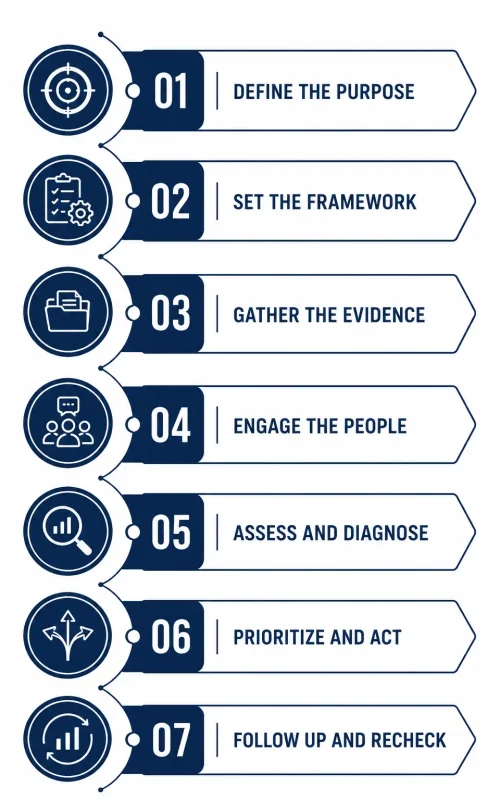
1. Define the Health Check Purpose
Start by clearly establishing why the health check is being conducted. A health check may be required because of emerging performance concerns, a major project milestone, a significant change, a recovery programme, governance requirements, or the need to support an important management decision.
Before starting, define what the assessment is expected to determine and who will use the findings.
A clear purpose helps the assessment remain focused and prevents it from becoming a general project review.
Consider:
- What triggered the health check?
- What decisions need to be supported?
- Which areas require particular attention?
- Who needs to receive the findings?
- What level of independence is appropriate?
The purpose should also determine the scope, depth, timing, and evidence requirements of the assessment.
For example, a health check following a major supplier problem may require greater attention to procurement, commercial exposure, schedule dependencies, and recovery options.
A clearly defined purpose provides direction for everything that follows.
2. Set the Assessment Framework
Once the purpose is clear, establish how project health will be assessed. The framework should define the health dimensions, assessment criteria, evidence requirements, and rating approach that will be used during the review.
Avoid creating an unnecessarily large checklist. The framework should be comprehensive enough to identify meaningful weaknesses while remaining practical for the project’s size and complexity.
A balanced assessment can consider:
- Business case and objectives
- Governance and decision-making
- Scope and requirements
- Schedule and cost
- Risk and issues
- Resources and capability
- Quality and delivery
- Stakeholder engagement
- Procurement and suppliers
Define what Green, Amber, and Red mean before the assessment begins. This reduces subjective interpretation between reviewers.
The criteria should also reflect the project’s lifecycle stage, complexity, risk exposure, and delivery environment.
A good framework creates consistency without preventing professional judgement.
3. Gather the Evidence
A project health check should be based on evidence rather than assumptions or opinions. Begin by collecting the information required to assess the agreed health dimensions.
Review the project’s key management and control information, including:
- Business case and project objectives
- Approved scope and requirements
- Baseline and current schedule
- Cost plan and forecasts
- Risk and issue registers
- Change records
- Quality information
- Resource information
- Procurement and contract records
- Governance and decision records
Do not simply collect documents. Examine whether the information is current, consistent, complete, and credible.
Compare reported performance with actual trends wherever possible. Look for unexplained variances, recurring issues, conflicting information, deteriorating indicators, and assumptions that may no longer be valid.
Where information is unavailable or unreliable, record this as part of the assessment rather than filling the gap with assumptions.
The objective is to build an evidence base that reflects the project’s actual condition, not simply its reported status.
4. Engage the People
Project documents cannot reveal everything happening within a project. People working directly with the project often see problems, tensions, delays, and changing conditions before these become visible in formal reports.
Conduct focused discussions with people who can provide different perspectives, such as:
- Project sponsor
- Project manager
- PMO
- Project controls team
- Technical leads
- Procurement and commercial teams
- Suppliers and contractors
- Users and business representatives
- Key stakeholders
Ask open questions about what is working, what is becoming difficult, where decisions are being delayed, and what concerns may not yet appear in project reporting.
Compare these observations with available evidence rather than accepting individual opinions as facts.
The environment should encourage honest and constructive feedback. People should be able to raise concerns without feeling that the health check is intended to assign blame.
The strongest health checks combine documented evidence with the experience of people closest to the project.
5. Assess and Diagnose
With the evidence and stakeholder perspectives collected, assess the project’s overall condition against the agreed framework.
Do not stop at assigning a Green, Amber, or Red rating. The important question is why the project has reached that condition and what it means for future delivery.
Look for:
- Recurring performance problems
- Increasing risk exposure
- Weak controls
- Delayed decisions
- Resource constraints
- Stakeholder misalignment
- Supplier difficulties
- Scope instability
- Quality deterioration
- Unrealistic assumptions
Where a weakness is identified, investigate its underlying cause. A schedule problem, for example, may actually originate from unresolved design decisions or resource constraints.
Also consider how different weaknesses interact with each other.
Project health is often influenced by connected problems rather than one isolated issue.
The assessment should distinguish between conditions that require immediate intervention, issues that need management attention, and areas that are currently healthy.
The objective is diagnosis—not simply classification.
6. Prioritize and Act
A health check becomes valuable when its findings are converted into practical decisions and corrective actions.
Not every finding requires the same level of intervention. Prioritize issues according to their potential impact on project objectives, urgency, risk exposure, dependencies, and available recovery options.
For significant findings, establish:
- Required action
- Accountable owner
- Priority
- Target completion date
- Expected outcome
- Escalation requirement
Focus first on conditions that could materially affect the project’s ability to deliver its objectives.
Where several findings are connected, address the underlying systemic cause rather than treating each symptom separately.
For example, repeated schedule delays may require changes to decision-making, resource allocation, supplier management, or scope control rather than simply adding schedule recovery activities.
Management should also agree which findings require immediate intervention and which can remain under monitoring.
A health check should lead to decisions that improve project conditions, not merely document weaknesses.
7. Follow Up and Recheck
The health-check process does not end when the assessment report is issued. Corrective actions need to be monitored to determine whether they are actually improving the project’s condition.
Establish a follow-up mechanism that tracks:
- Action completion
- Responsible owners
- Expected improvements
- Changes in project indicators
- Remaining risks
- New warning signs
Do not consider an issue resolved simply because an action has been completed. The important question is whether the action has produced the intended improvement.
For example, completing a recovery plan does not automatically mean that schedule health has improved. The project should examine subsequent performance and determine whether the underlying condition is changing.
If an intervention does not produce the expected result, reassess the underlying cause and determine whether additional action is required.
Capture important lessons from the assessment for future projects and future health checks.
A successful health check creates a continuous feedback loop: assess, act, measure, learn, and reassess.
Practical Example
Putting the Approach Into Practice
A project health check becomes more useful when the assessment is applied to a real project situation rather than treated as a theoretical exercise. The following example shows how the seven-step approach can be used to identify a developing problem and support timely management action.
Project Situation
Consider a large construction project involving the design, procurement, and installation of specialized equipment. The monthly project report shows the overall project as Green. Cost performance is within the approved budget, and the major completion milestone remains achievable according to the current schedule.
However, the project sponsor has requested a health check because several concerns have emerged across the project team.
Step 1 — Define the Purpose
The health check is intended to determine whether the project remains capable of achieving its major completion milestone and whether the current Green status is supported by reliable evidence.
Step 2 — Set the Assessment Framework
The review focuses particularly on schedule, procurement, design coordination, risk, resources, governance, and stakeholder confidence, because these areas have recently shown signs of pressure.
Step 3 — Gather the Evidence
The assessment team reviews the baseline schedule, procurement records, risk register, change log, progress reports, design deliverables, and recent cost forecasts.
The schedule shows that the equipment installation activity has progressively lost float during the previous reporting periods.
Step 4 — Engage the People
Discussions with the procurement team reveal that the supplier has experienced manufacturing difficulties. The engineering team also reports that several design clarifications remain unresolved.
These concerns were not clearly visible in the executive dashboard.
Step 5 — Assess and Diagnose
The assessment identifies a developing dependency:
Design clarification → Manufacturing delay → Equipment delivery risk → Installation pressure → Commissioning risk
The project is therefore not as healthy as its overall Green rating suggests.
Step 6 — Prioritize and Act
The project manager establishes a focused recovery plan involving engineering, procurement, the supplier, and project controls.
Actions include accelerating critical design decisions, increasing supplier monitoring, reviewing installation sequencing, and escalating unresolved decisions.
Step 7 — Follow Up and Recheck
The team monitors equipment manufacturing, design closure, schedule float, and installation readiness during subsequent reporting periods.
The health check has therefore done more than identify a problem. It has challenged the reported project position, identified the underlying causes, created targeted actions, and established a mechanism to confirm whether the project is recovering.
The value of a project health check is demonstrated when it reveals what routine reporting may not show and gives management enough time to act.
Common Mistakes to Avoid
A project health check can lose its value when the assessment is poorly designed, overly focused on reporting, or disconnected from project decision-making. Avoiding these common mistakes helps ensure that the review provides a realistic picture of project health and leads to meaningful action.
Treating the Health Check as a Status Report
A health check should not simply repeat information already available in the monthly project report. Its purpose is to diagnose the underlying condition of the project and determine whether current delivery conditions support successful outcomes.
Focusing Only on Green, Amber, and Red
RAG ratings are useful for communicating project condition, but they should not become the assessment itself. A rating without supporting evidence, explanation, and context can create a false sense of certainty.
Checking Everything Without Prioritization
Reviewing every possible project management area can make the assessment unnecessarily long and difficult to manage. Focus the depth of assessment on the project’s objectives, risks, complexity, lifecycle stage, and current concerns.
Accepting Project Reports Without Challenge
Project reports should be treated as important evidence, but not automatically as the complete truth. Compare reported information with trends, source data, interviews, forecasts, and other available evidence.
Ignoring Qualitative Information
Not every warning appears in a dashboard. Declining stakeholder confidence, poor communication, unresolved tensions, supplier concerns, or hesitation within the project team can provide valuable insight into project health.
Conducting the Review Without Independence
A project team may struggle to objectively challenge its own assumptions. Where appropriate, introduce an independent reviewer or assurance function to provide objective challenge and a different perspective.
Confusing Symptoms With Causes
A delayed milestone, cost increase, or quality problem may only be the visible result of a deeper issue. Investigate the underlying cause before deciding what corrective action is required.
Treating Every Finding as Equally Important
Not every weakness requires immediate intervention. Prioritize findings according to impact, urgency, risk exposure, dependencies, and the project’s ability to recover.
Producing Recommendations Without Owners
A recommendation without an accountable person can easily become another unresolved project action. Significant findings should have a clear owner, priority, deadline, and expected outcome.
Ending the Process After the Report
The health check should not finish when the report is submitted. Follow up on corrective actions and check whether the project’s condition has actually improved.
Repeating the Same Health Check Without Learning
Each assessment should contribute to organizational learning. Capture recurring weaknesses, successful interventions, and lessons about how project health was identified and improved.
Key Takeaways
A project health check should provide more than a periodic status rating. It should give project leaders an evidence-based understanding of the project’s current condition, underlying weaknesses, and ability to achieve its objectives.
- Define the purpose first. Establish why the health check is needed and what decisions the findings should support.
- Assess the whole project. Look beyond cost and schedule to consider governance, scope, risk, resources, quality, stakeholders, procurement, and delivery capability.
- Use reliable evidence. Combine project data, documents, performance trends, interviews, and stakeholder perspectives rather than relying on a single source.
- Challenge the reported position. A Green status does not automatically mean the project is healthy. Test whether the evidence supports the reported assessment.
- Look for root causes. Investigate why weaknesses are occurring rather than simply recording visible symptoms such as delays, cost increases, or quality problems.
- Make the assessment proportionate. Adjust the depth and focus of the health check according to project size, complexity, risk, lifecycle stage, and current concerns.
- Create an open environment. Encourage project participants and stakeholders to raise concerns that may not yet appear in formal reporting.
- Prioritize what matters. Focus management attention on findings that could materially affect project objectives or reduce the project’s ability to recover.
- Turn findings into action. Significant recommendations should have clear owners, priorities, deadlines, and expected outcomes.
- Recheck the project. Confirm whether corrective actions have actually improved project health rather than assuming that completed actions have solved the problem.
A project health check is most valuable when it moves beyond reporting and provides the evidence, insight, and direction needed to improve project performance before weaknesses become major delivery problems.
References
- International Journal of Project Management — Project and Program Diagnostics: A Systemic Approach
- International Journal of Project Management — Project Health and Performance in Saudi Arabian Construction Projects
- International Journal of Managing Projects in Business — Efficiency of Project Health Checks as an Early Warning System
- Journal of Management and Sustainability — A Contemporary Multi-Dimensional Project Health Check Framework
- ResearchGate — Risk Assessment and Project Health Check Tool for IT Projects
- arXiv — A Systematic Literature Review of Project Health Characteristics
- UK Government — Major Projects Authority Assurance Toolkit
- UK National Audit Office — Assurance for High-Risk Projects
- UK National Audit Office — Assurance for Major Projects
- Northern Ireland Department of Finance — Programme and Project Health Checks
- Crossrail Learning Legacy — Risk and Assurance
- Edinburgh Tram Inquiry — Official Report and Findings
FEATURED PROJECT MANAGEMENT GUIDES
Practical Guidance for the Challenges Project Professionals Face
Managing projects requires more than knowing established processes and concepts. Our featured guides focus on practical situations, challenges, and decisions that project professionals encounter, providing clear guidance to help them respond effectively.
How to Set Clear Project Objectives
Establish clear and aligned project objectives when stakeholders have different expectations, priorities, or interpretations of what successful project delivery should achieve.
How to Manage Difficult Project Stakeholders
Learn practical approaches for handling conflicting expectations, difficult conversations, delayed decisions, and stakeholder pressure while keeping the project focused.
How to Identify Early Warning Signs in a Project
Recognize emerging signals of project problems, understand their potential impact, and determine when investigation, corrective action, or escalation may be necessary.
MORE PROJECT MANAGEMENT RESOURCESE TYPES
Continue Your Project Management Learning
Project management knowledge becomes more valuable when you can apply it, see it in practice, and continue developing your capabilities. Explore our other resources to complement the practical guidance provided in these guides.
Templates
Use practical project management templates to structure planning, management, reporting, and other project activities.
Downloads
Access useful project management materials and reference resources to support your learning and day-to-day project work.
Career Roadmaps
Follow structured learning paths to develop project management knowledge, practical skills, and capabilities for your professional growth.
Case Studies
Explore realistic project situations, decisions, challenges, and outcomes to understand how project management practices work in practice.
Glossary
Find clear explanations of project management terminology, concepts, abbreviations, and commonly used professional language.
Insights & Articles
Explore professional perspectives, practical insights, emerging practices, and deeper discussions relevant to project management.
RELATED KNOWLEDGE DOMAINS
Continue Your Learning Across Related Knowledge Domains
Project Management is closely connected with specialized disciplines that support successful planning, execution, governance, performance measurement, and professional growth. Explore related knowledge domains to expand your expertise, develop complementary skills, and access practical resources across the complete project management ecosystem.
Expand your expertise one domain at a time and build a well-rounded project management skill set.
Why Explore Related Domains?
- Develop cross-functional project management expertise
- Discover specialized knowledge beyond core project management
- Access practical resources across interconnected disciplines
- Build a complete professional learning pathway
- Strengthen career readiness through continuous learning
Project Planning & Scheduling
Planning techniques, scheduling methods, and timeline management resources.
Project Controls
Performance measurement, forecasting, and project control best practices.
PMO
Governance, portfolio management, and organizational project excellence.
Risk Management
Risk identification, assessment, mitigation, and monitoring resources.
Primavera P6
Professional planning, scheduling, resource management, and reporting.
Microsoft Project
Project scheduling, tracking, reporting, and collaboration resources.
Power BI
Interactive dashboards, reporting, visualization, and project analytics.
PMI Certifications
Certification guidance, exam preparation, and professional development resources.