
PROJECT MANAGEMENT GUIDE
How to Make Better Project Decisions
Project decisions often involve incomplete information, competing priorities, uncertainty, time pressure, and different stakeholder views. This guide provides a practical approach to define the real problem, evaluate options, challenge assumptions, assess risks, and make better decisions with confidence.
Practical Guide · Project Management
The Decision-Making Challenge
Project managers make decisions throughout the project lifecycle. They decide whether to approve changes, allocate resources, accept risks, adjust schedules, resolve issues, or escalate problems. The quality of these decisions can directly influence project performance. PMI has reported that 47% of unsuccessful projects are impacted by poor decision-making, highlighting the importance of decision quality.
The challenge is becoming greater as projects operate in increasingly complex environments. PMI’s recent research found that 81% of project professionals believe project complexity has increased. Changing technology, diverse stakeholders, competing priorities, regulatory requirements, and uncertainty can all make project decisions more difficult.
Project managers also rarely have perfect information when an important decision is required. They may be working with incomplete data, conflicting recommendations, limited time, and uncertain outcomes. Waiting until every fact is available is often not practical. In some situations, delaying the decision can create a greater project problem than making a decision with reasonable uncertainty.
Human judgement can create another challenge. Research on project decision-making has identified influences such as optimism bias, overconfidence, anchoring, planning fallacy, and escalation of commitment. These can cause experienced professionals to underestimate risks, rely too heavily on previous decisions, or continue with an approach that is no longer producing the expected results.
Better project decisions therefore require more than collecting information or making decisions quickly. They require a structured approach to define the real problem, gather relevant evidence, challenge assumptions, compare options, understand trade-offs, assess risks, involve the right people, and make the decision at the appropriate level.
This guide provides a practical approach to making better project decisions when information is imperfect, opinions differ, uncertainty is high, and the project still needs to move forward.
Why Project Decisions Go Wrong
Project decisions rarely go wrong because of one mistake. They are often influenced by a combination of poor information, uncertainty, competing priorities, human judgement, time pressure, and organizational factors.
Understanding these causes helps a project manager identify where the decision-making process is becoming weak before committing to a course of action.
1. The Problem Is Not Clearly Defined
A project team may start looking for a solution before clearly defining what actually needs to be decided. The visible issue may only be a symptom of a deeper problem.
For example, a delayed activity may lead to an immediate decision to add resources. However, the real cause could be late design information, procurement delays, poor productivity, or an unresolved dependency.
When the problem is incorrectly defined, even a well-executed solution may fail to solve the real issue.
Before asking “What should we do?”, first ask “What exactly are we trying to solve?”
2. Information Is Incomplete, Poor-Quality, or Overwhelming
Project decisions depend on information, but the available information may be incomplete, outdated, inconsistent, or difficult to interpret. In other situations, the project team may have too much information without knowing which data actually matters.
More information does not automatically produce a better decision. The project manager needs information that is relevant, reliable, current, and directly connected to the decision.
The challenge is therefore not simply collecting more data. It is identifying the information that can genuinely improve the quality of the decision.
3. Decisions Are Made Under Uncertainty
Projects involve future outcomes that cannot always be predicted with certainty. Costs may change, risks may occur, suppliers may perform differently than expected, and schedules may shift.
A project manager may therefore need to decide before all the facts are available. Waiting for complete certainty can itself delay action and increase project exposure.
Good decision-making under uncertainty means identifying what is known, what is uncertain, what assumptions are being made, and what level of uncertainty the project can reasonably accept.
4. Stakeholders Have Conflicting Priorities
Different stakeholders may recommend different decisions because they are responsible for different outcomes. A client may prioritize speed, finance may focus on cost, technical teams may prioritize quality, while operations may want minimum disruption.
None of these priorities is necessarily wrong. The difficulty arises when they compete.
Without a clear project objective and decision criteria, stakeholder influence can turn a project decision into a negotiation between competing interests rather than an objective assessment of the available options.
5. Decision Authority Is Unclear
A decision can remain unresolved when people are unsure who has the authority to approve, reject, recommend, or escalate it.
The issue may move between the project manager, sponsor, client, functional manager, steering committee, or another authority while the project continues to wait.
This is a governance problem, not simply a communication problem. Clear decision rights help prevent unnecessary delays and ensure that important decisions are made at the appropriate level.
6. Assumptions Are Treated as Facts
Projects depend on assumptions because the future cannot be known completely. Problems arise when assumptions are not identified, tested, or challenged.
A team may assume that a supplier will recover lost time, resources will become available, costs will remain stable, or a proposed solution will perform as expected.
When these assumptions are treated as facts, the decision can appear more certain than it actually is.
A good decision makes important assumptions visible rather than hiding them.
7. Cognitive and Behavioural Biases Influence Judgement
Even experienced project professionals can be influenced by cognitive biases. Optimism bias, overconfidence, anchoring, confirmation bias, and planning fallacy can affect how information and alternatives are interpreted.
For example, a project manager may focus on information that supports an existing recommendation while giving less attention to evidence that challenges it.
Recognizing these influences does not eliminate bias, but deliberately challenging assumptions and seeking independent perspectives can reduce their effect on important decisions.
8. The Team Becomes Committed to an Earlier Decision
Sometimes a project continues with an approach because significant time, money, or effort has already been invested in it.
This can lead to escalation of commitment. Instead of objectively reconsidering the situation, the team may feel that abandoning the existing approach means admitting that the earlier decision was wrong.
A useful question is:
“If we were making this decision today, knowing what we know now, would we choose the same option?”
This helps separate the current decision from the investment already made.
9. Options and Consequences Are Not Properly Compared
Teams can become attached to the first solution that appears practical. Once a preferred option emerges, alternatives may receive little attention.
However, project decisions often involve trade-offs between cost, schedule, scope, quality, risk, resources, and expected benefits. Improving one area may create pressure somewhere else.
Comparing realistic alternatives makes these trade-offs visible and helps the project manager understand what the project is gaining and what it may be giving up with each option.
10. Time Pressure Encourages Reactive Decisions
Project problems often require quick action. A delayed activity, supplier failure, critical risk, or stakeholder escalation may create pressure to decide immediately.
Speed can be important, but excessive pressure can reduce the time available to consider alternatives, consequences, and risks. The team may simply choose the most familiar or immediately available option.
The objective is not to eliminate fast decisions. It is to match the level of analysis to the importance and urgency of the decision.
11. Group Pressure and Organizational Politics Influence the Decision
Project decisions are sometimes influenced by seniority, organizational relationships, commercial interests, or pressure to maintain agreement.
A technically strong option may receive less support if it conflicts with the interests or expectations of influential stakeholders. Similarly, team members may hesitate to challenge a senior person’s preferred option.
The project manager should create an environment where evidence can be challenged respectfully and where important decisions are evaluated against agreed project objectives rather than personal influence.
12. Decisions Are Not Reviewed and Lessons Are Not Captured
A decision is often considered complete once it has been approved and implemented. However, the expected result may not occur.
If the project team does not review the outcome, it loses an opportunity to understand whether its assumptions were correct, whether the chosen option delivered the expected result, and what should be done differently next time.
A decision should create learning, not just an outcome. Reviewing important decisions helps strengthen future project judgement and improves the organization’s decision-making capability.
What Should You Do?
Making a better project decision does not mean waiting until every piece of information is available. A practical decision process helps you separate the real problem from the symptoms, identify the information that matters, challenge assumptions, compare realistic options, and involve the right people without creating unnecessary delays.
Use the following 7-step approach when an important project decision needs to be made:
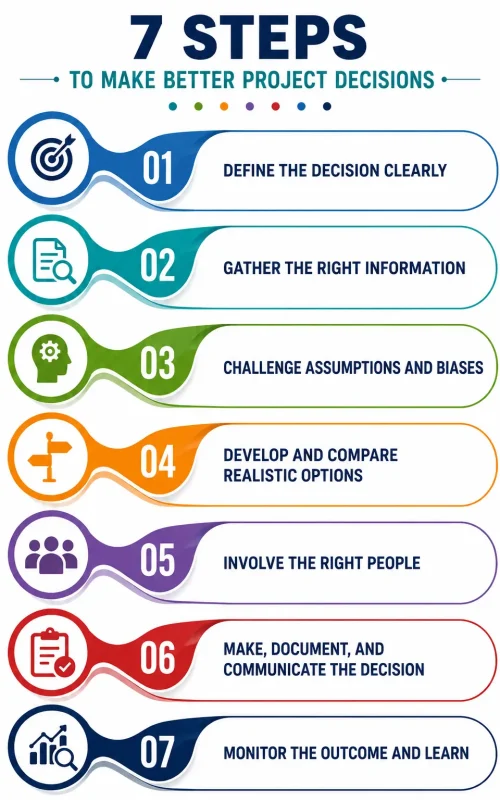
1. Define the Decision Clearly
Before looking for solutions, be clear about what decision actually needs to be made. Project teams can waste time solving the wrong problem when they react to a visible issue without understanding its underlying cause.
Start With the Decision
Ask:
- What exactly needs to be decided?
- Why is this decision required now?
- What project objective does it affect?
- What will happen if no decision is made?
- Who is affected by the decision?
For example, if a project is falling behind, the decision may not simply be “Should we add more resources?” The real decision could be whether to change the sequence of work, revise the delivery approach, reduce scope, add resources, or accept a revised completion date.
Separate the Problem From the Symptom
A clear decision starts with a clear problem. Avoid jumping directly to the first solution that comes to mind.
Define the decision before evaluating the solution.
When the decision is clearly framed, it becomes much easier to identify the right information, compare realistic options, and involve the appropriate people.
2. Gather the Right Information
Once the decision is clearly defined, gather the information that can actually help you make it. The goal is not to collect every available report or dataset. Too much irrelevant information can make the decision slower and less clear.
Focus on What Matters
Look for information such as:
- Current project performance
- Relevant cost and schedule data
- Known risks and constraints
- Previous project experience
- Stakeholder requirements
- Available resources
- Expected impact of each option
Check whether the information is reliable, current, complete, and relevant to the decision. If important information is missing, identify the gap rather than silently making an assumption.
Separate Facts From Assumptions
For example, “The supplier will recover the delay next month” is not a fact unless there is reliable evidence to support it. It may be an assumption that needs to be tested.
Good decisions do not require unlimited information. They require the right information at the right time.
Once the relevant evidence is available, the next step is to challenge the assumptions and biases that may influence how you interpret it.
3. Challenge Assumptions and Biases
Having information does not automatically make a decision objective. Project decisions can be influenced by assumptions, previous experience, personal preferences, and cognitive biases that affect how information is interpreted.
Challenge What You Believe
Before deciding, ask:
- What assumptions are we making?
- What evidence supports them?
- What evidence could prove them wrong?
- Are we giving more weight to information that supports our preferred option?
- Are we relying too heavily on a previous decision or estimate?
Watch for common biases such as optimism bias, anchoring, confirmation bias, overconfidence, and escalation of commitment.
Invite a Different View
Ask someone who understands the project but is not strongly attached to the preferred option to challenge the recommendation. A different perspective can expose risks or assumptions that the core team may have overlooked.
Do not ask only, “Why will this work?” Ask, “What could make this decision wrong?”
Challenging assumptions before committing to an option can prevent a reasonable-looking decision from becoming a costly project problem.
4. Develop and Compare Realistic Options
Once the problem, information, and assumptions are clear, avoid immediately choosing the first solution that appears workable. Develop realistic alternatives and compare what each option could mean for the project.
Look Beyond the Obvious Solution
For each option, consider its potential effect on:
- Cost
- Schedule
- Scope
- Quality
- Risk
- Resources
- Expected benefits
For example, if a project is behind schedule, adding resources may be one option. Other options could include resequencing activities, reducing non-critical scope, changing the delivery approach, or accepting a revised milestone.
Compare the Trade-Offs
There may not be a perfect option. One alternative may reduce schedule pressure but increase cost. Another may protect the budget but increase risk or extend the completion date.
The objective is to understand these trade-offs before committing.
Do not ask only, “Which option is best?” Ask, “Which option provides the most acceptable outcome for the project’s objectives and constraints?”
A structured comparison makes the decision more transparent and reduces the risk of choosing an option simply because it was the first or most familiar solution.
5. Involve the Right People
A project manager does not need to make every decision alone. The right people can provide technical knowledge, business context, project experience, or decision authority that improves the quality of the outcome.
Involve People for a Reason
Consider who can:
- Provide important information or expertise
- Explain potential project impacts
- Identify risks or constraints
- Represent affected stakeholders
- Approve or authorize the decision
- Take responsibility for implementation
The goal is not to involve everyone. Bringing too many people into a decision can create unnecessary discussion, delay, and pressure to reach an easy consensus.
Know When to Decide
If the decision falls within your authority and you have sufficient information, make it rather than unnecessarily passing it upward. If the decision exceeds your authority, has significant business impact, or requires governance approval, involve the appropriate decision-maker early.
Involve the people who can improve the decision—not simply the people who want to be part of it.
The right involvement gives the decision stronger evidence, clearer accountability, and greater support during implementation.
6. Make, Document, and Communicate the Decision
Once the options have been evaluated and the right people have been involved, the project needs to make a clear decision and move forward. Continuing to discuss the same issue without reaching a decision can create delays and uncertainty.
Make the Decision Clearly
Confirm:
- What has been decided
- Why this option was selected
- What assumptions influenced the decision
- Who is responsible for the next actions
- When the actions need to be completed
The decision should be made at the appropriate authority level. If approval is required from a sponsor, client, or governance body, ensure that approval is obtained before implementation.
Document the Reasoning
Record the important facts, options considered, key risks, assumptions, and reasons behind the decision. This creates a clear reference if the decision is questioned later and helps prevent people from interpreting the decision differently.
Then communicate the decision to the people who need to act on it.
A decision creates value only when people understand it, accept their responsibilities, and know what happens next.
7. Monitor the Outcome and Learn
Making the decision is not the end of the process. Once the decision is implemented, monitor whether it is producing the result that was expected. A decision that looked appropriate at the time may need adjustment when new information or project conditions emerge.
Check What Actually Happened
Compare the outcome against the expectations established when the decision was made:
- Did the expected result occur?
- Did the decision create any unexpected problems?
- Are the cost, schedule, quality, or risk impacts acceptable?
- Have the original assumptions changed?
- Does any corrective action need to be taken?
Do not treat a different outcome automatically as a failed decision. Project conditions can change after the decision is made. What matters is whether the team recognizes the change and responds appropriately.
Capture the Learning
For important decisions, record what worked, what did not, and what should be considered differently in future situations. This turns individual project experience into organizational learning.
A good decision-making process does not end with the decision. It ends when the outcome is understood and the learning is captured.
Practical Example
Putting the Approach Into Practice
A construction project is six weeks behind schedule. The project team is under pressure from the client to recover the delay without changing the contractual completion date. The project manager is considering adding additional crews and working extended hours, but this would significantly increase project cost.
1. Define the decision:
The project manager first identifies that the decision is not simply whether to add resources. The real decision is how to recover the schedule while protecting the project’s critical objectives.
2. Gather the right information:
The team reviews the current schedule, critical path, productivity data, remaining work, resource availability, cost implications, and contractual milestones.
3. Challenge assumptions:
The team questions whether additional resources will actually recover six weeks. They also test the assumption that extended working hours will produce the expected productivity.
4. Compare options:
Several options are assessed, including additional resources, resequencing activities, selective overtime, and accepting a revised milestone. Each option is compared against cost, schedule, quality, safety, and risk.
5. Involve the right people:
The project manager involves the planning team, construction manager, commercial team, client representative, and relevant subcontractors to validate the options.
6. Make and communicate the decision:
The team selects a combination of resequencing and targeted additional resources. The decision, assumptions, responsibilities, and recovery targets are documented and communicated.
7. Monitor and learn:
Weekly recovery metrics are established to determine whether the chosen approach is producing the expected improvement. If recovery falls below target, the strategy is reassessed rather than continuing simply because it was the original decision.
The lesson: A better decision did not come from having perfect information. It came from defining the real problem, challenging assumptions, comparing alternatives, involving the right people, and monitoring the result.
Common Mistakes to Avoid
Even experienced project professionals can make poor decisions when they are under pressure or too closely attached to a preferred solution. Avoiding these common mistakes can improve decision quality and reduce unnecessary project risk.
Making the Decision Before Defining the Problem
Jumping directly to a solution can result in treating the symptom rather than the actual problem. Clearly define what needs to be decided before evaluating possible solutions.
Collecting Too Much Information
More information does not always create better decisions. Large amounts of irrelevant, outdated, or conflicting data can make the situation harder to understand. Focus on information that directly supports the decision.
Waiting for Complete Certainty
Project decisions often need to be made with incomplete information. Waiting for every uncertainty to disappear can allow risks, delays, or costs to grow. Identify the important uncertainties and decide what level of uncertainty is acceptable.
Relying Only on the First Solution
The first workable option may not be the best option. Develop realistic alternatives and compare their consequences before committing.
Ignoring Contradictory Evidence
Once a preferred option has been identified, teams may focus on information that supports it. Actively look for evidence that challenges the recommendation.
Allowing Seniority to Replace Evidence
A senior stakeholder’s opinion can be valuable, but authority should not automatically replace analysis. Important decisions should still be evaluated against project objectives, evidence, risks, and constraints.
Continuing With a Decision Because of Past Investment
Money and effort already spent should not determine whether an approach remains appropriate. Evaluate the option based on what the project needs now, not simply what has already been invested.
Delaying Decisions Without a Clear Reason
Some decisions are postponed because the team hopes more information will eventually appear. If the available evidence is sufficient to act, unnecessary delay can create additional project impact.
Failing to Document the Decision
If the decision, assumptions, responsibilities, and reasoning are not recorded, people may later disagree about what was decided or why. Important decisions should have a clear reference point.
Never Reviewing the Outcome
A decision should not disappear from attention after approval. Monitor the result and determine whether the expected outcome was achieved. This allows the project team to correct the course and improve future decisions.
Key Takeaways
Better project decisions come from a disciplined process rather than intuition alone. You do not need perfect information, but you do need to understand the problem, challenge your assumptions, consider the alternatives, and remain accountable for the outcome.
- Define the decision first. Make sure you are solving the right problem rather than reacting to its symptoms.
- Use the right information. Focus on relevant, reliable, and current evidence instead of simply collecting more data.
- Challenge assumptions and bias. Ask what could make your preferred option wrong.
- Compare realistic alternatives. Understand the trade-offs across cost, schedule, scope, quality, risk, resources, and benefits.
- Involve the right people. Use the knowledge, expertise, and authority needed to improve the decision without creating unnecessary delays.
- Decide at the right level. Make decisions within your authority and escalate those requiring wider governance or approval.
- Document the reasoning. Record important assumptions, options, risks, and responsibilities so the decision remains clear.
- Monitor what happens next. A decision should be reviewed against its expected outcome and adjusted when circumstances change.
- Learn from the result. Every significant decision can improve the way future project decisions are made.
A better project decision is not necessarily the decision with the most information or the fastest answer. It is a decision made deliberately, using the best available evidence, clear judgement, understood trade-offs, and a willingness to learn from the outcome.
References
- PMI — Pulse of the Profession: Capture the Value of Project Decision-Making
- PMI — Critical Decision-Making Skills for Project Managers
- PMI — Better, Faster Project Decisions
- PMI — Risk Analysis and Decisions in Uncertain Times
- PMI — Project Governance and Decision Making
- OECD — Evidence-Informed Infrastructure Decision-Making
- Flyvbjerg — How Planning Fallacy and Optimism Bias Affect Projects
- Project Management Journal — Project Governance and Decision-Making
- International Journal of Project Management — Information and Project Decision-Making
- International Journal of Project Management — Project Decision-Making and Organizational Context
- Project Management Journal — Escalation of Commitment in Projects
- Construction Project Research — Optimism Bias, Risk and Infrastructure Decisions
FEATURED PROJECT MANAGEMENT GUIDES
Practical Guidance for the Challenges Project Professionals Face
Managing projects requires more than knowing established processes and concepts. Our featured guides focus on practical situations, challenges, and decisions that project professionals encounter, providing clear guidance to help them respond effectively.
How to Set Clear Project Objectives
Establish clear and aligned project objectives when stakeholders have different expectations, priorities, or interpretations of what successful project delivery should achieve.
How to Take Control of a Project That Is Falling Behind
Understand why a project is falling behind, assess the underlying situation, and determine practical actions to stabilize delivery and regain control.
How to Manage Difficult Project Stakeholders
Learn practical approaches for handling conflicting expectations, difficult conversations, delayed decisions, and stakeholder pressure while keeping the project focused.
MORE PROJECT MANAGEMENT RESOURCESE TYPES
Continue Your Project Management Learning
Project management knowledge becomes more valuable when you can apply it, see it in practice, and continue developing your capabilities. Explore our other resources to complement the practical guidance provided in these guides.
Templates
Use practical project management templates to structure planning, management, reporting, and other project activities.
Downloads
Access useful project management materials and reference resources to support your learning and day-to-day project work.
Career Roadmaps
Follow structured learning paths to develop project management knowledge, practical skills, and capabilities for your professional growth.
Case Studies
Explore realistic project situations, decisions, challenges, and outcomes to understand how project management practices work in practice.
Glossary
Find clear explanations of project management terminology, concepts, abbreviations, and commonly used professional language.
Insights & Articles
Explore professional perspectives, practical insights, emerging practices, and deeper discussions relevant to project management.
RELATED KNOWLEDGE DOMAINS
Continue Your Learning Across Related Knowledge Domains
Project Management is closely connected with specialized disciplines that support successful planning, execution, governance, performance measurement, and professional growth. Explore related knowledge domains to expand your expertise, develop complementary skills, and access practical resources across the complete project management ecosystem.
Expand your expertise one domain at a time and build a well-rounded project management skill set.
Why Explore Related Domains?
- Develop cross-functional project management expertise
- Discover specialized knowledge beyond core project management
- Access practical resources across interconnected disciplines
- Build a complete professional learning pathway
- Strengthen career readiness through continuous learning
Project Planning & Scheduling
Planning techniques, scheduling methods, and timeline management resources.
Project Controls
Performance measurement, forecasting, and project control best practices.
PMO
Governance, portfolio management, and organizational project excellence.
Risk Management
Risk identification, assessment, mitigation, and monitoring resources.
Primavera P6
Professional planning, scheduling, resource management, and reporting.
Microsoft Project
Project scheduling, tracking, reporting, and collaboration resources.
Power BI
Interactive dashboards, reporting, visualization, and project analytics.
PMI Certifications
Certification guidance, exam preparation, and professional development resources.