
PROJECT MANAGEMENT GUIDE
How to Set Clear Project Objectives
Projects can lose direction when objectives are vague, unrealistic, poorly measured, or not aligned with stakeholder expectations. This guide provides a practical approach to define meaningful outcomes, set measurable objectives, establish clear priorities, align stakeholders, and keep project objectives relevant throughout delivery.
Practical Guide · Project Management
The Project Objective Challenge
A project can have a strong team, detailed schedule, and sufficient resources, yet still struggle when the objective itself is unclear or poorly aligned. Research across construction, infrastructure, IT, healthcare, energy, and public-sector projects shows that setting objectives is not simply an initiation activity—it influences how teams plan, prioritize, make decisions, and measure success.
Studies have found that shared project objectives and effective communication are associated with better project outcomes, while research on project success shows that success extends beyond traditional measures such as cost, time, and scope. Projects can meet their delivery targets and still fail to achieve the business outcomes they were created to deliver.
Why Is This Difficult?
Project teams commonly face:
- Unclear business needs — the project starts with a solution before the real problem is defined.
- Output-focused objectives — teams describe what they will deliver rather than what they need to achieve.
- Different stakeholder expectations — sponsors, clients, users, and delivery teams may define success differently.
- Unrealistic targets — objectives may not match available time, budget, resources, or organizational capability.
- Poor measurement — objectives use words such as improve, enhance, or optimize without defining what success means.
- Conflicting priorities — cost, schedule, quality, scope, risk, and business benefits may compete.
- Changing conditions — business priorities, regulations, technology, and stakeholder expectations can change during delivery.
The problem can become even greater in large projects involving multiple organizations. An objective understood by the sponsor may be interpreted differently by consultants, contractors, suppliers, and end users.
A clear project objective therefore needs more than a well-written statement. It needs a clear purpose, a defined outcome, measurable success criteria, realistic targets, agreed priorities, stakeholder alignment, and a way to remain relevant throughout the project lifecycle.
This guide provides a practical approach to setting project objectives that can actually guide planning, support decisions, align stakeholders, and provide a clear measure of project success.
Why Project Objectives Become Unclear
Project objectives can become unclear long before the project starts showing visible problems. The causes are often connected: an unclear business need can lead to a weak objective, which can then create conflicting expectations, poor measurement, and difficulty making decisions during execution.
1. The Business Need Is Not Clearly Understood
Projects sometimes begin with a management request or a proposed solution before the underlying business problem has been properly defined.
For example, “Implement a new project management system” describes a solution, but it does not explain what the organization wants to achieve. Is the purpose to improve reporting, reduce forecasting errors, increase visibility, or standardize project controls?
When the business need is unclear, the project objective can become a description of what will be delivered rather than what should be achieved.
Start with the problem or opportunity before defining the project objective.
2. Outputs Are Confused With Outcomes
A project may define its objective as building a facility, implementing software, or launching a new process. These are outputs.
The actual objective may be the result expected from those outputs.
Output: Implement a customer-service platform.
Outcome: Reduce average response time from 24 hours to 8 hours.
Without this distinction, a project can deliver everything in its scope and still fail to create the expected business value.
3. Different Stakeholders Define Success Differently
Sponsors, clients, users, project teams, contractors, and functional managers can have different expectations.
One stakeholder may prioritize cost, another schedule, another quality, and another business benefits.
If these expectations are not aligned early, the project may technically have an approved objective while different people are working toward different interpretations of success.
A clear objective needs shared understanding, not just formal approval.
4. Objectives Are Written Too Broadly
Words such as improve, enhance, optimize, strengthen, modernize, and increase efficiency sound positive but often provide little direction.
For example:
“Improve project reporting.”
Improve it by how much? For whom? By when? Which aspect of reporting needs improvement?
Broad objectives make it difficult to establish priorities, assign accountability, and measure success.
5. Objectives Are Not Measurable
Without meaningful measures, the team may reach project closure without being able to determine whether the intended result was achieved.
Compare:
Reduce project delays.
with:
Reduce average schedule variance from 12% to below 5% within six months.
The second provides a basis for measuring progress and determining success.
6. Objectives Are Unrealistic
An objective can be specific and measurable while still being impossible or highly impractical to achieve.
For example:
Complete the project three months earlier without additional resources or budget.
The target is clear, but the project may not have the capacity to achieve it.
Objectives should be tested against time, budget, resources, technology, dependencies, risks, and organizational capability before they are committed.
7. Too Many Priorities Are Treated as Equally Important
Projects often try to optimize everything at the same time:
- Reduce cost
- Accelerate delivery
- Increase quality
- Reduce risk
- Expand scope
- Improve customer experience
These objectives can conflict.
When priorities are not established, the team may struggle when a trade-off becomes unavoidable.
Clear objectives should identify what matters most when everything cannot be optimized simultaneously.
8. Objectives Are Not Connected to Business Strategy
A project may have a well-written objective but still fail to support the organization’s wider direction.
For example, a project may be designed to reduce operating costs while the organization’s strategy is shifting toward higher service quality and customer experience.
The project objective should therefore have a clear connection between:
Business strategy → Business need → Project outcome → Project objective
9. The Objective Is Defined Around a Preferred Solution
Sometimes the organization decides what it wants to implement before deciding what it actually needs to achieve.
For example:
“We need to implement an AI forecasting system.”
The underlying objective might actually be:
“Improve demand-forecast accuracy from 70% to 85% within 12 months.”
The second statement defines the result and allows different solutions to be evaluated.
Define the outcome before becoming committed to the solution.
10. Stakeholder Objectives Are Not Translated Into Project Objectives
Senior management may establish a broad objective such as:
Improve operational efficiency.
The project team then needs to translate this into a specific, measurable result that can guide execution.
Without this translation, the objective may remain too strategic for the delivery team to use.
A useful chain is:
Business Goal → Desired Outcome → Project Objective → Deliverables → Measures
11. Objectives Change Without Proper Governance
Business priorities, regulations, technology, budgets, and stakeholder expectations can change during a project.
Changing an objective is not necessarily wrong. The problem occurs when objectives change informally without assessing the effect on scope, schedule, cost, resources, risks, and expected benefits.
Objective changes should therefore be properly assessed, justified, approved, and communicated.
12. The Objective Is Forgotten After Project Initiation
This is one of the most practical problems.
The objective may be clearly documented in the project charter, but once execution begins, attention shifts to schedules, tasks, issues, procurement, changes, and daily problems.
The objective stops guiding decisions.
A useful question throughout execution is:
“Does this decision or change help us achieve the project objective?”
A project objective should not be something the team writes at the beginning and forgets. It should remain a reference point throughout the project lifecycle.
What Should You Do?
Setting a clear project objective is more than writing a statement during project initiation. A strong objective should give the project team a clear direction for planning, prioritization, decision-making, and measuring success.
Use the following seven-step approach to turn a broad business need into an objective that the project team can understand, measure, and use throughout delivery.
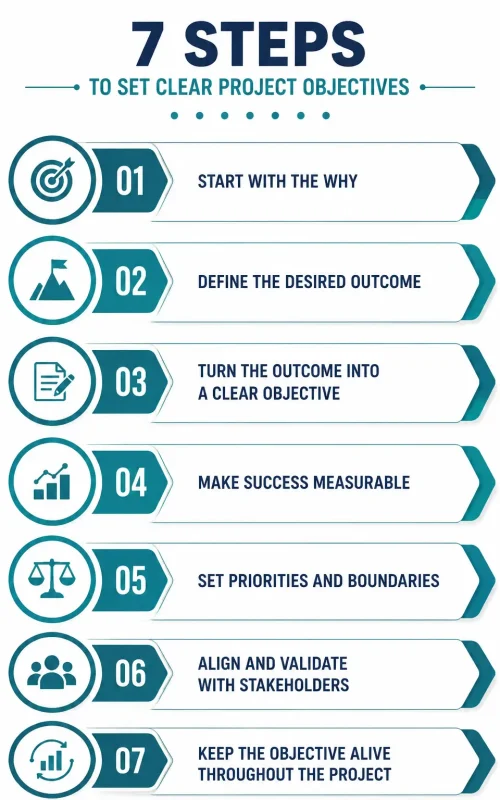
1. Start With the Why
A clear project objective starts with understanding why the project exists. Before defining targets or deliverables, identify the business problem, opportunity, or need that is driving the project.
Understand the Business Need
Start by identifying:
- What problem needs to be addressed?
- Why is it important now?
- What happens if the problem is not addressed?
- What business outcome is expected?
- How does the project support the organization’s priorities?
This prevents the team from defining the objective around a solution too early.
For example, implementing a new project reporting system is a solution or deliverable. The underlying need may be to reduce reporting delays, improve management visibility, or increase forecast accuracy.
Focus on the Reason, Not the Solution
When the business need is clear, the project team has greater flexibility to evaluate different ways of achieving the desired result.
A useful sequence is:
Business Need → Desired Outcome → Project Objective → Deliverables
This creates a clear connection between why the project is required and what it is expected to achieve.
Define the reason first. The solution should come later.
2. Define the Desired Outcome
Once the reason for the project is clear, define what meaningful change the project is expected to create. The desired outcome should describe the result the organization wants—not simply the work the project team will perform.
Focus on the Change
Ask:
- What should be different after the project?
- Who should benefit from the change?
- What improvement is expected?
- How will the organization know the change has occurred?
For example, implementing a project management system is an output. The desired outcome could be faster reporting, better project visibility, or improved forecast accuracy.
This distinction is important because a project can deliver its planned outputs without achieving the intended business outcome.
Connect the Outcome to the Need
The desired outcome should provide a clear link between the original business need and the objective that will eventually be established.
Business Need → Desired Outcome → Project Objective
Keep the outcome focused on the result or change, rather than the activities required to produce it.
A well-defined outcome gives the project team a clear direction and creates a strong foundation for developing a specific and measurable project objective.
First define the change you want to achieve. Then define exactly how the project will achieve it.
3. Turn the Outcome Into a Clear Objective
Once the desired outcome is understood, translate it into a clear project objective that the project team can use to guide planning and execution.
The objective should state what the project intends to achieve, rather than simply describing the activities or deliverables involved.
Make the Objective Specific
A clear objective should help the team understand:
- What needs to be achieved
- Who or what will be affected
- What level of improvement is expected
- When the result should be achieved
For example, instead of improve project reporting, a stronger objective could be:
Reduce monthly project reporting preparation time from five working days to two working days by the end of Q4.
This gives the team a much clearer direction.
Remove Ambiguity
Avoid relying on broad terms such as improve, enhance, optimize, strengthen, or modernize unless they are supported by a defined result.
The objective should be understandable to someone who is not deeply involved in the project.
It should also remain focused on the result, rather than prescribing a particular solution unless the solution itself is an unavoidable project requirement.
A good project objective tells the team what success should look like—not simply what work needs to be completed.
4. Make Success Measurable
A project objective becomes useful when the team can determine whether it has actually been achieved. Without clear measures, different stakeholders may have different opinions about whether the project was successful.
Define How Success Will Be Measured
For each objective, identify:
- What will be measured
- The current baseline
- The target to be achieved
- When the target should be achieved
- How the result will be verified
For example, improve project reporting efficiency is difficult to assess on its own. A measurable objective could target a reduction in monthly reporting preparation time from five working days to two.
The measure should relate directly to the intended outcome. Avoid selecting metrics simply because the data is easy to collect.
Establish a Clear Basis for Success
A useful structure is:
Measure → Baseline → Target → Timeframe → Evidence
The baseline shows where the project is starting. The target defines the expected improvement, while the timeframe establishes when the result should be achieved.
Measurement also helps during execution. Instead of waiting until project closure, the team can track progress and identify whether the objective is still achievable.
If the team cannot clearly explain how success will be measured, the objective probably needs more work.
5. Set Priorities and Boundaries
Projects often have several objectives, but not every objective can have equal priority. Cost, schedule, scope, quality, risk, resources, and business benefits may compete with each other during delivery.
Decide What Matters Most
Before the project begins, establish:
- What must be achieved
- What can be adjusted if necessary
- Which constraints must be protected
- What is outside the project
- Which priorities take precedence when objectives conflict
For example, a project may aim to reduce cost while also accelerating delivery. If achieving both is unrealistic, the project team needs to know which objective has greater priority.
Without this clarity, different stakeholders may make different decisions based on their own interpretation of what matters most.
Define the Boundaries
Clear boundaries are equally important. A project objective should not become so broad that every related request is treated as part of the project.
Define what the project will achieve and will not attempt to achieve.
This helps control scope, manage expectations, and provide a consistent basis for evaluating changes.
Clear priorities tell the team what to protect. Clear boundaries tell the team where the project stops.
6. Align and Validate With Stakeholders
A project objective should not be considered clear simply because it has been written and approved. The people who sponsor, deliver, use, or are affected by the project should have a common understanding of what the objective means and what success looks like.
Bring the Right People Together
Review the objective with relevant stakeholders and confirm:
- What the project is expected to achieve
- Why the outcome matters
- How success will be measured
- Which priorities must be protected
- What the project will and will not cover
- Who is accountable for achieving the result
Pay particular attention to differences in expectations. A sponsor may focus on business benefits, while the delivery team may focus on scope and the end user may focus on usability or service quality.
Resolve Differences Early
Do not assume that stakeholder agreement means everyone simply says yes. Ask questions and identify different interpretations before the project moves too far into execution.
Where expectations conflict, use the project’s priorities, business case, constraints, and success criteria to reach a clear position.
Stakeholder alignment turns an objective from a project statement into a shared commitment.
Once the objective is agreed, communicate it clearly to the wider project team so that everyone understands what the project is trying to achieve and how their work contributes to it.
7. Keep the Objective Alive Throughout the Project
Defining and approving the objective is not the end of the process. The objective should remain a reference point throughout project planning and delivery.
Use the Objective to Guide Decisions
When the project team faces a change, risk, new requirement, or competing priority, ask:
- Does this support the project objective?
- Does it improve the expected outcome?
- Does it introduce a conflict with an existing priority?
- Will it affect the agreed success measures?
- Does it require the objective itself to change?
This helps prevent the project from gradually moving away from its original purpose.
Review When Circumstances Change
Business priorities, regulations, technology, budgets, stakeholder expectations, and external conditions can change during delivery. The objective may therefore need to be reviewed.
However, changes should not happen informally. Assess the impact on scope, cost, schedule, resources, risks, and expected benefits, and use the appropriate governance process before changing the agreed objective.
Keep the Team Connected to the Outcome
Project schedules and task lists tell people what needs to be done. The objective reminds them why the work matters.
Regularly connecting project activities and decisions back to the objective helps maintain focus and prevents unnecessary work from becoming part of the project.
A clear objective should guide the project from initiation to completion—not simply remain inside the project charter.
Practical Example
Putting the Approach Into Practice
An organization is experiencing delays in monthly project reporting. Reports take several days to prepare, information is collected manually from different teams, and senior management often receives project performance information later than needed.
Management proposes implementing a new project reporting platform.
Instead of immediately defining the objective as implement a new reporting platform, the project team applies the seven-step approach.
1. Start With the Why
The underlying problem is slow and inconsistent project reporting, which limits management visibility and delays decision-making.
2. Define the Desired Outcome
The organization wants faster, more consistent, and more reliable project performance information for management.
3. Turn the Outcome Into a Clear Objective
The team defines an objective to reduce monthly project reporting preparation time from five working days to two working days by the end of Q4.
4. Make Success Measurable
The baseline is five working days. The target is two working days. The project team also establishes measures for reporting accuracy and on-time report availability.
5. Set Priorities and Boundaries
Faster reporting is the primary objective. The project will improve the reporting process but will not redesign the organization’s entire project management system.
6. Align and Validate With Stakeholders
Project managers, finance, senior management, and reporting users review the objective and agree on the expected outcome and measures.
7. Keep the Objective Alive
During implementation, new requests are assessed against the objective. Features that do not contribute to faster, more reliable reporting are challenged or deferred.
The result: The project is no longer simply about implementing a technology platform. It has a clear business purpose, measurable outcome, defined boundaries, and agreed success criteria.
Common Mistakes to Avoid
Even a well-planned project can lose direction when objectives are poorly defined, misunderstood, or no longer used during delivery. Avoiding these common mistakes can make project objectives more useful and actionable.
Starting With the Solution
Defining the project around a preferred technology, system, or delivery method can hide the actual business need.
Define the problem and desired outcome before selecting the solution.
Confusing Deliverables With Objectives
Completing a system, facility, report, or training program does not automatically mean the project achieved its intended outcome.
Separate what the project delivers from what the organization expects to achieve.
Using Vague Language
Words such as improve, enhance, optimize, and strengthen can make objectives difficult to measure.
Replace broad statements with specific outcomes and measurable targets.
Setting Unrealistic Targets
Ambitious objectives can be useful, but targets that ignore available resources, time, budget, dependencies, or organizational capability can set the project up for failure.
Test feasibility before committing to the objective.
Treating Every Priority as Equal
Trying to maximize cost, schedule, quality, scope, and benefits simultaneously can create conflicting expectations.
Identify which objectives have priority when trade-offs are unavoidable.
Assuming Stakeholder Agreement
An approved objective does not guarantee that everyone interprets it in the same way.
Validate the objective with the people who sponsor, deliver, use, and are affected by the project.
Changing Objectives Without Governance
Objectives may legitimately change, but informal changes can gradually move the project away from its original purpose.
Assess the impact and follow the appropriate change and governance process.
Forgetting the Objective During Execution
Teams can become focused on tasks, schedules, issues, and deliverables while losing sight of the intended outcome.
Use the objective as a reference point for major decisions, changes, and priorities.
Measuring Only Project Delivery
Completing the planned scope on time and within budget does not necessarily prove that the project created the expected business value.
Measure both delivery performance and the outcome the project was created to achieve.
Setting Objectives Without a Clear Baseline
A target has limited meaning if the team does not know where it is starting.
Establish a baseline before defining the expected improvement.
Key Takeaways
Clear project objectives give the team a shared direction and provide a practical basis for planning, decision-making, prioritization, and measuring success.
- Start with the why. Understand the business problem, opportunity, or need before defining the project.
- Focus on the outcome. Define the meaningful change the organization expects, not just what the project will deliver.
- Make the objective specific. State clearly what the project is expected to achieve, for whom, and by when.
- Make success measurable. Establish a baseline, target, timeframe, and evidence for determining whether the objective has been achieved.
- Set priorities and boundaries. Identify what matters most and what falls outside the project’s objective.
- Align stakeholders. Make sure sponsors, project teams, users, and other key stakeholders share the same understanding of success.
- Test feasibility. Ensure the objective is realistic given the available time, budget, resources, capabilities, dependencies, and risks.
- Keep the objective visible. Use it to guide major decisions, changes, priorities, and trade-offs throughout delivery.
- Govern objective changes. When circumstances require a change, assess its impact before modifying the agreed objective.
- Measure the outcome, not just delivery. Completing the planned scope does not automatically mean the project achieved its intended business value.
A clear objective is more than a statement in a project charter. It is the reference point that connects the business need to the project’s expected outcome and keeps the team focused on what success actually means.
References
- UK Government — Guide for Effective Benefits Management in Major Projects
- UK National Audit Office — Understanding Challenges in Delivering Project Objectives
- OECD — Infrastructure Governance
- World Bank Independent Evaluation Group — Clarifying Objectives and Fixing Weak Results Frameworks
- International Journal of Project Management — Project Success: A Multidimensional Strategic Concept
- International Journal of Project Management — Defining Success for Software Projects
- International Journal of Project Management — Business and Project Strategy Alignment
- Construction Economics and Building — Boosting Project Outcomes Through Goal Alignment: A Case Study of Vietnam
- Buildings — Goal Alignment Through Inter-Organizational Incentives: A Case Study of a Hydropower Project
- ASCE — Critical Success Factors in Construction Projects
- Crossrail Learning Legacy — Collaboration at Crossrail
- Springer — Quantitative Risk Management in Gas Injection Project: Oman Case Study
- PMI — Project Success Measures: Evolution and Interpretation
- PMI — Systems Engineering and Architecture Case Study
- ResearchGate — Implementation of an ERP System: A Case Study of a Full-Scope SAP Project
- ResearchGate — Benefits Realisation and Its Contributions for Achieving Project Outcomes
- ResearchGate — An International Railway Project: A Project Management Case Study
- IGLC — Huarmey Hospital Project: Measurable Project Targets and VDC
FEATURED PROJECT MANAGEMENT GUIDES
Practical Guidance for the Challenges Project Professionals Face
Managing projects requires more than knowing established processes and concepts. Our featured guides focus on practical situations, challenges, and decisions that project professionals encounter, providing clear guidance to help them respond effectively.
How to Make Better Project Decisions
Use a structured approach to understand project situations, evaluate available options, involve the right people, and make timely decisions with greater confidence.
How to Identify Early Warning Signs in a Project
Recognize emerging signals of project problems, understand their potential impact, and determine when investigation, corrective action, or escalation may be necessary.
How to Conduct a Project Health Check
Assess the overall condition of a project, identify emerging concerns, and determine where attention or corrective action is needed to protect project outcomes.
MORE PROJECT MANAGEMENT RESOURCESE TYPES
Continue Your Project Management Learning
Project management knowledge becomes more valuable when you can apply it, see it in practice, and continue developing your capabilities. Explore our other resources to complement the practical guidance provided in these guides.
Templates
Use practical project management templates to structure planning, management, reporting, and other project activities.
Downloads
Access useful project management materials and reference resources to support your learning and day-to-day project work.
Career Roadmaps
Follow structured learning paths to develop project management knowledge, practical skills, and capabilities for your professional growth.
Case Studies
Explore realistic project situations, decisions, challenges, and outcomes to understand how project management practices work in practice.
Glossary
Find clear explanations of project management terminology, concepts, abbreviations, and commonly used professional language.
Insights & Articles
Explore professional perspectives, practical insights, emerging practices, and deeper discussions relevant to project management.
RELATED KNOWLEDGE DOMAINS
Continue Your Learning Across Related Knowledge Domains
Project Management is closely connected with specialized disciplines that support successful planning, execution, governance, performance measurement, and professional growth. Explore related knowledge domains to expand your expertise, develop complementary skills, and access practical resources across the complete project management ecosystem.
Expand your expertise one domain at a time and build a well-rounded project management skill set.
Why Explore Related Domains?
- Develop cross-functional project management expertise
- Discover specialized knowledge beyond core project management
- Access practical resources across interconnected disciplines
- Build a complete professional learning pathway
- Strengthen career readiness through continuous learning
Project Planning & Scheduling
Planning techniques, scheduling methods, and timeline management resources.
Project Controls
Performance measurement, forecasting, and project control best practices.
PMO
Governance, portfolio management, and organizational project excellence.
Risk Management
Risk identification, assessment, mitigation, and monitoring resources.
Primavera P6
Professional planning, scheduling, resource management, and reporting.
Microsoft Project
Project scheduling, tracking, reporting, and collaboration resources.
Power BI
Interactive dashboards, reporting, visualization, and project analytics.
PMI Certifications
Certification guidance, exam preparation, and professional development resources.