
PROJECT MANAGEMENT GUIDE
How to Manage Difficult Project Stakeholders
Stakeholder conflicts can arise from competing priorities, unclear expectations, changing requirements, communication gaps, and lack of trust. This guide provides a practical approach to understand what is driving difficult stakeholder behaviour, address concerns, build alignment, and keep the project moving forward.
Practical Guide · Project Management
The Stakeholder Challenge
Projects are becoming more complex, and managing stakeholders has become more challenging with them. PMI’s recent research found that 81% of project professionals believe project complexity has increased, with competing interests, diverse stakeholder groups, political dynamics, and misaligned objectives contributing to this challenge.
Today’s projects can involve clients, contractors, suppliers, regulators, internal teams, communities, end users, and senior decision-makers. Each stakeholder may have different priorities, expectations, responsibilities, concerns, and levels of influence. Some stakeholders may have significant influence over project decisions without being under the project manager’s direct authority.
During execution, these differences can create practical problems. A stakeholder may delay an important decision, repeatedly change requirements, challenge project information, resist a proposed change, withhold cooperation, or escalate concerns. Communication gaps and lack of trust can make these situations even more difficult to resolve.
A stakeholder issue that appears small at first can gradually affect the wider project. Delayed decisions can hold up dependent activities. Changing requirements can create rework. Conflicting expectations can consume management time. Resistance can slow implementation, while unresolved disagreements can eventually affect schedule, cost, resources, quality, and project relationships.
The challenge is therefore not simply to communicate more or keep stakeholders informed. The project manager needs to understand what is driving the stakeholder’s position, what they are trying to protect or achieve, how much influence they have, and what the project needs from them.
The right response will depend on the situation. Some stakeholders need better information, some need greater involvement, some require negotiation, and others may require clear boundaries or formal escalation.
Managing difficult stakeholders is not about making everyone agree. It is about creating enough understanding, alignment, and cooperation to keep the project moving toward its objectives.
Why Stakeholder Relationships Become Difficult
Stakeholder relationships rarely become difficult without an underlying reason. The behaviour we see may be the result of conflicting priorities, unclear expectations, lack of trust, poor communication, competing interests, or concerns about how the project will affect the stakeholder. Understanding the cause helps the project manager choose the right response instead of reacting only to the behaviour.
1. Priorities Are Not Aligned
Different stakeholders may define project success differently. A client may want the fastest possible delivery, finance may focus on cost, while technical or operational teams may prioritize quality and reliability. These priorities can conflict even when everyone is acting in good faith.
When these differences are not openly discussed, the project manager may face pressure from different directions. What starts as a difference in priorities can develop into repeated challenges, delayed decisions, or resistance when stakeholders feel that their objectives are being overlooked.
2. Expectations Were Never Clearly Aligned
Stakeholders often enter a project with different assumptions about what will be delivered, when it will be completed, who is responsible, and what level of quality or support is expected. These assumptions may not be discussed clearly because everyone believes they have the same understanding.
Problems appear when execution exposes these differences. A stakeholder may then challenge the project team or demand changes because the actual delivery does not match what they believed had been agreed. What appears to be difficult behaviour may therefore be an expectation that was never properly aligned.
3. The Stakeholder Does Not Trust the Project Team
Trust can weaken when commitments are repeatedly missed, information arrives late, problems are not communicated openly, or project decisions appear inconsistent. Once confidence decreases, stakeholders may begin questioning reports, requesting additional evidence, or closely monitoring project activities.
This can make normal project communication much more difficult. Even accurate information may be challenged because the stakeholder has lost confidence in the team’s ability to deliver. Rebuilding trust requires transparency, reliable commitments, consistent communication, and visible follow-through.
4. Communication Is Poor or Incomplete
Stakeholder communication problems are not always caused by a lack of meetings. A stakeholder may receive information too late, receive incomplete information, hear different messages from different teams, or feel that their concerns are not being properly considered.
These gaps can create misunderstandings and frustration. Over time, the stakeholder may become more demanding or resistant because they no longer feel confident that the project team is providing the information needed to make informed decisions.
5. The Stakeholder Feels Excluded From Important Decisions
A stakeholder can become resistant when decisions affecting their responsibilities, resources, users, or business area are made without meaningful involvement. This can happen when the project team considers a decision technical or internal while the stakeholder believes they should have been consulted.
The resulting resistance may appear unreasonable, but the underlying issue could be a feeling of being ignored or losing control over an area for which they remain accountable. Involving the right stakeholders at the right time can prevent many such conflicts.
6. The Project Is Creating a Real Impact on the Stakeholder
Not all difficult stakeholder behaviour is unreasonable. A project can have genuine consequences for a stakeholder’s budget, resources, responsibilities, operations, revenue, working methods, safety, or customers. A stakeholder who strongly challenges the project may therefore be protecting a legitimate interest.
The project manager needs to understand this impact before judging the behaviour. If the project is creating a real concern for the stakeholder, simply asking them to cooperate will rarely solve the problem. The impact itself may need to be addressed.
7. The Stakeholder Resists Change
A stakeholder may support a project initially but become resistant when requirements, processes, technology, responsibilities, or working methods change. Resistance can come from uncertainty, additional workload, fear of disruption, loss of control, or concerns about whether the proposed change will deliver its expected benefits.
The project manager should therefore avoid treating every objection as unwillingness to cooperate. Understanding what the stakeholder believes they may lose, what they do not understand, or what risk they are trying to avoid can reveal the real reason behind the resistance.
8. Power, Influence, and Authority Are Uneven
A project manager may have formal authority over the project team but limited authority over many important stakeholders. A senior executive, client representative, functional manager, regulator, supplier, or community representative may have considerable influence over project decisions without reporting to the project manager.
This creates a different management challenge. The project manager cannot simply instruct such stakeholders to cooperate. They may need to use evidence, negotiation, relationship-building, governance mechanisms, or escalation to influence the outcome while maintaining a professional relationship.
9. Personal, Cultural, or Relationship Differences Affect the Interaction
Project disagreements do not always arise from project requirements or objectives. Differences in communication style, personality, cultural expectations, previous experiences, or established relationships can influence how people interpret information and respond to decisions.
If these differences are ignored, a technical disagreement can become personal. Previous conflicts can also influence how a stakeholder interprets new information. The project manager needs to separate the relationship issue from the actual project issue and keep discussions focused on facts, responsibilities, and outcomes.
10. Problems Are Not Addressed Early
A small stakeholder concern can become a serious relationship problem when it remains unresolved for too long. A stakeholder may initially raise a question or disagreement that could have been resolved through a simple discussion. If the concern is repeatedly postponed, frustration can gradually increase.
The stakeholder may eventually escalate the issue, withdraw cooperation, or challenge later decisions more aggressively. Early intervention does not mean agreeing with every concern. It means acknowledging important issues, understanding them, and deciding what action is appropriate before they develop into larger project problems.
What Should You Do?
Managing a difficult stakeholder starts with understanding the situation rather than reacting to the behaviour. The following steps help you identify the underlying issue, choose the right response, build alignment, and escalate when necessary.
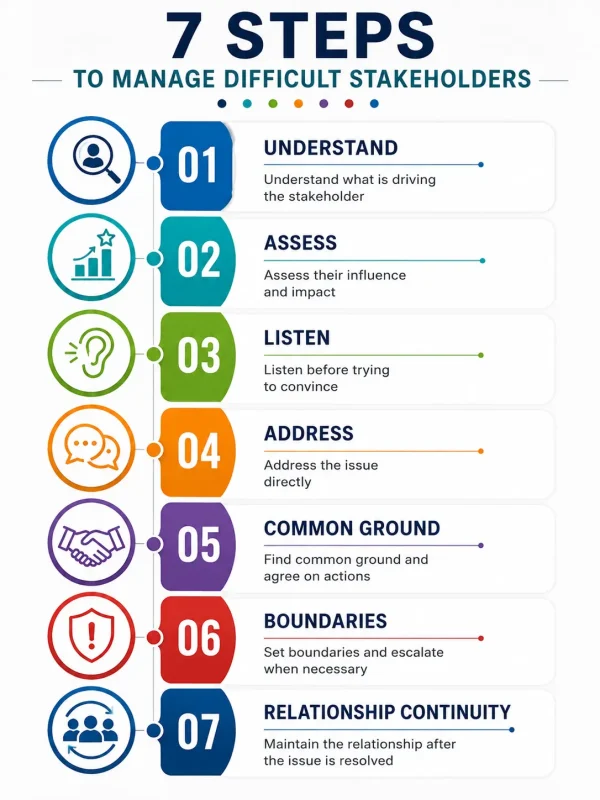
1. Understand What Is Driving the Stakeholder
Before trying to change a stakeholder’s behaviour, understand what is behind it. Repeated challenges, delayed approvals, resistance, or frequent escalations may be symptoms of a concern that the project team has not fully understood.
Look Beyond the Behaviour
Ask yourself:
- What is the stakeholder concerned about?
- What outcome are they trying to protect or achieve?
- What could they lose if the current approach continues?
- Has the project affected their responsibilities, resources, or authority?
- Is there information they have that the project team may be missing?
The concern may relate to cost, schedule, quality, risk, business impact, resources, authority, responsibilities, or an unmet expectation. Understanding the underlying issue helps you decide whether the situation requires clarification, additional information, negotiation, involvement, or escalation.
A Simple Rule
Do not respond to the behaviour before understanding the reason behind it.
A stakeholder who appears difficult may actually be protecting a legitimate business interest. Your first objective is therefore not to convince them—it is to understand what is driving their position.
2. Assess Their Influence and Impact
Not every difficult stakeholder requires the same level of attention. Before deciding how to respond, understand how much influence the stakeholder has and how strongly their actions can affect the project.
Look at Their Influence
Consider whether the stakeholder can:
- Approve or reject important decisions
- Control resources, funding, or access
- Influence senior management
- Delay decisions or project activities
- Change requirements or priorities
- Influence other stakeholders
- Create contractual, regulatory, or operational consequences
Also consider how dependent the project is on their cooperation. A stakeholder may have limited formal authority but still be critical because the project cannot progress without their input, approval, resources, or support.
Match Your Response to the Situation
A stakeholder with high influence and high project impact needs closer engagement than someone with limited influence and little impact.
The goal is not to manage every stakeholder equally. It is to give the right level of attention to the stakeholders who can significantly affect the project’s outcome.
3. Listen Before Trying to Convince
When a stakeholder is difficult, the natural reaction is often to defend the project or explain why the current approach is correct. This can make the conversation more difficult. Before trying to convince them, give them an opportunity to explain their position.
Start With Questions:
Use open questions to understand the concern:
- What is your main concern with the current approach?
- What risk do you believe we may be overlooking?
- What outcome would you need to see before supporting this?
- What impact do you expect this decision to have?
Listen carefully and avoid interrupting with an immediate solution. You may discover that the stakeholder has information, experience, or concerns that the project team has not considered.
Confirm Your Understanding
After listening, summarize their position in simple words and ask whether you have understood it correctly. This helps separate actual concerns from assumptions or misunderstandings.
Listening does not mean agreeing with every demand. It means understanding the stakeholder well enough to respond to the real issue rather than the behaviour.
First understand their position. Then decide how you should respond.
4. Address the Issue Directly
Once you understand the stakeholder’s concern, address the issue directly instead of allowing frustration to build through repeated emails, indirect escalation, or unresolved discussions.
Focus on the Issue, Not the Person
Keep the conversation centred on the specific project issue. Use facts, agreed requirements, project objectives, and available evidence rather than making the discussion personal.
Explain:
- What is happening
- Why it matters to the project
- What constraints exist
- What options are available
- What decision or action is needed
If the stakeholder has a valid concern, acknowledge it and work toward a practical response. If the concern is based on incorrect information, clarify the facts without dismissing the stakeholder’s position.
Keep the Conversation Constructive
Avoid statements such as “You are delaying the project” or “This is not our problem.” Instead, explain the project impact and discuss what can be done to resolve the issue.
Address the difficult issue directly, but keep the relationship professional. The objective is to solve the problem—not to win the argument.
5. Find Common Ground and Agree on Actions
Once the stakeholder’s concern is understood and openly discussed, look for areas where both the project and stakeholder have a shared interest. You may not be able to satisfy every demand, but you can often find an outcome that addresses the most important concerns without compromising the project’s objectives.
Focus on Shared Outcomes
Bring the discussion back to what both sides need to achieve:
- What outcome can both parties support?
- What can be changed without harming the project?
- What cannot be changed, and why?
- What action can each person take?
Avoid treating the discussion as a win-or-lose negotiation. Where possible, develop options together and agree on the most practical approach.
Make the Agreement Clear
Do not finish the conversation with a general understanding such as “We will look into it.” Agree on the action, owner, expected outcome, and timeframe. Document important decisions and commitments so there is a shared reference later.
You do not need complete agreement. You need enough common ground to move the project forward with clear commitments.
6. Set Boundaries and Escalate When Necessary
Not every stakeholder issue can be resolved through discussion. If a stakeholder continues to make unreasonable demands, blocks important decisions, repeatedly ignores agreed responsibilities, or creates a serious risk to project objectives, the project manager may need to set clear boundaries or escalate the matter.
Know When to Escalate
Escalation may be appropriate when:
- A critical decision remains blocked
- Project commitments are being seriously affected
- The stakeholder exceeds agreed authority
- Contractual or governance issues arise
- Repeated attempts to resolve the issue have failed
- The situation creates significant project risk
Escalation should be based on the project impact, not personal frustration. Clearly document the issue, previous attempts to resolve it, the impact on the project, and the decision or support required.
Escalate the Issue, Not the Person
Avoid presenting escalation as a complaint about a difficult individual. Explain the situation objectively and use the appropriate governance route.
Good escalation protects the project without unnecessarily damaging the stakeholder relationship.
7. Maintain the Relationship After the Issue Is Resolved
Resolving a stakeholder issue does not automatically restore the relationship. If the project manager returns to normal communication only when another problem occurs, the stakeholder may continue to feel ignored or uncertain about the project.
Build Confidence Through Consistency
After reaching an agreement:
- Deliver what you committed to
- Keep the stakeholder informed
- Follow up on agreed actions
- Share important changes early
- Acknowledge concerns before they become conflicts
- Recognize the stakeholder’s contribution when appropriate
Small, consistent actions can gradually rebuild confidence, especially when trust has been damaged.
Keep the Relationship Professional
Do not allow one difficult episode to define the entire relationship. Continue involving the stakeholder appropriately, even when there are no immediate problems. Regular and predictable communication can prevent future misunderstandings and make difficult conversations easier when they arise.
The goal is not simply to resolve today’s conflict. It is to create a working relationship that makes tomorrow’s project decisions easier.
Practical Example
Putting the Approach Into Practice
Consider an infrastructure project where a senior client stakeholder repeatedly rejects completed deliverables and requests changes that were not part of the originally agreed requirements. The project team believes the stakeholder is delaying progress, while the stakeholder believes the delivered solution does not adequately support the operational needs of the business.
- The project manager first understands what is driving the stakeholder’s behaviour. Through a focused discussion, it becomes clear that the stakeholder is concerned about how the final solution will work for the operations team. The issue is therefore not simply resistance; there is a genuine business concern behind the repeated objections.
- The project manager then assesses the stakeholder’s influence and impact. Because the stakeholder has approval authority over the deliverables, continued disagreement could directly affect acceptance and project completion.
- Instead of immediately defending the existing deliverables, the project manager listens to the stakeholder’s concerns and identifies the specific requirements that are not being addressed. The project team then addresses the issue directly using the approved scope, current requirements, project constraints, and available options.
- The discussion identifies some requirements that can reasonably be accommodated and others that would constitute additional scope. The project manager and stakeholder find common ground, agree on the necessary changes, and document the decisions, responsibilities, and timelines.
- When further changes are requested outside the agreed scope, the project manager sets clear boundaries and follows the appropriate change-control and escalation process rather than allowing informal requests to continue affecting delivery.
- Finally, the project manager maintains the relationship by providing regular updates, following through on commitments, and involving the stakeholder appropriately in subsequent decisions.
The project does not succeed because the stakeholder suddenly becomes easy to manage. It succeeds because the project manager understands the concern, manages the influence, addresses the real issue, establishes clear boundaries, and maintains a professional relationship throughout the process.
Common Mistakes to Avoid
When dealing with a difficult stakeholder, the project manager’s response can either reduce the tension or make the situation worse. Under pressure, it is easy to react quickly, avoid difficult conversations, or agree to demands simply to keep things moving. Recognizing these common mistakes helps you stay objective and protect both the project and the working relationship.
Taking the Behaviour Personally
A stakeholder challenging your decision does not necessarily mean they are challenging you personally. Treating the situation as a personal conflict can make discussions defensive and reduce the chance of finding a solution.
Trying to Win the Argument
The objective is to achieve a workable project outcome, not to prove that the project manager is right. Even when your position is technically correct, dismissing the stakeholder’s concerns can damage cooperation.
Communicating More Without Listening
Sending more emails, reports, and meeting invitations will not solve a problem that has not been understood. Find out what the stakeholder actually needs before deciding how to communicate with them.
Agreeing to Every Demand
Trying to keep a stakeholder satisfied by accepting every request can create uncontrolled changes, unrealistic commitments, and additional project risk. Understand the request, assess its impact, and use the appropriate change or governance process.
Avoiding Difficult Conversations
Ignoring a difficult stakeholder rarely makes the problem disappear. Unresolved concerns can become larger conflicts, especially when they affect decisions, responsibilities, or project commitments.
Escalating Too Early
Escalation should not be the first response to every disagreement. Whenever possible, understand the concern and attempt to resolve the issue at the appropriate level before involving senior management.
Escalating Too Late
The opposite can also cause problems. If a stakeholder continues blocking a critical decision or creating significant project impact after reasonable attempts to resolve the issue, delaying escalation can allow the situation to deteriorate further.
Failing to Document Important Agreements
Verbal agreements can easily be interpreted differently later. Important decisions, responsibilities, changes, and commitments should be documented so everyone has a clear reference point.
Treating Every Stakeholder the Same Way
Different stakeholders require different approaches. Their influence, concerns, responsibilities, and level of involvement can vary significantly. An approach that works with one stakeholder may not work with another.
Forgetting the Relationship After the Conflict
Resolving the immediate issue is not the end of stakeholder management. If trust has been damaged, continued communication and reliable follow-through are needed to prevent the same relationship problem from returning.
Key Takeaways
Managing difficult stakeholders is an ongoing project responsibility. The goal is not to eliminate disagreement, but to understand concerns, manage influence, resolve issues constructively, and maintain enough alignment to keep the project moving.
- Understand before reacting. Difficult behaviour often has an underlying cause that needs to be identified.
- Assess influence and impact. Give greater attention to stakeholders who can significantly affect project outcomes.
- Listen before convincing. Understanding the stakeholder’s position can reveal concerns that are not immediately visible.
- Address issues directly. Focus on facts, project objectives, and practical solutions rather than personal behaviour.
- Create common ground. You do not need complete agreement; you need workable commitments that support project progress.
- Set boundaries when required. Use change control, governance, or escalation when normal engagement is no longer sufficient.
- Maintain the relationship. Consistent communication and reliable follow-through help rebuild trust after difficult situations.
A difficult stakeholder does not have to become a project obstacle. When the project manager understands the cause, chooses the right response, and manages the relationship deliberately, disagreement can become an opportunity to improve decisions and strengthen project delivery.
References
- PMI — Driving Success in Complex Projects
- PMI — Rethinking Project Stakeholder Management
- PMI — Systems Approach to Project Stakeholder Management
- PMI — Managing Conflicting Expectations
- PMI — Stakeholder Analysis: A Pivotal Practice
- World Bank — Stakeholder Engagement and Accountability
- OECD — Stakeholder Engagement for Sustainable Infrastructure
- APM — Stakeholder Engagement in Refurbishment Projects
- IFC — Stakeholder Engagement: A Good Practice Handbook
- PMI — Managing Communications Effectively and Efficiently
FEATURED PROJECT MANAGEMENT GUIDES
Practical Guidance for the Challenges Project Professionals Face
Managing projects requires more than knowing established processes and concepts. Our featured guides focus on practical situations, challenges, and decisions that project professionals encounter, providing clear guidance to help them respond effectively.
How to Conduct a Project Health Check
Assess the overall condition of a project, identify emerging concerns, and determine where attention or corrective action is needed to protect project outcomes.
How to Take Control of a Project That Is Falling Behind
Understand why a project is falling behind, assess the underlying situation, and determine practical actions to stabilize delivery and regain control.
How to Make Better Project Decisions
Use a structured approach to understand project situations, evaluate available options, involve the right people, and make timely decisions with greater confidence.
MORE PROJECT MANAGEMENT RESOURCESE TYPES
Continue Your Project Management Learning
Project management knowledge becomes more valuable when you can apply it, see it in practice, and continue developing your capabilities. Explore our other resources to complement the practical guidance provided in these guides.
Templates
Use practical project management templates to structure planning, management, reporting, and other project activities.
Downloads
Access useful project management materials and reference resources to support your learning and day-to-day project work.
Career Roadmaps
Follow structured learning paths to develop project management knowledge, practical skills, and capabilities for your professional growth.
Case Studies
Explore realistic project situations, decisions, challenges, and outcomes to understand how project management practices work in practice.
Glossary
Find clear explanations of project management terminology, concepts, abbreviations, and commonly used professional language.
Insights & Articles
Explore professional perspectives, practical insights, emerging practices, and deeper discussions relevant to project management.
RELATED KNOWLEDGE DOMAINS
Continue Your Learning Across Related Knowledge Domains
Project Management is closely connected with specialized disciplines that support successful planning, execution, governance, performance measurement, and professional growth. Explore related knowledge domains to expand your expertise, develop complementary skills, and access practical resources across the complete project management ecosystem.
Expand your expertise one domain at a time and build a well-rounded project management skill set.
Why Explore Related Domains?
- Develop cross-functional project management expertise
- Discover specialized knowledge beyond core project management
- Access practical resources across interconnected disciplines
- Build a complete professional learning pathway
- Strengthen career readiness through continuous learning
Project Planning & Scheduling
Planning techniques, scheduling methods, and timeline management resources.
Project Controls
Performance measurement, forecasting, and project control best practices.
PMO
Governance, portfolio management, and organizational project excellence.
Risk Management
Risk identification, assessment, mitigation, and monitoring resources.
Primavera P6
Professional planning, scheduling, resource management, and reporting.
Microsoft Project
Project scheduling, tracking, reporting, and collaboration resources.
Power BI
Interactive dashboards, reporting, visualization, and project analytics.
PMI Certifications
Certification guidance, exam preparation, and professional development resources.