
PROJECT CONTROLS INSIGHT
Why Do Project Cost Variances Keep Growing?
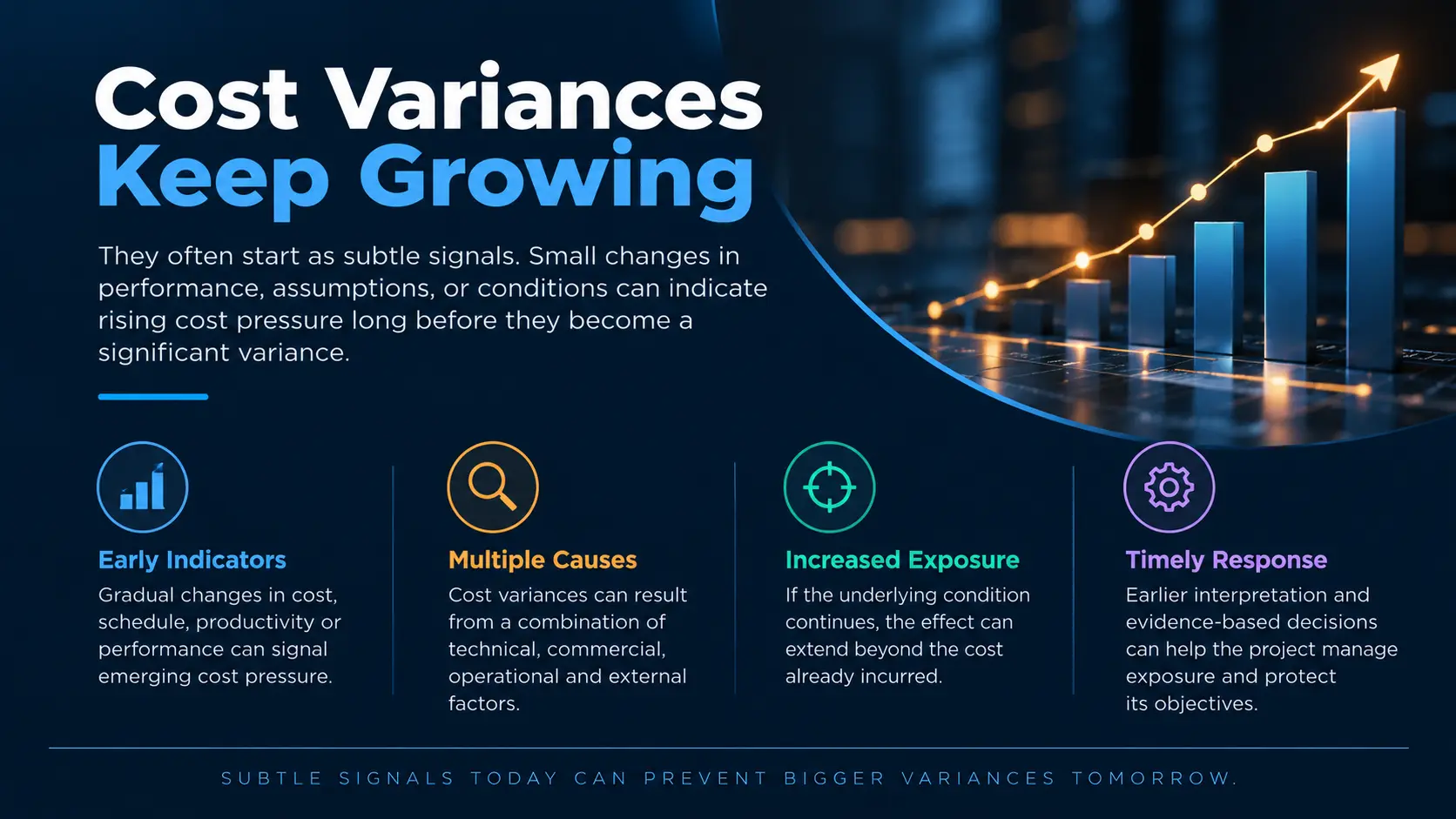
Project cost variances provide important information about actual cost performance against expectations. However, identifying an unfavorable variance does not always prevent it from growing. A variance can persist when the conditions behind it continue, interact with other project pressures, or remain embedded in the work that is still to be completed.
This Insight examines why cost variances can continue growing after they have been identified, how persistent conditions affect remaining cost exposure, and what project professionals should reconsider when cost performance starts moving away from expectations.
Professional Insight · Project Controls · 14–18 min read
Introduction
Cost variance is an important signal of how project spending compares with planned performance. However, identifying an unfavorable variance does not automatically prevent the problem from growing. A project may recognize the variance, explain its immediate cause, and still experience further cost deterioration.
This happens when the conditions behind the variance continue into the work that remains. For example, lower productivity, repeated rework, changing scope, price movements, or schedule pressure can continue affecting future costs. In some situations, several smaller conditions can also interact and produce a larger cumulative effect.
Cost Variances Keep Growing when the project responds to the measurement without fully addressing the conditions producing it. Therefore, professionals need to look beyond the size of the current variance. They also need to consider its persistence, underlying drivers, remaining exposure, and effect on the credibility of the forecast.
This Insight examines why unfavorable cost performance can persist, why professionals may miss the underlying pattern, and what can happen when the condition continues. It then presents a practical lens for connecting variance evidence with diagnosis, forecasting, response, and learning.
The Common Assumption
Cost variance is often treated as a straightforward signal: identify the difference, explain the cause, and take corrective action. However, that sequence can overlook how cost conditions develop over time. Several common assumptions can make a growing variance appear less significant, more temporary, or easier to resolve than it really is.
The following assumptions are worth challenging because they can shift attention away from what the variance reveals about the work that remains.
A Growing Variance Means Cost Control Has Failed
An unfavorable cost variance can indicate a performance problem, but it does not automatically prove that the entire cost-control process has failed. A variance tells professionals that actual cost performance differs from the expected position. However, it does not explain the conditions that produced the difference.
Projects can experience unfavorable variance because of changing quantities, productivity, scope, market conditions, rework, schedule effects, or other factors. Therefore, Cost Variances Keep Growing when professionals treat the measurement as the diagnosis rather than as evidence requiring further investigation.
The Variance Will Correct Itself as the Project Progresses
Another common assumption is that an unfavorable variance will naturally reduce as the project progresses. That may happen when an isolated event causes temporary cost pressure. However, it becomes risky when the same condition continues into remaining work.
For example, lower productivity can affect several reporting periods if the underlying constraint remains unresolved. Similarly, repeated rework, changing scope, or continued price exposure can carry the same cost pressure forward. The important question is therefore not only how much variance has accumulated, but whether the remaining work still contains the conditions that produced it.
More Cost Control Will Automatically Stop the Variance
Better reporting can improve visibility, but visibility alone does not change project conditions. A team can produce accurate cost reports while productivity remains low, design information remains incomplete, or procurement conditions continue to create pressure.
Therefore, professionals should distinguish between seeing a problem, understanding a problem, and changing the condition that produces it. These are different management activities. More frequent reporting may identify a worsening trend earlier, but the project still needs an appropriate response to the underlying driver.
The Original Budget Remains the Right Reference
The approved baseline remains essential for measuring project performance. However, the baseline does not make every assumption behind the forecast permanently valid. Actual performance can provide new evidence about productivity, quantities, rates, risks, and remaining work.
Professionals should therefore protect baseline integrity while testing whether the assumptions supporting future cost remain credible. A controlled baseline and a realistic forecast serve different purposes. Treating them as identical can hide emerging exposure.
A Larger Variance Is Always More Concerning
Magnitude matters, but it does not tell the entire story. A large one-time variance may result from an isolated event, while a smaller unfavorable variance can repeat across several periods and reveal a persistent condition.
Consequently, professionals should consider the direction, persistence, cause, remaining exposure, and response effectiveness alongside the size of the variance. Cost Variances Keep Growing becomes a more important management signal when the same underlying condition continues to affect future work.
What Is Really Happening?
A growing cost variance usually reflects more than one isolated financial event. The underlying conditions can continue, interact, or change the assumptions behind the remaining work. Therefore, the important question is not simply what caused the variance, but what is happening to the conditions that will determine future cost.
Research on project cost overruns and project dynamics shows why this broader view matters. Cost, schedule, scope, productivity, rework, resources, and external conditions can influence one another. As a result, Cost Variances Keep Growing when unfavorable conditions remain active or combine with other pressures across the project.
The Variance Can Become Self-Reinforcing
Some cost problems can create conditions that increase the original problem. For example, low productivity can delay work, create schedule pressure, and require additional resources or overtime. Those responses can then increase cost further.
The sequence will vary by project, but the principle is important. An unfavorable cost condition can create secondary effects that make the original variance harder to contain. Professionals should therefore look for feedback between cost performance and the conditions driving it.
Remaining Work May Carry the Same Cost Problem
Historical variance describes what has already happened. It does not automatically describe how the remaining work will perform. If the same productivity, pricing, rework, or resource condition remains, future cost exposure may continue to accumulate.
This creates an important distinction between historical variance and remaining exposure. A project can explain the cost already incurred while still underestimating what the same condition could cost in the remaining work.
Cost and Schedule Problems Can Reinforce Each Other
Cost and schedule performance often interact, although the relationship depends on the project’s circumstances. Extended durations can increase supervision, equipment, facilities, or other time-related costs. Schedule pressure can also lead to acceleration, overtime, or additional resources.
Conversely, cost pressure can restrict resources or procurement decisions and affect planned progress. Therefore, professionals should examine cost performance alongside relevant schedule conditions rather than assuming that each problem operates independently.
Scope and Change Can Keep Reopening Cost Exposure
Scope changes do more than add direct cost. Repeated changes can affect quantities, procurement, sequencing, rework, productivity, and schedule conditions. Each change can therefore create additional exposure beyond its initial approved value.
The professional concern is not that every change causes cost growth. Instead, repeated change can prevent the project’s cost trajectory from stabilizing. That makes change frequency, timing, downstream effects, and remaining exposure important parts of cost interpretation.
Market Conditions Can Change the Cost Environment
Not every growing variance results from project execution. Inflation, material prices, labor rates, exchange rates, and supply conditions can change the cost environment after the original estimate or budget was established.
Therefore, professionals should distinguish between execution-driven cost pressure and external cost exposure where the project context allows that distinction. The forecast should reflect credible current evidence rather than assumptions that no longer represent the environment.
Multiple Small Drivers Can Produce a Large Variance
A material variance does not always have one dominant cause. Small productivity losses, minor quantity changes, price increases, rework, procurement effects, and additional supervision can accumulate over time.
This is why professionals should move beyond a simple cause list and examine how conditions interact. Cost Variances Keep Growing can reflect a pattern of connected pressures rather than one identifiable event. Understanding that pattern provides a stronger basis for assessing remaining exposure and deciding what needs to change.
Why Do Professionals Miss the Problem?
Professionals rarely miss a cost variance because the project lacks information. More often, the project sees the number but does not fully interpret what it means for future work. Reporting can therefore remain accurate while the underlying cost condition continues.
This becomes important when Project Cost Variances Keep Growing across several reporting periods. The challenge shifts from detecting the variance to recognizing its pattern, testing its explanation, and assessing whether the same exposure remains in the work ahead.
They Focus on the Variance Instead of the Condition Behind It
Cost reports make variance visible, but the number itself does not explain the operating condition behind it. Professionals may identify an unfavorable labor, material, subcontract, or indirect-cost variance without fully investigating what changed in the work.
For example, a labor variance may reflect lower productivity, additional work, resource constraints, rework, or a combination of factors. Therefore, the measurement should trigger investigation rather than become the conclusion. The professional question is not only what moved, but what condition caused it to move.
They Treat Repeated Variance as a Series of Separate Events
Monthly reporting can encourage teams to explain each variance within the reporting period that produced it. That approach works reasonably well for isolated events. However, it can hide a recurring condition when similar variances appear month after month.
A project may report productivity issues, rework, procurement pressure, or additional resource costs as separate events. The deeper pattern may be one unresolved condition affecting several periods. Repeated explanations can therefore conceal repeated causes.
Professionals should compare variance drivers across periods and ask whether the same condition keeps appearing. A recurring explanation deserves more attention than another isolated variance review.
They Accept the Explanation Before Testing the Trajectory
A reasonable explanation can create a false sense of closure. Once a team records a cause, the variance may appear understood even though the underlying condition remains active.
Consider rework caused by incomplete information. Explaining the current cost as rework does not establish that future rework will stop. The project still needs to determine whether the source condition has changed and whether remaining work carries the same exposure.
Explanation is not correction. Professionals should test whether the identified cause has actually changed and whether subsequent performance provides evidence of improvement.
They Continue to Trust a Forecast After Its Assumptions Have Changed
A forecast depends on assumptions about quantities, productivity, rates, scope, resources, procurement, risks, and remaining duration. As the project develops, actual evidence can challenge some of those assumptions.
However, teams can continue using an earlier forecast because it remains approved or because changing it creates management uncertainty. This can become problematic when actual performance repeatedly contradicts the assumptions supporting the forecast.
A credible forecast should therefore respond to evidence. Forecast stability is not the same as forecast reliability. A forecast that changes because new evidence improves understanding can be more credible than one that remains unchanged despite persistent contrary evidence.
They Wait for the Variance to Become Material
Management attention often increases when a variance crosses a financial threshold. Thresholds are useful because they help teams focus attention and escalation. However, they can also create a blind spot when professionals overlook smaller but persistent signals.
A recurring unfavorable variance may indicate that the project is repeatedly experiencing the same condition. Meanwhile, the remaining quantity exposed to that condition may still be substantial.
Therefore, professionals should consider magnitude together with persistence, direction, cause, and remaining exposure. A small variance that continues can provide an earlier warning than a large variance that appears only once.
This is where Project Cost Variances Keep Growing becomes a trajectory problem rather than a reporting problem. The project may already possess enough information to act, but the information has not yet been connected into a meaningful view of future exposure.
What Happens If It Continues?
A growing cost variance becomes more serious when the underlying condition remains active. The impact then extends beyond the amount already spent. It can affect the credibility of forecasts, the flexibility of management decisions, and the project’s ability to recover without creating additional pressure elsewhere.
The consequences will vary by project and delivery environment. However, Project Cost Variances Keep Growing can gradually change the management problem from explaining past performance to managing increasingly uncertain future exposure.
The Forecast Becomes Harder to Defend
Persistent unfavorable performance creates a more difficult question for project leadership: what evidence supports the current forecast? A forecast does not become unreliable simply because performance has changed. However, repeated variance should trigger a closer examination of the assumptions supporting remaining cost.
If productivity remains below the original assumption, prices continue to rise, or repeated changes affect remaining work, the original forecast may no longer reflect current conditions. Therefore, professionals need to distinguish between a forecast that remains stable because conditions remain stable and one that remains stable despite contradictory evidence.
Forecast credibility depends on the evidence supporting its assumptions, not simply on how often the forecast changes.
Recovery Becomes More Difficult as Options Narrow
When a cost condition continues, the project may have fewer practical options for changing its trajectory. Some opportunities may depend on decisions that become harder once procurement commitments, sequencing, contracts, or remaining quantities become fixed.
Schedule pressure can also influence recovery decisions. A project may consider additional resources, overtime, resequencing, or acceleration. These responses can help in appropriate circumstances, but they can also introduce additional cost or operational pressure.
Therefore, the issue is not that every delayed response will cost more. The concern is that continued exposure can reduce flexibility and increase the scale of intervention required.
Cost Pressure Can Spread Into Other Performance Areas
Cost problems rarely operate in complete isolation. Depending on the project, management may respond by changing resources, procurement decisions, sequencing, scope priorities, or schedule strategies. Each response can affect another part of project performance.
For example, a schedule delay can increase time-related costs. In another situation, cost pressure may restrict resources and affect progress. Rework can increase both direct cost and duration. However, these relationships depend on the project’s circumstances and should not be assumed automatically.
Professionals should therefore watch for interactions across performance areas, particularly where the same condition affects more than one project objective.
Management Can Start Treating Symptoms Instead of Drivers
Persistent variance creates pressure to demonstrate that management is responding. That pressure can encourage actions that improve visibility without changing the underlying condition.
- Increasing reporting frequency without changing the cost driver.
- Adding resources without understanding why existing resources underperform.
- Accelerating work while unresolved rework or design issues remain.
- Revising forecasts without addressing the conditions behind the change.
- Escalating the variance repeatedly without defining what decision should follow.
A corrective action should have a clear connection to the condition it is intended to change. If the driver remains unchanged, repeated action can consume management attention without materially improving performance.
The Remaining Cost Expectation Becomes Less Credible
A project can spend more than planned and still have a credible estimate for the remaining work. The concern emerges when current performance provides evidence that the assumptions behind remaining cost may no longer hold.
For example, repeated productivity losses can challenge labor assumptions. Continuing price changes can challenge material-rate assumptions. Repeated scope changes can challenge quantity assumptions. Therefore, professionals should ask what evidence supports the current estimate to complete.
This is why historical variance and remaining exposure require separate attention. The cost already incurred cannot be changed, but the assumptions governing future cost can still be tested and improved.
The Variance Becomes the Story Instead of the Signal
The purpose of cost variance reporting is to help professionals understand changing project conditions and make better decisions. However, repeated reporting can become an end in itself when teams continue discussing the number without changing their understanding or response.
The project may know its current variance, cumulative variance, forecast variance, and performance index. Yet those measurements provide limited management value if the team cannot explain what they mean for the remaining work.
This is the point where Project Cost Variances Keep Growing becomes more than a financial reporting issue. It becomes evidence that the project may need to reconsider its assumptions, causal analysis, forecast, or response strategy.
The objective of cost control is not to produce increasingly detailed descriptions of a problem. It is to provide enough evidence to change the project’s trajectory.
What Should Project Professionals Reconsider?
A growing cost variance should prompt more than a review of the latest numbers. It should also prompt professionals to reconsider how they interpret performance, assess remaining exposure, validate forecasts, and judge corrective action.
Therefore, Project Cost Variances Keep Growing when the project continues to interpret the signal without sufficiently challenging the conditions behind it. The objective is not to abandon established project controls practices. Instead, it is to strengthen the professional judgement applied after those controls produce a signal.
The following considerations move the discussion from measurement toward decision quality. They focus on what the variance means, what remains exposed, whether the forecast can still be defended, and whether the response is actually changing project conditions.
From Variance Measurement to Variance Diagnosis
A cost variance tells the project that actual performance differs from the selected expectation or baseline. However, the number does not explain why the difference exists. Therefore, measurement should be treated as the starting point for diagnosis rather than the diagnosis itself.
This distinction matters because the same variance can arise from very different conditions. Productivity may have deteriorated, quantities may have changed, scope may have expanded, rates may have moved, work may have been performed earlier than planned, or an estimating assumption may no longer reflect current conditions.
Consequently, a corrective action based only on the variance value can address the wrong problem. Professionals should ask whether the reported variance represents a symptom, a driver, or the combined result of several interacting drivers.
PMI’s earned value guidance supports this distinction by treating variance analysis as a basis for investigation and management action rather than an automatic explanation. A measurement identifies where attention is required; diagnosis determines what deserves attention.
This becomes especially important when Cost Variances Keep Growing. Repeatedly calculating the same indicator provides little additional management value if the project has not improved its understanding of the condition producing it.
Historical Performance Versus Remaining Exposure
A historical variance describes what has already happened. Remaining exposure describes what could still happen. These are related questions, but they require different forms of judgement.
A project can accurately report its past overrun while still underestimating the financial consequences of the condition that produced it. For example, a work package may have consumed more labour than planned because productivity is below the original assumption. Recording the historical variance is necessary, but the more important question may be whether the remaining work will experience the same condition.
Professionals should therefore connect historical performance with the characteristics of unfinished work. This is particularly important when the remaining scope resembles the work that has already generated the unfavorable variance.
- What portion of the affected work remains?
- Does the remaining work face the same cost driver?
- Have productivity, quantities, rates, scope, or execution conditions changed?
- What evidence supports the current estimate to complete?
- Could the same condition affect related work packages?
This shifts attention from explaining yesterday’s variance to understanding tomorrow’s exposure. As a result, Cost Variances Keep Growing when historical performance is reported accurately but its implications for remaining work are not adequately projected.
Baseline Integrity and Forecast Realism
A controlled baseline provides an essential reference for measuring performance. However, baseline control does not mean that every assumption supporting the baseline remains valid throughout execution.
Professionals should therefore preserve the integrity of the approved baseline while separately testing whether the forecast remains realistic. This distinction prevents two different questions from becoming confused: How are we performing against the approved plan? and What do we now expect the remaining work to cost?
The difference becomes important when quantities, productivity rates, market prices, design information, delivery conditions, or execution strategies have changed. A project can maintain a stable baseline and still require a materially different forecast for the remaining work.
Therefore, a forecast should not gain credibility simply because it remains consistent with an earlier expectation. Its credibility should come from assumptions that remain relevant and evidence that supports them.
Baseline control protects the reference for performance measurement; forecast discipline tests whether that reference still supports a credible view of the future.
Patterns Across Time, Work, and Cost
Cost variance is often reviewed period by period or at a high project level. That approach is useful for reporting, but it can conceal the pattern that matters. A recurring small variance across several periods may reveal a structural condition that a single reporting period does not make obvious.
The appropriate unit of analysis should therefore follow the management question rather than the reporting structure. Instead of reviewing only the current period, professionals may need to examine patterns across time, work packages, cost categories, suppliers, locations, activities, or other meaningful dimensions.
- Review multiple reporting periods rather than isolated movements.
- Compare similar work packages to identify recurring conditions.
- Separate quantity, rate, productivity, scope, and timing effects where practical.
- Trace whether apparently unrelated variances share a common driver.
- Compare reported variance magnitude with actual remaining exposure.
This broader view can reveal interactions that disappear when every variance is treated as an independent event. Moreover, it helps distinguish an isolated exception from a persistent pattern.
For that reason, Cost Variances Keep Growing when recurring conditions are fragmented across reports instead of being examined as connected performance patterns. The reporting system should support diagnosis rather than unintentionally constrain it.
Evidence Beyond the Project Forecast
A forecast can appear internally consistent while still being overly optimistic. Therefore, professionals should not rely exclusively on assumptions already embedded in the project’s own forecast. Independent evidence can provide an important challenge to internal expectations.
Useful evidence may include actual productivity from completed work, current supplier quotations, observed market rates, realized risk events, updated quantities, comparable completed work, historical performance, and current execution conditions. The appropriate evidence will vary by project, industry, contract structure, and cost composition.
Reference-class thinking also provides a useful outside-view principle. Instead of asking only whether the project’s forecast appears reasonable internally, professionals can ask how comparable work actually performed under similar conditions.
This does not justify applying generic adjustment percentages without context. Rather, it introduces evidence that can challenge unsupported optimism and reveal assumptions that deserve closer examination.
A forecast deserves confidence because its assumptions are supported, not simply because its numbers are internally consistent. When Cost Variances Keep Growing, external evidence can help determine whether the forecast is adapting to reality or preserving an earlier expectation.
Corrective Action and the Driver It Changes
Assigning an action does not necessarily mean that the project has corrected the condition. Therefore, professionals should judge corrective action by its effect on the underlying driver rather than by whether an action has been recorded, communicated, or closed.
For example, increasing reporting frequency may improve visibility without changing productivity. Adding resources may increase capacity without resolving inefficient methods. Reforecasting may improve the reported expectation without changing the conditions that created the original variance.
A stronger corrective-action review connects the intervention to the condition it is intended to change.
- Identify the specific cost driver or condition requiring intervention.
- Define the operational change expected from the response.
- Establish evidence that will demonstrate whether the change occurred.
- Review the subsequent cost and performance trajectory.
- Escalate or revise the response when the driver remains active.
The key question is not simply whether an action was completed. It is whether the condition changed and whether subsequent performance provides evidence of that change.
Ultimately, Cost Variances Keep Growing when corrective action changes the reporting process without changing the condition behind the variance. Effective project controls therefore connect measurement, diagnosis, forecasting, response, and learning into one management cycle.
A Practical Professional Lens
A cost variance should not be viewed only as a number to report. It can also be treated as evidence about the conditions affecting project performance.
The TRACE → EXPLAIN → TEST → PROJECT → RESPOND → LEARN sequence provides a practical way to move from the reported variance toward a more forward-looking management response. It is a Kleios analytical lens, developed for professional interpretation rather than presented as a formal industry standard.
TRACE — Where Did the Variance Originate?
Start by locating where the variance emerged. The objective is not simply to identify the affected cost account. Instead, trace the variance to the work, period, quantity, rate, productivity condition, scope element, supplier, activity, or other relevant source.
This first step prevents professionals from treating a project-level number as though it were a single event. A reported variance may combine several smaller conditions with different causes and different implications for remaining work.
TRACE asks where the signal originated before the project decides what the signal means.
EXPLAIN — What Is Producing It?
Once the source is clearer, examine the condition producing the variance. The explanation should connect the observed cost outcome with an identifiable project condition rather than simply restating the financial result.
For example, “labour cost exceeded budget” describes the result. A stronger explanation might identify lower productivity, additional rework, changed quantities, extended working hours, or another evidenced condition. The appropriate explanation will depend on the project’s work and available data.
This distinction matters because Cost Variances Keep Growing when the project repeatedly explains the financial symptom without identifying the condition that continues to produce it.
TEST — Is the Explanation Supported?
An explanation can sound reasonable without being sufficiently supported. Therefore, professionals should test the explanation against available evidence before treating it as the basis for a forecast or corrective action.
Useful evidence may include actual quantities, productivity records, labour hours, supplier information, change records, schedule performance, completed comparable work, current market information, and other project-specific evidence. No single evidence source will be appropriate for every situation.
Testing also means challenging assumptions. If the project attributes a variance to a temporary condition, professionals should examine whether evidence supports that expectation. Otherwise, the forecast may continue to assume recovery that has not yet occurred.
A plausible explanation is not the same as a demonstrated explanation. This distinction becomes increasingly important when the same variance pattern continues across reporting periods.
PROJECT — What Happens If the Condition Continues?
The next question is forward-looking. If the condition producing the variance remains active, what could happen to the remaining work?
This requires more than extending the historical variance mechanically. Professionals should consider the amount of affected work remaining, the likelihood that the condition will persist, interactions with schedule or scope, and whether other risks could amplify the exposure.
This is where historical performance becomes relevant to forecast credibility. A project should be able to explain why a previous unfavorable condition is expected to disappear rather than simply assume that future performance will return to the original expectation.
When Cost Variances Keep Growing, the trajectory can be more informative than the latest variance value. The professional question becomes not only “How much have we lost?” but also “What exposure remains if nothing changes?”
RESPOND — What Action Changes the Driver?
Once the exposure is understood, determine what response could change the condition producing it. The response should connect directly to the diagnosed driver rather than simply address the visibility of the problem.
For example, additional reporting may improve awareness but not productivity. Similarly, adding resources may not resolve a design constraint, procurement issue, inefficient work method, or recurring rework condition.
A useful response should therefore identify the intended change, the responsible decision-maker, the expected timing, and the evidence that will demonstrate whether the intervention worked.
Response effectiveness should be judged by changed conditions and subsequent performance, not simply by completed action items.
LEARN — What Should Change in the Control System?
The final step asks whether the project has learned anything that should change how it controls future work. A recurring variance may reveal more than a local performance problem. It may indicate weaknesses in estimating assumptions, planning, productivity measurement, risk treatment, forecasting, change management, or management response.
Learning should therefore move beyond documenting the cause. The project should consider whether the same condition could affect other work and whether its controls can detect the condition earlier.
The sequence then becomes cyclical rather than linear. New information can require the project to revisit the source, challenge the explanation, update the exposure, and reconsider the response.
This creates a more useful management cycle: measure the signal, understand the condition, test the evidence, assess the trajectory, change the driver, and learn from the result.
Ultimately, the purpose is not to eliminate every unfavorable variance. Some variances are temporary, recoverable, externally driven, or within accepted tolerance. The professional objective is to distinguish those conditions from persistent drivers that can continue affecting the project’s remaining cost performance.
When Cost Variances Keep Growing, the strongest response is not simply better reporting. It is better diagnosis followed by evidence-based intervention.
Key Takeaways
A growing cost variance is not only a record of past performance. It can also provide evidence about conditions that may continue affecting the project’s remaining work.
Cost Variances Keep Growing when the project identifies the financial signal but does not sufficiently address the conditions producing it. Therefore, professionals should look beyond the size of the variance and examine its cause, persistence, direction, and remaining exposure.
- Measurement is not diagnosis. A variance identifies an area requiring attention, but professionals still need to establish what is producing it.
- Historical variance is not remaining exposure. Past cost performance should inform the forecast, especially when unfinished work faces similar conditions.
- Baseline control is not forecast certainty. The approved baseline can remain the performance reference while forecast assumptions are tested against current evidence.
- Patterns matter. Repeated smaller variances can reveal persistent conditions that individual reporting periods may conceal.
- Forecasts need evidence. Actual performance, current market information, completed comparable work, and other relevant evidence can challenge unsupported assumptions.
- Corrective action should change the driver. An action is more valuable when subsequent evidence shows that the underlying condition has changed.
Ultimately, Cost Variances Keep Growing should prompt a forward-looking management question: what condition is continuing, what exposure remains, and what decision could change the trajectory? Strong project controls connect measurement with diagnosis, forecasting, response, and organizational learning.
References
This Insight draws on international standards, government guidance, professional practice, and peer-reviewed research. These sources support the discussion of earned value management, cost forecasting, variance diagnosis, cost-overrun causation, uncertainty, and management response.
- ISO 21508:2026 — Project, programme and portfolio management — Earned value management — Current international guidance on earned value management and its application across projects, programmes, and portfolios.
- ISO 21512:2024 — Project, programme and portfolio management — Earned value management implementation guidance — Guidance for establishing, implementing, and maintaining an earned value management system.
- U.S. GAO — Cost Estimating and Assessment Guide: GAO-20-195G — Best practices for developing reliable cost estimates, managing assumptions, updating estimates with actual costs, and applying earned value management.
- HM Treasury — The Green Book 2026 — Government guidance on evidence-based appraisal, uncertainty, risk, and decision-making.
- PMI — Earned Value Management: Reading the Numbers — Practical discussion of earned value indicators and the interpretation required to turn performance information into management action.
- Ahiaga-Dagbui, Love, Smith & Ackermann (2017) — Toward a Systemic View to Cost Overrun Causation in Infrastructure Projects — Examines systemic perspectives on cost-overrun causation and the limitations of simplistic causal explanations.
- Love, Ahiaga-Dagbui & Irani (2016) — Cost Overruns in Transportation Infrastructure Projects — Examines interacting uncertainties and risks in transportation infrastructure cost overruns.
- Cantarelli et al. (2010) — Cost Overruns in Large-scale Transportation Infrastructure Projects — Reviews technical, economic, psychological, and political explanations for cost overruns.
- Flyvbjerg et al. (2018) — Five Things You Should Know About Cost Overrun — Discusses cost-overrun measurement, data quality, behavioral bias, and reference-class forecasting.
- AACE International — Recommended Practice 17R-97: Cost Estimate Classification System — Provides a structured relationship between estimate classification, project definition, and estimate maturity.
Together, these references support the central argument of this Insight: a cost variance should be treated as evidence requiring diagnosis, forecast assessment, and management response rather than as a standalone financial result.
Related Kleios Resources
If you want to apply these ideas to a real project, the following Kleios resources provide practical guidance and tools for interpreting cost performance, assessing exposure, and strengthening project controls decisions.
- How to Analyze Project Cost Variances A practical guide for identifying, interpreting, and investigating cost variances so professionals can move beyond the reported number and understand the conditions behind it.
- How to Build Reliable Project Cost Forecasts A practical guide for developing cost forecasts that reflect current project conditions, assumptions, performance information, and remaining work.
- How to Monitor Project Cost and Schedule A practical guide for monitoring cost and schedule performance, identifying emerging deviations, and connecting project controls information with management attention.
- Project Cost Variance Template A structured Excel framework for recording, analyzing, and documenting cost variances and the conditions requiring further investigation.
- Project Cost Forecasting Template A structured Excel framework for organizing cost forecasting information, reviewing current performance, and developing a forward-looking view of project cost exposure.
- Cost-Schedule Performance Template A structured Excel framework for reviewing cost and schedule performance together and identifying relationships between financial and schedule conditions.
- How to Prepare Effective Project Controls Reports A practical guide for turning project controls information into clear reporting that supports analysis, communication, escalation, and management decisions.
- Project Controls Resources Explore the wider collection of Kleios project controls guides, templates, and practical resources for monitoring, analyzing, forecasting, and managing project performance.
FEATURED PROJECT CONTROLS INSIGHTS
Professional Perspectives on the Challenges Project Controls Face
Our featured Project Controls Insights examine recurring challenges involving early warning signals, cost variances, progress measurement, forecasting, reporting, and integrated performance. Moreover, they encourage professionals to look beyond reported figures and consider the conditions influencing them.
When do Progress Measurements Mislead Project Decisions
Examine when Progress Measurements Mislead project decisions despite established measurement methods. Therefore, consider whether reported progress accurately represents completed work and supports effective management action.
Why do Project Cost Forecasts Lose Reliability
Examine why Cost Forecasts Lose Reliability despite established forecasting processes and available project data. Moreover, consider how actual costs, commitments, accruals, assumptions, and performance trends can affect forecast quality.
When does Project Controls Reporting Value Decline?
Examine when Project Controls Reports contain extensive information but provide limited management value. As a result, consider whether reporting remains timely, relevant, understandable, and connected to project decisions.
MORE PROJECT CONTROLS RESOURCE TYPES
Continue Your Project Controls Learning
Project controls knowledge becomes more valuable when professionals can understand concepts, apply structured tools, and examine their practical use. Explore our other Project Controls resources to complement the analytical perspectives provided by these Insights.
Guides
Explore clear guidance to understand project controls concepts, evaluate performance, and apply effective approaches throughout project delivery.
Downloads
Access useful project controls materials and reference resources to support learning, analysis, and day-to-day project work.
Career Roadmaps
Follow structured learning paths to develop project controls knowledge, practical skills, tools, and capabilities for professional growth.
Templates
Use structured Project Controls templates to support setup, progress measurement, cost analysis, forecasting, performance monitoring, and reporting.
Case Studies
Explore realistic project controls situations, decisions, challenges, and outcomes to understand how control practices work during project delivery.
Glossary
Find clear explanations of project controls, cost management, progress measurement, forecasting, performance analysis, reporting, and related terminology.
Looking for more project management resources? Explore the Kleios Technologies Resources Hub to discover our complete collection of guides, templates, downloads, career roadmaps, case studies, glossary resources, and insights.
RELATED KNOWLEDGE DOMAINS
Continue Your Learning Across Related Knowledge Domains
Project Management is closely connected with specialized disciplines that support successful planning, execution, governance, performance measurement, and professional growth. Explore related knowledge domains to expand your expertise, develop complementary skills, and access practical resources across the complete project management ecosystem.
Expand your expertise one domain at a time and build a well-rounded project management skill set.
Why Explore Related Domains?
- Develop cross-functional project management expertise
- Discover specialized knowledge beyond core project management
- Access practical resources across interconnected disciplines
- Build a complete professional learning pathway
- Strengthen career readiness through continuous learning
Project Management
Practical project management knowledge, practices, and professional resources.
Project Planning & Scheduling
Planning techniques, scheduling methods, and timeline management resources.
PMO
Governance, portfolio management, and organizational project excellence.
Risk Management
Risk identification, assessment, mitigation, and monitoring resources.
Primavera P6
Professional planning, scheduling, resource management, and reporting.
Microsoft Project
Project scheduling, tracking, reporting, and collaboration resources.
Power BI
Interactive dashboards, reporting, visualization, and project analytics.
PMI Certifications
Certification guidance, exam preparation, and professional development resources.