
PROJECT CONTROLS INSIGHT
Why Do Cost Forecasts Lose Reliability?
Cost Forecasts Lose Reliability when the assumptions, performance evidence, risks, and delivery conditions behind them no longer support the expected final cost. A forecast may remain stable and appear credible while productivity declines, schedule pressures increase, unresolved issues emerge, or recovery assumptions become less realistic.
This Insight examines why project cost forecasts lose reliability, how outdated assumptions, incomplete evidence, uncertainty, and changing project conditions weaken cost expectations, and what project professionals should reconsider to produce more credible forecasts and make better-informed decisions.
Professional Insight · Project Controls · 16–20 min read
Introduction
Project cost forecasts help professionals understand the expected final cost and make informed decisions before financial pressures become difficult to manage. However, a forecast can appear credible while the conditions supporting it gradually change. Actual costs may rise, productivity may decline, schedules may extend, or unresolved issues may create additional exposure.
Cost Forecasts Lose Reliability when the assumptions, performance evidence, risks, and delivery conditions no longer support the expected final cost. Updating the forecast does not automatically improve its reliability, especially when the underlying assumptions remain unchanged.
The challenge extends beyond estimating calculations. Professionals must understand the cost of remaining work, assess changing project conditions, examine recovery assumptions, and recognize uncertainty that a single figure may conceal. A forecast that identifies an emerging overrun can support better decisions than an apparently favourable figure without sufficient evidence.
This Insight explores why project cost forecasts lose reliability, how professionals can recognize the warning signs, and what they should reconsider when evaluating expected final cost. It also introduces a practical Kleios lens to connect forecast evidence with timely, defensible management decisions.
The Common Assumption
Project professionals often rely on established estimates, regular reporting, and approved recovery plans to understand the expected final cost. These controls are essential. However, they can create false confidence when teams assume that an updated figure, a stable outlook, or an approved budget automatically indicates a reliable forecast.
The problem is not the use of forecasting methods. It is assuming that the forecast remains credible without testing whether its underlying assumptions still reflect current project conditions.
An Updated Forecast Must Be a More Reliable Forecast
Updating a forecast incorporates new information only when the team reassesses the relevant assumptions and cost drivers. If productivity declines or unresolved issues increase exposure, simply replacing actual costs and recalculating the estimate may leave the underlying problem untouched. A current forecast is not necessarily a credible forecast.
Current Spending Does Not Necessarily Predict the Cost of Remaining Work
Actual expenditure provides important evidence, but it cannot explain the entire cost of completion. The remaining work may involve different quantities, productivity levels, resource requirements, or technical constraints. Therefore, professionals must assess both recorded performance and the conditions under which the outstanding work will be delivered.
A Stable Forecast Indicates Stable Project Conditions
A forecast that changes little between reporting periods may appear reassuring. However, unchanged figures can conceal deteriorating productivity, emerging procurement pressures, or delays that have not yet been translated into cost impacts. Stability is meaningful only when the supporting evidence remains consistent with the reported outlook.
An Approved Budget Represents the Expected Final Cost
An approved budget establishes an authorized financial position; it does not guarantee the eventual cost. As scope, performance, and delivery conditions change, the expected final cost may diverge from the original baseline. Budget compliance and forecast credibility are different measures. Professionals must report both clearly.
A Recovery Plan Makes the Revised Forecast Achievable
Recovery plans often depend on improved productivity, additional resources, faster approvals, or more favourable procurement outcomes. Yet planned improvements do not guarantee results. Cost Forecasts Lose Reliability when expected savings remain in the estimate without sufficient evidence that the necessary conditions can be achieved. Professionals should distinguish intended recovery from demonstrated improvement.
These assumptions share a common weakness: they place confidence in the reported number without adequately testing the evidence behind it. Forecast reliability depends on whether the assumptions, performance data, and expected cost of remaining work still reflect the project’s actual delivery conditions.
What Is Really Happening?
Cost forecasts rarely lose reliability for one reason alone. Instead, changes in scope, actual performance, schedule conditions, risk exposure, and estimating assumptions can gradually weaken the expected final cost. The forecast becomes unreliable when its underlying logic no longer reflects how the project is likely to be delivered.
The Cost Baseline No Longer Represents the Current Scope
Projects evolve as teams refine designs, clarify requirements, identify missing work, or change delivery strategies. If the cost forecast continues to reflect an earlier scope or outdated quantities, it may omit costs that the current delivery plan requires. Approved changes can also introduce new work, while unresolved scope can create uncertainty. Professionals must distinguish genuine scope changes from estimating corrections and execution inefficiencies because each affects the forecast differently.
Actual Performance Changes the Cost of Remaining Work
Actual costs and productivity provide evidence about project performance. However, the cost of remaining work depends on whether future activities can achieve the assumed quantities, rates, and productivity. If rework increases or output falls below expectations, the original estimate to complete may no longer be realistic. Conversely, demonstrated improvements can support a lower forecast. Historical performance should inform the outlook, but professionals must test whether it remains relevant to future work.
Schedule Changes Alter the Cost of Delivery
Schedule changes can affect supervision, site overheads, equipment use, resource deployment, procurement, and contractual exposure. However, not every delay increases total cost by the same amount. Available float, resequencing, or changes in resource allocation may absorb some effects. Reliable forecasting therefore requires professionals to connect schedule changes with their actual cost consequences rather than applying automatic assumptions about delay.
Risk and Uncertainty Are Not Fully Reflected in the Forecast
A forecast may include known risks yet still underestimate uncertainty in quantities, productivity, prices, or unresolved technical requirements. A single expected-cost figure can conceal these differences. Sensitivity analysis, scenarios, or probabilistic methods can help when the exposure justifies them. The appropriate approach depends on the quality of available data and the decision at stake. Contingency should reflect defensible risk and uncertainty assessments, not an arbitrary allowance.
Individual Cost Drivers Reinforce One Another
Cost pressures often interact. A design issue may delay procurement, disrupt work sequencing, reduce productivity, and extend site operations. Assessing each issue separately can therefore understate the combined exposure. Professionals need to examine how connected technical, commercial, and schedule conditions influence the overall cost outlook.
Historical Data and Assumptions Lose Relevance
Historical rates, productivity benchmarks, and previous project outcomes provide useful reference points. However, differences in scope, market conditions, complexity, location, or delivery strategy can limit their relevance. Professionals should verify that historical evidence fits the current project before relying on it to support expected savings or remaining-work estimates.
A Point Estimate Conceals the Range of Possible Outcomes
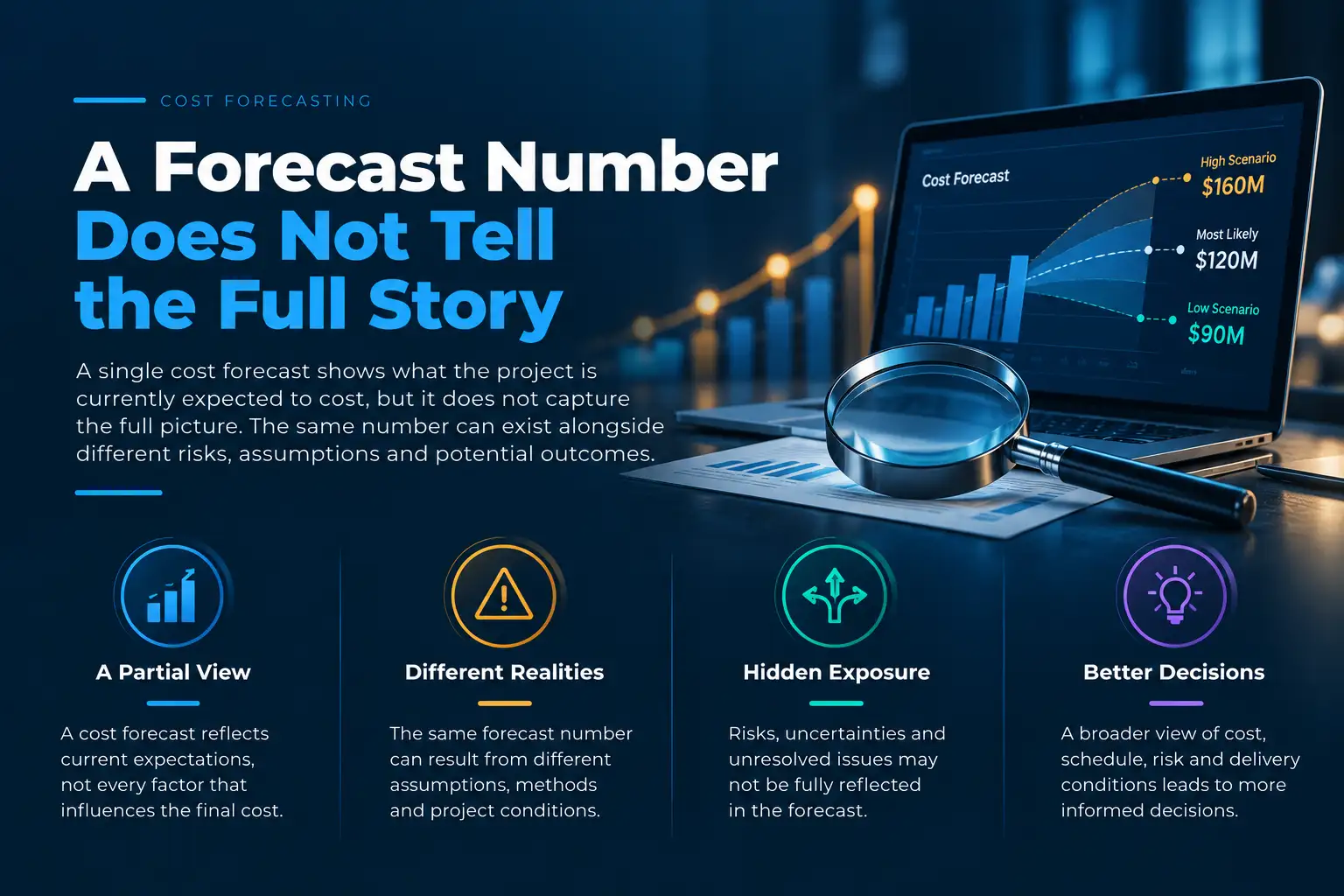
A single forecast figure simplifies reporting, but it cannot communicate every uncertainty behind the estimate. Two projects with the same expected final cost may have very different exposure because their risks, assumptions, and remaining work differ. Cost Forecasts Lose Reliability when decision-makers treat a precise figure as certainty instead of examining its supporting evidence and plausible alternatives.
Together, these mechanisms explain why a forecast can remain formally updated while becoming less representative of the likely outcome. Reliability depends on continuously reconciling the estimating basis, actual performance, remaining work, and future exposure.
Why Do Professionals Miss the Problem?
Even experienced project professionals can overlook a weakening cost forecast. Established reporting systems, regular reviews, and detailed cost data cannot guarantee reliability when teams interpret evidence through outdated expectations or fragmented information.
The problem often lies not in the absence of information, but in how professionals interpret and challenge it.
The Approved Budget Becomes an Anchor
Once management approves a budget, it can become the reference point for every subsequent discussion. Teams may interpret new information in ways that preserve the original financial expectation.
However, an approved budget establishes an authorized position, not proof of the eventual cost. Cost Forecasts Lose Reliability when budget expectations outweigh evidence about the likely outcome. Professionals should use the baseline to measure performance while independently assessing the expected final cost.
Recovery Assumptions Receive More Attention Than Evidence
Recovery plans can provide a credible route to improved performance, but their benefits depend on execution. Teams may expect additional resources, better productivity, faster approvals, or procurement savings to restore the original outlook.
Yet a detailed plan does not prove that these improvements will occur. Professionals should distinguish planned recovery from feasible recovery and demonstrated results. Otherwise, expected savings can remain in the forecast even when the supporting conditions have not materialized.
Reported Cost Data Provide an Incomplete View of Exposure
Financial reports show recorded expenditure, but they may not reveal every obligation or emerging cost pressure. Invoice delays, incomplete accruals, outstanding commitments, and differences between spending and accomplished work can distort interpretation.
Low expenditure may reflect delayed activity rather than efficient delivery. Similarly, high expenditure does not automatically establish a final cost overrun. Professionals must reconcile actual costs with progress, commitments, remaining work, and future obligations before judging the outlook.
Forecast Ownership Becomes Fragmented
Engineering, procurement, scheduling, commercial management, and project controls often hold different pieces of the cost picture. Each team may report its information accurately, yet the overall forecast can remain incomplete if those inputs are not reconciled.
For example, a procurement delay may extend site operations while a separate cost estimate still assumes the original completion date. Reliable forecasting requires professionals to connect information across functions, not simply collect individual reports.
Fragmented information can also create inconsistent assumptions. Procurement may use current supplier prices while the cost forecast retains earlier rates. Scheduling may report a later completion date while the estimate still assumes the original duration. Unless these differences are reconciled, the forecast may understate the combined exposure.
Management Reporting Rewards Stability Over Credibility
Forecast increases can trigger difficult discussions about funding, affordability, performance, or accountability. In some environments, these pressures may encourage teams to defend the existing budget position rather than revise expectations promptly.
This does not mean every stable forecast reflects deliberate bias. However, reporting practices can discourage early disclosure when forecast changes appear to signal failure. A credible reporting culture should welcome evidence-based revisions and explain their causes instead of treating every increase as poor control.
The distinction matters because a forecast increase may reveal a problem that management can still address. Delaying that information does not remove the exposure. Instead, it can reduce the time available to assess alternatives and make informed decisions.
Uncertainty Is Mistaken for Lack of Control
Professionals may prefer one precise figure because stakeholders need clear financial expectations. Yet a precise number cannot eliminate uncertainty in scope, productivity, prices, or delivery conditions.
Teams may hesitate to communicate ranges or alternative scenarios because they fear appearing uncertain. In reality, explaining uncertainty can strengthen decision-making. The objective is not to remove every unknown, but to identify the assumptions that matter and show how they could affect the expected final cost.
The forecasting method also matters. A calculation based on historical cost performance may be useful when future work resembles completed work. However, it can become misleading when the remaining activities have different constraints or when project conditions have materially changed.
These factors can reinforce one another. Budget anchoring encourages optimistic assumptions, fragmented information limits challenge, and reporting pressure discourages forecast revisions.
Professionals can miss the problem even when useful information exists, because their processes do not consistently turn that information into a credible view of final cost.
What Happens If It Continues?
When a cost forecast becomes unreliable, the consequences extend beyond reporting accuracy. Management may commit funds against unrealistic expectations, delay necessary interventions, or make delivery decisions based on an outdated understanding of the project’s financial position.
If the underlying problems remain unaddressed, the project may lose both financial visibility and valuable opportunities to respond before its options become more limited.
Budget Exposure Becomes Visible Too Late
An unreliable forecast can make emerging cost pressures appear smaller or less urgent than they are. Management may continue relying on productivity assumptions, incomplete commitments, or recovery expectations that no longer reflect actual delivery conditions.
As the project progresses, the gap between the reported outlook and the likely financial outcome may become increasingly difficult to ignore. By then, expenditure may already be committed, contractual obligations may have increased, and opportunities to change the delivery approach may have narrowed.
Cost Forecasts Lose Reliability when emerging cost pressures remain hidden behind outdated assumptions. The principal danger is not simply that the final cost exceeds the budget. It is that decision-makers recognise the likely exposure too late to evaluate alternatives effectively.
Contingency Decisions Lose Their Evidence Base
Contingency should reflect the risks and uncertainty associated with delivering the defined scope. When the underlying estimate is unreliable, decisions about contingency may no longer correspond to the project’s actual exposure.
Management might release contingency because the forecast appears favourable, even though significant risks remain unresolved. Alternatively, it may retain inadequate reserves because known cost pressures have not been incorporated into the expected final cost.
Double counting can create a different problem. A risk may already be included in the base estimate but also covered by contingency, or it may be inadequately reflected in both. Professionals should reconcile the cost estimate, risk assessment, uncertainty analysis, and contingency provision before recommending changes.
Contingency cannot compensate for a weak estimate. Its purpose is to address defined risks and uncertainty, not to conceal gaps in the forecast or replace a realistic assessment of remaining work.
Recovery Options Become More Constrained
Early identification of cost pressures can give project teams time to evaluate resequencing, productivity improvements, procurement alternatives, or changes to delivery priorities. These options may become less practical as work advances and resources or contracts become committed.
Consider a project where declining productivity increases the expected duration of site activities. If the issue is identified early, the team may investigate work sequencing, resource availability, or constraints affecting output. If it remains hidden, the project may eventually need expensive acceleration or extended site operations.
However, intervention does not automatically create savings. Additional resources may increase direct costs, acceleration may introduce coordination risks, and resequencing may shift rather than eliminate expenditure. Each option should be assessed against its feasibility, expected cost, schedule impact, and potential unintended consequences.
Procurement and Commercial Commitments Rely on Weak Assumptions
Procurement decisions, subcontract awards, resource plans, and commercial negotiations depend on assumptions about timing, quantities, prices, and remaining work. When these assumptions become outdated, the financial implications of individual decisions may not be reflected accurately in the overall forecast.
For example, a later completion date may extend equipment hire, supervision, temporary facilities, or other time-related costs. If the cost forecast retains the original duration, the expected final cost may omit these additional exposures.
Other exposures may arise from pending variations, contractual claims, supplier changes, and commitments not yet visible in reported expenditure. These items should be assessed according to their status, contractual basis, likelihood, and potential value rather than automatically treated as confirmed costs.
Without coordination between project controls, scheduling, procurement, and commercial teams, individually reasonable assumptions can produce a misleading overall outlook. The objective is to reconcile these inputs and establish which financial consequences are confirmed, probable, uncertain, or already included in the estimate.
Management Decisions Become Reactive
When reported forecasts repeatedly fail to reflect changing conditions, management may respond to visible financial problems instead of anticipating them. Attention shifts towards immediate funding gaps, urgent cost reductions, and recovery measures.
This reactive approach can direct effort towards symptoms rather than causes. Teams may impose broad spending reductions when the underlying issue is concentrated in one work package, a procurement constraint, or an unrealistic productivity assumption.
The resulting interventions may fail to improve the expected outcome because they do not address the factors driving cost exposure. A stronger response connects each material forecast change to its cause, evaluates available actions, and tests whether the proposed intervention is likely to deliver its intended benefit.
Management can then distinguish between exposure that can be reduced, exposure that can be transferred or avoided, and exposure that must be accepted or funded. This distinction supports more proportionate decisions than reacting to the headline forecast figure alone.
Confidence in Forecasts and Project Reporting Erodes
Repeated forecast revisions can weaken stakeholder confidence when their causes remain unclear or earlier estimates were presented with unjustified certainty. Sponsors, clients, funders, and delivery teams may begin questioning whether reported figures provide a dependable basis for decisions.
However, revisions are not inherently evidence of poor control. A forecast that changes in response to new information may be more credible than one that remains unchanged despite deteriorating performance. Confidence depends on whether professionals explain what changed, why it matters, and how the revised outlook was developed.
Cost Forecasts Lose Reliability when stakeholders cannot connect reported figures to transparent assumptions, current evidence, and realistic expectations. Credibility depends on the quality of the reasoning behind the forecast, not on whether its headline figure remains stable between reporting periods.
A defensible forecast should make material assumptions visible, explain significant changes, and communicate uncertainty proportionately. This allows stakeholders to understand both the expected final cost and the conditions that could cause it to change.
Ultimately, unreliable cost forecasting can weaken financial control, restrict response options, distort contingency decisions, and erode trust in project reporting. Project professionals should investigate emerging changes early, connect cost and schedule evidence, and revise the outlook whenever the available evidence warrants it.
What Should Project Professionals Reconsider?
Improving cost forecast reliability requires more than updating spreadsheets or increasing reporting frequency. Project professionals need to reconsider how they interpret performance, validate assumptions, assess uncertainty, and communicate the expected final cost.
The objective is not to produce an unchanged forecast, but to maintain a defensible view of the project’s likely financial outcome as conditions evolve.
Treat Forecast Changes as Evidence to Investigate
A forecast revision should trigger an investigation into what has changed, why it matters, and whether the current estimate remains credible. An increase may reflect deteriorating productivity, additional scope, revised prices, schedule movement, or previously unrecognised exposure.
Equally, a forecast reduction deserves scrutiny. It may reflect genuine efficiency, completed risk-reduction measures, favourable commercial outcomes, or a change in delivery strategy. However, it could also result from deferred expenditure, omitted commitments, or optimistic assumptions about remaining work.
Professionals should therefore examine the drivers behind each material change rather than judging the forecast solely by whether it moves upwards or downwards. A revision is useful when its causes are understood and its implications are reflected in subsequent decisions.
A practical review should establish what changed since the previous forecast, which assumptions were affected, what evidence supports the revision, and whether any related cost or schedule consequences remain unaccounted for. This turns forecast movement into a source of management information rather than simply a reporting event.
Separate Budget Compliance From Expected Final Cost
The approved budget and the expected final cost serve different purposes. The budget establishes an authorised financial limit or reference position, while the forecast estimates what the project is currently expected to cost based on available evidence.
Combining these concepts can create pressure to preserve the approved figure even when delivery conditions have changed. Professionals should maintain a clear distinction between financial performance against the baseline and the latest estimate of the final outcome.
For example, a project may remain within its approved budget because a significant work package has not yet started. That position does not demonstrate that the remaining work can be completed within the available funding.
Conversely, a forecast above budget does not automatically mean every available management option has been exhausted. The exposure may be reduced through feasible changes, but any anticipated benefit should be supported by a realistic assessment rather than assumed in advance.
Cost Forecasts Lose Reliability when the need to demonstrate budget compliance overrides an evidence-based assessment of the likely final cost. Reporting should make both positions visible so that decision-makers can understand the current exposure and the actions required to manage it.
Challenge Assumptions Behind Remaining Work
The expected cost of remaining work is often a major determinant of the final forecast. Professionals should examine whether the assumptions used to estimate that work remain realistic, especially when actual performance differs from the original plan.
Historical productivity can provide a useful starting point, but it should not be applied mechanically. Remaining activities may involve different quantities, complexity, access conditions, resource availability, learning effects, or technical constraints.
A disciplined review should test the assumptions that materially influence the estimate:
- Are productivity rates based on recent, representative performance or original planning assumptions?
- Do remaining quantities, design maturity, and work-package boundaries reflect the current scope?
- Are resource availability, procurement lead times, and outstanding decisions consistent with the planned delivery sequence?
- Are recovery savings supported by defined actions, sufficient resources, achievable timing, and measurable evidence?
- Have commitments, accruals, rework, and other expected costs been assessed without omission or double counting?
These questions help distinguish a forecast based on demonstrated conditions from one that depends on unverified expectations. Where evidence is limited, professionals should make the uncertainty visible and identify what information would strengthen the estimate.
Connect Schedule Changes to Cost Consequences
Schedule and cost forecasts should not be developed as independent views of the same project. Changes in completion dates, activity sequences, resource loading, or procurement timing can affect the cost of delivering the remaining scope.
A delay may extend site supervision, equipment hire, temporary facilities, or other time-dependent costs. It may also change escalation exposure, subcontract arrangements, or the timing of supplier payments. However, not every delay creates an equivalent cost increase; available float, resequencing, or existing resource arrangements may absorb some effects.
Professionals should evaluate the actual relationship between schedule movement and cost rather than apply a blanket adjustment. The assessment should identify affected activities, the likely duration of the impact, relevant cost rates, contractual implications, and any credible mitigation measures.
The same discipline applies when a recovery plan changes the schedule. A shorter duration may reduce time-related costs while increasing labour, equipment, or coordination expenditure. The relevant question is whether the proposed schedule outcome and its associated cost assumptions are jointly achievable.
Distinguish Identified Risk From Uncertainty
Identified risks can be described, assessed, and assigned potential responses. Uncertainty is broader and may include variability in productivity, incomplete design information, market movements, or events whose precise nature and consequences are not yet known.
A risk register can help structure the assessment, but it does not automatically capture every source of uncertainty affecting the final cost. Similarly, a contingency allowance should not be treated as proof that all potential exposure has been adequately covered.
Professionals should select an assessment method proportionate to the project’s complexity, available data, and decision requirements. Depending on the circumstances, this may involve:
- Scenario analysis to compare plausible delivery outcomes.
- Sensitivity analysis to identify assumptions with the greatest effect on final cost.
- Reference-class comparisons using relevant historical projects to challenge internal expectations.
- Probabilistic analysis when sufficient data and decision value justify estimating a range of possible outcomes.
The purpose is not to create unnecessary analytical complexity. It is to understand which factors could materially change the expected final cost, how plausible those changes are, and whether management needs to adjust its decisions or financial provisions.
Use Independent Evidence to Challenge Internal Expectations
Internal estimates contain essential knowledge about project scope, execution plans, resources, and constraints. However, internal familiarity can also make teams more comfortable with established assumptions, even when those assumptions deserve renewed scrutiny.
Independent evidence can help test whether the forecast reflects realistic expectations. Relevant comparisons may include completed work packages, comparable projects, supplier quotations, observed productivity, contractual information, and documented outcomes from earlier estimates.
Historical benchmarks require careful interpretation. Differences in scope, geography, market conditions, delivery strategy, project maturity, and risk allocation can make apparently similar projects poor comparators. Adjustments and limitations should therefore be explained rather than hidden behind a benchmark figure.
Independent review should also examine the logic of the forecast, not simply produce an alternative number. Reviewers should test key assumptions, identify omitted exposures, assess the feasibility of recovery measures, and determine whether the estimate is consistent with current project evidence.
Effective challenge is not about proving the forecast wrong; it is about establishing whether the forecast remains defensible. This approach encourages constructive scrutiny without treating every difference of opinion as a failure of control.
Ultimately, stronger cost forecasting depends on connecting evidence, assumptions, uncertainty, and decisions. Project professionals should be prepared to revise the outlook when conditions change, explain the reasons clearly, and distinguish expected outcomes from hoped-for improvements.
A Practical Professional Lens
Reliable cost forecasting requires a repeatable way to connect the approved baseline, actual performance, emerging exposure, and expected final cost. Project professionals need a practical review process that challenges assumptions before financial surprises become difficult to manage.
Kleios recommends a six-stage professional lens: BASELINE → PERFORMANCE → EXPOSURE → OUTLOOK → CHALLENGE → DECIDE. This is an original Kleios framework for structuring forecast reviews, not a formally prescribed methodology from an external professional body.
1. BASELINE — Confirm What the Forecast Represents
Begin by establishing the scope, quantities, delivery strategy, schedule assumptions, and cost basis underlying the current estimate. A forecast cannot be assessed properly if its reference conditions are unclear or no longer represent the work being delivered.
Identify approved changes, unresolved scope decisions, design development, and changes to execution strategy. Distinguish genuine scope growth from estimating omissions or inefficiencies within the original scope. These differences matter because they affect how cost movements should be explained and managed.
2. PERFORMANCE — Test the Evidence Against Actual Delivery
Next, compare actual performance with the assumptions used in the forecast. Recorded expenditure alone is insufficient because it does not necessarily show how much work has been completed or what it will cost to finish the remaining scope.
Reconcile actual costs with progress, commitments, productivity, rework, and remaining quantities. Where earned value management is used, interpret cost and schedule performance indicators alongside the nature of the remaining work. Historical performance provides evidence, but it should not automatically determine the cost of activities with different conditions.
3. EXPOSURE — Identify What Could Change the Final Cost
Build a forward-looking view of cost exposure. Consider factors that have already affected performance and those that could influence future expenditure, including schedule changes, procurement constraints, unresolved decisions, commercial issues, and market conditions.
Focus on the exposures that could materially change the forecast rather than listing every conceivable issue. For each significant item, clarify its status, potential cost effect, timing, supporting evidence, and whether it is already reflected in the estimate or contingency.
- Confirmed costs and commitments that are not yet fully reflected in reported actuals.
- Expected cost consequences of schedule movement or changing delivery conditions.
- Unresolved risks and uncertainty affecting the remaining work.
- Potential savings that depend on recovery actions or unverified assumptions.
This assessment should distinguish known obligations from uncertain outcomes. Doing so reduces the risk of treating every possible cost as inevitable or overlooking exposure simply because it has not yet become a recorded transaction.
4. OUTLOOK — Establish a Credible Expected Final Cost
Combine actual expenditure, outstanding commitments, and the estimated cost of remaining work to establish the current expected final cost. Incorporate relevant risks and future cost drivers using a method appropriate to the project’s maturity, complexity, and available evidence.
Where the evidence supports a range of outcomes, communicate that uncertainty rather than implying unjustified precision. The central estimate should remain traceable to its assumptions, while significant scenarios show how plausible changes could affect the financial outcome.
Cost Forecasts Lose Reliability when the outlook reflects what the team hopes will happen rather than what the available evidence supports. A credible forecast can exceed the approved budget; its value lies in representing the likely outcome honestly enough to support decisions.
5. CHALLENGE — Test Whether the Outlook Is Defensible
Before accepting the forecast, challenge the assumptions that have the greatest influence on the result. Ask whether the estimate would remain credible if productivity failed to improve, procurement took longer, or a recovery measure delivered only part of its expected benefit.
Independent challenge can come from project controls, commercial teams, functional specialists, or an appropriate assurance process. The reviewer should examine the reasoning, evidence, and consistency of the estimate rather than simply replace the forecast with another unsupported figure.
Useful challenge questions include:
- Which assumptions have changed since the previous forecast, and what evidence supports the current values?
- Are recovery benefits achievable within the available time, resources, and delivery constraints?
- Have cost and schedule consequences been assessed together?
- Which uncertainties could materially alter the expected final cost?
- Are any commitments, risks, savings, or contingency provisions omitted or counted twice?
The purpose is not to force a forecast increase or reduction. It is to establish whether the current outlook remains defensible and to identify the evidence needed to improve it.
6. DECIDE — Convert the Forecast Into Management Action
A forecast review is incomplete if it ends with a revised number and no decision. Management should determine whether the findings require intervention, a contingency review, a scope or delivery decision, revised funding expectations, or closer monitoring.
Record the selected actions, accountable owners, required decisions, and evidence that will demonstrate whether the intervention is working. Define when the forecast should be reassessed, particularly when a key assumption changes or a significant risk materialises.
Consider an illustrative project in which productivity declines while the forecast remains unchanged. The completion date begins to move, increasing the potential cost of site operations. Rather than automatically increasing the estimate, the team reassesses remaining quantities, realistic productivity, schedule consequences, and the feasibility of recovery measures.
The review may confirm that resequencing or available schedule float can absorb part of the exposure. Alternatively, it may demonstrate that additional cost is likely and the outlook needs revision. Either outcome is defensible when it follows from evidence rather than an obligation to preserve the previous figure.
The professional objective is to make the expected financial outcome visible, challenge it consistently, and act while meaningful choices remain available. This turns cost forecasting from a periodic reporting exercise into an ongoing decision-support process.
Key Takeaways
Reliable cost forecasting depends on more than accurate calculations. It requires current evidence, realistic assumptions, transparent uncertainty, and consistent review of the project’s expected financial outcome.
- Forecast stability does not guarantee reliability. An unchanged figure can conceal deteriorating performance, emerging risks, or assumptions that no longer reflect delivery conditions.
- Budget compliance and forecast credibility are different. The approved budget establishes an authorised reference position; the forecast should represent the expected final cost based on current evidence.
- Remaining work deserves rigorous scrutiny. Actual expenditure alone cannot establish the final cost. Professionals must assess progress, commitments, productivity, outstanding quantities, and future cost drivers.
- Schedule and cost forecasts must remain connected. Changes in completion dates, resource requirements, and procurement timing can alter the expected cost, although the actual impact depends on project conditions.
- Uncertainty must be made visible. Risk assessment, sensitivity analysis, scenarios, and relevant historical comparisons can help explain the range of plausible outcomes.
- Recovery plans require evidence. Anticipated savings should not be treated as achievable until their assumptions, resources, timing, and implementation constraints have been tested.
- Forecast revisions can strengthen control. Changes should be explained through evidence, and management actions should address the underlying causes rather than simply preserve the previous estimate.
Ultimately, Cost Forecasts Lose Reliability when reported expectations stop reflecting the project’s actual delivery conditions. Project professionals should continually test the outlook, communicate material exposure, and support decisions with a defensible estimate of the likely final cost.
References
This Insight draws on authoritative cost-estimating guidance, government frameworks, and peer-reviewed research examining forecast reliability, cost uncertainty, optimism bias, and project cost overruns. The following references provide the principal evidence base for the analysis.
- Cost Estimating and Assessment Guide: Best Practices for Developing and Managing Program Costs — U.S. Government Accountability Office (2020). Guidance on estimate development, validation, risk analysis, and updates.
- NASA Cost Estimating Handbook, Version 4.0 — NASA. Cost-estimating methods, uncertainty analysis, and joint cost-schedule confidence.
- Cost Estimating Guidance — Infrastructure and Projects Authority (2021). Evidence-based estimating for infrastructure projects and programmes.
- The Green Book 2026 — HM Treasury. Appraisal, risk, uncertainty, and optimism bias.
- Major Project Program Cost Estimating Guidance — Federal Highway Administration (2007). Cost-estimate scope, assumptions, risks, and review.
- Underestimating Costs in Public Works Projects: Error or Lie? — Flyvbjerg, Holm, and Buhl (2002). Research on systematic cost-estimate inaccuracies.
- Toward a Systemic View to Cost Overrun Causation in Infrastructure Projects — Ahiaga-Dagbui et al. (2017). A review of systemic explanations for cost overruns.
- Curbing Optimism Bias and Strategic Misrepresentation in Planning — Flyvbjerg (2008). Reference class forecasting in practice.
- An Earned Schedule-Based Regression Model to Improve Cost Estimate at Completion — Narbaev and De Marco (2014). Research on improving estimate-at-completion forecasting.
- Reducing Risks in Megaprojects: The Potential of Reference Class Forecasting — Research on using comparable project outcomes to challenge internal forecasts.
These sources represent different contexts and methods. Their principles should be applied with appropriate consideration of project type, maturity, contractual arrangements, available data, and uncertainty.
Related Kleios Resources
Understanding why cost forecasts lose reliability is only one part of effective project controls. The following Kleios resources provide practical guidance and tools for developing credible cost forecasts, analysing cost variances, monitoring delivery performance, and strengthening project cost management.
- How to Build Reliable Project Cost Forecasts — Explore how to develop cost forecasts using current project information, realistic assumptions, and a defensible assessment of remaining work.
- How to Analyze Project Cost Variances — Understand the drivers behind cost variances and distinguish reported expenditure from the implications for expected final cost.
- How to Monitor Project Cost and Schedule — Connect schedule developments, cost performance, and delivery conditions to build a more complete view of project performance.
- Project Cost Forecasting Template — Apply a structured framework for assessing forecast inputs, estimating remaining costs, and reviewing the expected final cost.
- Project Controls Resources — Explore the broader Kleios Project Controls resource hub for additional guides, templates, and practical tools supporting project monitoring and control.
Together, these resources support a more disciplined approach to cost forecasting: validate the assumptions, understand actual performance, assess future exposure, challenge the expected outcome, and use the forecast to support better decisions.
FEATURED PROJECT CONTROLS INSIGHTS
Professional Perspectives on the Challenges Project Controls Face
Our featured Project Controls Insights examine recurring challenges involving early warning signals, cost variances, progress measurement, forecasting, reporting, and integrated performance. Moreover, they encourage professionals to look beyond reported figures and consider the conditions influencing them.
When does Project Controls Reporting Value Decline?
Examine when Project Controls Reports contain extensive information but provide limited management value. As a result, consider whether reporting remains timely, relevant, understandable, and connected to project decisions.
Why Cost and Schedule Performance Diverge?
Explore why Cost and Schedule Performance can move differently during project execution. Instead, examine whether these signals reflect separate conditions or reveal connected underlying performance issues.
Why do Project Controls Miss Early Warning Signals
Examine why Project Controls Miss emerging problems despite regular monitoring, reporting, and performance reviews. Therefore, explore how weak signals, delayed information, and changing conditions can reduce early visibility.
MORE PROJECT CONTROLS RESOURCE TYPES
Continue Your Project Controls Learning
Project controls knowledge becomes more valuable when professionals can understand concepts, apply structured tools, and examine their practical use. Explore our other Project Controls resources to complement the analytical perspectives provided by these Insights.
Guides
Explore clear guidance to understand project controls concepts, evaluate performance, and apply effective approaches throughout project delivery.
Downloads
Access useful project controls materials and reference resources to support learning, analysis, and day-to-day project work.
Career Roadmaps
Follow structured learning paths to develop project controls knowledge, practical skills, tools, and capabilities for professional growth.
Templates
Use structured Project Controls templates to support setup, progress measurement, cost analysis, forecasting, performance monitoring, and reporting.
Case Studies
Explore realistic project controls situations, decisions, challenges, and outcomes to understand how control practices work during project delivery.
Glossary
Find clear explanations of project controls, cost management, progress measurement, forecasting, performance analysis, reporting, and related terminology.
Looking for more project management resources? Explore the Kleios Technologies Resources Hub to discover our complete collection of guides, templates, downloads, career roadmaps, case studies, glossary resources, and insights.
RELATED KNOWLEDGE DOMAINS
Continue Your Learning Across Related Knowledge Domains
Project Management is closely connected with specialized disciplines that support successful planning, execution, governance, performance measurement, and professional growth. Explore related knowledge domains to expand your expertise, develop complementary skills, and access practical resources across the complete project management ecosystem.
Expand your expertise one domain at a time and build a well-rounded project management skill set.
Why Explore Related Domains?
- Develop cross-functional project management expertise
- Discover specialized knowledge beyond core project management
- Access practical resources across interconnected disciplines
- Build a complete professional learning pathway
- Strengthen career readiness through continuous learning
Project Management
Practical project management knowledge, practices, and professional resources.
Project Planning & Scheduling
Planning techniques, scheduling methods, and timeline management resources.
PMO
Governance, portfolio management, and organizational project excellence.
Risk Management
Risk identification, assessment, mitigation, and monitoring resources.
Primavera P6
Professional planning, scheduling, resource management, and reporting.
Microsoft Project
Project scheduling, tracking, reporting, and collaboration resources.
Power BI
Interactive dashboards, reporting, visualization, and project analytics.
PMI Certifications
Certification guidance, exam preparation, and professional development resources.