
PROJECT CONTROLS GUIDE
How to Build Reliable Project Cost Forecasts
Building reliable project cost forecasts requires more than updating the budget or calculating an Estimate at Completion. This guide provides a practical approach to establish a reliable cost basis, assess current performance, analyze cost drivers, forecast remaining costs, incorporate uncertainty, validate the forecast, take informed action, and improve forecasting accuracy throughout project delivery.
Practical Guide · Project Controls
The Project Cost Forecasting Challenge
Building reliable project cost forecasts is difficult because the final cost depends on work that has not yet happened. Project teams must use current performance, remaining work, commitments, changes, risks, productivity, and other evidence to predict an outcome that is still evolving.
This is not simply a theoretical problem. Research across major infrastructure projects has found substantial inaccuracies between forecast and actual project costs. Reported average cost forecast inaccuracies have reached approximately 44.7% for rail projects, 33.8% for bridges and tunnels, and 20.4% for roads. These findings demonstrate the difficulty of predicting final project costs when conditions continue to change.
The original budget does not predict the final cost
The approved budget provides an important reference point, but it does not automatically provide a reliable forecast of the final cost. As project conditions change, the team needs to reassess the cost of the remaining work.
A project may remain within its approved budget while productivity declines, procurement costs increase, quantities change, or additional work enters the project. If the team continues to rely mainly on the original budget, the forecast can gradually become disconnected from current project conditions.
Forecasting depends on incomplete and changing information
Project cost forecasts combine information from actual costs, commitments, progress, quantities, schedules, procurement records, changes, risks, and contractor information.
However, these inputs do not always become available at the same time or with the same level of reliability. Consequently, project teams may build forecasts using incomplete commitments, delayed cost information, uncertain quantities, or assumptions that have not yet been validated.
The quality of the forecast is therefore closely connected to the quality, completeness, consistency, and timeliness of the information supporting it.
Remaining work creates significant uncertainty
A project becomes more informed as work progresses, but uncertainty does not disappear automatically. The remaining work may contain activities with significant cost exposure.
Procurement, construction, commissioning, testing, rework, claims, unresolved changes, and closeout activities can all influence the final cost. Therefore, a reliable forecast needs to consider the nature, quantity, productivity, and uncertainty of the remaining work, rather than simply extending the original budget.
Cost variance does not explain what happens next
A project may show an unfavourable cost variance, but the variance itself does not explain the future cost position. The team needs to determine what is driving the difference and whether those conditions are likely to continue.
For example, poor cost performance may result from low productivity, higher quantities, increased rates, procurement conditions, scope changes, or schedule impacts. Each situation can require a different forecasting approach.
Simply applying the same historical performance factor to all remaining work can therefore produce a misleading result.
Forecasting methods can produce different results
There is no single forecasting method that is appropriate for every project or every stage of delivery. A forecast based on historical cost performance may produce a different result from a detailed bottom-up estimate of the remaining work.
The appropriate approach depends on factors such as the reliability of current performance data, the amount of work completed, the nature of the remaining work, the stability of project conditions, and the reasons behind existing cost variances.
This means the project team needs to understand why a particular forecasting method is being used, rather than treating a calculated EAC as automatically reliable.
Management judgement can influence the forecast
Cost forecasting also involves professional judgement. Optimism, pressure to maintain the approved budget, anchoring to earlier estimates, or excessive confidence in previous assumptions can influence how remaining costs are assessed.
A technically calculated forecast can therefore still be unreliable if its assumptions are weak or if significant risks and cost drivers are not properly challenged.
The real challenge is forecast confidence
The objective is not simply to produce another Estimate at Completion. Management needs to understand how the forecast was developed, which assumptions support it, what risks could change the outcome, and how much confidence should be placed in the result.
A reliable project cost forecast therefore requires more than financial data. It requires a structured process that connects current cost performance with remaining work, cost drivers, commitments, risks, uncertainty, and evidence-based judgement.
The challenge is not simply to forecast the final cost. It is to produce a forecast that is credible, transparent, evidence-based, and capable of improving as the project generates better information.
Understanding these challenges provides the foundation for examining why project cost forecasts become unreliable and what project teams can do to build forecasts that management can confidently use for decision-making.
Why Do Project Cost Forecasts Become Unreliable?
Reliable Project Cost Forecasts rarely fail because of one calculation error. More often, the problem develops from weaknesses in the information, assumptions, processes, and decisions used to build the forecast.
The following causes represent the major factors that can reduce forecast reliability and make it difficult for project teams to predict the final cost with confidence.
1. Unreliable or Incomplete Cost Data
Project cost forecasts depend on timely and accurate information about actual costs, commitments, accruals, invoices, quantities, and remaining obligations. When this information is incomplete or delayed, the forecast may not reflect the project’s true financial position.
For example, committed procurement costs may not yet appear in actual expenditure, while site costs may be incurred before they are fully recorded. As a result, the reported cost position can appear better than the underlying exposure. If forecasting starts with an unreliable current-cost position, even a technically sound forecasting method can produce an unreliable result.
2. Weak Cost Breakdown and Work Structure
A forecast becomes difficult to manage when project costs cannot be clearly connected to the work that generates them. Poor alignment between the Work Breakdown Structure, Cost Breakdown Structure, schedule, contracts, and control accounts can make it difficult to determine where costs are occurring and what remains to be spent.
Consequently, project teams may see an overall cost variance without being able to isolate its drivers. This limits their ability to forecast individual work packages accurately. A reliable forecast requires costs to be structured at a level that allows actual performance and remaining work to be meaningfully assessed.
3. Poor Definition of Remaining Work
Forecasting depends heavily on understanding what work remains. However, teams sometimes focus more on costs already incurred than on the scope still required to complete the project.
Remaining engineering, procurement, construction, testing, commissioning, closeout, and corrective work may not be fully defined. In addition, quantities can change as design develops or site conditions become clearer.
When remaining work is underestimated, the Estimate at Completion can become artificially optimistic. Therefore, forecasting must consider the actual scope still required, not simply calculate future costs from the original budget or historical spending pattern.
4. Over-Reliance on Historical Cost Performance
Historical performance indicators can provide useful forecasting information, but they do not automatically predict future performance. A cost variance may have resulted from a temporary event, while other variances may represent continuing problems.
For example, an early procurement cost increase may not apply to the remaining procurement scope. Similarly, a temporary productivity problem may have already been corrected.
If the project team mechanically applies past performance to all remaining work, the resulting forecast may overstate or understate the final cost. Forecast methods must therefore reflect the actual reasons behind past performance.
5. Uncontrolled Changes and Scope Growth
Changes to project scope can significantly affect the final cost forecast when they are not identified and incorporated promptly. Design development, client changes, field conditions, contractor claims, and additional requirements can create costs that were not included in the original plan.
If these changes remain pending or are tracked separately from the main forecast, management may receive a forecast that appears controlled while significant exposure exists outside it.
The problem becomes greater when teams treat approved budget as the forecast. A reliable forecast needs visibility of both approved changes and credible potential cost exposure.
6. Procurement and Commitment Uncertainty
Procurement can create a major gap between reported actual cost and expected final cost. Purchase orders, subcontract commitments, pending variations, escalation clauses, freight, taxes, and unresolved commercial issues may create future obligations that are not yet visible in actual expenditure.
For example, a major equipment package may have only a small amount invoiced while most of the contractual commitment remains outstanding. Looking only at actual cost would therefore underestimate the project’s exposure.
Reliable Project Cost Forecasts need to consider actual costs, commitments, accruals, and expected remaining obligations together.
7. Productivity and Quantity Uncertainty
Forecast accuracy can deteriorate when the project team does not have reliable information about actual quantities and productivity. Labour productivity, equipment utilisation, installation rates, material consumption, and rework can all influence the cost of remaining work.
A project may have completed 60% of its planned quantity but consumed significantly more labour than expected. If the remaining forecast assumes the original productivity rate without considering the observed performance, the final cost may be understated.
Therefore, forecasting should reflect current productivity and remaining quantities rather than relying only on planned unit rates.
8. Risks and Uncertainty Are Not Properly Incorporated
Not all future costs are certain. Projects may face risks related to procurement, productivity, design development, market prices, weather, contractors, regulatory requirements, or technical performance.
A forecast that excludes these uncertainties can provide a precise-looking number without representing the project’s full cost exposure. However, simply adding an arbitrary contingency does not solve the problem either.
The project team needs to identify relevant risks, assess their potential cost impact, consider their probability, and determine how they should influence the forecast. This creates a more realistic view of possible final outcomes.
9. Weak Integration Between Cost, Schedule, and Progress
Cost forecasting becomes less reliable when cost information is analyzed separately from schedule and physical progress. Schedule delays can extend project overheads, reduce productivity, increase supervision costs, and affect procurement or subcontractor costs.
Similarly, reported progress can provide important context for understanding whether expenditure represents actual accomplishment.
For example, higher-than-planned spending may be reasonable if significantly more physical work has been completed. Conversely, high expenditure combined with low progress may indicate a serious cost efficiency problem. Integrating cost, schedule, and progress provides a stronger basis for forecasting.
10. Forecasts Are Not Challenged Independently
Project teams can become too familiar with their own assumptions. Once a forecast has been prepared, there may be limited challenge of its underlying logic, especially when management expectations create pressure to maintain an acceptable outcome.
This can lead to optimistic assumptions about productivity, unresolved changes, procurement costs, or recovery plans.
A forecast review should therefore ask whether the assumptions are supported by evidence, whether risks have been considered, and whether the remaining work can realistically be completed within the forecast. Independent challenge does not mean changing the forecast arbitrarily. It means testing whether the forecast is defensible.
11. Forecasting Processes Are Inconsistent
Different project functions may use different assumptions, reporting periods, cost classifications, or forecasting methods. One team may forecast from commitments, another from historical expenditure, and another from a detailed estimate of remaining work.
When these approaches are consolidated without clear rules, the overall forecast can become difficult to understand and reconcile.
Inconsistent forecasting also makes it harder to compare performance between reporting periods. Establishing common definitions, responsibilities, status dates, forecasting methods, and review procedures helps ensure that Project Cost Forecasts are produced consistently across the project.
12. Forecasts Are Not Updated When Conditions Change
A forecast is only useful if it reflects the project’s current position. However, some teams continue using previous assumptions even after significant changes occur.
New delays, revised quantities, supplier problems, productivity deterioration, approved changes, or emerging risks can make an earlier forecast obsolete.
When forecasts are not updated promptly, management may make decisions using information that no longer represents project reality. A strong forecasting process therefore requires regular updates and clear triggers for reassessment when material changes occur. The objective is not to change the forecast frequently without reason, but to keep it aligned with meaningful changes in project conditions.
What Should You Do?
Building reliable Project Cost Forecasts requires a structured process that connects the current cost position with actual performance, remaining work, cost drivers, risks, and management judgement.
The following seven steps provide a practical control cycle for developing, validating, communicating, and continuously improving project cost forecasts throughout project delivery.
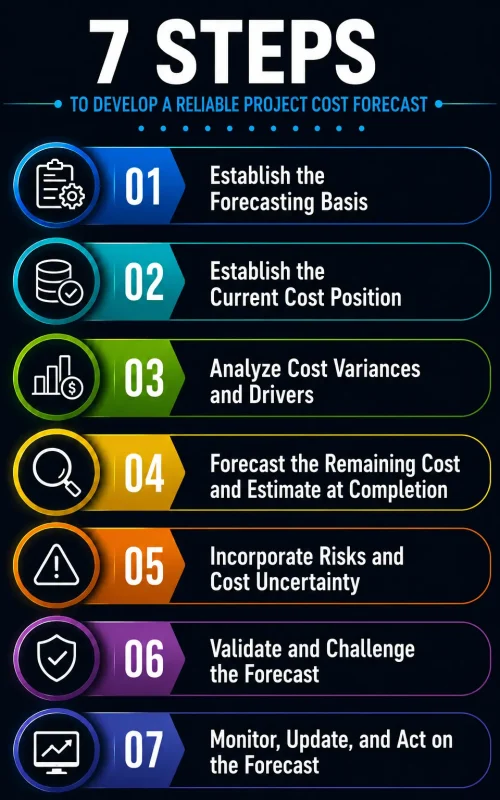
Step 1 — Establish the Forecasting Basis
A reliable project cost forecast starts with a clearly defined basis. Before calculating the expected final cost, the project team needs to establish what is being forecast, which cost structure will be used, what information is included, and which assumptions support the calculation.
This prevents the forecast from becoming simply a number produced from the latest cost report. Instead, it creates a controlled basis that can be reviewed, challenged, and updated as project conditions change.
Define what the forecast represents
First, establish the specific outcome the forecast is intended to predict. In most projects, this will include the expected total cost at completion, but the forecast may also need to show the remaining cost and the major cost components that make up the expected outcome.
Clearly define whether the forecast covers:
- Direct project costs
- Indirect and project overhead costs
- Procurement and subcontract commitments
- Approved changes
- Known potential exposures
- Contingency or risk allowances, where applicable
The scope of the forecast should remain consistent from one reporting cycle to the next unless a controlled change requires otherwise.
Align the cost structure with the project work
The forecasting basis should connect the cost structure with the way the project is planned and executed. Where practical, the Work Breakdown Structure, Cost Breakdown Structure, control accounts, schedule activities, contracts, and work packages should provide traceability between physical work and cost.
This allows the team to determine where costs have occurred and what costs are still required to complete specific areas of work.
Establish the forecasting status date
Use a defined status date for the forecast. Actual costs, commitments, progress, schedule information, and other inputs should relate to the same reporting period as far as practical.
A common status date helps prevent one function from providing current information while another provides older information. It also makes movement between successive forecasts easier to understand.
Document assumptions and known conditions
Every forecast contains assumptions. The important point is to make them visible and testable.
Record assumptions relating to:
- Remaining quantities and scope
- Expected productivity
- Material and subcontract costs
- Resource requirements
- Schedule duration
- Pending changes and commitments
- Known risks and uncertainties
When assumptions are documented, the team can determine later whether the forecast changed because project performance changed or because an underlying assumption was incorrect.
Define the forecasting approach
The team should also establish how the forecast will be developed. Depending on the project and available information, this may involve a detailed bottom-up estimate of remaining work, performance-based forecasting, or a combination of methods.
The method should reflect the maturity of the project, reliability of current data, nature of remaining work, and reasons for existing cost performance.
At the end of this step, the project should have a clearly defined and documented forecasting basis. This provides the foundation for establishing the current cost position and developing a forecast that can be tested against actual project evidence.
Step 2 — Establish the Current Cost Position
Before forecasting the final project cost, the team needs to establish a reliable picture of the project’s current cost position. A forecast built on incomplete actual costs, missing commitments, incorrect accruals, or outdated information can produce a misleading result even when the forecasting method itself is appropriate.
The objective of this step is to determine what the project has spent, what it has committed, what costs have been incurred but not yet recorded, and what obligations remain before the project can be completed.
Capture actual costs completely
Start with the latest available actual cost information from the project’s financial or cost-control system. Confirm that costs have been recorded against the correct project, control account, work package, cost category, and reporting period.
Review important cost categories such as:
- Labour and staff costs
- Materials and equipment
- Subcontract and contractor costs
- Engineering and professional services
- Construction and site costs
- Project overheads
- Other applicable indirect costs
Investigate unusual movements before using the information in the forecast. A large cost movement may result from genuine project performance, timing differences, accounting adjustments, or incorrect allocation.
Include commitments and outstanding obligations
Actual expenditure alone does not represent the full cost exposure. Review purchase orders, subcontracts, service agreements, approved commitments, and other contractual obligations that will result in future project costs.
For example, an equipment package may have generated only a small invoice so far, while most of its contractual value remains committed. Excluding that commitment could make the current cost position appear artificially low.
Reconcile significant commitments with procurement and commercial records to confirm that values, scope, and expected timing remain current.
Identify accruals and incurred costs
Determine whether work has been performed or goods have been received but the corresponding cost has not yet been recorded through the normal accounting process.
Examples may include:
- Completed subcontract work awaiting invoice
- Materials received but not yet invoiced
- Site services already consumed
- Labour or services performed during the reporting period
- Other known costs awaiting financial processing
Accruals should be based on reasonable evidence and reconciled when actual invoices or final costs become available.
Reconcile cost with physical progress
Compare the current cost position with the amount of work actually accomplished. This provides an important reasonableness check.
For example, significantly high expenditure combined with limited physical progress may indicate productivity problems, front-loaded spending, material purchases, or cost allocation issues. Conversely, strong physical progress with unusually low recorded cost may indicate delayed cost recognition or missing accruals.
Cost should therefore be reviewed alongside progress, quantities, and schedule information rather than in isolation.
Separate known cost from uncertain exposure
Not every future cost has the same level of certainty. Separate confirmed costs and commitments from potential changes, claims, risks, and other uncertain exposures.
This distinction helps management understand what is already financially committed and what could affect the final cost if a particular event occurs.
Validate the current position before forecasting
Before moving to the forecasting calculation, reconcile the current cost position with finance, procurement, commercial, planning, and other relevant functions.
The result should provide a defensible starting point covering actual costs, commitments, accruals, approved changes, and identified cost exposure.
At the end of Step 2, the project team should know what the project has actually spent and what financial obligations already exist. This creates a reliable foundation for the next step: understanding why the current cost position differs from the plan and which cost drivers may influence the remaining forecast.
Step 3 — Analyze Cost Variances and Drivers
Once the current cost position is established, the next step is to understand how actual cost performance differs from the plan and what is causing those differences. A reliable Project Cost Forecast should not simply carry historical variances into the future. The project team needs to determine whether each significant variance is temporary, recurring, already resolved, or likely to affect the remaining work.
This analysis connects historical cost performance with future expectations. It also helps the team avoid making unsupported assumptions when developing the Estimate at Completion.
Compare actual cost with the plan
Start by comparing actual costs with the approved cost baseline for the same reporting period. Review both current-period and cumulative performance so that recent changes are not hidden by the overall project position.
Where Earned Value Management is used, consider the relationship between Planned Value, Earned Value, and Actual Cost.
A negative Cost Variance indicates that the actual cost is greater than the earned value for the work accomplished. However, the variance is only a signal for investigation. It does not by itself explain why the difference occurred.
Measure cost efficiency where appropriate
The Cost Performance Index can provide another indication of cost efficiency:
A CPI below 1.00 indicates that the project is obtaining less earned value for each unit of actual cost. The team should investigate the underlying reasons before deciding whether the observed performance should influence the remaining cost forecast.
Identify the drivers behind significant variances
Break significant cost variances down into their underlying drivers. Depending on the project, these may include:
- Higher or lower quantities
- Labour productivity
- Material price changes
- Equipment utilisation
- Subcontractor performance
- Design development or scope changes
- Rework and quality problems
- Procurement conditions
- Schedule-related costs
This analysis is important because the same cost variance can have completely different forecasting implications depending on its cause.
Determine whether the variance will continue
Next, determine whether the identified cost driver is likely to affect the remaining work.
For example, a one-time equipment purchase at a higher price may explain a past variance without affecting future costs. In contrast, continuing labour productivity below the planned rate may indicate that similar cost pressure will continue.
Ask:
- Is the cause temporary or continuing?
- Has the problem already been corrected?
- Will the remaining work have similar characteristics?
- Are future quantities or rates different?
- Is a recovery action already producing measurable results?
Connect cost performance with physical progress
Cost variance should be reviewed alongside physical progress and productivity. Higher expenditure does not necessarily indicate poor cost performance if the project has also completed more work than planned.
Conversely, high expenditure combined with limited physical accomplishment may indicate productivity problems, inefficient resource use, incorrect cost allocation, or other issues requiring investigation.
Translate the findings into forecasting assumptions
Finally, determine how each significant variance should influence the remaining cost forecast. Document whether the variance has already been absorbed, is expected to continue, can be recovered, or requires a change to the Estimate to Complete.
At the end of this step, the team should understand what has caused the major cost variances, whether those causes are likely to continue, and how they should influence the remaining cost. This provides the evidence needed to develop a realistic Estimate at Completion in the next step.
Step 4 — Forecast Remaining Cost and Estimate at Completion
After analyzing the current cost position and the drivers behind significant variances, the next step is to determine how much the remaining project work is expected to cost. This forward-looking assessment forms the basis for the Estimate at Completion (EAC).
A reliable forecast should reflect the actual condition of the remaining work. It should consider current performance, remaining quantities, commitments, productivity, approved changes, known costs, and other factors that can influence the final outcome.
Define the work that remains
Begin by identifying the work that is still required to complete the project. The remaining scope should be detailed enough to support a realistic cost assessment.
Review areas such as:
- Remaining quantities and activities
- Outstanding engineering and design work
- Open procurement packages
- Remaining construction work
- Subcontractor scope
- Testing and commissioning
- Rework and corrective activities
- Closeout and completion requirements
This approach helps prevent the common mistake of estimating the remaining cost simply as a percentage of the original budget.
Develop the Estimate to Complete
The Estimate to Complete (ETC) represents the expected cost required to finish the remaining work. The project team should select an approach that matches the nature and maturity of the remaining scope.
A detailed bottom-up ETC can be appropriate when remaining quantities, resources, rates, commitments, and activities can be reasonably defined. Performance-based methods can provide another useful view when historical cost performance is reliable and representative of future work.
For significant work packages, it can be useful to involve the people responsible for executing the work. Their knowledge of remaining quantities, productivity, procurement status, and site conditions can improve the quality of the estimate.
Use current performance carefully
The cost performance identified in Step 3 should influence the forecast, but it should not automatically be applied to every remaining activity.
Determine whether the historical performance is representative of the remaining work. Consider whether:
- The same productivity conditions will continue
- Remaining work is more or less complex
- Future quantities differ from completed quantities
- Material or labour rates have changed
- Corrective actions have already improved performance
- Known problems have been removed or are still present
This prevents the forecast from becoming a mechanical extension of past performance.
Calculate the Estimate at Completion
Once the remaining cost has been established, combine it with the validated actual cost to determine the expected total project cost.
This relationship is straightforward, but the reliability of the EAC depends on the quality of both inputs. A mathematically correct EAC can still be misleading if actual costs are incomplete or the ETC is based on unrealistic assumptions.
Use performance-based EAC as a cross-check
Where Earned Value data is reliable, a performance-based EAC can provide an additional reference point. For example, when current cost performance is expected to continue, one commonly used relationship is:
Here, BAC represents the Budget at Completion and CPI represents the Cost Performance Index.
This should be treated as a forecasting method based on a specific assumption, not as an automatic replacement for a detailed ETC. If the remaining work differs significantly from the completed work, the assumption that historical cost performance will continue may not be appropriate.
Compare forecasting approaches
Where practical, compare the bottom-up forecast with an independent performance-based calculation. A significant difference between the two should trigger investigation.
For example, a bottom-up ETC may reflect known procurement savings and improved productivity, while a CPI-based calculation may continue historical cost inefficiency. The difference provides useful information about the assumptions behind each forecast.
The objective is not to select whichever number looks better. It is to understand why the results differ and determine which forecast is better supported by current project evidence.
Check the forecast against the project position
Before finalizing the EAC, compare it with the current schedule, physical progress, procurement position, approved changes, risks, and remaining scope.
If the forecast assumes that the project will complete within the original schedule while significant delays remain unresolved, the cost implications should be reassessed. Similarly, if substantial physical work remains but the ETC appears unusually low, the underlying assumptions should be challenged.
At the end of this step, the project team should have a forward-looking EAC supported by a realistic assessment of remaining work and current project performance. The next step is to incorporate risks and uncertainty so that the forecast reflects the range of conditions that could influence the final project cost.
Step 5 — Incorporate Risks and Cost Uncertainty
A Project Cost Forecast should reflect more than the cost that is currently expected. The final project cost can still change because of identified risks, uncertain quantities, market conditions, productivity changes, commercial exposure, and other events that have not yet been fully resolved.
The purpose of this step is to make those exposures visible and determine how they should influence the forecast. The objective is not to add an arbitrary contingency percentage, but to connect uncertainty with identifiable project conditions and documented assumptions.
Identify risks that can affect remaining cost
Review the current risk register, issue log, commercial information, procurement status, and project conditions to identify risks that could change the remaining cost.
Depending on the project, relevant exposures may include:
- Material and equipment price escalation
- Labour productivity changes
- Design development or late changes
- Quantity growth or uncertainty
- Supplier and subcontractor problems
- Schedule delays and extended durations
- Rework and quality issues
- Contractor claims and commercial disputes
- Regulatory or approval requirements
- Foreign exchange movements where applicable
Focus on risks that have a credible connection to the remaining project cost rather than automatically including every item in the project risk register.
Separate known costs from uncertain exposure
Not every potential cost should be treated as an uncertain risk. A cost that has already been incurred, a confirmed commitment, an approved change, and a potential future claim have different levels of certainty.
Classify significant cost items according to their current status. This helps the team understand what is already included in the forecast and what represents additional exposure.
It also reduces the risk of double counting. For example, a potential subcontractor claim should not be added as a separate risk allowance if the same expected amount has already been incorporated into the ETC.
Assess probability and financial impact
For significant risks, assess both the likelihood of occurrence and the potential financial consequence. Use available project evidence wherever possible rather than assigning unsupported values.
For example, if a key supplier has experienced repeated delivery problems, consider the potential cost of expediting, alternative procurement, additional site resources, or schedule-related impacts.
The assessment should also consider whether the risk is already partially reflected in the current forecast. This ensures that the risk analysis complements the EAC instead of creating another independent number with no clear relationship to it.
Consider uncertainty in the remaining work
Some cost uncertainty exists even when no specific risk event has been identified. Remaining quantities may change, productivity may vary, market rates may move, or the complexity of unfinished work may not yet be fully understood.
Review the major assumptions behind the ETC and identify where uncertainty is greatest.
Pay particular attention to:
- Uncertain quantities
- Unproven productivity assumptions
- Future material or labour rates
- Incomplete design information
- Uncommitted procurement
- Uncertain duration of remaining work
These factors can influence the final cost even when no individual risk event occurs.
Use scenarios when uncertainty is material
When uncertainty could materially affect the final outcome, consider presenting alternative forecast scenarios rather than relying on one number.
A practical approach may include:
- Most likely: reflects current evidence and expected conditions.
- Favourable: reflects credible improvements or favourable conditions.
- Adverse: reflects credible cost pressures and significant unresolved exposures.
Scenario analysis helps management understand how sensitive the forecast is to major assumptions. It also makes uncertainty more transparent than presenting a single figure with an implied level of precision that the available information may not support.
Avoid arbitrary contingency adjustments
A common forecasting weakness is adding a fixed percentage to the expected cost simply because the project contains uncertainty. This may increase the forecast without explaining where the exposure exists or why the allowance is appropriate.
Instead, significant allowances should have a defined basis. They may relate to identified risks, estimating uncertainty, known commercial exposure, or an established organizational estimating approach.
A clear basis makes the forecast easier to review, challenge, and update as project conditions change.
Integrate risk treatment into the forecast
After assessing the risks and uncertainties, determine how each significant exposure should be treated. Some may already be included in the ETC, some may require a separate allowance, and others may be better represented through scenario analysis.
Document the treatment and assumptions clearly. This allows the project team to remove, revise, or update the exposure when the underlying risk changes.
At the end of this step, the team should understand which risks and uncertainties could affect the final cost, how significant they are, what is already included in the forecast, and how remaining exposure has been treated. This provides the foundation for independently validating and challenging the forecast in the next step.
Step 6 — Validate and Challenge the Forecast
A forecast should not be accepted simply because the calculation is mathematically correct. Before it is used for project decisions, the team should validate the forecast, challenge its assumptions, and confirm that it is supported by current project evidence.
This step provides an independent check between the forecast and the actual project position. It helps identify unrealistic assumptions, missing costs, duplicated allowances, unexplained changes, and differences between the forecast and other project information.
Reconcile the forecast with current cost information
Begin by checking that the forecast agrees with the latest validated actual costs, commitments, accruals, approved changes, and other relevant financial information.
Investigate material differences between the forecasting model and the cost-control system. A difference may be valid, but it should have a clear explanation.
Pay particular attention to:
- Missing actual costs
- Unrecorded commitments
- Incorrect accruals
- Duplicate costs
- Incorrect cost allocation
- Pending changes
A forecast cannot be considered reliable if its starting cost position cannot be reconciled.
Test the remaining-cost assumptions
Review the assumptions used to develop the ETC. Ask whether the remaining quantities, productivity rates, unit costs, resource requirements, procurement values, and expected durations are supported by current evidence.
For example, if the forecast assumes that labour productivity will return to the planned rate, the team should identify what evidence supports that assumption. A planned recovery that has not yet occurred should not automatically be treated as achieved performance.
Each major assumption should therefore be traceable to evidence, an approved decision, or a clearly documented forecasting basis.
Challenge the forecasting method
Consider whether the selected forecasting method remains appropriate for the current stage of the project.
For example, a performance-based calculation may be useful when historical performance is stable and representative of the remaining work. However, a detailed bottom-up assessment may be more appropriate when the remaining work has substantially different characteristics.
Where practical, compare the primary forecast with another reasonable forecasting approach. A significant difference should trigger investigation rather than being ignored.
Cross-check the forecast against the schedule
The cost forecast should be consistent with the current project schedule. Review whether the forecast assumes a completion position that is realistic given the remaining activities and current schedule performance.
Schedule conditions can influence cost through:
- Extended project overheads
- Additional supervision
- Lower productivity
- Extended equipment requirements
- Additional subcontractor costs
- Acceleration or recovery measures
If the schedule indicates conditions that could materially affect cost, the forecast should reflect those conditions or clearly explain why they have been excluded.
Check progress and physical performance
Compare the forecast with actual physical progress and productivity. This provides another independent reasonableness check.
A forecast may appear reasonable financially while being inconsistent with the amount of work actually completed. For example, a low remaining cost estimate may not be credible if substantial physical work remains and productivity is currently below plan.
Use measurable quantities and verified progress wherever possible instead of relying solely on subjective percentage estimates.
Conduct an independent challenge
Significant forecasts should be reviewed by people who can challenge the assumptions objectively. Depending on the project, this may involve project controls, commercial, finance, planning, procurement, project management, or another independent reviewer.
The reviewer should ask practical questions such as:
- What evidence supports the forecast?
- What has changed since the previous forecast?
- Which assumptions have the greatest impact?
- What costs could still be missing?
- Which risks are not reflected?
- What would make the forecast wrong?
The purpose is not to force the forecast toward a particular target. It is to determine whether the forecast is reasonable, explainable, and defensible.
Document validation results
Record significant challenges, agreed adjustments, unresolved assumptions, and reasons for accepting or changing the forecast. This creates an audit trail and makes future forecast movements easier to understand.
At the end of Step 6, the project team should have a forecast that has been reconciled, tested against project evidence, independently challenged, and supported by documented assumptions. The final step is to use this validated forecast for decision-making and continuously monitor whether it remains accurate as the project develops.
Step 7 — Monitor, Update, and Act on the Forecast
A project cost forecast is not a one-time calculation. It is a forward-looking management tool that should change when project conditions change. After the forecast has been developed and validated, the project team needs to monitor actual performance, identify forecast movement, understand why it changed, and take action when the expected final cost begins to move away from the approved plan.
The objective of this step is to turn forecasting into a continuous control cycle rather than treating the Estimate at Completion as another number in the monthly report.
Update the forecast at defined intervals
Establish a consistent forecasting cycle that matches the project’s reporting and control requirements. At each cycle, update the forecast using the latest validated information rather than simply carrying forward the previous result.
Review changes in:
- Actual costs
- Commitments and accruals
- Physical progress
- Remaining quantities
- Productivity
- Procurement status
- Approved changes
- Risks and uncertainties
- Schedule performance
This allows the forecast to progressively reflect what the project team has learned during delivery.
Track movement between forecasts
Do not focus only on the latest EAC. Compare the current forecast with the previous forecast and identify the reasons for significant movement.
For example, if the EAC increases from one reporting period to the next, determine whether the movement resulted from:
- New actual cost information
- Changes in remaining quantities
- Productivity deterioration
- Approved scope changes
- New commitments
- Emerging risks
- Schedule impacts
- Changes in forecasting assumptions
A forecast movement should have an explanation that management can understand and challenge.
Monitor forecast accuracy
Compare previous forecasts with subsequent actual results. This creates an important feedback loop for improving the forecasting process.
For example, if the team repeatedly forecasts labour costs below the eventual actual cost, investigate why. The underlying issue may be an unrealistic productivity assumption, incomplete remaining quantities, delayed cost recognition, or an overlooked risk.
Forecast accuracy should therefore be reviewed as a performance measure of the forecasting process itself, not simply as a retrospective financial exercise.
Set escalation thresholds
Define when a forecast movement or cost exposure requires management attention. Thresholds may be based on the size of the variance, percentage movement, impact on contingency, effect on major work packages, or potential effect on project objectives.
Clear thresholds help the team distinguish between normal forecasting movement and conditions that require intervention.
For significant movements, communicate:
- What changed
- Why it changed
- Expected financial impact
- Whether the impact is temporary or continuing
- What action is required
- Who owns the action
Connect the forecast to corrective action
A forecast becomes valuable when it supports decisions. If the expected final cost is increasing because of productivity problems, procurement issues, rework, or schedule delays, the project team should identify actions that can influence the remaining outcome.
Actions may include improving productivity, renegotiating commercial issues, controlling additional scope, changing procurement strategies, reducing avoidable rework, or implementing an approved recovery plan.
Each significant action should have a clear owner, target date, and expected result.
Measure whether actions change the forecast
Do not assume that completing a corrective action automatically improves the project cost position. Monitor subsequent performance to determine whether the expected benefit has actually occurred.
For example, if additional resources are introduced to improve productivity, compare subsequent productivity and cost performance against the expected improvement. If the result does not materialize, reassess the remaining cost and update the forecast.
Maintain a clear forecasting history
Retain previous forecasts, assumptions, major changes, validation comments, and management decisions. This creates a historical record showing how the expected final cost evolved throughout the project.
This information is valuable for governance, management reviews, audits, and future estimating. More importantly, it allows the organization to identify recurring forecasting weaknesses and improve its estimating practices on future projects.
At the end of Step 7, Project Cost Forecasts should operate as a continuous feedback and control mechanism. The team should know not only the latest expected final cost, but also how the forecast is moving, why it is moving, whether corrective actions are working, and what decisions are required next.
This completes the forecasting cycle: establish the basis, understand the current position, analyze performance, forecast remaining cost, incorporate uncertainty, validate the result, and continuously monitor and act on what the forecast reveals.
Practical Example
Putting the Approach Into Practice
Consider a large industrial construction project with an approved budget of $50 million. The project is currently in the construction phase, and management has become concerned about increasing costs and the possibility of exceeding the approved budget.
The project controls team decides to develop a reliable Project Cost Forecast by applying the seven-step approach described in this guide.
Step 1: Establish the Forecasting Basis
The team first defines the basis for the forecast. The approved cost baseline, reporting period, current status date, project scope, cost structure, and forecasting assumptions are reviewed.
The team also confirms that the forecast will cover the complete remaining scope, including construction, procurement, testing, commissioning, project overheads, and closeout activities.
This creates a consistent basis for comparing the current forecast with the approved project plan.
Step 2: Establish the Current Cost Position
The project controls team reconciles actual costs, commitments, accruals, and approved changes.
The review shows that $28 million has been incurred and another $3 million is committed for approved procurement and subcontract work. Therefore, the current cost position is $31 million.
The team checks the information against the financial records and confirms that significant costs have been captured without material duplication.
This gives the team a reliable starting point for forecasting the remaining cost.
Step 3: Analyze Cost Variances and Drivers
The team then compares actual performance with the approved cost baseline and identifies significant variances.
The analysis identifies three major cost drivers:
- Labour productivity is below the planned level.
- Several material packages were purchased above the original budgeted rates.
- Additional rework has increased construction costs.
The team investigates each variance rather than assuming that all three will continue.
The higher material cost is largely a completed procurement issue and is therefore treated as a historical impact. However, low labour productivity and rework are still affecting ongoing work and may increase the cost of the remaining scope.
Step 4: Forecast the Remaining Cost and Estimate at Completion
The team now assesses the work that remains. Remaining construction quantities, labour requirements, procurement commitments, subcontractor costs, testing, commissioning, and closeout activities are reviewed.
The detailed assessment indicates that the remaining work is expected to cost $21 million.
EAC = $31M + $21M = $52M
The current Estimate at Completion is therefore $52 million, compared with the approved budget of $50 million.
The team also develops a performance-based forecast as a cross-check. The difference between the two approaches is investigated rather than simply selecting the more favourable result.
Step 5: Incorporate Risks and Cost Uncertainty
The team reviews the risk register, commercial information, procurement status, and remaining work to identify cost exposures that may not yet be fully reflected in the forecast.
Three significant exposures are identified:
- Continued low labour productivity
- Potential additional rework
- Uncertainty around final commissioning requirements
The team checks whether these exposures are already included in the $21 million ETC. Known rework costs already included in the ETC are not added again.
The uncertain commissioning exposure is kept separately because the final requirement has not yet been confirmed. Management is therefore shown both the current forecast and the additional potential exposure.
Step 6: Validate and Challenge the Forecast
Before presenting the forecast to management, the project controls team validates the $52 million EAC.
The forecast is checked against:
- Latest actual costs and commitments
- Remaining physical quantities
- Current project schedule
- Construction productivity
- Procurement status
- Approved changes
- Known risks and uncertainties
The planning team confirms that the schedule is experiencing delays in the same construction areas where productivity is below plan. This supports the conclusion that the cost pressure is not simply a historical variance.
The commercial and construction teams independently challenge the remaining-cost estimate. Several assumptions are refined, but the $52 million forecast remains supported by the available evidence.
Step 7: Monitor, Update, and Act on the Forecast
The project manager does not treat the $52 million EAC as a final answer. The team identifies the main controllable cost driver: low labour productivity.
A productivity improvement plan is introduced for the affected work packages. Responsibility is assigned, measurable productivity targets are established, and performance is reviewed during each reporting cycle.
During the next forecast cycle, actual productivity is compared with the recovery target. The ETC is then updated using the latest evidence.
If productivity improves and the expected cost reduces, the EAC can be revised accordingly. If productivity remains below target, the forecast should reflect that continuing condition rather than assuming that recovery will occur automatically.
What the Seven-Step Approach Achieved
The project team did not simply report that the project was forecast to exceed its $50 million budget.
Instead, the seven steps established:
- What the forecast is based on
- Where the project currently stands
- Why cost performance has changed
- What the remaining work is expected to cost
- What risks could change the outcome
- Whether the forecast is credible
- What actions are required to influence the final cost
This demonstrates the key principle of reliable Project Cost Forecasts: the value of a forecast is not simply in predicting the final cost, but in providing enough reliable information for the project team to understand what is driving that outcome and act while there is still an opportunity to influence it.
Common Mistakes to Avoid
Forecasting from the Original Budget Alone
Using the original budget as the primary basis for the forecast can hide the project’s current reality. The approved budget represents the planned cost, not necessarily the cost required to complete the remaining work. A reliable forecast should incorporate actual costs, commitments, remaining quantities, current productivity, approved changes, risks, and updated project conditions.
Treating Percentage Complete as Cost Forecasting
A project being 60% complete does not automatically mean that 60% of the budget has been spent or that 40% of the budget is sufficient to finish. Different activities have different cost profiles. Forecasts should therefore be based on the actual remaining scope and its expected cost rather than simply applying a percentage to the original budget.
Carrying Every Historical Variance Forward
Not every past cost variance will continue into the future. Some variances result from one-time events, while others indicate continuing performance problems. Automatically extending all historical variances can distort the forecast. Each significant variance should be investigated to determine its cause, whether it has been resolved, and whether it is relevant to the remaining work.
Ignoring the Cost of Remaining Work
A forecast can become unreliable when the team focuses heavily on costs already incurred and gives insufficient attention to unfinished work. Remaining quantities, activities, commitments, productivity, procurement requirements, testing, commissioning, and closeout costs should be assessed carefully. The Estimate to Complete should represent what the project realistically expects to spend to finish the remaining scope.
Using an Unrealistic Estimate to Complete
An ETC may appear reasonable while being based on optimistic assumptions. Examples include assuming planned productivity will immediately return, remaining quantities will not increase, or unresolved problems will disappear without evidence. Major ETC assumptions should be supported by current project information and reviewed by the people responsible for executing the remaining work.
Applying EAC Formulas Without Understanding Their Assumptions
Performance-based EAC formulas can provide useful forecasting information, but they are not automatic answers. A formula such as BAC divided by CPI assumes particular conditions about future performance. If the remaining work differs significantly from completed work, blindly applying the formula can produce an unrealistic result. Always understand the forecasting method and its underlying assumptions.
Adding Arbitrary Contingency
Adding a fixed percentage to the forecast simply because the project contains uncertainty does not explain the actual exposure. It can also create false confidence if significant risks remain unidentified. Cost allowances should have a clear basis linked to identified risks, estimating uncertainty, commercial exposure, or an established project control methodology.
Failing to Reconcile Actual Costs and Commitments
A forecast can be seriously distorted when actual costs, commitments, accruals, or approved changes are incomplete or duplicated. Before developing the EAC, reconcile the current cost position with reliable financial information. The forecasting team should know exactly what has already been incurred, committed, approved, and included in the forecast.
Ignoring Schedule Performance
Cost and schedule performance are often closely connected. Delays can increase supervision, equipment, labour, overhead, and other project costs. A cost forecast that ignores significant schedule deterioration may therefore underestimate the remaining cost. Review the latest schedule and determine whether delays, productivity changes, or recovery measures could influence the financial outcome.
Double Counting Risks and Costs
The same potential cost can accidentally appear in several parts of the forecast. For example, a known subcontractor exposure may already be included in the ETC and then added again as a separate risk allowance. Clearly identify what is already included, what remains uncertain, and what is being treated separately to prevent duplication.
Accepting the Forecast Without Independent Challenge
The person who prepares a forecast may naturally become attached to its assumptions. Without an independent review, unrealistic expectations or missing costs can remain unnoticed. Significant forecasts should be challenged by appropriate project controls, commercial, finance, planning, or project management personnel who can test the assumptions and compare the forecast with actual project conditions.
Treating the EAC as a Static Number
A forecast becomes less useful when it is prepared once and simply repeated in subsequent reports. Project conditions continuously change as work progresses, risks develop, and corrective actions produce results. Update the forecast using current evidence, explain significant movements, monitor forecast accuracy, and take action when the expected final cost begins to move away from the approved plan.
Key Takeaways
Building reliable Project Cost Forecasts requires more than updating the expected final cost. A strong forecasting process connects a reliable cost baseline with current cost performance, remaining work, variance analysis, risk assessment, validation, and continuous monitoring so project teams can understand where the project is heading and take action while there is still an opportunity to influence the outcome.
- Establish a clear forecasting basis. Define the cost baseline, reporting period, scope, cost structure, assumptions, and responsibilities before developing the forecast.
- Establish a reliable current cost position. Reconcile actual costs, commitments, accruals, approved changes, and remaining scope so the forecast starts with dependable information.
- Analyze cost performance and its drivers. Identify significant variances and determine whether their causes are temporary, continuing, recoverable, or likely to affect the remaining work.
- Forecast the remaining cost realistically. Develop the ETC and EAC using current project conditions, remaining quantities, productivity, commitments, and appropriate forecasting methods.
- Include risks and uncertainty. Identify significant cost exposures, distinguish known costs from uncertain events, and avoid arbitrary contingency or double counting.
- Validate and challenge the forecast. Test the forecast against actual costs, physical progress, schedule performance, risks, and other project information before using it for management decisions.
- Monitor and act continuously. Track forecast movement, measure forecast accuracy, assign corrective actions, and update the EAC when project conditions or assumptions change.
A reliable Project Cost Forecast does more than predict the final cost. It explains where the project is heading, what is driving that outcome, how confident the team can be in the forecast, and what actions can still influence the final result.
References
- The Standard for Earned Value Management — Project Management Institute (PMI)
- Earned Value Approach: Forecasting Final Cost and Schedule Results — Project Management Institute (PMI)
- Earned Value for the Masses: A Practical Approach — Project Management Institute (PMI)
- Earned Value: The Good, the Bad, and the Ugly — Project Management Institute (PMI)
- Cost Estimating and Assessment Guide: Best Practices for Developing and Managing Program Costs — U.S. Government Accountability Office (GAO)
- Defense Infrastructure: Action Needed to Increase the Reliability of Construction Cost Estimates — U.S. Government Accountability Office (GAO)
- Incorporating All Leading Practices Could Improve Accuracy and Credibility of Projects’ Cost Estimates — U.S. Government Accountability Office (GAO)
- NASA Cost Estimating Handbook — National Aeronautics and Space Administration (NASA)
- NASA Cost Estimating Handbook — Appendix G: Cost Risk and Uncertainty Methodologies — NASA
- Joint Cost Schedule Risk and Uncertainty Handbook — NASA
- Cost Estimating Guide — U.S. Department of Energy (DOE)
- Monitoring Performance Against Baseline — Project Management Institute (PMI)
FEATURED PROJECT CONTROLS GUIDES
Practical Guidance for Measuring, Analyzing, and Controlling Project Performance
Effective project controls requires more than collecting project data and preparing reports. Teams need to measure progress, understand cost and schedule performance, identify variances, investigate their causes, and develop realistic forecasts.
How to Prepare Effective Project Controls Reports
Understand how to organize project performance information, present key variances, explain underlying issues, highlight emerging risks, and provide management with actionable information.
How to Monitor Project Cost and Schedule
Learn how to compare planned and actual performance, identify emerging cost and schedule issues, evaluate trends, and support timely corrective project actions.
How to Set Up Effective Project Controls
Learn how to establish project controls processes, define responsibilities, set performance measures, structure reporting requirements, and create a reliable framework for project performance management.
MORE PROJECT CONTROLS RESOURCE TYPES
Continue Your Project Controls Learning
Project controls knowledge becomes more valuable when you can understand performance, apply structured methods, and develop practical skills. Explore the other resources within the Project Controls collection to complement the guidance provided in these guides.
Templates
Use practical templates and checklists to establish controls, measure progress, analyze variances, develop forecasts, prepare reports, and support project performance management.
Downloads
Access useful project controls materials and reference resources to support learning and day-to-day activities involving cost, progress, forecasting, reporting, and project performance.
Career Roadmaps
Follow structured learning paths to develop project controls knowledge, practical skills, analytical capabilities, and professional competencies for project controls career development.
Case Studies
Explore project controls situations, decisions, challenges, and outcomes to understand how cost, progress, forecasting, reporting, and performance practices are applied in real projects.
Glossary
Find clear explanations of project controls, cost control, progress measurement, forecasting, performance management, reporting, and related terminology used across project environments.
Insights & Articles
Explore professional perspectives, insights, emerging practices, and discussions relevant to project controls, cost management, performance measurement, forecasting, and reporting.
Looking for more project management resources? Explore the Kleios Technologies Resources Hub to discover our complete collection of guides, templates, downloads, career roadmaps, case studies, glossary resources, and insights.
RELATED KNOWLEDGE DOMAINS
Continue Your Learning Across Related Knowledge Domains
Project Management is closely connected with specialized disciplines that support successful planning, execution, governance, performance measurement, and professional growth. Explore related knowledge domains to expand your expertise, develop complementary skills, and access practical resources across the complete project management ecosystem.
Expand your expertise one domain at a time and build a well-rounded project management skill set.
Why Explore Related Domains?
- Develop cross-functional project management expertise
- Discover specialized knowledge beyond core project management
- Access practical resources across interconnected disciplines
- Build a complete professional learning pathway
- Strengthen career readiness through continuous learning
Each knowledge domain complements your Project Management expertise, helping you build broader capabilities and solve real-world project challenges with greater confidence.
Project Management
Practical project management knowledge, practices, and professional resources.
Project Planning & Scheduling
Planning techniques, scheduling methods, and timeline management resources.
PMO
Governance, portfolio management, and organizational project excellence.
Risk Management
Risk identification, assessment, mitigation, and monitoring resources.
Primavera P6
Professional planning, scheduling, resource management, and reporting.
Microsoft Project
Project scheduling, tracking, reporting, and collaboration resources.
Power BI
Interactive dashboards, reporting, visualization, and project analytics.
PMI Certifications
Certification guidance, exam preparation, and professional development resources.