
PROJECT CONTROLS INSIGHT
When does Project Controls Reporting Value Decline?
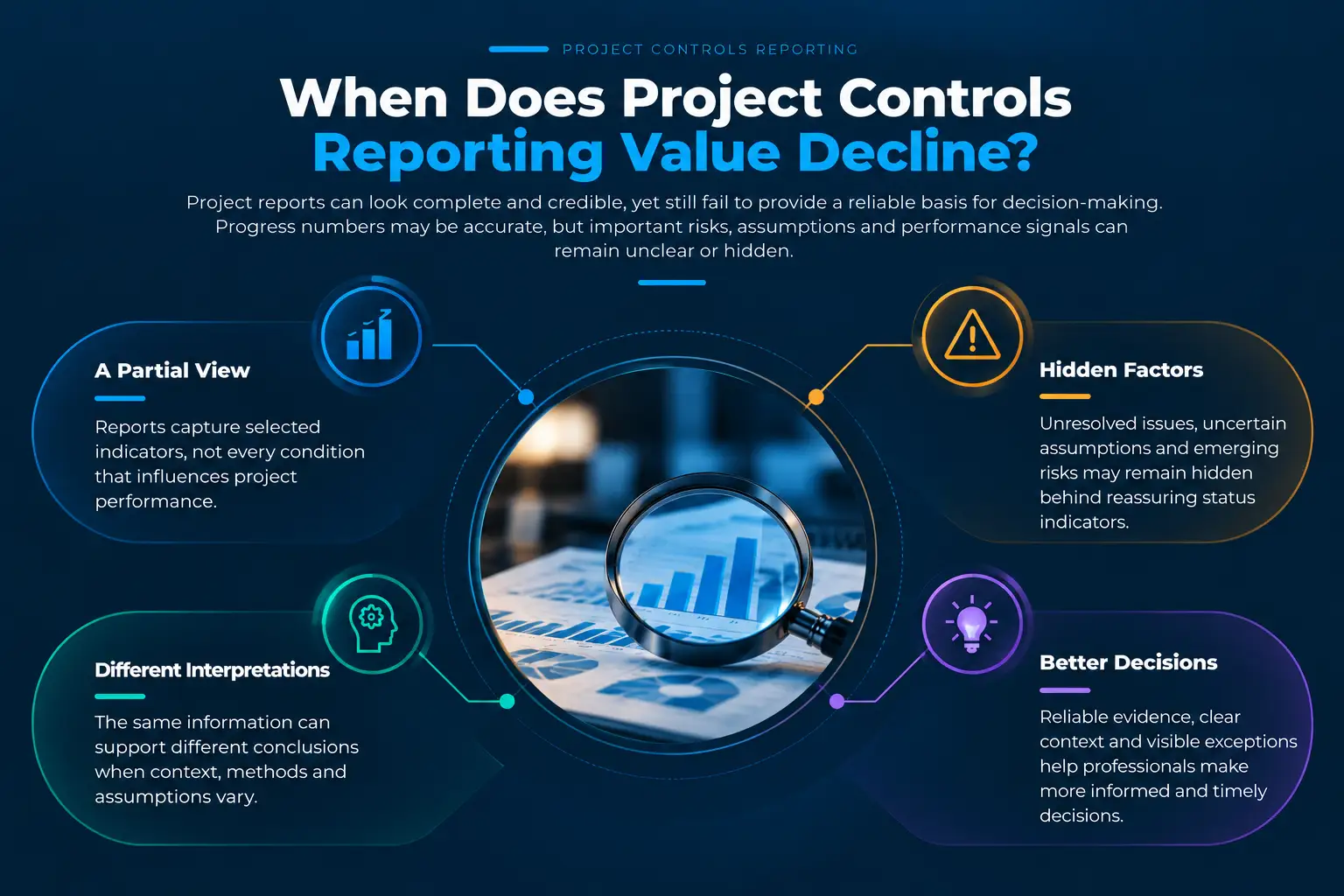
Project Controls Reporting Value declines when reports fail to provide the context, reliable evidence, and meaningful interpretation needed for sound project decisions. Reports may appear complete and accurate while material exceptions remain hidden, assumptions go unchallenged, emerging risks receive insufficient attention, or reported actions fail to resolve underlying problems.
This Insight examines why project controls reports can lose their decision-making value, how weaknesses in data quality, context, interpretation, and reporting practices affect project oversight, and what project professionals should reconsider to make reporting more useful, credible, and actionable.
Professional Insight · Project Controls · 18–24 min read
Introduction
Project controls reports help professionals understand project performance, identify emerging concerns, and support management decisions. However, producing reports regularly does not guarantee that they provide a reliable picture of project conditions or highlight the issues that require attention.
Project Controls Reporting Value declines when reports fail to connect reliable evidence with meaningful interpretation and actionable decisions. A report may contain accurate figures, complete tables, and clear status indicators, yet still conceal deteriorating performance, unresolved dependencies, or unrealistic recovery assumptions.
The problem is not always poor data or inadequate reporting processes. Sometimes, established reports satisfy every formal requirement but fail to explain what has changed, why it matters, or what may happen next.
This Insight examines why reporting loses its decision-making value, how weaknesses in data quality, context, interpretation, and accountability affect project oversight, and why these problems can persist even within established control environments.
It also presents a practical framework that project professionals can use to assess reporting effectiveness and strengthen the connection between evidence, decisions, actions, and feedback. The objective is not simply to produce better reports, but to make reporting more useful for controlling project outcomes.
The Common Assumption
Project controls teams follow established reporting cycles, formats, and information requirements. When reports arrive on time, contain the required indicators, and present consistent status updates, the reporting process can appear effective. However, meeting reporting requirements does not necessarily mean that reports provide the understanding needed to control a project.
Several common assumptions explain why professionals may trust reports without questioning their actual decision-making value.
A Complete Report Is a Useful Report
A report may contain every required table, indicator, commentary field, and status update. Consequently, readers may assume that it provides a complete understanding of project performance.
However, completeness describes whether a report contains the expected information. Usefulness depends on whether that information answers the questions decision-makers need to resolve. A report can satisfy every reporting requirement while leaving important problems unexplained.
Accurate Numbers Produce an Accurate Overall Picture
Professionals naturally place confidence in figures drawn from established systems and measurement processes. Yet individually accurate figures can still produce a misleading overall picture when teams use inconsistent definitions, outdated assumptions, or incompatible reporting periods.
For example, reported progress may accurately reflect completed activities but fail to reveal unresolved work threatening a critical milestone. Reliable individual figures do not automatically guarantee a reliable interpretation of the project.
This distinction matters because Project Controls Reporting Value depends on more than the correctness of individual figures. Professionals must also understand how the information connects, what it excludes, and whether the combined picture reflects current project conditions.
More Metrics Provide Better Control
Adding indicators can appear to strengthen oversight because managers receive more information about cost, schedule, productivity, resources, risks, and progress. Nevertheless, additional metrics do not automatically improve understanding.
When reports contain excessive detail without prioritisation, material exceptions can become harder to identify. As a result, teams may spend more time reviewing figures and less time investigating their implications. Effective reporting prioritises decision-relevant signals over the volume of information presented.
Regular Reporting Guarantees Timely Awareness
Weekly status updates and monthly dashboards create a predictable flow of project information. However, a regular reporting cycle cannot guarantee that emerging problems receive attention while intervention can still make a difference.
If information arrives late, relies on outdated inputs, or focuses mainly on completed work, developing concerns may remain unnoticed between reporting dates. Therefore, reporting frequency must support timely investigation, not merely routine publication.
A Green Status Means the Project Is Under Control
Green status indicators help managers scan reports quickly. Yet a single colour can compress complex conditions into a judgement that hides uncertainty, conflicting evidence, or weaknesses in the underlying assumptions.
A project may remain within its current tolerances while productivity declines or a critical approval remains unresolved. A favourable status should prompt informed review rather than replace it. Project Controls Reporting Value depends on whether the report explains the evidence behind its status and identifies conditions that could change the outlook.
What Is Really Happening?
Reports rarely lose their value for just one reason. More often, several weaknesses develop together, affecting how teams collect information, interpret performance, communicate concerns, and respond to emerging problems.
Understanding these mechanisms helps professionals look beyond a report’s appearance and examine whether its contents reflect the project’s actual condition.
Data Quality Degrades Before the Report Looks Incomplete
A report can contain every required field while relying on information that is outdated, inconsistent, or insufficiently verified. For example, teams may submit progress updates on time without confirming whether the reported quantities reflect completed and accepted work.
These weaknesses do not always make the report look incomplete. Instead, they can undermine the reliability of its conclusions. Reporting quality depends on the fitness of the underlying evidence, not simply whether teams populate the required fields.
Indicators Lose Their Context
Metrics rarely explain themselves. A cost variance, productivity rate, or schedule indicator needs an appropriate baseline, measurement definition, reporting period, and explanation of relevant conditions.
Without that context, readers may misinterpret normal variation as a serious problem or overlook a developing concern. Therefore, Project Controls Reporting Value depends on explaining what an indicator means, why it changed, and which assumptions influence its interpretation.
Aggregation Conceals Material Exceptions
Summary reports help management review complex projects efficiently. However, project-wide totals and averages can conceal significant weaknesses within individual work packages, locations, contractors, or technical activities.
Overall progress may remain close to plan while a critical activity falls behind. Similarly, acceptable aggregate costs may conceal concentrated overruns in areas that threaten future performance. Useful aggregation preserves visibility of exceptions that could materially affect project outcomes.
Reporting Becomes Retrospective
Many reports explain what happened during the previous period. They record completed work, actual expenditure, missed milestones, and previously identified issues. This information remains essential for understanding performance.
However, historical results alone cannot explain what is likely to happen next. If reports fail to examine emerging constraints, forecast assumptions, unresolved dependencies, and recovery feasibility, managers may receive warnings only after performance deteriorates. Effective reporting connects historical performance with forward-looking exposure.
Reporting Bias Weakens Candour
Reporting depends on people interpreting evidence and communicating their findings. Yet optimism, pressure to demonstrate progress, fear of criticism, or expectations from senior management can influence how teams present emerging problems.
Consequently, teams may soften adverse commentary, delay escalation, or present recovery intentions as though they were confirmed outcomes. Credible reporting distinguishes observed facts, estimates, assumptions, and proposed corrective actions. It also makes uncertainty visible instead of hiding it behind reassuring language.
These behaviours can weaken Project Controls Reporting Value even when the reporting process follows established procedures. The critical issue is whether the report communicates the evidence honestly enough for decision-makers to assess the real position.
Information Becomes Fragmented Across Functions
Cost, schedule, risk, progress, procurement, and change teams may maintain separate datasets and reporting cycles. Each function can produce internally consistent information while overlooking relationships that affect the wider project.
For example, a schedule update may show a delayed approval while the cost forecast still assumes the original delivery sequence. Unless teams reconcile these positions, the combined report may present an inconsistent outlook. Integrated reporting must connect related evidence rather than simply place separate updates side by side.
Visual Presentation Substitutes for Interpretation
Dashboards, charts, traffic-light indicators, and concise summaries make information easier to scan. Nevertheless, clear presentation does not guarantee sound analysis.
A report may show that productivity has declined without explaining the cause, likely duration, or effect on completion. Visuals should help readers identify and investigate important signals, while analysis explains their meaning and implications.
Actions Are Reported but Not Closed
Reports often record agreed actions, assigned owners, and target dates. However, recording an action does not establish that someone completed it, resolved the underlying issue, or improved project performance.
An action may remain open across several reporting cycles while its status receives routine updates. Consequently, management may see evidence of activity without evidence of progress toward resolution. Effective reporting tracks actions through completion and checks whether the intended result actually occurred.
Together, these mechanisms explain how reports can remain orderly while providing an increasingly weak basis for decisions. Recognising them raises a deeper question: why do established reporting practices allow these weaknesses to persist?
Why Do Professionals Miss the Problem?
Reporting weaknesses can persist even when experienced professionals follow established procedures and use recognised project controls systems. The problem often lies not in the absence of reporting activity, but in the expectations, behaviours, and organisational arrangements that shape how people produce and interpret reports.
When reporting routines become familiar, professionals may focus on maintaining the process rather than questioning whether its outputs still support effective decisions. Several factors help explain why this happens.
Compliance Becomes the Objective
Project teams often work to fixed reporting calendars, prescribed formats, and management submission deadlines. These requirements provide consistency and discipline. However, they can also encourage teams to treat report completion as the primary measure of success.
A report may reach management on time, contain every required field, and satisfy governance requirements without explaining a material performance concern. Consequently, teams may celebrate timely submission while overlooking weaknesses in the analysis.
Completing the reporting process is an operational requirement, not proof that the report has fulfilled its decision-making purpose. Professionals must evaluate both compliance and usefulness.
Established Templates Shape What Gets Noticed
Standard templates help organisations maintain consistent reporting across teams and reporting periods. Nevertheless, predefined fields can influence which issues receive attention and which remain outside the discussion.
For example, a template may request actual cost, schedule variance, progress percentage, and recovery actions without asking whether the recovery assumptions remain achievable. Teams can therefore complete the template correctly while leaving a critical question unanswered.
Over time, familiar formats may reinforce familiar explanations. Reporting structures should guide professional judgement without restricting it to the questions already included in the template. Professionals must remain alert to emerging conditions that standard fields may not capture.
Reporting Ownership Is Fragmented
Project controls reporting often depends on contributions from planners, cost controllers, risk specialists, engineers, procurement teams, and project managers. Each contributor may understand their own information without seeing how it affects the wider project outlook.
Problems emerge when teams assume that someone else will reconcile conflicting figures, challenge assumptions, or explain cross-functional implications. Data ownership may be clear, yet responsibility for the overall interpretation remains uncertain.
This gap can weaken Project Controls Reporting Value because no single contribution necessarily provides the integrated view management needs. Clear responsibilities must cover data validation, analytical integration, interpretation, and escalation.
Unfavorable Information Is Difficult to Escalate
Reporting depends on people communicating concerns honestly, including when evidence challenges established expectations. However, organisational pressure, seniority, commercial sensitivities, or fear of criticism can make unfavorable information difficult to present.
A team may describe a delayed activity as recoverable before confirming the required resources or approvals. Similarly, repeated forecast deterioration may receive optimistic commentary because contributors expect conditions to improve.
When people feel safer reporting reassuring interpretations than uncomfortable evidence, management can lose visibility of material exposure. Professionals need to distinguish verified recovery measures from intentions, and uncertainty from confirmed outcomes.
Report Consumers Do Not Challenge the Output
Project managers, sponsors, and governance forums may receive regular reports without examining how the conclusions were reached. Familiar layouts and established reporting relationships can make the information appear dependable, particularly when headline indicators remain stable.
However, readers need to ask whether the evidence supports the reported status, whether assumptions have changed, and whether significant exceptions require attention. Otherwise, the reporting process can become a one-way exchange in which teams present information but decision-makers do not test its meaning.
Effective oversight requires constructive challenge, not simply the receipt and acknowledgement of reports. Questions about evidence, uncertainty, dependencies, and recovery feasibility help reveal weaknesses that presentation alone cannot expose.
Reporting Effectiveness Is Rarely Evaluated
Organisations often review whether reports were submitted, whether required fields were completed, and whether reporting deadlines were met. Yet they may not examine whether the information helped managers identify emerging concerns, make better decisions, or resolve problems earlier.
Without such evaluation, outdated indicators, unnecessary detail, and ineffective reporting cycles can remain in place. Teams may continue producing information because the process exists, rather than because readers still need it in its current form.
A practical review should examine which information supported decisions, which indicators generated little useful discussion, and which concerns surfaced too late. Project Controls Reporting Value improves when organisations learn from reporting outcomes and adapt their reporting arrangements accordingly.
These factors can reinforce one another. Compliance-focused routines, restrictive templates, fragmented accountability, limited candour, passive review, and absent feedback can allow reporting weaknesses to persist without attracting sufficient attention. The consequences become more significant when those weaknesses begin to influence project decisions and management responses.
What Happens If It Continues?
When reporting weaknesses remain unresolved, their effects can extend beyond the report itself. Management may receive information regularly yet struggle to recognise emerging problems, assess the reliability of forecasts, or determine where intervention matters most.
These consequences do not occur in every project. However, when reports consistently fail to reveal material conditions or support timely decisions, the project becomes more vulnerable to avoidable delays, ineffective responses, and weakened oversight.
Emerging Problems Receive Attention Too Late
Early warning signs often appear before a project records a major variance. Productivity may decline, approvals may take longer, procurement commitments may weaken, or corrective actions may repeatedly miss their target dates.
If reports focus mainly on completed work and headline performance, these developing conditions may not receive sufficient attention. By the time a missed milestone or significant cost variance becomes visible, the project may have fewer practical response options.
Delayed recognition can reduce the time available to investigate, decide, and respond. Earlier visibility does not guarantee recovery, but it can give decision-makers more opportunity to assess their options.
Decisions Are Made Against an Incomplete Picture
Management decisions depend on understanding the current position, likely future conditions, and the assumptions behind available options. When reports omit material exceptions or present conflicting information without explanation, decision-makers may form an inaccurate view of the situation.
For example, a recovery plan may appear affordable because the cost forecast excludes the additional resources needed to accelerate delayed work. Meanwhile, the schedule forecast may assume an approval that remains unresolved.
Such inconsistencies can undermine Project Controls Reporting Value by making decisions appear better supported than the underlying evidence justifies. Managers may approve recovery measures, defer intervention, or commit resources without fully understanding the associated exposure.
Risks Are Normalized Across Reporting Cycles
Repeated exceptions can gradually become accepted as normal project conditions. A milestone slips again, a forecast deteriorates slightly, or an unresolved issue appears in successive reports without a meaningful change in management response.
Over time, teams may become accustomed to these patterns and treat continued deviation as an expected feature of delivery. However, recurring exceptions may indicate that existing assumptions, corrective measures, or escalation thresholds no longer reflect the project’s actual condition.
Repeated reporting should prompt investigation when the same concern persists without effective resolution. Otherwise, familiarity can reduce the urgency of issues that still threaten project outcomes.
Accountability Becomes Difficult to Establish
Effective project oversight requires a clear connection between reported concerns, management decisions, assigned responsibilities, and completed actions. Weak reporting can break this connection when teams record issues without clarifying ownership or documenting the reasoning behind decisions.
For example, several functions may acknowledge a delayed approval without establishing who must resolve the dependency, when escalation becomes necessary, or how closure will be verified. Later reviews may reveal the delay but struggle to establish why the response failed.
Without traceable decisions and action ownership, organisations can find it harder to distinguish unclear responsibility from ineffective execution. That uncertainty also limits learning from previous reporting cycles.
Assurance and Governance Lose Effectiveness
Governance forums and assurance reviews depend on credible information to challenge assumptions, assess exposure, and determine whether management responses remain appropriate. If reports conceal uncertainty or fail to reconcile conflicting evidence, reviewers may focus on the reported status rather than the conditions behind it.
Consequently, meetings can become exercises in reviewing indicators instead of examining material threats and testing recovery decisions. Formal governance arrangements may remain in place, yet their ability to identify weaknesses can diminish.
Effective governance requires evidence that supports challenge, not simply information that fills the reporting pack. Where uncertainty remains, reports should make that limitation visible and identify the investigation or decision required.
Trust in Project Controls Declines
When reports repeatedly fail to explain unexpected outcomes, stakeholders may begin to question their credibility. Managers may request additional reconciliations, develop parallel spreadsheets, or rely on informal updates because they do not fully trust the established reporting process.
These workarounds can create duplicate effort and introduce further inconsistencies. They may also weaken confidence in the people responsible for producing and interpreting project information, even when the underlying problem involves broader systems or governance arrangements.
Trust depends on transparent evidence, defensible interpretation, and visible follow-through. Project Controls Reporting Value can deteriorate when stakeholders repeatedly discover that the reported position did not adequately reflect material conditions or unresolved uncertainty.
These consequences reinforce one another. Late warnings can weaken decisions, ineffective responses can allow risks to persist, and repeated surprises can erode confidence in reporting. The practical challenge is to recognise these weaknesses early and reconsider how reports support project decisions and corrective action.
What Should Project Professionals Reconsider?
Improving project reporting requires more than refining dashboards or adding performance indicators. Professionals need to reconsider what reports are expected to achieve, how evidence is interpreted, and whether reported information leads to better decisions. Project Controls Reporting Value depends on the quality of understanding and action that reporting enables, not simply on the completeness of its output.
Measure Decision Usefulness, Not Just Report Completion
A report can be completed on time, follow the required format, and pass every review without helping anyone make a better decision. Submission deadlines and reporting compliance remain important, but they measure process execution rather than the usefulness of the information produced.
Professionals should begin by identifying the management questions each report must answer. Project directors may need to assess forecast credibility, package managers may need to resolve delivery constraints, and sponsors may need to decide whether additional resources or intervention are justified. Each audience needs evidence relevant to its responsibilities.
To assess decision usefulness, consider whether the report:
- Identifies material changes since the previous reporting period.
- Explains why those changes matter to project objectives or delivery commitments.
- Provides sufficient evidence to support a decision or challenge an assumption.
- Clarifies where further investigation, intervention, or confirmation is required.
Not every report needs to trigger an action. Confirming that the existing plan remains credible can be a valid outcome, provided the conclusion is supported by evidence. Evaluate reporting against its intended purpose, not merely against timely submission.
Make Context Part of the Evidence
Performance indicators describe particular aspects of a project, but they rarely explain the entire situation. A variance, progress percentage, productivity rate, or milestone forecast must be interpreted alongside its measurement basis, assumptions, limitations, and relationship to other project conditions.
For example, reported progress may remain close to plan while difficult activities accumulate outstanding work. A cost forecast may appear stable while depending on unresolved technical approvals or unconfirmed recovery measures. In both cases, the figures may be correct, yet the overall interpretation may be incomplete.
Professionals should strengthen the evidence behind reported indicators by:
- Clarifying the measurement method, reporting cut-off, and material assumptions.
- Explaining significant changes, unusual trends, and deviations from expectations.
- Connecting cost, schedule, progress, risk, and technical information where dependencies affect outcomes.
- Disclosing uncertainty, missing evidence, and conditions that could alter the forecast.
This does not mean adding lengthy commentary to every metric. It means providing enough explanation for readers to understand the significance and limitations of the evidence. A number becomes useful when professionals can explain what it establishes, what it does not establish, and why the distinction matters.
Distinguish Material Signals From Background Detail
Project reports can become crowded with indicators simply because data is available or a template has always included it. However, additional metrics do not automatically improve control. Excessive detail can make significant exceptions harder to identify, particularly when readers have limited time to assess several competing priorities.
Professionals should evaluate whether each measure helps explain performance, reveal exposure, or support a decision. The appropriate level of detail will differ by audience and reporting purpose. Operational teams may need detailed analysis, while senior stakeholders generally need clear visibility of material changes and their implications.
A more focused reporting approach should:
- Separate significant exceptions from routine performance information.
- Use trends to identify deterioration that a single reporting period may conceal.
- Explain the consequences of exceptions for milestones, costs, dependencies, or delivery commitments.
- Keep supporting detail accessible without allowing it to obscure the main message.
Materiality must reflect the project context. A small cost variance may matter when contingency is limited, while a seemingly minor schedule delay may threaten a critical interface. Thresholds help direct attention, but they should not replace professional judgement.
The aim is not to show less information indiscriminately, but to make consequential information harder to miss.
Challenge the Overall Narrative
A collection of individually reasonable indicators can still create a misleading picture of project health. Costs may remain within tolerance and reported progress may appear stable while productivity declines, approvals remain unresolved, or recovery assumptions become increasingly difficult to achieve.
Professionals should test whether the headline status reflects the full body of evidence. This requires examining contradictions between indicators, comparing current results with previous trends, and challenging forecasts that depend on unconfirmed actions. A favorable status should be supported by more than the absence of a reported threshold breach.
Useful review questions include:
- What evidence supports the current forecast?
- Which assumptions could materially change the expected outcome?
- Are reported progress and risk assessments consistent with unresolved constraints?
- Does the recovery plan have confirmed resources, accountable owners, and achievable dates?
The purpose of challenge is not to make every status appear negative. It is to ensure that confidence matches the available evidence. This is particularly important when a forecast relies on productivity improvements, pending decisions, or corrective actions whose effectiveness has not yet been demonstrated.
A credible report distinguishes the current position from the expected outcome and makes the assumptions connecting them visible. This allows decision-makers to judge not only where the project stands, but also how dependable its future outlook may be.
Protect the Credibility of Unfavorable Information
Reporting becomes less reliable when people believe that raising concerns will lead to blame, unnecessary escalation, or pressure to present a more favorable status. Under these conditions, uncertainty may be understated, risks softened, and recovery assumptions reported with more confidence than the evidence supports.
Project leaders and controls professionals should distinguish transparent reporting from poor performance. An emerging issue is not necessarily evidence of poor management; identifying it early may demonstrate effective monitoring. Delaying disclosure, however, can reduce the time available to understand its consequences and respond.
Reporting reviews should examine the quality of the analysis, the credibility of assumptions, and the timeliness of escalation. They should also allow professionals to distinguish confirmed facts from estimates and unresolved uncertainties. This creates a more dependable basis for decisions, even when the information is unfavorable.
An uncomfortable but evidence-based warning is more useful than a reassuring status that cannot withstand scrutiny. Professionals should communicate what is known, what remains uncertain, and what further evidence is needed.
Connect Reporting to Decision and Action Ownership
Identifying a problem does not ensure that it will be resolved. Reports can record exceptions, list actions, and document meetings without establishing whether the underlying exposure has changed. Reporting must connect findings to decisions, accountable owners, required dates, and evidence of follow-up.
For material exceptions, professionals should make clear what response is required, who owns it, when it is due, and whether a decision or escalation remains outstanding. Subsequent reporting should verify completion and assess whether the response improved the project’s condition. Closing an action administratively does not necessarily mean the original problem has been resolved.
This distinction separates activity from impact. Meetings held, plans issued, and actions recorded are evidence of work performed, not necessarily evidence of improved performance. The reporting cycle should examine whether the intervention addressed the cause, reduced exposure, or changed the forecast.
Ultimately, Project Controls Reporting Value depends on a traceable relationship between reliable evidence, sound interpretation, informed decisions, and effective follow-up. Reporting should not become an administrative endpoint. It should help professionals understand the project, determine what matters, assign appropriate responses, and learn whether those responses worked.
A Practical Professional Lens
Project professionals need a practical way to assess whether reporting provides a dependable picture of project conditions and supports sound decisions. The following Kleios framework connects reporting purpose, evidence quality, interpretation, and management response. It offers a structured way to identify where reporting loses usefulness and what professionals can do to strengthen it.
Apply the PURPOSE–TRUST–CONTEXT–SIGNAL–ACTION–FEEDBACK Framework
The framework follows six connected stages. Each stage examines a different aspect of reporting effectiveness, from establishing why information is needed to checking whether the resulting decisions and actions achieve their intended outcomes.
1. PURPOSE — What understanding or decision must the report support?
Begin by identifying the management question the report must answer. Clarify its intended audience, decision requirements, and reporting objectives. Without a defined purpose, reports can accumulate information without establishing what readers need to understand, decide, or resolve.
2. TRUST — Is the evidence reliable and fit for purpose?
Examine data sources, measurement methods, reporting cut-offs, and validation arrangements. Identify estimates, incomplete records, and unverified assumptions. Reliable evidence does not eliminate uncertainty, but it helps professionals understand the limitations of the conclusions they can reasonably draw.
3. CONTEXT — Are the assumptions, trends, and dependencies understood?
Interpret indicators alongside relevant project conditions. Consider previous performance, remaining work, dependencies, constraints, and forecast assumptions. This stage helps distinguish a meaningful change from a variation that appears significant only when viewed in isolation.
4. SIGNAL — Are material changes and contradictions visible?
Identify significant exceptions, deteriorating trends, and inconsistencies between reported indicators. Test whether the headline status reflects the supporting evidence. The objective is to make important developments visible without allowing routine detail to overwhelm the message.
5. ACTION — Are decisions, owners, and deadlines clear?
Determine what response is required, who is accountable, and when action or escalation must occur. Where immediate intervention is unnecessary, record the rationale and the conditions that would require reassessment. This stage connects reporting to management responsibility rather than leaving findings as observations.
6. FEEDBACK — Did the response work, and what should change?
Review whether decisions and corrective actions addressed the original concern. Compare expected outcomes with actual results, then update forecasts, assumptions, or reporting arrangements where necessary. This final stage turns reporting into a learning cycle rather than a recurring administrative exercise.
The six stages work as a connected sequence, not as isolated checks. Unreliable evidence can distort interpretation, missing context can conceal important signals, and unclear ownership can prevent effective action. Reviewing the complete sequence helps professionals identify where the reporting process breaks down and how to strengthen Project Controls Reporting Value.
Test the Framework Against a Realistic Project Situation
Consider an illustrative project report showing progress broadly aligned with plan and costs within approved tolerances. However, productivity in a critical work package is declining, a technical approval remains unresolved, and the completion forecast assumes timely approval and a recovery in productivity. The additional resources required for recovery have not been confirmed.
The framework helps professionals examine two central questions:
- Does the reported position reflect the supporting evidence? Check whether progress measures represent verified work, whether the forecast accounts for the unresolved approval, and whether productivity assumptions are supported by recent performance.
- Does the report make the required response clear? Identify who owns the approval, who must confirm recovery resources, when these matters need resolution, and how their effects will be reflected in the forecast.
This assessment does not automatically classify the project as unhealthy. The approval may arrive on time, and productivity may recover. Instead, the framework exposes the assumptions behind the forecast and identifies what must be confirmed before confidence in the expected outcome is justified.
It also helps distinguish a reported status from a credible forecast. The current position may be acceptable, but the future outcome remains conditional on unresolved matters. Making those conditions visible gives decision-makers a stronger basis for determining whether to monitor, intervene, or revise expectations.
Make the Review Part of the Reporting Cycle
The framework is most useful when applied consistently at appropriate reporting and decision points. Project controls teams can use it during report preparation, management reviews, forecast updates, and investigations into unexpected performance. The depth of review should reflect the project’s complexity, exposure, and decision requirements.
Professionals can use the review to identify recurring weaknesses, including unreliable inputs, unexplained assumptions, unclear escalation routes, or actions that close without resolving the original problem. These findings can inform targeted improvements to reporting processes, data controls, responsibilities, and management reviews.
The framework is a Kleios-developed professional synthesis, not an externally prescribed standard or a validated predictive model. It is intended to structure critical thinking and complement established project controls procedures, contractual requirements, and professional judgement—not replace them.
Ultimately, effective reporting should help professionals understand the current position, assess the credibility of the outlook, identify material concerns, and follow decisions through to their outcomes. Project Controls Reporting Value improves when reporting becomes a continuous process of evidence, interpretation, action, and learning.
Key Takeaways
Project reporting is valuable when it helps professionals understand project conditions, evaluate emerging concerns, and make informed decisions. Complete reports and accurate metrics are important, but they do not guarantee that decision-makers receive a reliable picture of project performance.
- Measure usefulness, not just completion. Assess whether reports answer relevant management questions and support appropriate decisions.
- Interpret evidence in context. Consider assumptions, dependencies, trends, and limitations before drawing conclusions from individual indicators.
- Make material signals visible. Prioritize significant changes, emerging risks, and contradictions that could affect delivery outcomes.
- Challenge the overall narrative. Test whether reported status and forecasts are consistent with supporting evidence and realistic assumptions.
- Protect reporting credibility. Encourage timely disclosure of unfavorable information and distinguish uncertainty from confirmed performance problems.
- Connect findings to action. Establish clear ownership, deadlines, escalation routes, and follow-up to determine whether interventions worked.
The Kleios PURPOSE–TRUST–CONTEXT–SIGNAL–ACTION–FEEDBACK framework offers a practical way to review these connected responsibilities. It helps professionals examine the purpose of reporting, the reliability of evidence, the significance of findings, and the effectiveness of management responses.
Project Controls Reporting Value ultimately depends on whether reporting improves understanding and supports effective action. The objective is not to produce more information, but to make the right information credible, meaningful, and useful when decisions matter.
References
The following references informed this Insight’s analysis of project reporting quality, decision support, reporting bias, information overload, data reliability, and performance forecasting. The selection combines peer-reviewed research with authoritative government guidance.
- The Linkage Between Reporting Quality and Performance in IS Projects. Information & Management (2007).
- The Effects of Optimistic and Pessimistic Biasing on Software Project Status Reporting. Information & Management (2007).
- The Performance Effects of Optimistic and Pessimistic Project Status Reporting Behavior. International Journal of Project Management (2023).
- Project Management Information Systems: An Empirical Study of Their Impact on Project Managers and Project Success. International Journal of Project Management (2008).
- Prediction of Project Outcome: The Application of Statistical Methods to Earned Value Management and Earned Schedule Performance Indexes. International Journal of Project Management (2009).
- Information Overload Research in Accounting: A Systematic Review of the Literature. Management Review Quarterly (2024).
- Exploring the Determinants and Performance Effects of Digital Dashboard Use by Management Accountants. Journal of Management Control (2026 issue). E
- Assessing Data Reliability. U.S. Government Accountability Office (2019).
- GAO Schedule Assessment Guide: Best Practices for Project Schedules. U.S. Government Accountability Office (2015).
- Cost Estimating and Assessment Guide: Best Practices for Developing and Managing Program Costs. U.S. Government Accountability Office (2020).
The conclusions and the PURPOSE–TRUST–CONTEXT–SIGNAL–ACTION–FEEDBACK framework represent the original professional synthesis developed for Kleios Technologies; they should not be interpreted as findings or a formal methodology established by any single reference.
Related Kleios Resources
The following Kleios resources complement this Insight by helping professionals strengthen reporting practices, validate performance information, investigate variances, and improve project monitoring and control.
- How to Prepare Effective Project Controls Reports — Learn how to structure project controls reports so that performance information, significant exceptions, and management priorities are communicated clearly.
- How to Measure Project Progress Accurately — Explore how reliable progress measurement supports a more defensible understanding of actual project performance.
- How to Monitor Project Cost and Schedule — Connect cost and schedule developments to identify emerging deviations and build a more complete view of project performance.
- How to Build Reliable Project Cost Forecasts — Examine forecast assumptions, remaining work, and current project information to develop more credible cost projections.
- Project Controls Reporting Template — Apply a structured reporting tool to organize project information and support consistent performance communication and review.
- Project Progress Measurement Template — Organize progress measurement inputs and record evidence of work completed to support systematic performance assessment.
- Project Controls Resources — Explore the broader Kleios resource collection for additional guides and templates covering project monitoring, performance analysis, forecasting, and control.
Together, these resources support a more disciplined reporting approach: measure performance reliably, interpret results in context, identify material signals, challenge the overall picture, and connect findings to decisions and follow-up actions.
FEATURED PROJECT CONTROLS INSIGHTS
Professional Perspectives on the Challenges Project Controls Face
Our featured Project Controls Insights examine recurring challenges involving early warning signals, cost variances, progress measurement, forecasting, reporting, and integrated performance. Moreover, they encourage professionals to look beyond reported figures and consider the conditions influencing them.
Why Cost and Schedule Performance Diverge?
Explore why Cost and Schedule Performance can move differently during project execution. Instead, examine whether these signals reflect separate conditions or reveal connected underlying performance issues.
Why do Project Controls Miss Early Warning Signals
Examine why Project Controls Miss emerging problems despite regular monitoring, reporting, and performance reviews. Therefore, explore how weak signals, delayed information, and changing conditions can reduce early visibility.
Why do Project Cost Variances Keep Growing
Explore why Cost Variances Keep Growing despite established budgets, monitoring, and corrective actions. However, changing scope, productivity, commitments, assumptions, and execution conditions can influence variance behaviour.
MORE PROJECT CONTROLS RESOURCE TYPES
Continue Your Project Controls Learning
Project controls knowledge becomes more valuable when professionals can understand concepts, apply structured tools, and examine their practical use. Explore our other Project Controls resources to complement the analytical perspectives provided by these Insights.
Guides
Explore clear guidance to understand project controls concepts, evaluate performance, and apply effective approaches throughout project delivery.
Downloads
Access useful project controls materials and reference resources to support learning, analysis, and day-to-day project work.
Career Roadmaps
Follow structured learning paths to develop project controls knowledge, practical skills, tools, and capabilities for professional growth.
Templates
Use structured Project Controls templates to support setup, progress measurement, cost analysis, forecasting, performance monitoring, and reporting.
Case Studies
Explore realistic project controls situations, decisions, challenges, and outcomes to understand how control practices work during project delivery.
Glossary
Find clear explanations of project controls, cost management, progress measurement, forecasting, performance analysis, reporting, and related terminology.
Looking for more project management resources? Explore the Kleios Technologies Resources Hub to discover our complete collection of guides, templates, downloads, career roadmaps, case studies, glossary resources, and insights.
RELATED KNOWLEDGE DOMAINS
Continue Your Learning Across Related Knowledge Domains
Project Management is closely connected with specialized disciplines that support successful planning, execution, governance, performance measurement, and professional growth. Explore related knowledge domains to expand your expertise, develop complementary skills, and access practical resources across the complete project management ecosystem.
Expand your expertise one domain at a time and build a well-rounded project management skill set.
Why Explore Related Domains?
- Develop cross-functional project management expertise
- Discover specialized knowledge beyond core project management
- Access practical resources across interconnected disciplines
- Build a complete professional learning pathway
- Strengthen career readiness through continuous learning
Project Management
Practical project management knowledge, practices, and professional resources.
Project Planning & Scheduling
Planning techniques, scheduling methods, and timeline management resources.
PMO
Governance, portfolio management, and organizational project excellence.
Risk Management
Risk identification, assessment, mitigation, and monitoring resources.
Primavera P6
Professional planning, scheduling, resource management, and reporting.
Microsoft Project
Project scheduling, tracking, reporting, and collaboration resources.
Power BI
Interactive dashboards, reporting, visualization, and project analytics.
PMI Certifications
Certification guidance, exam preparation, and professional development resources.