
PROJECT CONTROLS TEMPLATE
Project Cost Variance Template
Managing project cost variance requires more than comparing budget and actual costs. The Project Cost Variance Template provides a structured Excel framework for consistent cost analysis. It helps teams define variance requirements and organize costs for effective control. It also establishes the cost baseline, validates actual costs, and identifies performance variances. Furthermore, teams can investigate causes, forecast EAC, and drive management action. The template also supports review, approval, revision control, and traceability throughout the cost-control cycle.
Excel Template · Project Controls
ABOUT THE TEMPLATE
A Structured Framework for Managing Project Cost Variances
The Project Cost Variance Template is an Excel-based project-controls workbook for establishing a structured cost variance management process. It helps teams define variance requirements, organize costs, establish comparison bases, validate actual costs, analyze variances, and support management decisions.
The template connects project context with cost requirements, cost structures, baseline controls, actual cost data, variance analysis, forecasting, reporting, management actions, and governance. Therefore, teams can trace cost variances from their source through analysis, forecast impact, management action, and controlled review.
Define Cost Variance Requirements
Define the objectives, scope, cost categories, analysis levels, reporting frequency, data sources, evidence requirements, validation needs, thresholds, and responsibilities. Then, establish the requirements that will guide the cost variance process.
Structure Costs for Control
Organize project costs into control accounts, work packages, cost accounts, cost elements, and other defined control levels. Next, connect the cost structure with the WBS, responsibilities, coding basis, and reporting requirements.
Establish the Baseline & Validate Costs
Establish the approved cost baseline, reporting periods, status dates, comparison basis, currency, and change controls. Then, collect actual costs, validate source data, reconcile differences, and establish a reliable period-aligned cost basis.
Analyze, Forecast & Manage
Calculate cost variances against the approved comparison basis and investigate their causes and significance. Furthermore, forecast ETC and EAC where applicable, report findings, drive management actions, and control reviews, approvals, and revisions.
WHAT’S INCLUDED
Everything You Need to Analyze and Manage Project Cost Variances
The Project Cost Variance Template connects project context, cost requirements, cost structure, baseline controls, actual cost data, variance analysis, forecasting, reporting, and governance. Each section supports a defined stage of establishing, operating, reviewing, and improving a controlled project cost variance process.
01
Project Profile
Establish the project, contractual, commercial, organizational, and cost-control context required for variance analysis. Capture project characteristics, cost drivers, reporting needs, systems, methodologies, responsibilities, and other relevant controls.
02
Cost Variance Requirements
Define the requirements for identifying and reporting cost variances across the project. Establish variance methods, cost levels, reporting frequency, data sources, evidence needs, validation requirements, thresholds, responsibilities, and EVM applicability.
03
Cost Structure & Control Accounts
Organize project costs into WBS elements, control accounts, work packages, cost accounts, and cost elements. Connect these structures with coding requirements, responsible functions, naming conventions, and defined cost-control levels.
04
Cost Baseline & Reporting Basis
Establish the approved cost baseline and comparison basis for measuring cost performance. Define reporting periods, status dates, cost recognition, currency, time-phasing, sign conventions, change treatment, and baseline controls.
05
Actual Cost & Cost Data
Collect and validate actual cost information from defined sources and reporting periods. Record posted costs, accruals, estimated actuals, adjustments, commitments, cost exposure, reconciliation differences, and supporting evidence.
06
Cost Variance Analysis
Calculate and analyze cost variances against the approved comparison basis. Assess current and cumulative performance, cost elements, thresholds, significance, and EVM measures where applicable.
07
Forecast & EAC Analysis
Investigate variance causes and assess their potential impact on final project cost. Develop ETC, EAC, VAC, and applicable forecasting measures using documented assumptions, risks, methods, and confidence levels.
08
Reporting & Management Action
Convert cost analysis into clear management information and actionable decisions. Record findings, management attention, decisions, escalations, corrective actions, mitigation measures, responsibilities, target dates, and follow-up outcomes.
09
Review / Approval / Revision
Govern the cost variance framework through structured reviews, approvals, revisions, and change history. Maintain traceability of reviewed information, approved changes, applicable versions, and the current controlled basis.
HOW TO USE THE TEMPLATE
From Cost Data to Managed Project Cost Variance
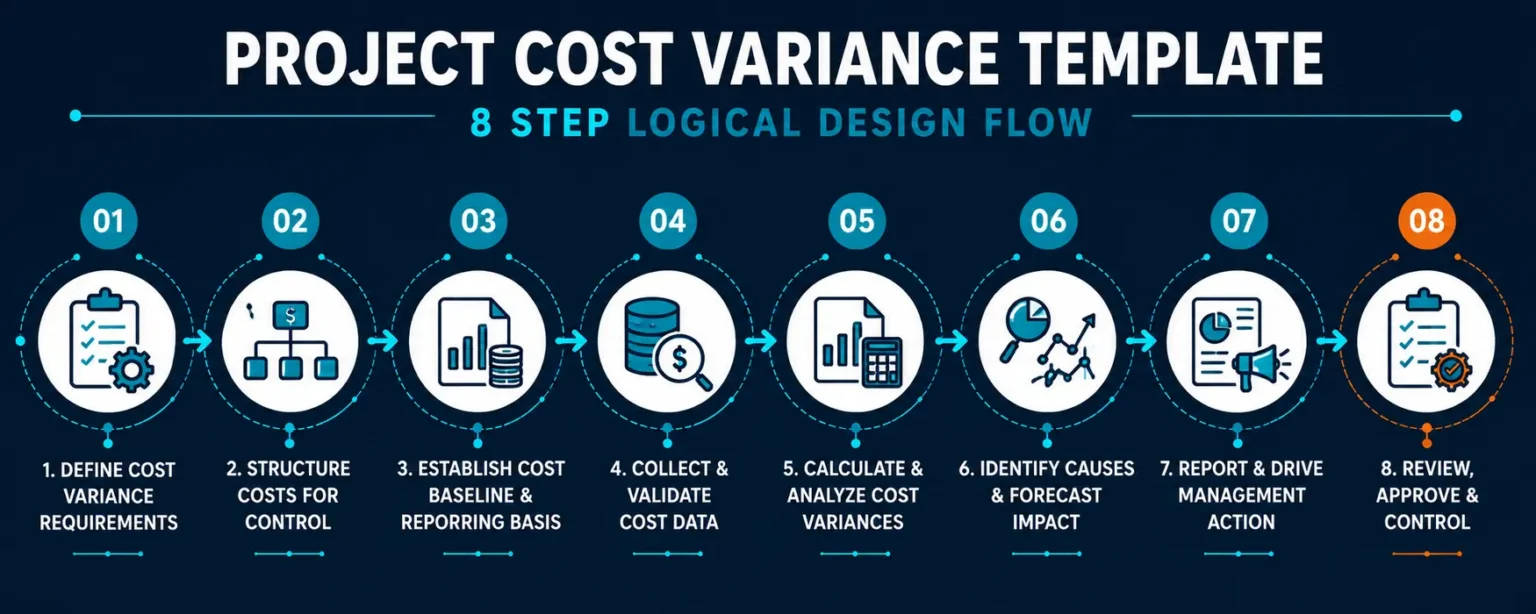
Use the Project Cost Variance Template as a progressive cost-control workflow rather than as a collection of separate worksheets. Start by defining the project context and variance requirements. Then structure costs, establish the comparison basis, collect and validate cost data, analyze variances, forecast cost impact, manage actions, and complete the required reviews.
1. Establish the Project Context
Start with the Project Profile and record the project, contractual, commercial, organizational, and cost-control context. Capture the systems, methodologies, reporting needs, cost drivers, responsibilities, and other factors that affect cost variance analysis.
2. Define Cost Variance Requirements
Use Cost Variance Requirements to define what the project needs from its variance management process. Establish variance objectives, cost categories, analysis levels, reporting frequency, data sources, evidence requirements, validation needs, thresholds, and responsibilities.
3. Structure Costs for Control
Use Cost Structure & Control Accounts to organize costs into control accounts, work packages, cost accounts, and cost elements. Then connect these structures with the WBS, coding basis, responsible functions, and defined control levels.
4. Establish the Cost Baseline & Reporting Basis
Use Cost Baseline & Reporting Basis to establish the controlled reference for cost comparison. Define the approved baseline, reporting periods, status dates, currency, cost recognition, time-phasing, sign conventions, and baseline-change requirements.
5. Collect & Validate Cost Data
Use Actual Cost & Cost Data to record actual costs and related cost exposure for each reporting period. Capture posted costs, accruals, estimated actuals, adjustments, commitments, and reconciliation differences. Then validate the data against defined sources and evidence.
6. Calculate & Analyze Cost Variances
Use Cost Variance Analysis to compare recognized actual costs against the approved comparison basis. Analyze current and cumulative variances, cost elements, thresholds, significance, and applicable EVM measures. This step quantifies performance before teams investigate causes and forecast impact.
7. Identify Causes & Forecast Cost Impact
Use Forecast & EAC Analysis to investigate variance causes and assess their potential impact. Record contributing factors, assumptions, risks, ETC, EAC, VAC, applicable forecasting methods, and forecast confidence. Then use the results to support forward-looking cost decisions.
8. Report, Act & Govern
Use Reporting & Management Action to communicate variance findings and drive decisions, corrective actions, mitigation, and escalation. Finally, use Review, Approval & Revision to review the framework, control revisions, record approvals, and maintain traceability of the current applicable basis.
Build a Controlled Cost Variance Management Process
Effective cost variance management starts with defined requirements, structured costs, an approved comparison basis, and validated cost data. Use the template to connect variance analysis with forecasting, management action, and governance. Then refine the process as project conditions, reporting needs, and cost-control requirements change.
PROJECT COST VARIANCE
The Core Dimensions of Effective Project Cost Variance Management
Effective cost variance management requires more than comparing budget and actual costs. It requires defined variance requirements, structured cost information, a controlled comparison basis, validated cost data, meaningful analysis, and forward-looking forecasts. The template connects these dimensions to help teams understand cost performance and support informed management decisions.
Cost Variance Objectivity
Define cost variances using agreed comparison bases, calculation methods, sign conventions, and thresholds. Clear rules help teams evaluate cost performance consistently across reporting periods and cost levels.
Cost Structure & Traceability
Connect cost variances with control accounts, work packages, cost accounts, cost elements, and defined coding structures. As a result, teams can trace variance results back to the relevant cost information.
Baseline Integrity
Compare recognized actual costs against an approved and controlled cost baseline or other defined comparison basis. Therefore, teams can identify meaningful deviations while maintaining clarity around approved baseline changes.
Actual Cost Reliability
Use validated, period-aligned cost data from defined sources and supporting evidence. Reconcile actual costs, accruals, adjustments, commitments, and other exposures before drawing conclusions from variance results.
Variance Visibility
Analyze current and cumulative cost variances across relevant cost levels and elements. This helps teams identify significant performance differences, emerging concerns, and areas that require further investigation.
Root Cause Insight
Investigate the factors contributing to identified cost variances rather than treating variance values as conclusions. Connect findings with cost drivers, assumptions, risks, and other relevant project conditions.
Forecast Confidence
Use variance results, current performance, assumptions, and defined forecasting methods to assess ETC, EAC, and potential final cost outcomes. Furthermore, document forecast direction and confidence to support forward-looking decisions.
Management Control
Connect variance findings with management decisions, escalations, corrective actions, mitigation measures, follow-up, and outcomes. Ultimately, this creates a controlled process that moves from cost variance identification to effective management action.
PROJECT COST VARIANCE STATUS
Use Status to Control the Cost Variance Management Lifecycle
The template uses structured status classifications to show the current state of cost baselines, variance analysis, forecasts, actions, decisions, and approvals. Therefore, teams can distinguish developing cost information from approved bases, active management actions, controlled revisions, and completed records.
Draft
Cost Basis Being Developed
The cost baseline, variance requirements, analysis basis, or related information is still being developed. The project team should complete the required information before progressing to formal review or approval.
Under Review
Cost Basis Being Reviewed
The defined cost basis or variance information is undergoing review by designated stakeholders. Reviewers assess the supporting data, comparison basis, calculations, assumptions, and relevant cost-control information before approval.
Approved
Cost Basis Authorised
The defined cost basis has completed the required review and received approval. The project team can therefore use the approved baseline, reporting basis, or related control information within its defined scope.
Active
Cost Basis In Use
The approved cost basis is currently in use for cost reporting, variance analysis, forecasting, and management decisions. Teams should apply the defined requirements, controls, and reporting rules during each applicable reporting cycle.
Superseded
Previous Cost Basis Replaced
A subsequent approved version has replaced the previous cost basis or control record. The project team should retain the earlier version, approval records, supporting evidence, and revision history to preserve traceability.
Closed
Cost Record Completed
The applicable cost review, variance record, action, or control activity has reached completion. The project team should retain the supporting information and outcome records for future reference, auditability, and traceability.
FROM PROJECT CONTEXT TO MANAGED COST VARIANCE
Build a Controlled Framework for Understanding Project Cost Performance
Effective cost variance management requires more than comparing budget and actual costs. Teams need a defined cost basis, structured cost information, reliable actual-cost data, controlled comparison references, and clear analysis. The template connects these elements so project teams can understand variance, assess forecast impact, and support management decisions.
Establish the Cost Control Foundation
Define the Cost Variance Basis
Start by defining what the project needs to measure and why. Establish variance objectives, cost categories, analysis levels, reporting requirements, data sources, validation expectations, thresholds, and responsibilities.
This foundation gives the team a consistent basis for identifying and assessing cost variances.
Structure Costs for Effective Control
Organize project costs into control accounts, work packages, cost accounts, cost elements, and defined control levels. Then connect these structures with the WBS, coding basis, responsibilities, and reporting requirements.
This structure helps teams trace cost performance to the relevant area of project work.
Establish the Cost Comparison Basis
Define the approved cost baseline and reporting basis used to compare cost performance. Establish reporting periods, status dates, currency, cost recognition, time-phasing, sign conventions, and baseline-change requirements.
A controlled comparison basis therefore supports meaningful and consistent variance analysis.
Establish Reliable Actual Cost Data
Collect actual cost information from defined sources and reporting periods. Record posted costs, accruals, estimated actuals, adjustments, commitments, and other cost exposure. Then validate and reconcile the information before analysis.
Reliable cost data gives teams a stronger foundation for identifying genuine performance differences.
From Cost Variance to Management Insight
Understand Variance Before Taking Action
A variance value alone does not explain project cost performance. The template therefore connects variance analysis with root-cause investigation, forecasting, management decisions, actions, and follow-up.
Calculate & Analyze Cost Variances
Compare recognized actual costs with the approved comparison basis to identify current and cumulative variances. Analyze cost performance across relevant control levels and cost elements, using defined thresholds and applicable EVM measures where required.
Investigate Causes & Forecast Cost Impact
Investigate the factors contributing to significant cost variances. Then assess ETC, EAC, VAC, assumptions, risks, forecast direction, and confidence using an appropriate forecasting method.
Report Findings & Drive Management Action
Convert variance and forecast results into clear management information. Record findings, decisions, escalations, corrective actions, mitigation measures, responsibilities, target dates, and follow-up requirements.
Review & Control the Cost Framework
Review the cost variance process as project conditions, requirements, and reporting needs change. Finally, control approvals, revisions, and change history so the current cost basis remains clear and traceable.
DESIGNED FOR FLEXIBLE USE
Adapt Project Cost Variance Management to Your Project Environment
Projects differ in their cost structures, contractual arrangements, reporting requirements, accounting practices, forecasting methods, and control environments. The Project Cost Variance Template provides a consistent cost-control framework while allowing teams to adapt cost structures, comparison bases, variance methods, forecasting approaches, thresholds, and management actions to each project.
Construction & Infrastructure
Apply the framework to construction and infrastructure projects by analyzing control accounts, work packages, cost elements, commitments, accruals, and actual costs. Additionally, connect cost data with reporting periods, validated sources, variance analysis, forecasting, and management action.
Engineering, EPC & Manufacturing
Adapt the framework for engineering, EPC, and manufacturing projects by analyzing engineering costs, procurement, fabrication, production, testing, equipment, and other defined cost elements. Furthermore, connect actual costs with approved baselines, variance methods, forecasting requirements, and supporting evidence.
IT & Digital Projects
Use the framework for IT and digital projects by analyzing development, resources, software, vendors, infrastructure, services, and other agreed cost categories. Therefore, teams can connect recognized costs with approved comparison bases, variance analysis, forecasting, and management decisions.
Professional & Corporate Projects
Apply the framework to consulting and corporate projects by analyzing work packages, resources, deliverables, services, overheads, and other defined project costs. In addition, teams can adapt reporting periods, cost structures, variance thresholds, forecasting methods, and management actions.
Learn the Approach and Apply It to Your Project
First, understand how structured cost variance management turns cost data into reliable management information. Then, use the workbook to define variance requirements, structure costs, establish the baseline, validate actual costs, analyze variances, forecast EAC, and drive management action.
Project Cost Variance Template FAQs
What is a Project Cost Variance Template?
It is an Excel framework for establishing a structured project cost variance management process. It helps teams define cost requirements, organize cost structures, validate actual costs, analyze variances, forecast cost outcomes, and support management decisions.
Who can use the Project Cost Variance Template?
Project Managers, Project Controls Professionals, Cost Engineers, Finance teams, Commercial Managers, Planners, Project Analysts, contractors, consultants, and management teams can use the template.
What does the template include?
The template includes project profiling, cost variance requirements, cost structures, control accounts, baseline controls, actual cost data, variance analysis, EAC forecasting, management actions, and governance.
Does the template calculate project cost variances automatically?
The workbook provides formula-based variance analysis with safeguards for unavailable or zero denominators. Users must provide appropriate project data, comparison bases, and defined inputs.
Does the template work with Primavera P6 and Microsoft Project?
Yes. Teams can use information from Primavera P6, Microsoft Project, ERP platforms, accounting systems, and other project tools as inputs. However, the template does not replace these systems.
Can I customize the template for my project?
Yes. You can adapt cost structures, variance methods, reporting periods, thresholds, forecasting approaches, responsibilities, and other requirements to suit your project.
Can the template be used across different industries?
Yes. Teams can adapt the framework for construction, infrastructure, EPC, engineering, manufacturing, IT, software, R&D, public-sector, and other project environments.
Learn & Apply
Understand Cost Variance. Establish Greater Control.
First, learn how structured cost variance management connects actual costs with comparison bases, analysis, forecasting, and management action. Then, apply the workbook to establish consistent cost-control practices and improve cost visibility.
Learn with the Guide
How to Analyze Project Cost Variances
Learn how to establish a reliable comparison basis, validate actual costs, identify significant variances, investigate causes, and support effective cost decisions.
Apply with the Template
Project Cost Variance Template
Use the Excel framework to define variance requirements, structure costs, establish the baseline, validate actual costs, analyze variances, forecast EAC, report findings to management.
FEATURED PROJECT CONTROLS TEMPLATES
Templates for Essential Project Controls Activities
Our featured templates support key project controls activities, from establishing control frameworks and measuring progress to analyzing cost performance, forecasting outcomes, reporting results, and monitoring project performance.
Choose the resource that matches your current control requirement, then adapt it to your project’s size, complexity, industry, delivery method, reporting structure, and control environment. As the library grows, additional templates and checklists will support a wider range of project controls activities.
Project Cost Forecasting Template
Structure project cost forecasting by capturing budget information, actual performance, commitments, forecast assumptions, remaining costs, cost trends, and key drivers to support consistent and informed project cost projections.
Cost & Schedule Performance Template
Monitor cost and schedule performance together by reviewing budgets, actuals, progress, forecasts, schedule status, variances, trends, and key performance indicators to identify emerging issues and support timely project controls decisions.
Project Controls Reporting Template
Structure project controls reporting by organizing cost, schedule, progress, forecast, variance, risk, trend, and action information into a consistent reporting framework that supports management review and informed project decisions.
MORE PROJECT CONTROLS RESOURCE TYPES
Continue Your Project Controls Learning
Project controls knowledge becomes more valuable when you can understand performance, apply structured methods, and develop practical skills. Explore the other resources within the Project Controls collection to complement the guidance provided in these guides.
Guides
Learn how to establish project controls, measure progress, monitor cost and schedule performance, analyze variances, build forecasts, and prepare effective project controls reports.
Downloads
Access useful project controls materials and reference resources to support learning and day-to-day activities involving cost, progress, forecasting, reporting, and project performance.
Career Roadmaps
Follow structured learning paths to develop project controls knowledge, practical skills, analytical capabilities, and professional competencies for project controls career development.
Case Studies
Explore project controls situations, decisions, challenges, and outcomes to understand how cost, progress, forecasting, reporting, and performance practices are applied in real projects.
Glossary
Find clear explanations of project controls, cost control, progress measurement, forecasting, performance management, reporting, and related terminology used across project environments.
Insights & Articles
Explore professional perspectives, insights, emerging practices, and discussions relevant to project controls, cost management, performance measurement, forecasting, and reporting.
Looking for more project management resources? Explore the Kleios Technologies Resources Hub to discover our complete collection of guides, templates, downloads, career roadmaps, case studies, glossary resources, and insights.
RELATED KNOWLEDGE DOMAINS
Continue Your Learning Across Related Knowledge Domains
Project Management is closely connected with specialized disciplines that support successful planning, execution, governance, performance measurement, and professional growth. Explore related knowledge domains to expand your expertise, develop complementary skills, and access practical resources across the complete project management ecosystem.
Expand your expertise one domain at a time and build a well-rounded project management skill set.
Why Explore Related Domains?
- Develop cross-functional project management expertise
- Discover specialized knowledge beyond core project management
- Access practical resources across interconnected disciplines
- Build a complete professional learning pathway
- Strengthen career readiness through continuous learning
Each knowledge domain complements your Project Management expertise, helping you build broader capabilities and solve real-world project challenges with greater confidence.
Project Management
Practical project management knowledge, practices, and professional resources.
Project Planning & Scheduling
Planning techniques, scheduling methods, and timeline management resources.
PMO
Governance, portfolio management, and organizational project excellence.
Risk Management
Risk identification, assessment, mitigation, and monitoring resources.
Primavera P6
Professional planning, scheduling, resource management, and reporting.
Microsoft Project
Project scheduling, tracking, reporting, and collaboration resources.
Power BI
Interactive dashboards, reporting, visualization, and project analytics.
PMI Certifications
Certification guidance, exam preparation, and professional development resources.