
PROJECT MANAGEMENT INSIGHT
Why Do Stakeholder Management Problems Affect Projects?
Effective stakeholder management can strengthen alignment, decision-making, and project outcomes. However, identifying stakeholders and communicating with them does not guarantee shared understanding, sustained support, or effective engagement. When stakeholder concerns, competing interests, changing influence, or unclear expectations remain unresolved, they can affect decisions, requirements, risk, schedule, cost, and ultimately project performance.
This insight examines why stakeholder management problems persist, how these issues develop, and what project professionals should reconsider when stakeholder dynamics begin to shape the project.
Professional Insight · Project Management · 14–18 min read
Introduction
Stakeholder relationships can shape project decisions, requirements, risks, implementation, and outcomes. Yet, stakeholder management problems can remain hidden even when stakeholder registers are maintained, communication plans are followed, and regular engagement activities take place.
Research shows that stakeholder influence is not static. Power, legitimacy, urgency, interests, relationships, and dependencies can change as a project moves through its lifecycle. Stakeholders may also form coalitions, influence one another, or affect decisions through informal networks that formal stakeholder maps do not fully capture.
At the same time, stakeholders can support the same project while holding different expectations about success, acceptable trade-offs, risks, or project impacts. Communication can therefore create information flow without creating shared understanding or alignment. Likewise, stakeholder disagreement may reflect legitimate differences in interests or constraints rather than simply poor relationships.
This creates an important distinction: stakeholder identification and communication provide structure and visibility, but they do not guarantee alignment, effective engagement, or sustained support.
This insight examines why stakeholder management problems affect projects, why professionals may overlook changing stakeholder influence and emerging misalignment, and how unresolved stakeholder dynamics can propagate into decisions, requirements, change, risk, schedule, cost, implementation, and intended project value.
The Common Assumption
Why the Assumption Seems Reasonable
A common view is that stakeholder management problems can be controlled through a structured sequence of identification, analysis, communication, engagement, and monitoring.
The logic is reasonable. A project team can establish a stakeholder-management process that considers:
- Who can affect the project or may be affected by it.
- What interests, expectations, influence, and concerns different stakeholders have.
- How different stakeholders should be engaged.
- How stakeholder relationships and expectations should be monitored as the project progresses.
Research has also provided useful ways to assess stakeholder relevance. For example, stakeholder salience can be considered through factors such as power, legitimacy, and urgency. Project management guidance similarly emphasizes stakeholder identification, analysis, tailored engagement, and productive involvement in project decisions and implementation.
These practices are valuable because they make stakeholder considerations visible. They provide a practical foundation for recognizing and addressing stakeholder management problems before they become more difficult to manage.
Where the Assumption Falls Short
The difficulty begins when the existence of a stakeholder-management process is treated as evidence that stakeholder relationships are fully understood.
Several distinctions matter:
- Identification is not understanding. A stakeholder register can identify relevant parties without revealing their underlying expectations, relationships, or ability to influence decisions.
- Communication is not engagement. Information can be distributed without confirming whether stakeholders understand it, accept its implications, or intend to support the resulting decisions.
- A stakeholder category is not permanent. Influence and relevance can change when project conditions, decisions, dependencies, or external pressures change.
- Agreement is not alignment. Stakeholders can support the same project while holding different views about priorities, trade-offs, risks, success, or acceptable impacts.
- More involvement is not always better. Broad participation can strengthen engagement, but it can also increase expectations or create competing requirements that the project cannot satisfy simultaneously.
These distinctions help explain why stakeholder management problems can persist even when formal processes appear to be working. Research on real-world stakeholder analysis has identified practical difficulties in identifying stakeholders, assessing their importance, and uncovering their expectations.
Other research has also highlighted changing stakeholder influence, informal relationships, competing interests, and the limitations of relying only on conventional stakeholder-analysis techniques.
Stakeholder identification is necessary. Stakeholder analysis is necessary. Communication is necessary. But none of these, by itself, proves that the project understands the relationships and dynamics influencing its decisions.
This is the point where the analysis needs to move beyond stakeholder-management activity and examine what is actually happening within the stakeholder system.
What Is Really Happening?
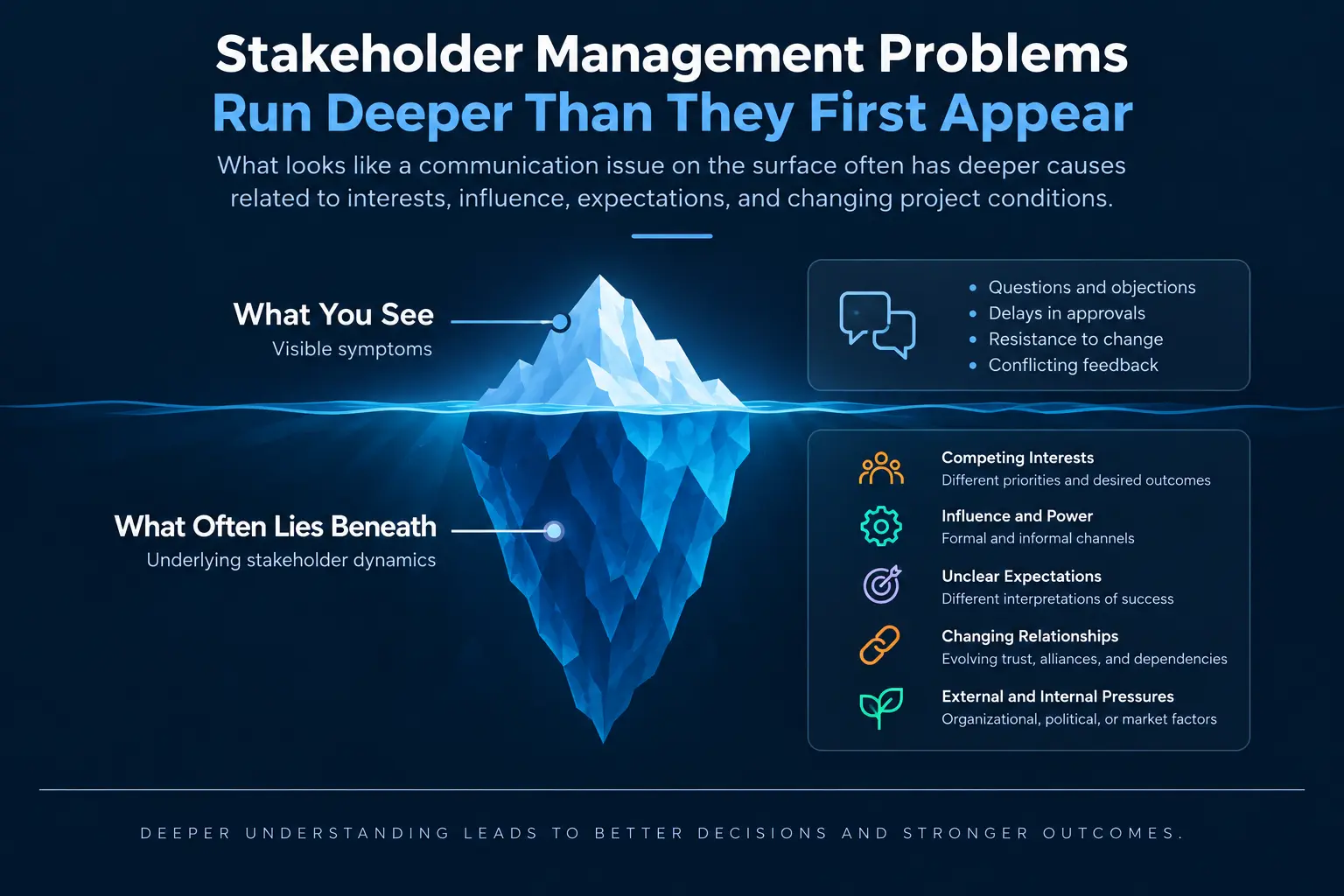
Stakeholder management problems rarely arise from a single communication failure. They can develop when influence changes, relationships evolve, expectations diverge, engagement creates unresolved expectations, or structural conditions shape stakeholder behaviour. Understanding these dynamics helps explain why formal stakeholder-management activities can be in place while project decisions, requirements, risks, and implementation are still being affected.
Stakeholder Influence Changes as the Project Changes
Stakeholder influence is not a fixed project attribute. It can change as decisions, dependencies, risks, approvals, resources, and project conditions change.
Stakeholder research has long recognized that relevance can depend on factors such as power, legitimacy, and urgency. However, these factors do not remain constant throughout a project. A stakeholder with limited influence during planning may become highly consequential during implementation. Another stakeholder may become less central after a major decision is resolved.
This creates a problem for static stakeholder assessments. A stakeholder map can accurately describe the situation when it was created and still become misleading later.
Professionals should therefore ask:
- Who can materially affect the project at this point in its lifecycle?
- Who has gained or lost influence since the last review?
- Which new decision, dependency, or external condition has changed stakeholder relevance?
Stakeholder management problems can emerge when these changes occur faster than the project’s understanding of its stakeholder environment.
Stakeholder Maps Can Miss Relationships That Matter
Stakeholders do not operate only as separate individuals or organizations positioned on a matrix. They also form relationships, coalitions, dependencies, and informal networks.
Research using social-network perspectives has shown that informal relationships can reveal influential actors, communication bottlenecks, groups, and connections that formal structures may not make visible. Other project research has similarly highlighted the value of understanding relationships between stakeholders rather than examining each stakeholder independently.
This matters because formal authority and practical influence are not always the same. Someone may have limited formal decision rights but strong access to information, operational knowledge, relationships, community support, or influential decision-makers.
A useful stakeholder analysis therefore needs to consider not only who matters, but also how influence moves through the system.
In simple terms:
- A stakeholder list shows who is connected to the project.
- A stakeholder map shows selected characteristics of those stakeholders.
- A relationship view shows how stakeholders can influence one another and the project.
Stakeholders are therefore not simply a list. They form a network of relationships that can affect project decisions.
Stakeholders Can Agree With the Project but Disagree With Each Other
Another source of stakeholder management problems is the assumption that project support means stakeholder alignment.
Stakeholders can support the overall project while holding different views about what should happen when priorities compete. One group may emphasize schedule. Another may prioritize quality or operational continuity. Others may focus on cost, compliance, safety, risk, user acceptance, or long-term benefits.
These differences are not necessarily evidence of poor stakeholder management. They can reflect legitimate interests and different positions within the project system.
Research on project success has demonstrated that different stakeholder groups can hold different views of what successful delivery means. This becomes particularly important when a project reaches decisions involving unavoidable trade-offs.
The professional challenge is therefore not to eliminate every difference. It is to make important differences visible, understand their consequences, and ensure that trade-offs are addressed through appropriate project governance and decision-making.
Communication Can Create Information Flow Without Creating Alignment
Communication is essential to stakeholder engagement, but communication activity does not automatically produce shared understanding.
A project can distribute updates, conduct meetings, issue reports, and respond to questions while important differences remain unresolved. Stakeholders may receive the same information but interpret its implications differently.
This creates several different states that should not be treated as equivalent:
- Information received does not necessarily mean information understood.
- Information understood does not necessarily mean stakeholders agree.
- Agreement does not necessarily mean stakeholders will continue supporting the project.
- Support does not necessarily mean stakeholders will behave consistently during implementation.
This distinction is particularly important when projects involve uncertainty or difficult trade-offs. Stakeholder management problems can remain hidden when teams measure communication activity rather than changes in understanding, decisions, risk exposure, or stakeholder behaviour.
Some Stakeholder Problems Are Structural, Not Interpersonal
Project teams sometimes describe resistance as a problem with a difficult stakeholder. That explanation can be convenient, but it may overlook the conditions producing the behaviour.
Stakeholder responses can be shaped by factors such as:
- Competing objectives or incentives.
- Loss of resources, authority, or operational flexibility.
- Contractual or governance constraints.
- Exposure to project impacts or disruption.
- Limited information or uncertainty about consequences.
- Previous experiences that influence trust or expectations.
Research on stakeholder influence shows that stakeholders can use different strategies when attempting to shape project outcomes. Their behaviour may therefore reflect the structure of the situation rather than simply their personality or attitude.
Instead of asking only, “Why is this stakeholder being difficult?”, professionals should also ask, “What conditions are producing this stakeholder response?”
Engagement Can Create Expectations the Project Cannot Fulfil
Engagement is generally intended to improve understanding, participation, support, and decision quality. However, more involvement does not automatically produce better outcomes.
Research on stakeholder inclusiveness highlights an important tension. Broader involvement can strengthen engagement and satisfaction, but it can also increase expectations, introduce competing requirements, and make it harder to maintain focus on the stakeholders most critical to the project’s current decisions.
This means engagement needs boundaries. Stakeholders should understand:
- What they can influence.
- What the project has already decided.
- Which constraints cannot be changed.
- How competing requirements will be evaluated.
- Who holds the relevant decision authority.
Without these boundaries, engagement can unintentionally create expectations that the project cannot satisfy.
Stakeholder Problems Can Propagate Into Project Performance
The most important issue is that stakeholder management problems rarely remain confined to stakeholder-management activities. They can appear elsewhere in the project as operational symptoms.
A typical progression may look like this:
- Stakeholder expectations, interests, or influence are insufficiently understood.
- Differences remain unresolved or become more difficult to surface.
- Decision friction, resistance, or requirements conflict increases.
- Changes, rework, delayed approvals, escalation, or additional mitigation become necessary.
- Schedule, cost, risk, quality, or resource pressure increases.
- Implementation, adoption, operational readiness, or benefit realization can weaken.
This progression is not inevitable, and the strength of each relationship depends on project context. However, research on stakeholder influence, project governance, construction implementation, and benefits realization indicates that stakeholder dynamics can have consequences beyond communication and relationship management.
The practical implication is significant: a schedule delay, repeated change request, unresolved approval, escalating risk, or implementation problem may sometimes be a stakeholder issue appearing somewhere else in the project system.
Why Do Professionals Miss the Problem?
Stakeholder management problems are often difficult to recognise because the warning signs do not always appear as stakeholder problems. They may first appear as communication activity, outdated analysis, conflict, delayed decisions, project-control issues, or uneven attention to different stakeholders.
Stakeholder Management Is Reduced to Communication Activity
One reason stakeholder management problems remain unnoticed is that communication is easier to observe and measure than stakeholder understanding.
Project teams can readily track meetings, reports, presentations, workshops, responses, and communication frequency. These activities are important, but activity does not necessarily demonstrate effectiveness.
A more useful question is what changed because of the engagement. For example:
- Did engagement reveal a previously unknown requirement?
- Did it expose a material risk or dependency?
- Did it improve a project decision?
- Did it resolve a disagreement or clarify an expectation?
- Did it improve implementation or operational readiness?
When teams focus primarily on communication activity, stakeholder management problems can remain hidden behind apparently healthy engagement metrics.
Static Stakeholder Maps Create False Confidence
A stakeholder map can be useful, but it represents a particular point in time. Projects do not remain in that state.
New decisions can change influence. Requirements can change relationships. External events can create new stakeholders. Implementation can make previously peripheral stakeholders more consequential. As a result, an accurate map can gradually become an incomplete explanation of the stakeholder environment.
This creates a subtle form of false confidence. The project has a documented analysis, so the team assumes the underlying situation is understood.
However, the more important question is whether the analysis still reflects the conditions influencing the project now.
Formal Authority Gets More Attention Than Informal Influence
Organizational structures make formal authority visible. Informal influence is harder to see, so it can receive less attention.
Yet stakeholders can influence projects through relationships, access to information, operational knowledge, community connections, professional networks, or their ability to build support around an issue. Research using network perspectives highlights how these relationships can reveal influential actors and connections that conventional stakeholder analysis may overlook.
Therefore, stakeholder management problems may develop around people who appear relatively unimportant in formal project structures but have substantial practical influence.
A useful diagnostic question is: Who listens to this stakeholder when an important decision is being contested?
Conflict Is Treated as Failure Instead of Information
Project teams often prefer visible agreement because it appears to indicate alignment. However, suppressing disagreement can remove information the project needs.
Conflict may reveal competing objectives, unclear requirements, hidden dependencies, unacceptable impacts, incomplete information, or uncertainty about decision authority.
This does not mean every conflict is productive. Unmanaged conflict can obstruct implementation and increase project pressure. The important distinction is whether the project investigates what the conflict is signalling.
Conflict can be a diagnostic signal before it becomes a project problem.
Stakeholder Issues Are Separated From Project Controls
Another blind spot occurs when stakeholder concerns are treated as a separate management activity rather than a potential cause of project-performance symptoms.
A stakeholder issue may appear in project controls as:
- Repeated approval delays.
- Requirements changes.
- Unexpected rework.
- Escalating risks.
- Resource or access constraints.
- Recurring disputes or decision escalation.
If these symptoms are reviewed only as schedule, cost, scope, or risk issues, their stakeholder-related causes may remain unidentified. Stakeholder management problems can therefore appear in project controls as symptoms rather than causes.
Visible Stakeholders Receive More Attention Than Less Visible Ones
Visibility can also distort stakeholder attention. Senior decision-makers, highly vocal participants, and stakeholders with formal authority naturally attract attention. However, less visible groups may still have significant influence or exposure to project impacts.
Research on stakeholder engagement increasingly emphasizes the importance of understanding affected, marginalized, and less visible stakeholders rather than relying only on those easiest to identify or access.
The result is an important distinction: visibility is not the same as importance, and participation is not the same as influence.
When these blind spots combine, stakeholder management problems can remain below the surface until they affect a decision, approval, requirement, implementation activity, or project outcome. Recognising these signals early gives project professionals an opportunity to investigate the underlying stakeholder dynamics before they become more difficult project problems.
What Happens If It Continues?
Stakeholder problems rarely remain isolated. When concerns, competing interests, or unresolved expectations continue without being addressed, their effects can move from stakeholder interactions into decisions, requirements, delivery activities, and ultimately project outcomes.
Decisions Become Slower and More Contested
When stakeholder concerns are not understood early, decisions can become harder later. People may question decisions, ask for more information, seek additional approvals, or reopen issues that the team thought were already settled.
This does not mean every delayed decision is caused by stakeholders. However, stakeholder management problems can add friction when different parties have different interests, decision rights, information, or expectations.
The warning signs may include:
- The same decision keeps returning for discussion.
- Approval takes longer than expected.
- Different stakeholders give conflicting directions.
- Important decisions are repeatedly escalated.
Over time, decision friction can become a delivery problem.
Requirements and Priorities Become Unstable
Unclear stakeholder expectations often surface when the project reaches a decision that has real consequences.
A stakeholder may support an objective in principle but challenge a specific requirement once its cost, operational impact, risk, or implementation effect becomes clear. Another stakeholder may introduce a different priority at the same time.
This can lead to:
- Late requirement changes.
- Competing priorities.
- Repeated clarification.
- Scope discussions that return after decisions appear settled.
Stakeholder management problems can therefore contribute to instability even when the original project requirements appeared clear.
Conflict Becomes Rework, Delay, and Cost Pressure
Unresolved disagreement rarely stays at the level of discussion. If it reaches design, procurement, implementation, or approval activities, the project may need to respond through changes or additional work.
For example, a disagreement about a requirement may lead to redesign. A delayed approval may affect planned work. A change in stakeholder expectations may require additional analysis or consultation.
Research on stakeholder influence and project implementation has linked stakeholder conflict and opposition with difficulties such as implementation obstacles, delays, and cost pressure in some project contexts. The exact effect depends on the project and the stakeholders involved.
The important point is that stakeholder management problems can become visible through ordinary project-performance measures.
Delivery Can Succeed While Adoption or Value Suffers
A project can deliver its planned output and still fall short of its intended value.
This can happen when the people expected to use, operate, support, approve, or benefit from the result are not sufficiently prepared or committed. The physical or technical deliverable may be complete, while adoption remains weak or expected benefits are harder to realize.
This is why project success should not always be judged only by whether scope, schedule, and cost targets were achieved. Research on project success and benefits management points to the importance of connecting project delivery with broader organizational and stakeholder outcomes.
Stakeholder management problems can therefore continue beyond delivery and affect what happens after the project produces its output.
The Project Learns About Resistance Too Late
Perhaps the most costly outcome is discovering stakeholder resistance only when the project reaches a point where change is difficult.
Early concerns are usually easier to explore. Later concerns may appear when a decision must be approved, a system must be adopted, an operation must change, or a commitment must be made.
By then, the project may have limited room to respond. The issue can become a formal escalation, a change request, a schedule problem, or an implementation risk.
A useful way to view the progression is:
- Stakeholder concerns remain poorly understood.
- Differences become harder to resolve.
- Decision friction or resistance increases.
- Changes, rework, delays, or escalation become more likely.
- Pressure moves into schedule, cost, risk, implementation, or benefits.
The earlier a project recognizes these signals, the more options it usually has to respond. Stakeholder awareness is therefore not simply a communication responsibility; it is part of understanding the conditions that can influence project decisions, controls, implementation, and outcomes.
What Should Project Professionals Reconsider?
The practical response is not to create more stakeholder-management activity for its own sake. It is to improve how the project detects changing influence, understands competing interests, tests alignment, and connects stakeholder information with project decisions and controls.
Reconsider Stakeholder Management as Relationship and Decision Management
Stakeholder management is often treated as a communication responsibility. A stronger view is to see it as part of how the project understands relationships, manages competing interests, and makes decisions.
Stakeholders can influence decisions through authority, resources, information, relationships, approvals, operational dependencies, or external pressure. Therefore, the project needs to understand not only who the stakeholders are, but how their relationships affect the decisions the project must make.
A useful question is:
What relationships and stakeholder dynamics are shaping the decisions the project needs to make?
This shifts attention from managing communication activity to understanding the conditions that influence project decisions.
Revisit Stakeholder Relevance Throughout the Lifecycle
A stakeholder assessment should not be treated as a one-time exercise. Project conditions change, and stakeholder relevance can change with them.
Instead of asking only who the important stakeholders are, project professionals should periodically ask:
- Who is becoming more consequential?
- Who is becoming less relevant?
- What has changed their influence?
- Which new dependency or decision has changed the stakeholder landscape?
This simple shift can help reveal stakeholder management problems before an outdated assessment creates false confidence.
Use Stakeholder Categories as a Starting Point, Not a Conclusion
Tools such as power-interest grids and stakeholder matrices are useful starting points. However, they should support professional judgment rather than replace it.
Depending on the project, professionals may also need to consider:
- Legitimacy and urgency.
- Operational dependency.
- Exposure to project impacts.
- Access to critical information or resources.
- Informal influence and network position.
- Ability to build support or resistance around an issue.
The right level of analysis depends on project complexity and context. The objective is not to create a more complicated stakeholder register. It is to understand what the project actually needs to know.
Test Shared Meaning, Not Just Agreement
A stakeholder saying “yes” does not always mean that the stakeholder understands the project in the same way as everyone else.
Professionals should test whether critical stakeholders share a workable understanding of:
- What success means.
- Which outcomes matter most.
- Which trade-offs may be required.
- What risks are acceptable.
- What decisions they can influence.
A useful test is: Would these stakeholders make compatible decisions if the project faced the difficult trade-off we expect?
Treat Conflict as Information
Conflict should not automatically be treated as evidence that stakeholder management has failed. It can reveal information that the project did not previously understand.
When disagreement appears, ask what is behind it:
- Is there a genuine difference in interests?
- Is an important requirement unclear?
- Is someone exposed to an unacceptable impact?
- Is information incomplete or interpreted differently?
- Is decision authority unclear?
Understanding the source of conflict can be more valuable than trying to remove the conflict quickly.
Measure Engagement by Its Effect on the Project
The final reconsideration is simple but important: measure engagement by what it changes, not only by what the team does.
Useful evidence may include:
- Earlier identification of risks and concerns.
- Clearer or more stable requirements.
- Better-informed decisions.
- Earlier resolution of disagreements.
- Stronger implementation readiness.
- Better understanding of expected outcomes and benefits.
This does not mean every engagement activity must produce an immediate measurable result. Rather, the project should be able to explain why the engagement matters and what it is expected to influence.
The deeper lesson is that stakeholder management problems are easier to address when professionals stop asking only whether stakeholders have been managed and start asking whether the project understands the changing stakeholder system well enough to make sound decisions.
A Practical Professional Lens
The research points to a broader way of looking at stakeholder management problems. Instead of asking only whether stakeholders have been identified and engaged, project professionals can examine six connected dimensions that help reveal how stakeholder conditions may be influencing the project.
This is not intended to replace a stakeholder register, stakeholder matrix, engagement assessment, or other formal project-management method. It is a practical diagnostic lens that can be used during project reviews, major decisions, risk discussions, change assessments, and periods of increasing stakeholder tension.
Strategic Relevance
Start with the intended project outcome and consider which stakeholders can affect or be affected by achieving it.
- Who matters to the intended outcome now?
- Who can materially affect that outcome?
- Who is materially affected by the project?
- Has stakeholder relevance changed since the last review?
Influence and Dependency
Look beyond formal authority and consider how the project depends on different stakeholders.
- Who controls important resources, approvals, information, access, or operational decisions?
- Who can enable, constrain, delay, or redirect the project?
- Who has significant informal influence?
A useful question is: If this stakeholder changed position tomorrow, what part of the project would be affected first?
Shared Meaning and Expectations
Check whether important stakeholders understand the project in compatible ways.
- Do they interpret success in similar ways?
- Do they understand the main trade-offs?
- Are expectations realistic and understood?
- Would they respond similarly to a difficult project decision?
Relationship Health
Pay attention to how relationships are changing, not just whether communication continues.
- Is trust weakening?
- Are disagreements becoming more frequent?
- Are stakeholders bypassing normal communication channels?
- Are new coalitions or escalation patterns appearing?
Engagement Effectiveness
Ask what stakeholder engagement has actually changed rather than measuring engagement only through activity.
- Did it reveal something the project did not know?
- Did it improve a decision?
- Did it expose or reduce a risk?
- Did it clarify requirements or expectations?
- Did it improve readiness for implementation?
Project Consequences
Finally, connect stakeholder conditions with what is happening elsewhere in the project.
- Are decisions taking longer?
- Are requirements becoming unstable?
- Are approvals or dependencies creating delays?
- Are risks, rework, disputes, or changes increasing?
- Could a current project problem actually be a stakeholder problem appearing somewhere else?
These six dimensions are not intended to replace formal stakeholder-analysis methods. They provide a broader professional lens for recognizing stakeholder management problems that may not appear in a stakeholder register or communication report.
Used together, they can also help professionals connect stakeholder observations with project controls. A change in stakeholder influence may become a risk; a disagreement may become a requirement issue; an approval problem may become a schedule concern; and weakening support may become an implementation or benefits-realization risk.
The question is not whether stakeholders are being managed. The question is whether the project understands the changing stakeholder system well enough to make sound decisions and protect the intended outcome.
Key Takeaways
Stakeholder management problems are rarely caused by a single communication failure. They often develop because projects involve changing relationships, competing interests, different expectations, and multiple forms of influence.
The research and analysis in this Insight point to several important conclusions:
- Identification is only the starting point. A stakeholder register can identify relevant parties, but it does not automatically reveal their relationships, expectations, or practical influence.
- Stakeholder influence changes. Relevance can increase or decrease as project conditions, decisions, dependencies, and external pressures change.
- Formal authority does not capture all influence. Relationships, information, operational knowledge, resources, and informal networks can also affect project decisions.
- Communication does not guarantee alignment. Receiving information, understanding it, agreeing with it, and continuing to support it are different things.
- Conflict can provide useful information. Disagreement may reveal competing interests, unclear requirements, risks, dependencies, or decision constraints.
- Stakeholder issues can become project issues. Delayed decisions, changing requirements, rework, escalating risks, and implementation challenges may sometimes have stakeholder-related causes.
- Engagement should be judged by its effect. The goal is not simply more communication, but better understanding, decisions, readiness, and project outcomes.
Ultimately, stakeholder management problems deserve attention because stakeholder dynamics can influence how a project makes decisions, responds to change, manages risk, and delivers its intended outcomes.
The practical question for project professionals is not simply whether stakeholders have been identified and engaged. It is whether the project understands the changing stakeholder conditions well enough to recognize emerging issues and make sound decisions.
References
This Insight draws on peer-reviewed research covering stakeholder salience, stakeholder analysis, engagement, influence, project governance, and project success.
- Mitchell, R. K., Agle, B. R., & Wood, D. J. (1997). Toward a Theory of Stakeholder Identification and Salience: Defining the Principle of Who and What Really Counts. Academy of Management Review, 22(4), 853–886.
- Jepsen, A. L., & Eskerod, P. (2009). Stakeholder analysis in projects: Challenges in using current guidelines in the real world. International Journal of Project Management, 27(4), 335–343.
- Aaltonen, K., Kujala, J., & Oijala, T. (2008). Stakeholder salience in global projects. International Journal of Project Management, 26(5), 509–516.
- Mok, K. Y., Shen, G. Q., & Yang, J. (2015). Stakeholder management studies in mega construction projects: A review and future directions. International Journal of Project Management, 33(2), 446–457.
- Eskerod, P., Huemann, M., & Ringhofer, C. (2015). Stakeholder Inclusiveness: Enriching Project Management with General Stakeholder Theory. Project Management Journal.
- Olander, S., & Landin, A. (2005). Evaluation of stakeholder influence in the implementation of construction projects. International Journal of Project Management, 23(4), 321–328.
- Joslin, R., & Müller, R. (2016). The relationship between project governance and project success. International Journal of Project Management, 34(4), 613–626.
- Musawir, A. U., Serra, C. E. M., Zwikael, O., & Ali, I. (2017). Project governance, benefit management, and project success: Towards a framework for supporting organizational strategy implementation. International Journal of Project Management, 35(8), 1658–1672.
- Yang, R. J., Shen, G. Q., Ho, M., Drew, D. S., & Chan, A. P. C. (2009). Exploring critical success factors for stakeholder management in construction projects. Journal of Civil Engineering and Management, 15(4), 337–348.
- Aaltonen, K., Derakhshan, R., Di Maddaloni, F., & Turner, R. (2024). Stakeholder engagement: Theoretical and methodological directions for project scholarship. International Journal of Project Management.
Related Kleios Resources
If you want to apply these ideas to a real project, the following Kleios resources provide practical guidance and tools for understanding, analysing, and managing stakeholder relationships.
-
How to Manage Difficult Project Stakeholders
A practical guide for understanding difficult stakeholder situations, identifying the factors behind resistance, and responding more effectively. -
Project Stakeholder Management Template
A structured Excel framework for stakeholder identification, analysis, engagement planning, communication, interaction tracking, monitoring, and reassessment. -
Project Management Insights
Explore more evidence-informed insights into project challenges, decisions, behaviours, and practices.
FEATURED PROJECT MANAGEMENT INSIGHTS
Professional Perspectives on the Challenges Projects Face
Our featured Project Management Insights examine recurring challenges, decision gaps, hidden causes, and assumptions that can influence project outcomes. They encourage professionals to look beyond visible symptoms and consider what may be happening underneath.
Why Does Project Decision Making Get Delayed?
Explore why teams delay important project decisions despite having available information. As a result, examine how accountability, competing priorities, escalation, and organizational factors can create decision bottlenecks.
Why Do Project Health Checks Miss Problems?
Examine why project health checks can indicate acceptable performance while deeper concerns continue developing. Instead, look beyond reported status and consider the conditions that influence actual project health.
Why Do Early Project Warning Signs Get Ignored?
Explore the signals and patterns that often appear before significant project problems emerge. Moreover, examine why teams sometimes overlook these indicators and what that reveals about project management practices.
MORE PROJECT MANAGEMENT RESOURCESE TYPES
Continue Your Project Management Learning
Project management knowledge becomes more valuable when you can apply it, see it in practice, and continue developing your capabilities. Explore our other resources to complement the practical guidance provided in these guides.
Guides
Explore clear guidance to understand common challenges, evaluate situations, and apply effective approaches throughout project delivery.
Downloads
Access useful project management materials and reference resources to support your learning and day-to-day project work.
Career Roadmaps
Follow structured learning paths to develop project management knowledge, practical skills, and capabilities for your professional growth.
Templates
Use practical project management templates to structure planning, management, reporting, and other project activities.
Case Studies
Explore realistic project situations, decisions, challenges, and outcomes to understand how project management practices work in practice.
Glossary
Find clear explanations of project management terminology, concepts, abbreviations, and commonly used professional language.
Looking for more project management resources? Explore the Kleios Technologies Resources Hub to discover our complete collection of guides, templates, downloads, career roadmaps, case studies, glossary resources, and insights.
RELATED KNOWLEDGE DOMAINS
Continue Your Learning Across Related Knowledge Domains
Project management connects with specialized disciplines, tools, and professional practices that support successful project delivery. Explore related knowledge domains to expand your expertise, develop complementary skills, and discover deeper resources beyond the Project Management Guides.
Expand your expertise one domain at a time and build a well-rounded project management skill set.
Why Explore Related Domains?
- Develop cross-functional project management expertise
- Discover specialized knowledge beyond core project management
- Access practical resources across interconnected disciplines
- Build a well-rounded professional learning pathway
- Strengthen your ability to address real-world project challenges
Each knowledge domain complements the practical guidance in our Project Management Guides, helping you build broader capabilities and address real-world project challenges with greater confidence.
Project Planning & Scheduling
Planning techniques, scheduling methods, and timeline management resources.
Project Controls
Performance measurement, forecasting, and project control best practices.
PMO
Governance, portfolio management, and organizational project excellence.
Risk Management
Risk identification, assessment, mitigation, and monitoring resources.
Primavera P6
Professional planning, scheduling, resource management, and reporting.
Microsoft Project
Project scheduling, tracking, reporting, and collaboration resources.
Power BI
Interactive dashboards, reporting, visualization, and project analytics.
PMI Certifications
Certification guidance, exam preparation, and professional development resources.