
PROJECT MANAGEMENT INSIGHT
Why Project Decision Making Gets Delayed?
Project decision making gets delayed for more than just indecision. Often, teams face unclear authority, incomplete information, or competing priorities. In addition, uncertainty and governance can slow important decisions. As a result, unresolved decisions can affect schedules, costs, risks, and project outcomes. This insight examines why project decision making gets delayed and what professionals should reconsider when decision timing starts affecting project performance.
Professional Insight · Project Management
Introduction
Project decisions rarely happen in a single moment. Instead, they move through information, analysis, consultation, approval, communication, and implementation.
However, project decision making gets delayed even when a formal decision process exists. Teams may have meetings, decision logs, governance structures, and approval routes. Yet, the decision can still remain unresolved or take effect too late.
Often, the problem starts before the decision reaches a meeting. The project may lack relevant information, clear authority, or a shared understanding of the issue. In other cases, stakeholders may hold different priorities, while uncertainty makes it difficult to determine when the available evidence is sufficient.
Therefore, decision delay should not automatically be treated as indecision. Some decisions require careful analysis, challenge, and consultation. Productive deliberation can protect decision quality. Unproductive waiting, however, can allow project conditions to change while the decision remains open.
This creates an important distinction: decision quality, decision timing, and decision implementation are related, but they are not the same thing. A high-quality decision can still lose value if it arrives after the relevant opportunity has narrowed.
This insight examines why project decision making gets delayed, why professionals may overlook the underlying causes, and how unresolved decisions can spread into project performance. It also considers what professionals should reconsider about information, authority, uncertainty, governance, and decision timing.
The Common Assumption
A Formal Decision Process Should Prevent Delay
Projects often assume that a defined decision process will keep important decisions moving. The logic seems reasonable. If responsibilities, approvals, meetings, and records are clear, decisions should progress.
However, a formal process does not guarantee timely movement. A decision can still wait for information, clarification, agreement, approval, or implementation. Therefore, having a process is not the same as having an effective decision flow.
More Information Should Make the Decision Easier
Another common assumption is that project decision making gets delayed because decision-makers do not have enough information. The natural response is to request more analysis, reports, forecasts, or specialist input.
More information can help. Yet, more information does not automatically create greater decision readiness. Professionals may receive substantial information while still lacking clarity about what matters most.
The distinction is important:
- Information available is not always information understood.
- Information understood is not always information relevant to the decision.
- Relevant information does not always resolve uncertainty.
- Reduced uncertainty does not always create agreement.
Faster Decisions Are Always Better Decisions
Projects also tend to treat speed as the obvious measure of decision effectiveness. If a decision takes too long, the solution appears simple: decide faster.
Yet, not every decision requires the same level of speed. Some decisions involve high uncertainty, significant consequences, or limited reversibility. Others may require careful challenge before action.
Consequently, the better question is not simply whether a decision was fast. It is whether the project made the decision in time for its consequences.
What Is Really Happening?
Decision Need Emerges Before the Decision Process Starts
A project rarely discovers a decision need when someone places it on an agenda. The need often appears earlier through a risk, change, dependency, constraint, or conflicting requirement.
However, the formal decision process may begin only after someone recognises the issue, gathers information, prepares analysis, and requests approval. This creates a gap between when the project needs a decision and when the decision process formally begins.
Research on critical project decisions shows that decision-making depends on cognitive, social, and situational factors. Therefore, decision timing depends on more than the formal governance process.
Decision Readiness Is a Moving Target
A decision may appear unready because information is incomplete. Yet, project conditions can change while teams wait for additional evidence.
A new risk may emerge. A supplier may change its position. A design assumption may become invalid. A milestone may approach. Consequently, the information needed to make the decision can change while the decision remains open.
This means project decision making gets delayed not only because information is missing. Sometimes, the project keeps changing what it considers sufficient information.
The important question is therefore not whether every uncertainty has disappeared. Instead, professionals should ask whether the remaining uncertainty is material to the choice.
Information Is Distributed Across the Project
Project information usually sits across different people, functions, systems, and organisations. Engineering may hold technical constraints. Commercial teams may understand contractual exposure. Procurement may know supplier conditions. The project manager may understand schedule consequences.
Therefore, the problem may not be a lack of information. It may be the difficulty of bringing relevant information together at the right time.
Research on group decision-making provides an important parallel. A major meta-analysis found that groups discuss shared information more often than information known only to particular members. As a result, important evidence can remain underused even when the group has substantial information.
Project information systems research reaches a related conclusion. Information quality and effective use matter because information availability alone does not guarantee better decisions.
Decision Authority and Knowledge Can Be Separated
Projects can also experience delay when decision authority and decision knowledge sit in different places.
A senior manager may have formal authority but limited technical knowledge. A specialist may understand the issue deeply but lack authority to commit the project. The decision can then move between people before anyone can act.
Research on governance and knowledge fit shows why this relationship matters. Tiwana’s research on systems-development projects found that alignment between governance decision rights and specialised knowledge can influence project performance.
This does not mean every decision should move to the technical expert. Instead, it highlights a structural question: does the decision process connect authority with the knowledge required to make a sound choice?
Multiple Interests Create Decision Friction
A project decision can involve several legitimate interests. One stakeholder may prioritise cost. Another may prioritise schedule. A technical team may prioritise reliability, while operations may focus on long-term usability.
These differences do not necessarily indicate poor stakeholder management. They can reflect genuine differences in objectives, constraints, responsibilities, or risk exposure.
Therefore, project decision making gets delayed when the project must reconcile legitimate differences without clear criteria for resolving them. Consultation can provide valuable information, but it does not automatically create a common decision position.
Uncertainty Changes What “Enough Information” Means
Projects operate with incomplete information. This becomes more difficult when decisions involve new technology, complex interfaces, changing requirements, or long delivery horizons.
Under these conditions, waiting for certainty can become impossible. The project must eventually decide while some uncertainty remains.
The Green Book 2026 recognises this through proportionate appraisal and explicit treatment of uncertainty. It also identifies approaches such as scenario analysis, decision trees, and real-options thinking for situations where uncertainty or reversibility matters.
Similarly, PMI’s Uncertainty Performance Domain treats risk, ambiguity, complexity, and volatility as conditions that teams must actively address.
Consequently, the question is not whether uncertainty exists. The better question is whether the project understands which uncertainty could materially change the decision.
Decision Latency Can Accumulate Across the Process
Project decision making gets delayed when small waiting periods accumulate across different stages of the decision flow.
Decision delay rarely comes from one large blockage. Instead, time can accumulate while teams wait for information, analysis, consultation, governance review, approval, communication, or implementation.
- Issue recognition and decision framing
- Relevant information and specialist input
- Stakeholder consultation and challenge
- Governance review and formal approval
- Communication and operational implementation
Each step may appear reasonable on its own. However, their combined effect can become significant.
Importantly, not every waiting period is wasteful. Some deliberation protects decision quality. The problem arises when projects cannot distinguish useful deliberation from avoidable waiting.
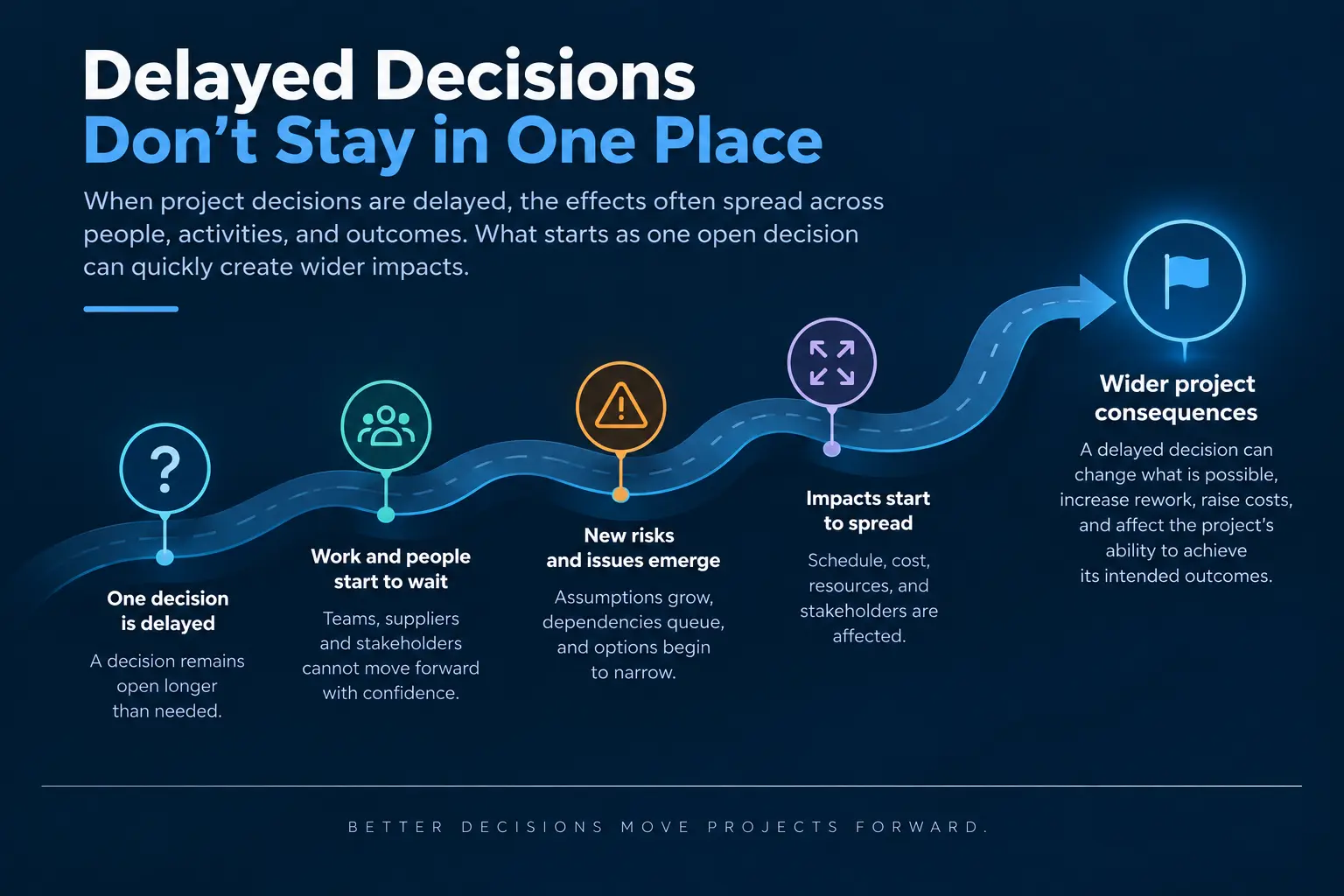
The Project Changes While the Decision Waits
Projects rarely stop completely while one decision remains open. Instead, teams often create temporary arrangements, assumptions, workarounds, or parallel activities.
These responses can keep work moving. However, they can also create hidden dependencies, rework, and additional constraints.
Meanwhile, costs can change, milestones can approach, stakeholder positions can harden, and alternatives can disappear. Research on project lock-in shows how earlier commitments, sunk costs, justification pressures, and path dependence can progressively restrict available choices.
As a result, a delayed decision can become a narrower decision. The project may eventually choose an option, but it may no longer have the same options available when the issue first emerged.
This is why decision timing matters beyond the decision itself. The project continues to evolve while the decision remains unresolved, and that changing context can affect both the choice and its consequences.
Ultimately, project decision making gets delayed within a changing project system. The delay is therefore more than time lost. It can alter the information, constraints, options, and consequences surrounding the decision.
Why Do Professionals Miss the Problem?
Decision Meetings Are Mistaken for Decision Processes
Professionals often judge decision activity by meetings, agendas, and approval forums. If these activities occur regularly, the process can appear healthy.
However, meetings show that people are discussing decisions. They do not show whether decisions are progressing. Time may still be lost before the meeting, between approval stages, or after agreement.
As a result, project decision making gets delayed while the project still appears to have an active decision process.
Decision Logs Can Create False Confidence
Decision logs provide useful visibility. They record issues, owners, actions, decisions, and dates. Yet, they can also hide the time spent between these events.
A decision may remain marked as “under review” for several weeks. Meanwhile, teams may continue working around it. The log records the status, but not always the operational consequence.
Therefore, a project can have strong decision documentation without having strong decision flow.
Information Volume Is Confused With Decision Readiness
Large projects can produce substantial reports, dashboards, forecasts, assessments, and technical papers. This creates a natural assumption that more information means better decision readiness.
Yet, research on group decision-making shows that teams often discuss information already shared by members more than unique information. Consequently, important evidence can remain outside the main discussion.
Project information systems research also highlights the importance of information quality and use. Information becomes valuable when decision-makers can interpret and apply it.
The problem can therefore remain hidden behind a large volume of information.
Formal Authority Gets More Attention Than Practical Decision Authority
Organisations often define decision rights through governance structures and approval matrices. These structures are important, but formal authority does not always explain how a decision actually moves.
A person may have approval authority without holding the technical knowledge required. Another person may hold the critical knowledge without having authority to commit the project.
Research on governance and knowledge fit helps explain this tension. Therefore, professionals can miss structural decision problems when they focus on who formally approves rather than how authority and knowledge interact.
Stakeholder Agreement Is Mistaken for Decision Readiness
Projects often seek broad agreement before making important decisions. This can reduce resistance and improve implementation. However, agreement is not always necessary for a decision to become ready.
Different stakeholders may hold legitimate interests and different risk perspectives. Their views can inform the decision without producing complete consensus.
Consequently, project decision making gets delayed when consultation continues without a clear distinction between input, agreement, approval, and decision authority.
Silence Is Mistaken for Agreement
A lack of objection can appear to indicate alignment. Yet, silence can have many explanations. People may lack information, avoid conflict, assume someone else will raise the concern, or believe their input will not change the outcome.
Research on group decision-making shows that information sharing can be uneven. Groups may focus on information already known to several members while overlooking unique information.
Therefore, apparent consensus can sometimes conceal unresolved information or concerns.
Escalation Is Mistaken for Resolution
When a decision becomes difficult, escalation often appears to be the obvious solution. Moving the issue to a higher authority can be appropriate when the required authority genuinely sits there.
However, escalation does not automatically resolve missing information, conflicting objectives, unclear criteria, or implementation constraints.
Recent research into major public projects has also highlighted how complex approval and assurance structures can blur accountability. As a result, adding another approval layer can sometimes move the problem rather than resolve it.
Decision Delay Is Separated From Project Controls
Project teams often track schedule, cost, risk, change, procurement, and resources separately from decision activity. This can make decision delay difficult to see as a project performance issue.
For example, a delayed decision may first appear as a late design release, a procurement hold, an unresolved risk, or a growing schedule constraint.
Therefore, professionals may manage the visible consequence without identifying the decision that caused it.
Professionals Focus on Decision Quality and Forget Decision Timing
Project professionals naturally want decisions to be well analysed, defensible, and evidence-based. That discipline is valuable. However, decision quality alone does not determine project value.
Research on decision speed shows that the relationship between speed and quality depends on context. Some decisions benefit from rapid action, while others require greater deliberation.
The deeper issue is therefore timing. A decision can be well reasoned but arrive after the project has passed the point where it could influence the intended outcome.
This is why professionals should examine not only whether a decision was sound, but also whether the project received it at the right time.
What Happens If It Continues?
The Decision Becomes More Expensive to Make
A delayed decision can increase the effort required to resolve it. More stakeholders may become involved, while more work becomes dependent on the outcome.
As assumptions become embedded in plans, designs, contracts, or resources, changing direction becomes harder. Consequently, project decision making gets delayed at one point, while the eventual decision becomes more complex.
Dependencies Begin to Queue Behind the Decision
Many project activities depend on earlier decisions. A design release may depend on an approved option, while procurement may depend on a confirmed specification.
When the decision remains open, dependent work can wait. Alternatively, teams may continue using temporary assumptions. Either response can create additional schedule and coordination exposure.
The Project Starts Making Decisions Under Greater Pressure
Time pressure often increases as milestones approach or available flexibility reduces. A decision that could have received careful attention earlier may eventually require rapid action.
Research shows that critical project decisions often involve incomplete information, competing goals, multiple perspectives, and time pressure. Therefore, unnecessary delay can change the conditions surrounding the final decision.
Rework and Change Pressure Increase
Teams often continue working around unresolved decisions. If the eventual decision differs from their assumptions, completed work may need to change.
Designs, procurement, sequencing, resources, contracts, and stakeholder expectations can all be affected. As a result, project decision making gets delayed while other parts of the project accumulate exposure to the unresolved issue.
Costs Can Increase Without the Decision Changing
Decision delay can create cost exposure even when the eventual decision remains unchanged. Teams may require additional analysis, temporary resources, repeated coordination, or extended management attention.
Therefore, the financial effect is not limited to changing the final choice. The project can incur cost simply because the choice remained unresolved.
Stakeholder Positions Can Harden
Time can change stakeholder positions. People may invest effort, make commitments, or publicly support a particular option.
Research on escalation of commitment shows that project stage, decision risk, and prior commitments can influence persistence with an existing course of action. Consequently, an unresolved decision can become harder to change for reasons beyond its original merits.
Options Can Close Before the Decision Is Made
One of the most important consequences of delay is the loss of optionality. Procurement commitments, design development, contractual obligations, market conditions, or physical progress can gradually remove alternatives.
Research on project lock-in shows how sunk costs, prior commitments, and path dependence can reduce flexibility over time.
A decision can remain technically open while the project’s real options are already closing.
Decision Quality Can Decline Because the Context Has Changed
A decision that was reasonable when first identified may require a different assessment later. Risks, costs, stakeholder priorities, and schedule constraints can all change.
Therefore, decision timing matters alongside decision quality. A sound decision made too late can have less value than the same decision made while meaningful options remain available.
Implementation Becomes More Difficult
Making a decision does not automatically change the project. Plans, contracts, schedules, systems, resources, and work instructions may still need to change.
If teams have already developed temporary arrangements, implementation can require additional correction and coordination. Thus, project decision making gets delayed not only when the choice remains unresolved, but also when the decision takes too long to become operational.
The Project Can Drift Into Escalation or Lock-In
When unresolved decisions continue affecting the project, teams may respond with escalation, additional oversight, or stronger commitment to the current direction.
These responses can help when used appropriately. However, they can also increase complexity without resolving the underlying issue.
The project can then enter a reinforcing cycle:
- The decision remains unresolved.
- The project continues under assumptions.
- Those assumptions create new dependencies.
- Available options become narrower.
- Pressure increases to maintain the existing direction.
The cost of decision delay is therefore not simply the time spent waiting. It is what the project becomes while the decision remains unresolved.
What Should Project Professionals Reconsider?
Reconsider Speed as the Only Measure of Decision Effectiveness
Faster decisions are not automatically better decisions. Some choices require analysis and challenge, while others lose value quickly when delayed.
Research shows that the relationship between decision speed and quality depends on context. Therefore, professionals should ask whether a decision was made in time for its consequences, rather than simply how quickly it was made.
Reconsider What “Decision Ready” Means
A decision does not need perfect information before it can be ready. Projects rarely operate with complete certainty.
Instead, professionals should consider whether:
- The decision question is clearly defined.
- Material options and consequences are understood.
- Relevant evidence is available.
- Important uncertainty is visible.
- The appropriate decision authority is clear.
The Green Book 2026 supports proportionate appraisal rather than unlimited analysis. Consequently, project decision making gets delayed when complete certainty becomes an informal requirement.
Reconsider the Idea That More Information Automatically Improves Decisions
More information can improve a decision, but only when decision-makers can interpret and use it effectively.
Research on group decision-making shows that teams can overlook information known only to individual members. Therefore, the better question is not “What more information can we collect?” but “What information could change this decision?”
This distinction also matters for project reporting. More dashboards, reports, and analysis do not necessarily create better decisions if the information does not address the decision that needs to be made.
Reconsider Where Decision Authority Sits
Formal approval structures provide control, but authority does not always sit close to the knowledge needed for the decision.
Research on governance and knowledge fit suggests that decision rights and specialised knowledge should connect effectively. This does not mean removing governance. Instead, it means examining whether the people with the necessary knowledge can influence the decision at the right point.
The question is therefore not simply “Who approves this?” It is also “Who understands the consequences well enough to inform that approval?”
Reconsider How Uncertainty Is Handled
Uncertainty is a normal project condition. Waiting until every unknown is resolved can therefore create unnecessary delay.
Instead, professionals should distinguish between what is known, what is assumed, what is treated as a risk, and what remains uncertain.
PMI’s Uncertainty Performance Domain and the Green Book both support active consideration of uncertainty rather than waiting for complete certainty. The aim is not to eliminate uncertainty before deciding, but to understand whether the remaining uncertainty could materially change the choice.
Reconsider How Stakeholder Input Is Used
Stakeholder input can improve decisions, expose risks, and reveal consequences that the core project team may overlook. However, every stakeholder does not need to reach complete agreement before a decision can proceed.
Professionals should distinguish consultation from agreement, approval, and decision authority. Otherwise, project decision making gets delayed when consultation continues without materially improving the decision.
The goal is therefore not maximum participation. It is purposeful participation that improves understanding, decision quality, or implementation.
Reconsider Escalation as a Default Remedy
Escalation is appropriate when the required authority genuinely sits at a higher level. However, moving a decision upward does not necessarily remove the underlying constraint.
Before escalating, professionals should identify what is actually preventing the decision:
- Missing authority
- Insufficient evidence
- Unclear decision criteria
- Unresolved risk acceptance
- Conflicting stakeholder interests
This prevents escalation from becoming a substitute for resolving the actual decision constraint.
Reconsider Whether Decision Timing Is Connected to Project Controls
Decision timing should be considered alongside schedule, risk, change, procurement, cost, and resource conditions.
A decision may appear administrative while actually controlling a critical dependency. Therefore, professionals should understand which project condition is waiting for the decision and what happens if it remains open.
This connection makes project decision making gets delayed visible as a project performance issue rather than an isolated administrative problem.
Reconsider What Happens After the Decision
A documented decision has limited value if it does not change the work.
Plans may need updating. Contracts may require clarification. Teams may need new instructions, while schedules, resources, systems, and stakeholder commitments may also need adjustment.
Consequently, decision effectiveness should include implementation. Professionals should ask whether the decision has actually reached the work it was intended to change.
Reconsider How the Project Learns From Decision Patterns
Individual decision delays can be difficult to interpret. Repeated patterns are often more revealing. Professionals can examine:
- Recurring waiting points
- Repeated escalations
- Frequently reopened decisions
- Recurring information gaps
- Implementation problems after decisions
APM research highlights the value of structured reflection and feedback around critical decisions. The objective is not to create more bureaucracy. Instead, it is to understand how the decision system behaves and improve it over time.
The deeper shift is from asking “Who is delaying the decision?” to asking “What in the decision system is creating the delay?”
A Practical Professional Lens
A useful way to examine project decision making is to look beyond the decision itself. Professionals should consider the conditions surrounding the decision and the effect of waiting.
The following six dimensions provide a practical lens for that assessment.
Decision Importance
Not every unresolved decision deserves the same level of attention. Its importance depends on what it can affect and how difficult it would be to reverse.
Consider:
- What outcome or dependency does the decision affect?
- What happens if the decision remains open?
- How reversible is the decision?
Decision Readiness
Readiness is not the same as having every possible piece of information. The question is whether the available evidence is sufficient for the decision’s consequence and uncertainty.
This helps professionals avoid two opposite problems: deciding without sufficient understanding and delaying because complete certainty is impossible.
Authority and Knowledge
Decision authority and decision knowledge may sit with different people. Therefore, professionals should examine whether the people who can decide are connected to those who understand the issue.
Where this connection is weak, the project may repeatedly seek clarification, approval, or escalation without resolving the underlying issue.
Stakeholder and Team Dynamics
Decisions can be affected by stakeholder interests, disagreement, relationships, and the willingness of people to share relevant information.
Professionals should therefore consider:
- Who needs to provide meaningful input?
- Who can enable or obstruct implementation?
- Is disagreement being surfaced or avoided?
- Is silence being mistaken for agreement?
Latency and Flow
The useful question is not simply how long a decision has been open. Professionals should examine where time is actually being spent.
For example:
- Waiting for information
- Waiting for review or approval
- Waiting for stakeholder alignment
- Waiting for implementation
This helps distinguish necessary deliberation from avoidable waiting.
Project Consequences
Finally, connect the decision to the wider project system. A decision can affect schedule, cost, risk, scope, resources, quality, implementation, or intended benefits.
Therefore, project decision making gets delayed should be treated as more than an administrative observation. The important question is what project condition is changing while the decision remains unresolved.
The question is not simply whether a decision is late. The question is what the project is becoming while it waits.
Key Takeaways
Project Decision Making Gets Delayed for reasons that extend beyond individual indecision. The deeper issue is how a project connects information, authority, uncertainty, stakeholders, governance, timing, and implementation.
- Decision quality, decision speed, and decision implementation are different dimensions. A fast decision is not automatically a good decision, and a good decision has little value if it arrives too late to influence the work.
- Not every delay is harmful. Some decisions require analysis, consultation, challenge, or reflection. The important question is whether the time spent improves the decision or simply allows the issue to remain unresolved.
- More information does not automatically create decision readiness. Information must be relevant, understood, sufficiently reliable, and capable of changing the available choice.
- Decision authority and decision knowledge may sit in different parts of the project. Effective governance therefore needs to connect decision rights with the people who hold the most relevant knowledge.
- Stakeholder input does not necessarily create alignment. Consultation, agreement, approval, decision authority, and implementation responsibility are different things.
- Unresolved decisions create consequences beyond the decision itself. Dependencies can queue, assumptions can spread, rework can increase, options can narrow, and stakeholder positions can become harder to change.
- Decision timing should be connected to project controls. Risks, changes, procurement constraints, schedule dependencies, cost pressures, and resource issues can all indicate that a decision is becoming time-critical.
- Decision effectiveness continues after approval. Projects should consider whether decisions were communicated, understood, implemented, and translated into the intended change.
When Project Decision Making Gets Delayed, the most useful question is not simply who is holding up the decision. Professionals should examine what is creating the delay, what the project is doing while it waits, and whether the decision will still have the same value when it arrives.
The deeper lesson is that decision performance is a project-system issue. Understanding where decisions slow down can reveal weaknesses in governance, information flow, stakeholder alignment, risk management, and project controls.
References
- Marguet, N. (2021). Detect, Reflect and Adapt: Factors Influencing Critical Project Decisions. Association for Project Management.
- Shepherd, N. G., Mooi, E. A., Elbanna, S., & Rudd, J. M. (2021). Deciding Fast: Examining the Relationship between Strategic Decision Speed and Decision Quality across Multiple Environmental Contexts. European Management Review, 18(2), 119–140.
- Shepherd, N. G., Mooi, E. A., Elbanna, S., & Lou, B. (2023). Fast and High-Quality Decision-Making: The Role of Behavioral Integration. European Management Review, 20(4), 679–697.
- Kolev, K. D., Dykes, B. J., Kang, S. (Sam), Hughes-Morgan, M., & Ferrier, W. J. (2025). Fast or Slow? A Meta-Analysis on the Performance Implications of Decision, Implementation, and Response Speed. Journal of Management Scientific Reports, 3(1).
- Tiwana, A. (2009). Governance-Knowledge Fit in Systems Development Projects. Information Systems Research, 20(2), 180–197.
- Lu, L., Yuan, Y. C., & McLeod, P. L. (2012). Twenty-Five Years of Hidden Profiles in Group Decision Making: A Meta-Analysis. Personality and Social Psychology Review, 16(1), 54–75.
- Caniëls, M. C. J., & Bakens, R. J. J. M. (2012). The Effects of Project Management Information Systems on Decision Making in a Multi Project Environment. International Journal of Project Management, 30(2), 162–175.
- Williams, T., & Samset, K. (2010). Issues in Front-End Decision Making on Projects. Project Management Journal, 41(2), 38–49.
- Cantarelli, C. C., Flyvbjerg, B., van Wee, B., & Molin, E. J. E. (2010). Lock-In and Its Influence on the Project Performance of Large-Scale Transportation Infrastructure Projects: Investigating the Way in Which Lock-In Can Emerge and Affect Cost Overruns. Environment and Planning B: Planning and Design, 37(5), 792–807.
- HM Treasury. (2026). The Green Book 2026. UK Government.
Related Kleios Resources
This insight examines why project decision making gets delayed and how decision delays can affect the wider project system. The following Kleios resources help turn those observations into practical project work.
- How to Make Better Project Decisions — A practical guide for improving project decision-making when information, uncertainty, stakeholder interests, and competing priorities make decisions difficult.
- Project Decision-Making Template — A structured resource for documenting, evaluating, and managing project decisions in a consistent way.
- Project Management Insights — Explore more evidence-informed perspectives on project management challenges, professional practices, and the issues that shape project performance.
Use the guide to strengthen the decision-making approach, the template to support its application, and the insights to examine the deeper issues behind common project challenges.
FEATURED PROJECT MANAGEMENT INSIGHTS
Professional Perspectives on the Challenges Projects Face
Our featured Project Management Insights examine recurring challenges, decision gaps, hidden causes, and assumptions that influence project outcomes. Moreover, they encourage professionals to look beyond surface-level problems and consider what may be happening underneath.
Why Do Project Health Checks Miss Problems?
Examine why project health checks can indicate acceptable performance while deeper concerns continue developing. Instead, look beyond reported status and consider the conditions that influence actual project health.
Why Do Early Project Warning Signs Get Ignored?
Explore the signals and patterns that often appear before significant project problems emerge. Moreover, examine why teams sometimes overlook these indicators and what that reveals about project management practices.
Why Do Project Recovery Plans Fail?
Examine why well-structured recovery plans can struggle during execution. Ultimately, consider how ownership, leadership, resources, stakeholder alignment, and execution discipline influence recovery outcomes.
MORE PROJECT MANAGEMENT RESOURCESE TYPES
Continue Your Project Management Learning
Project management knowledge becomes more valuable when you can apply it, see it in practice, and continue developing your capabilities. Explore our other resources to complement the practical guidance provided in these guides.
Guides
Explore clear guidance to understand common challenges, evaluate situations, and apply effective approaches throughout project delivery.
Downloads
Access useful project management materials and reference resources to support your learning and day-to-day project work.
Career Roadmaps
Follow structured learning paths to develop project management knowledge, practical skills, and capabilities for your professional growth.
Templates
Use practical project management templates to structure planning, management, reporting, and other project activities.
Case Studies
Explore realistic project situations, decisions, challenges, and outcomes to understand how project management practices work in practice.
Glossary
Find clear explanations of project management terminology, concepts, abbreviations, and commonly used professional language.
Looking for more project management resources? Explore the Kleios Technologies Resources Hub to discover our complete collection of guides, templates, downloads, career roadmaps, case studies, glossary resources, and insights.
RELATED KNOWLEDGE DOMAINS
Continue Your Learning Across Related Knowledge Domains
Project management connects with specialized disciplines, tools, and professional practices that support successful project delivery. Explore related knowledge domains to expand your expertise, develop complementary skills, and discover deeper resources beyond the Project Management Guides.
Expand your expertise one domain at a time and build a well-rounded project management skill set.
Why Explore Related Domains?
- Develop cross-functional project management expertise
- Discover specialized knowledge beyond core project management
- Access practical resources across interconnected disciplines
- Build a well-rounded professional learning pathway
- Strengthen your ability to address real-world project challenges
Each knowledge domain complements the practical guidance in our Project Management Guides, helping you build broader capabilities and address real-world project challenges with greater confidence.
Project Planning & Scheduling
Planning techniques, scheduling methods, and timeline management resources.
Project Controls
Performance measurement, forecasting, and project control best practices.
PMO
Governance, portfolio management, and organizational project excellence.
Risk Management
Risk identification, assessment, mitigation, and monitoring resources.
Primavera P6
Professional planning, scheduling, resource management, and reporting.
Microsoft Project
Project scheduling, tracking, reporting, and collaboration resources.
Power BI
Interactive dashboards, reporting, visualization, and project analytics.
PMI Certifications
Certification guidance, exam preparation, and professional development resources.