
PROJECT MANAGEMENT INSIGHT
Why Do Early Project Warning Signs Get Ignored?
Early Project Warning Signs can provide valuable information, yet seeing a signal does not guarantee that professionals will recognize its significance or act on it. Often, warning signs appear as small changes, ambiguous evidence, or patterns that do not fit established project expectations. Meanwhile, reporting structures, assumptions, competing priorities, and repeated deviations can influence how those signals are interpreted. As a result, a project can continue operating normally while important conditions deteriorate underneath. This insight examines why early project warning signs get ignored, how signals lose attention, and what professionals should reconsider when interpreting and responding to emerging project concerns.
Professional Insight · Project Management
Introduction
Projects rarely fail because nobody had any information. More often, important information exists but does not receive the attention, interpretation, or response it deserves.
Early Project Warning Signs can appear as small performance changes, recurring exceptions, unusual behaviours, delayed decisions, stakeholder concerns, or emerging patterns across different project areas. Yet these signals rarely announce themselves as clear evidence of a serious problem.
Instead, professionals must interpret incomplete and changing information. A signal may look temporary, isolated, or manageable when it first appears. Meanwhile, existing assumptions can shape how teams explain what they see.
Reporting systems can create another layer of difficulty. Information may lose context as it moves through reporting levels. Formal measures may also emphasize current performance while revealing less about developing conditions.
Human factors matter as well. People may hesitate to challenge established expectations, raise uncertain concerns, or reopen earlier decisions. Furthermore, repeated deviations can gradually become accepted as normal project behaviour.
This creates an important distinction: seeing a warning sign is not the same as recognizing its significance. Recognition requires context, professional judgement, constructive challenge, and an appropriate route to action.
This insight examines why Early Project Warning Signs get ignored, what happens when attention arrives too late, and how professionals can strengthen the way projects interpret and respond to emerging signals.
The Common Assumption
A Warning Sign Is Ignored Because Nobody Saw It
It is tempting to assume that a warning becomes irrelevant because nobody noticed it. Sometimes that happens, but detection is only the first stage.
Early Project Warning Signs can exist in performance data, conversations, behaviours, trends, or recurring exceptions. Yet people must still interpret those signals before they become meaningful information.
A project can therefore detect a change without recognizing what that change may indicate.
A Serious Warning Should Be Obviously Serious
Early signals rarely arrive with a clear label saying that a major problem is developing. Their meaning often depends on context, timing, relationships, and other evidence.
Consequently, professionals may judge an uncertain signal against today’s visible performance. That approach can underestimate a condition that has not yet produced measurable consequences.
The difficulty is not simply noticing the signal. It is judging whether its potential significance justifies further attention.
If the Data Is Available, the Warning Is Visible
More data does not automatically create better visibility. Information can remain difficult to interpret when it lacks context, arrives at the wrong time, or sits within a large volume of competing information.
Performance measurement research also distinguishes between lagging results and indicators that can provide earlier information about changing project conditions.
Therefore, Early Project Warning Signs may exist within available data without becoming visible as meaningful project concerns.
A Warning Sign Should Trigger Action Automatically
A warning sign provides evidence. It does not automatically prescribe a response.
Some signals require immediate intervention. Others require validation, closer monitoring, additional context, or discussion before action becomes appropriate.
Treating every anomaly as an escalation can create noise and reduce attention. Instead, professionals should match the response to the signal’s uncertainty, potential consequence, and relationship with other project conditions.
Experienced Professionals Should Recognize the Problem
Experience can improve pattern recognition and contextual judgement. However, experience also operates through established expectations and mental models.
A familiar project environment may make an unusual condition easier to explain. Consequently, professionals can interpret new evidence through explanations that worked previously.
The lesson is not to distrust experience. It is to combine experience with deliberate questioning when evidence does not fit expectations.
Repeated Warnings Become More Credible
Repetition does not always increase attention. In some environments, repeated deviations can gradually become accepted as normal.
When a condition produces no immediate negative consequence, people may adjust their expectations around it. Over time, the warning can lose its ability to create concern.
This creates a paradox: Early Project Warning Signs can become more familiar while becoming less influential.
A Green Project Has Little Reason to Worry
A favourable current status can provide useful assurance, but it does not describe every condition influencing future performance.
A project can remain within current tolerances while its options narrow, dependencies accumulate, or emerging risks become more difficult to manage.
For that reason, professionals should distinguish between current status and developing trajectory. A healthy-looking status today does not eliminate the need to understand what may be changing underneath.
What Is Really Happening?
The Signal Is Often Ambiguous
Early Project Warning Signs rarely provide a complete explanation of what is happening. A change in productivity, decision speed, stakeholder behaviour, or rework may have several possible causes.
Consequently, professionals must interpret signals before deciding what they mean. The same observation can represent a temporary variation, an emerging problem, or a symptom of a deeper condition.
Ambiguity does not make a signal useless. Instead, it creates a need for proportionate investigation and better contextual understanding.
People Interpret Signals Through Existing Expectations
Professionals rarely approach new information without assumptions. Existing plans, commitments, forecasts, and explanations influence how people interpret emerging evidence.
This can create a subtle filtering effect. A signal that supports the established project narrative may receive less scrutiny than one that challenges it.
Therefore, Early Project Warning Signs can lose significance before anyone consciously decides to ignore them.
The First Plausible Explanation Can Become the Dominant Explanation
Once a project develops a convincing explanation for a change, later information may become easier to interpret through that explanation.
For example, a productivity decline may initially appear to result from a temporary resource shortage. If that explanation becomes accepted, other possible causes may receive less attention.
The problem is not forming an explanation. The problem arises when the explanation stops being treated as something that evidence can challenge.
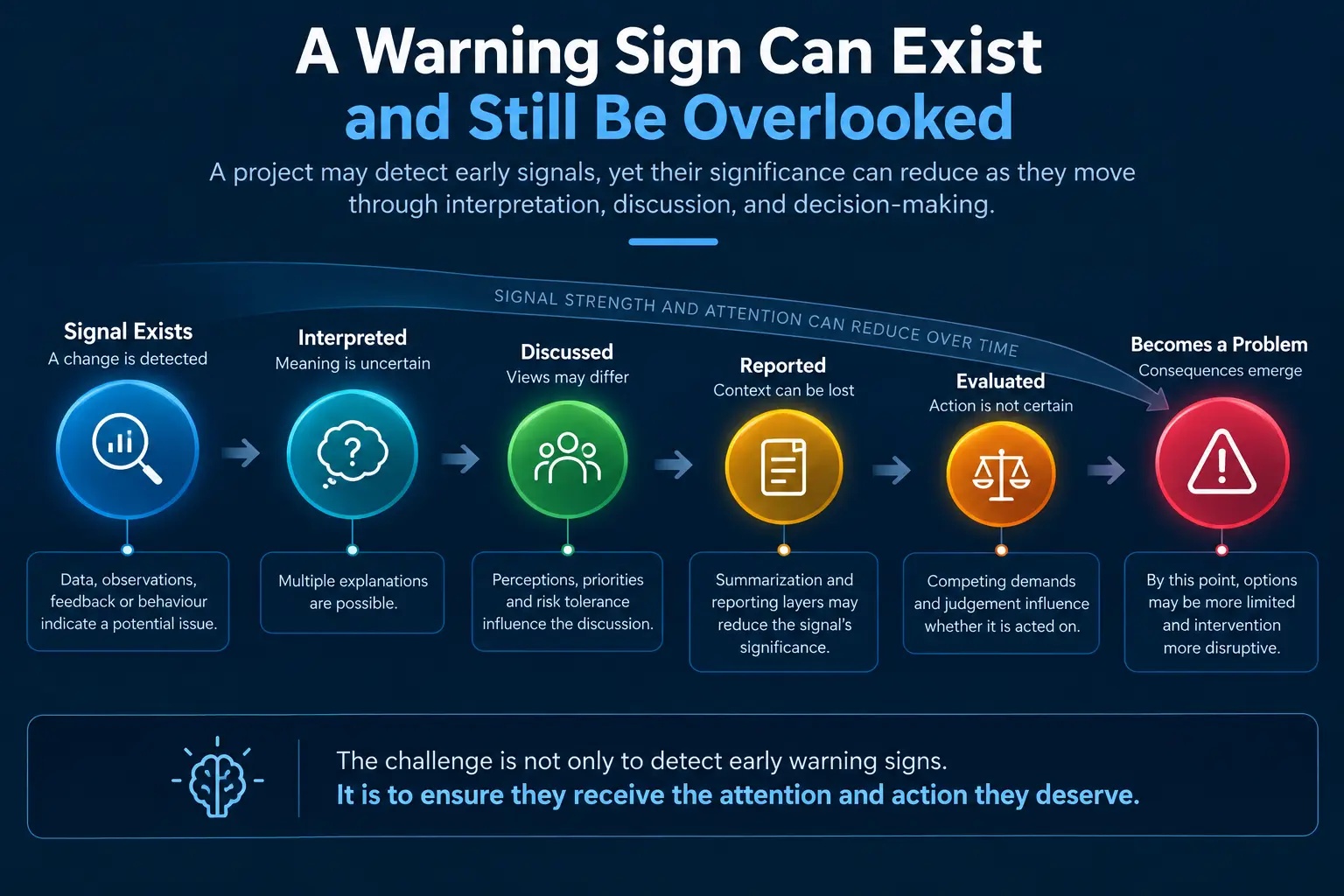
Signals Become Weaker as They Move Through the Reporting System
A warning can begin as a detailed observation within a team. It may then pass through meetings, reports, dashboards, governance forums, and management decisions.
Each stage can improve structure and consistency. However, summarization can also remove context, uncertainty, or the original reasoning behind the concern.
Reporting research shows that project status information can also reflect reporting behaviour and organizational conditions. Consequently, the final status presented to decision-makers may not contain everything known closer to the work.
Warning Signs Can Exist Between Reporting Categories
Projects often divide information into areas such as cost, schedule, risk, quality, resources, stakeholders, and technical performance.
These categories improve accountability, but important signals can cross several categories. A small resource issue may contribute to productivity loss, which creates schedule pressure and increases stakeholder concern.
No single category may show a critical breach. Yet the relationship between them may reveal a developing condition that deserves attention.
Repetition Can Change the Meaning of a Warning
A repeated deviation can initially attract attention. If the project survives each occurrence, people may gradually treat the condition as ordinary.
Over time, the organization can adjust its expectations instead of correcting the underlying condition. Research on normalization of deviance describes how repeated departures from expected practice can become accepted when they do not produce immediate negative consequences.
Thus, Early Project Warning Signs may become familiar enough to stop feeling like warnings.
People May Notice the Problem Before the System Does
Formal indicators provide consistency, but people working close to the project can notice changes that have not yet reached measurable thresholds.
These observations should not automatically override formal data. Instead, they should create an opportunity to investigate what the existing measures may not yet capture.
A comment about growing coordination difficulty, unusual workarounds, or declining confidence may become valuable when professionals connect it with other evidence.
The Person Seeing the Warning May Not Control the Response
Knowledge and authority do not always sit with the same person. A planner may identify a trend, while a project manager controls the response and a sponsor controls a major decision.
This separation can create delay even when the warning reaches the right people. The signal may be understood, yet no clear route may exist from observation to decision.
Professionals should therefore examine not only who sees Early Project Warning Signs, but also who can act on their implications.
The Cost of Acting Can Compete With the Cost of Waiting
Intervention usually creates visible costs. It may require replanning, additional resources, difficult conversations, design changes, or management attention.
The consequences of waiting are less certain at first. As a result, delaying action can appear reasonable even when the underlying condition deserves investigation.
This creates a difficult decision environment: professionals compare a certain immediate disruption with an uncertain future consequence.
A Warning Becomes Harder to Challenge Once It Fits the Project Narrative
Projects develop stories about why performance looks the way it does. These narratives help teams coordinate, but they can also influence how new evidence is interpreted.
If a warning fits the accepted story, professionals may explain it without investigating further. If it contradicts the story, they may require stronger evidence before accepting it.
The deeper issue is not whether the project has a narrative. It is whether the narrative remains open to revision when new evidence appears. That distinction can determine whether Early Project Warning Signs lead to learning or simply become another explanation for why the project continues as planned.
Why Do Professionals Miss the Problem?
The Signal Does Not Fit the Existing Project Narrative
Projects develop explanations for their current condition. These explanations help teams coordinate, yet they can also shape how new evidence gets interpreted.
When a signal conflicts with the accepted story, professionals may search for reasons to treat it as temporary or unrelated. Consequently, Early Project Warning Signs can receive less attention when they challenge established expectations.
The risk increases when the explanation has supported earlier decisions or significant commitments.
Professionals Wait for Stronger Evidence
Uncertainty creates a natural desire for confirmation. Professionals may wait for a clearer trend before investing time, resources, or management attention.
That caution can be appropriate when evidence remains weak. However, waiting for certainty can defeat the purpose of early warning because the signal may become obvious only after consequences appear.
The better question is whether the uncertainty justifies investigation, monitoring, or intervention, rather than whether the signal already proves a problem.
Small Deviations Are Treated as Isolated Events
A small variance rarely demands immediate concern on its own. Yet several modest changes can become meaningful when they occur together.
For example, slightly lower productivity, increasing rework, slower decisions, and growing stakeholder concerns may indicate a changing project environment.
When teams assess each issue separately, they can miss the interaction between them. Systemic project diagnostics therefore require attention to relationships, not only individual measures.
Teams Focus on Current Status Instead of Direction
Current performance provides important information, but it does not always show where the project is heading.
A project may remain within tolerance while contingency decreases, unresolved dependencies accumulate, or operating conditions deteriorate.
Early Project Warning Signs often become more useful when professionals examine trajectory alongside current status. Leading indicators can add earlier information about conditions that may influence future performance.
Formal Reports Receive More Trust Than Informal Evidence
Formal reports provide structure, traceability, and consistency. Those qualities make them valuable for governance and decision-making.
Nevertheless, people working close to the project may notice changes before formal measures capture them. Informal evidence should not automatically override reported data, but it can provide a reason to investigate.
A stronger approach combines formal evidence with informed human observation rather than treating either source as complete on its own.
Warning Signs Are Filtered Through Reporting Layers
A concern may begin with a detailed observation and pass through several reporting levels before reaching a decision-maker.
Each layer can improve clarity, yet summarization can remove context or reduce the apparent significance of uncertainty. Reporting research also shows that status reporting behaviour can influence the information presented about project conditions.
As a result, Early Project Warning Signs may become less visible as information moves further from the people who first observed them.
People Hesitate to Challenge the Project
Raising an uncertain concern can carry interpersonal or professional costs. People may worry about appearing negative, creating conflict, or challenging decisions made by influential stakeholders.
Research on psychological safety shows why team environments matter for learning and speaking up. Similarly, research on bad-news reporting highlights conditions that can discourage negative information from travelling upward.
The issue is not simply whether people have permission to speak. They also need confidence that raising a concern will produce constructive examination rather than automatic resistance.
Professionals Hesitate to Reopen Earlier Decisions
Projects accumulate commitments. Once teams invest time, money, resources, and credibility in a decision, reconsidering it can become increasingly difficult.
Escalation-of-commitment research explains how prior investment can contribute to continued support for an existing course of action, particularly when changing direction creates visible losses.
Consequently, Early Project Warning Signs that challenge earlier decisions may require stronger evidence before professionals accept that circumstances have changed.
Repeated Deviations Become Familiar
A recurring exception can gradually lose its ability to attract attention. If previous occurrences did not produce immediate consequences, teams may begin treating the condition as part of normal delivery.
Research on normalization of deviance shows how repeated departures from expected practice can become accepted over time.
Familiarity can therefore reduce curiosity precisely when recurrence should encourage professionals to examine the underlying condition.
Responsibility for the Warning Is Unclear
A person may identify a warning without having the authority to investigate or change the underlying condition.
This creates a gap between seeing, interpreting, deciding, and acting. The signal can therefore enter the project system without reaching an effective response point.
Professionals should clarify who can validate the concern, who can decide the response, and who owns the resulting action.
The Project Has More Signals Than Attention
Projects generate more information than decision-makers can examine deeply. Adding more indicators does not solve that limitation.
The professional challenge is to distinguish meaningful signals from normal variation, connect related observations, and direct attention toward conditions with material consequences.
Early Project Warning Signs become useful when the project can allocate attention intelligently, rather than simply increase the volume of monitoring.
What Happens If It Continues?
The Warning Becomes a Confirmed Problem
An uncertain signal can eventually become measurable deterioration. By then, the project may have lost much of the advantage that early recognition could have provided.
This does not mean every unresolved signal becomes a problem. Some signals disappear, while others remain within the project’s capacity to absorb them.
The concern arises when Early Project Warning Signs continue without sufficient investigation and the underlying condition gradually becomes harder to ignore.
Recovery Options Begin to Narrow
Time can change the range of practical responses available to a project. Dependencies may become fixed, commitments may increase, and alternative approaches may become more disruptive.
Consequently, an intervention that was relatively manageable earlier may require broader replanning later.
The important point is not that delay always removes options. Instead, delay can change the cost, feasibility, and consequences of those options.
Temporary Workarounds Become Permanent
Workarounds can help projects maintain continuity. They become problematic when they repeatedly compensate for an underlying condition without addressing why it exists.
Over time, the workaround can become part of normal delivery. The original problem then becomes less visible because the project has adapted around it.
This creates a subtle form of drift: the project appears to function, but the effort required to maintain that performance keeps increasing.
Small Problems Begin Interacting
Separate issues can remain manageable until they begin influencing one another. A resource constraint can affect productivity, which can increase schedule pressure and create additional stakeholder concern.
Once these relationships develop, the project may face a different problem from the one that originally generated the warning.
Therefore, Early Project Warning Signs should be considered within the wider project system rather than treated only as isolated events.
Decision Pressure Increases
Early in the process, the question may be whether a signal deserves investigation. Later, the question can become how much of the project can still be protected.
This shift reduces the time available for careful analysis. Management may need to choose between imperfect recovery options while stakeholders demand clearer answers.
As pressure increases, the project can move from learning about a condition to managing its consequences.
The Project Starts Defending Earlier Assumptions
When a warning challenges an earlier decision, changing direction can become increasingly difficult. Previous investment, commitments, and expectations can all influence the response.
Escalation-of-commitment research helps explain why people sometimes continue supporting an existing course despite evidence that circumstances have changed.
This does not mean every delayed response reflects poor judgement. It means professionals should recognize when protecting an earlier decision begins to compete with responding to current evidence.
Corrective Action Becomes More Disruptive
Later intervention often affects more established parts of the project. Changes may reach scope, sequencing, resources, procurement, technical decisions, or stakeholder commitments.
The resulting action may still be necessary. However, the project may need to disrupt functioning areas to correct a condition that was once easier to influence.
Early Project Warning Signs therefore have value partly because they can create an opportunity to intervene before the response becomes disproportionately disruptive.
Stakeholder Confidence Begins to Decline
Persistent unexplained issues can affect confidence in forecasts, reporting, leadership, and recovery plans. Stakeholders may begin asking why earlier signals did not produce a response.
Confidence does not disappear automatically. Yet repeated differences between reported expectations and observed conditions can make future information harder to accept without additional challenge.
The project can then spend more effort establishing credibility while simultaneously managing the underlying problem.
The Project Learns the Wrong Lesson From Repeated Survival
A project can survive a warning without proving that the warning was unimportant. Contingency, additional effort, favourable conditions, or simple timing may have absorbed its effects.
If teams interpret survival as evidence that the earlier concern was unnecessary, they may become less responsive to similar signals in the future.
That creates a dangerous learning pattern: the absence of failure becomes evidence that the warning did not matter.
The Organization Becomes Better at Explaining Problems Than Preventing Them
Once a problem becomes visible, organizations can often produce detailed explanations. They can identify causes, assign responsibilities, and document corrective actions.
Yet post-event explanation does not automatically reveal why earlier information failed to influence attention or action.
A stronger learning process examines both the problem and the earlier decision environment: what was known, what was believed, what was questioned, what was ignored, and what could have changed the response sooner.
What Should Project Professionals Reconsider?
A Warning Sign Is Not a Conclusion
A warning signal provides evidence that something may require attention. It does not automatically prove what is happening or why it is happening.
Professionals should therefore avoid two opposite responses: dismissing an uncertain signal and treating every signal as proof of a serious problem.
The better response is proportionate investigation. Uncertainty should lead to examination where appropriate, not automatically to dismissal.
Separate Detection From Interpretation
Seeing something change is different from understanding what the change means. Yet project reporting can move quickly from observation to explanation.
Professionals should deliberately separate the stages:
- What has actually changed?
- What could explain the change?
- What evidence supports each explanation?
- What would make the current interpretation less convincing?
This distinction helps prevent an initial explanation from becoming accepted before the evidence has been properly examined.
Ask What the Signal Is Being Compared Against
A number becomes meaningful through context. A small variance may be insignificant in one situation and highly important in another.
When reviewing Early Project Warning Signs, professionals should consider the relevant baseline, tolerance, trend, project phase, dependencies, available contingency, and potential consequence.
The objective is not to create more thresholds. It is to understand what makes a particular change meaningful in its current context.
Look for Combinations, Not Only Threshold Breaches
A project may remain within individual tolerances while several conditions deteriorate together. This is particularly important in complex projects where problems can interact.
For example, modest productivity decline, increasing rework, slower decisions, and rising stakeholder concern may carry more meaning together than any single indicator suggests.
Professionals should therefore ask whether several apparently minor signals are describing one changing system.
Challenge the First Plausible Explanation
Once a credible explanation emerges, people naturally organize subsequent information around it. That can make contradictory evidence easier to discount.
A useful professional discipline is to ask what evidence would challenge the current explanation. If no evidence is being considered capable of changing the interpretation, the review may have become confirmation rather than investigation.
This matters because Early Project Warning Signs can have several plausible causes, and the first explanation is not necessarily the most accurate one.
Treat Conflicting Evidence as Useful Information
A dashboard may indicate stable performance while project teams report growing difficulty. Neither source should automatically be treated as correct or incorrect.
Instead, the difference should prompt investigation. It may reveal a measurement limitation, reporting delay, local problem, emerging condition, or disagreement about what the indicator actually represents.
Therefore, conflicting evidence can itself become a signal rather than an inconvenience to be removed from the discussion.
Make It Safe to Surface Uncertainty
Not every concern should trigger escalation. However, professionals need an environment where uncertainty can be discussed before it becomes a confirmed problem.
Psychological safety research suggests that people are more able to contribute information and learn when interpersonal risks are manageable. For project teams, this means creating space for people to say that something is changing without requiring them to prove the entire case first.
The goal is constructive challenge without automatic alarm.
Treat Repetition as Information
Repeated deviations should not automatically be classified as normal simply because the project has learned to operate around them.
When a warning appears repeatedly, professionals should ask whether the recurrence indicates an unresolved cause, an unrealistic baseline, a weak control, or a condition that the project has gradually accepted.
Repetition can therefore provide information about the project’s operating system, not merely another entry in a status report.
Connect Warning Signals to Decision Authority
The person who sees a warning may not have the authority to investigate it fully, change the underlying condition, or allocate the required resources.
Professionals should therefore distinguish between knowledge, influence, decision authority, and execution responsibility. A warning system is weaker when information reaches someone who cannot move it toward an effective response.
Early Project Warning Signs become more actionable when the project knows where the relevant response authority sits.
Review What the Project Has Learned to Ignore
Every project develops informal ideas about what counts as normal, temporary, manageable, or not worth escalating. These judgments can be useful, but they can also become blind spots.
Professionals should periodically ask:
- What concerns keep recurring without changing the response?
- What exceptions have become accepted as normal?
- Which signals receive attention only after performance deteriorates?
- What information is difficult for people to raise?
The answer can reveal where the project has developed an attention gap. The objective is not to make every signal louder. It is to make the project better at deciding which signals deserve deeper attention and at changing course when evidence justifies it.
A Practical Professional Lens
Professionals do not need another scoring model to decide whether Early Project Warning Signs deserve attention. What is more useful is a mental model that helps connect a signal to interpretation, context, challenge, authority, and response.
The following six-part lens is designed for that purpose. It does not replace project controls, risk processes, health checks, or formal escalation. Instead, it helps professionals think more critically about what those systems are showing.
SIGNAL — What Changed?
Start with the observation rather than the explanation. Identify what has changed, when it changed, and what evidence supports the observation.
The evidence may come from performance data, project records, stakeholder feedback, team behaviour, decisions, dependencies, or emerging patterns. The important distinction is between what was observed and what someone believes it means.
MEANING — What Could It Mean?
A signal needs interpretation. Consider the most plausible explanation, but also consider whether other explanations could fit the evidence.
This is particularly important when Early Project Warning Signs are ambiguous. A change may indicate deterioration, temporary disruption, measurement weakness, or an entirely different underlying condition.
The professional question is not simply, “What does this mean?” It is also, “What else could explain it, and what evidence would distinguish those explanations?”
CONTEXT — What Else Is Happening?
A signal rarely exists in isolation. Examine what else is changing around it.
- Dependencies and interfaces
- Stakeholder relationships and expectations
- Resources and capability
- Technical, commercial, or delivery conditions
- Risks, assumptions, and unresolved decisions
The purpose is to determine whether the signal is isolated or part of a wider change in the project system.
CHALLENGE — What Would Make Us Reconsider?
Strong project judgement requires the willingness to question an interpretation after it has become accepted.
Ask what evidence would demonstrate that the current explanation is incomplete or wrong. Also consider whether contradictory information is being investigated or simply explained away.
This creates constructive challenge without requiring every concern to become an escalation.
AUTHORITY — Who Can Change the Condition?
Finding a warning is only useful if the project can connect that information to someone capable of influencing the underlying condition.
The person with the most information may not have decision authority. Likewise, the person with formal authority may not have the knowledge needed to understand the signal.
Therefore, Early Project Warning Signs should be considered alongside knowledge, influence, decision authority, and execution responsibility. This helps expose gaps between detecting a problem and being able to change it.
RESPONSE — What Actually Changed?
A response is not successful simply because an action was recorded or an issue was closed. The more important question is whether the underlying condition changed.
After a response, examine whether the signal disappeared, the risk reduced, the original interpretation proved correct, or another problem emerged.
This creates a feedback loop:
SIGNAL → MEANING → CONTEXT → CHALLENGE → AUTHORITY → RESPONSE → LEARNING
The final step matters because the project should use what it learned to improve future interpretation. In that sense, response should lead to learning, and learning should improve the next interpretation.
Three Levels of Professional Attention
The lens can also be viewed through three levels of maturity.
- Detection: Something has changed.
- Interpretation: We have examined what the change could mean and tested the explanation.
- Adaptation: The project changes its response because of what it has learned.
A project can be strong at detection while remaining weak at interpretation. It can also interpret signals well but fail to adapt because authority, incentives, resources, or decision processes prevent effective response.
The objective is not to make every signal louder. It is to make the project better at deciding which signals deserve deeper attention and better at changing course when the evidence says it should.
Key Takeaways
Early Project Warning Signs are valuable only when the project can recognize their significance, challenge its interpretation, connect the signal to the right context, and respond effectively.
The deeper issue is therefore not simply whether a project has warning mechanisms. It is whether those mechanisms support useful attention and professional judgement.
- A warning sign is evidence, not a conclusion. Professionals should investigate what a signal could mean rather than immediately dismissing or accepting it.
- Detection and interpretation are different activities. Seeing a change does not mean the project understands its significance.
- Context changes meaning. Baselines, trends, dependencies, project phase, stakeholders, risks, and consequences can determine whether a small change matters.
- Several modest signals can matter together. Important deterioration may emerge through interactions rather than a single threshold breach.
- Conflicting evidence deserves attention. Differences between formal reporting and human experience can reveal information that either source alone may miss.
- Psychological safety supports earlier challenge. People need to be able to surface uncertainty before they can provide useful evidence about emerging problems.
- Repeated exceptions can become normalized. A condition does not become healthy simply because the project has learned to operate around it.
- Detection needs a connection to authority. The person who sees the warning may not be able to change the condition.
- Action should be evaluated by its effect. Recording an action or closing an issue does not necessarily mean that the underlying condition has improved.
When Early Project Warning Signs are repeatedly overlooked, the project can become better at explaining deterioration than preventing it. That is why professionals should examine not only what the project monitors, but also what it notices, questions, accepts, and learns from.
The most useful question is not simply, “Did we see the warning?” It is: “Did we understand what the warning was telling us, and did the project change because of what it learned?”
References
The following references informed the analysis of early warning signals, project interpretation, reporting behaviour, organizational silence, normalization, and project decision-making. Publication links have been checked against publisher, professional-institution, or established academic sources.
- Williams, T., Klakegg, O. J., Walker, D. H. T., Andersen, B., & Magnussen, O. M. (2012). Identifying and Acting on Early Warning Signs in Complex Projects. Project Management Journal, 43(2), 37–53.
- Haji-Kazemi, S., Andersen, B., & Krane, H. P. (2013). A Review on Possible Approaches for Detecting Early Warning Signs in Projects. Project Management Journal, 44(5), 55–69.
- Nikander, I. O., & Eloranta, E. (1997). Preliminary Signals and Early Warnings in Industrial Investment Projects. International Journal of Project Management, 15(6), 371–376.
- Nikander, I. O., & Eloranta, E. (2001). Project Management by Early Warnings. International Journal of Project Management, 19(7), 385–399.
- Jaafari, A. (2007). Project and Program Diagnostics: A Systemic Approach. International Journal of Project Management, 25(8), 781–790.
- Zheng, L., Baron, C., Esteban, P., Xue, R., Zhang, Q., & Yang, S. (2019). Using Leading Indicators to Improve Project Performance Measurement. Journal of Systems Science and Systems Engineering, 28(5), 529–554.
- Guo, B. H. W., & Yiu, T. W. (2016). Developing Leading Indicators to Monitor the Safety Conditions of Construction Projects. Journal of Management in Engineering, 32(1).
- Kaufmann, C., & Kock, A. (2023). The Performance Effects of Optimistic and Pessimistic Project Status Reporting Behavior. International Journal of Project Management, 41(7), 102514.
- Morrison, E. W., & Milliken, F. J. (2000). Organizational Silence: A Barrier to Change and Development in a Pluralistic World. Academy of Management Review, 25(4), 706–725.
- Kutsch, E., Djabbarov, I., & Hall, M. (2021). How Managers Frame and Make Sense of Unexpected Events in Project Implementation. International Journal of Project Management, 39(5), 570–580.
These sources provide the evidence base for the Insight’s central argument: a warning signal becomes useful only when people interpret it, challenge their assumptions, connect it to context, and translate it into an effective response.
Related Kleios Resources
This Insight examines why warning signals can lose attention or significance even when project teams have monitoring and reporting mechanisms in place. The following Kleios resources provide practical methods and tools for identifying, assessing, and responding to emerging project concerns.
- How to Identify Early Warning Signs in a Project
A practical guide to establishing meaningful signals, using leading indicators, recognizing trends and patterns, validating warnings, and responding before emerging concerns become larger project problems. - Project Early Warning Signs Checklist
A structured tool for capturing warning signs across key project areas, assessing evidence and trends, analysing signals, defining responses, and monitoring follow-up. - Project Management Insights
Explore the wider collection of Kleios Insights examining the deeper issues, assumptions, behaviours, and systems that influence project performance.
Together, these resources connect the Insight’s analytical perspective with practical project management activities. The Insight asks why warning signals can be overlooked; the related guides and templates help professionals identify, examine, and respond to those signals in practice.
FEATURED PROJECT MANAGEMENT INSIGHTS
Professional Perspectives on the Challenges Projects Face
Our featured Project Management Insights examine recurring challenges, decision gaps, hidden causes, and assumptions that influence project outcomes. Moreover, they encourage professionals to look beyond surface-level problems and consider what may be happening underneath.
Why Do Project Recovery Plans Fail?
Examine why well-structured recovery plans can struggle during execution. Ultimately, consider how ownership, leadership, resources, stakeholder alignment, and execution discipline influence recovery outcomes.
Why Do Clear Project Objectives Fail?
Explore why clearly stated objectives can still produce weak outcomes when teams interpret priorities, success criteria, or responsibilities differently. Therefore, examine the factors that can weaken alignment despite having documented objectives.
Why Do Stakeholder Management Problems Affect Projects?
Examine how conflicting expectations, communication gaps, and unresolved stakeholder concerns can affect project performance. Furthermore, understand why relationship issues can eventually influence decisions, delivery, and project outcomes.
MORE PROJECT MANAGEMENT RESOURCESE TYPES
Continue Your Project Management Learning
Project management knowledge becomes more valuable when you can apply it, see it in practice, and continue developing your capabilities. Explore our other resources to complement the practical guidance provided in these guides.
Guides
Explore clear guidance to understand common challenges, evaluate situations, and apply effective approaches throughout project delivery.
Downloads
Access useful project management materials and reference resources to support your learning and day-to-day project work.
Career Roadmaps
Follow structured learning paths to develop project management knowledge, practical skills, and capabilities for your professional growth.
Templates
Use practical project management templates to structure planning, management, reporting, and other project activities.
Case Studies
Explore realistic project situations, decisions, challenges, and outcomes to understand how project management practices work in practice.
Glossary
Find clear explanations of project management terminology, concepts, abbreviations, and commonly used professional language.
Looking for more project management resources? Explore the Kleios Technologies Resources Hub to discover our complete collection of guides, templates, downloads, career roadmaps, case studies, glossary resources, and insights.
RELATED KNOWLEDGE DOMAINS
Continue Your Learning Across Related Knowledge Domains
Project management connects with specialized disciplines, tools, and professional practices that support successful project delivery. Explore related knowledge domains to expand your expertise, develop complementary skills, and discover deeper resources beyond the Project Management Guides.
Expand your expertise one domain at a time and build a well-rounded project management skill set.
Why Explore Related Domains?
- Develop cross-functional project management expertise
- Discover specialized knowledge beyond core project management
- Access practical resources across interconnected disciplines
- Build a well-rounded professional learning pathway
- Strengthen your ability to address real-world project challenges
Each knowledge domain complements the practical guidance in our Project Management Guides, helping you build broader capabilities and address real-world project challenges with greater confidence.
Project Planning & Scheduling
Planning techniques, scheduling methods, and timeline management resources.
Project Controls
Performance measurement, forecasting, and project control best practices.
PMO
Governance, portfolio management, and organizational project excellence.
Risk Management
Risk identification, assessment, mitigation, and monitoring resources.
Primavera P6
Professional planning, scheduling, resource management, and reporting.
Microsoft Project
Project scheduling, tracking, reporting, and collaboration resources.
Power BI
Interactive dashboards, reporting, visualization, and project analytics.
PMI Certifications
Certification guidance, exam preparation, and professional development resources.