
PROJECT MANAGEMENT INSIGHT
Why Do Project Health Checks Miss Problems?
Project health checks can provide useful visibility, yet they cannot reveal everything affecting a project. Often, assessments rely on snapshots, reported data, and formal performance measures. However, emerging risks, weak signals, conflicting information, and changing conditions can remain outside the assessment. In addition, reporting culture and established project narratives can influence what becomes visible. As a result, a project can appear healthy while important problems develop underneath. This insight examines why project health checks miss problems and what professionals should reconsider when assessing project health.
Professional Insight · Project Management
Introduction
A project health check can provide valuable visibility into a project’s current condition. However, it cannot guarantee that every important problem will become visible.
Project health assessments often combine performance data, risk information, stakeholder perspectives, governance evidence, and professional judgement. Therefore, they can provide a structured view of project health without capturing every emerging condition.
Moreover, some problems develop gradually before they affect formal performance measures. Weak signals may appear through recurring exceptions, unresolved dependencies, declining confidence, or increasing workarounds. Yet, these signals can remain disconnected from the formal assessment.
Similarly, project teams may report information through established categories and reporting structures. Consequently, aggregation can hide deterioration that becomes clearer at a more detailed level.
The phrase project health checks miss problems captures this important limitation. The issue does not necessarily reflect poor assessment design. Instead, it can reflect gaps in visibility, timing, interpretation, human information, and system interaction.
This insight examines these limitations and explores what professionals should reconsider when assessing project health.
The Common Assumption
A Complete Checklist Should Reveal the Problem
A structured checklist brings consistency to a project health assessment. Yet, complete questions do not guarantee complete diagnosis.
Projects can develop conditions that sit outside predefined categories or emerge through relationships between several areas. A checklist may identify familiar issues while overlooking interactions that have not previously been recognized. This is one reason project health checks miss problems even when the assessment itself appears thorough.
The professional challenge, therefore, is not simply to complete every question. It is to interpret what the evidence reveals and consider what may exist beyond the assessment structure.
Green, Amber, and Red Ratings Represent the Whole Picture
RAG ratings provide a practical way to summarize project conditions and focus management attention. However, a summary rating cannot represent every dimension of project health.
A green rating may coexist with emerging risks, unresolved dependencies, or declining confidence. Conversely, an amber condition may reflect a temporary issue that the project is actively improving.
The more useful question is therefore what evidence and assumptions sit behind the rating. A colour can guide attention, but it should not replace professional interpretation.
Current Performance Tells Us About Future Health
Project reporting naturally gives considerable attention to outcomes that have already occurred. Milestones, actual costs, defects, and completed scope all provide valuable evidence, yet they describe conditions after they have developed.
Leading indicators can add another perspective by highlighting changing conditions earlier. Useful signals may include:
- Growing decision backlogs
- Recurring rework or exceptions
- Increasing unresolved dependencies
- Declining resource capacity
These indicators do not predict failure automatically. Their value lies in prompting investigation before lagging measures confirm deterioration.
More Data Means Better Visibility
Projects can generate large volumes of performance, risk, financial, technical, commercial, and stakeholder information. Yet, more information does not automatically create better understanding.
Data becomes useful when it helps answer questions that matter to the project’s current condition and direction. Without that connection, reporting volume can increase while diagnostic insight remains unchanged.
The issue is therefore not how much information the assessment collects, but whether the available evidence provides sufficient visibility into the conditions that could materially affect the project.
If People Know About a Problem, It Will Be Reported
A health assessment depends partly on people communicating what they see. Yet, organizational climate, hierarchy, perceived consequences, and interpersonal relationships can influence whether negative information reaches decision-makers.
Research on bad-news reporting and psychological safety illustrates why information may be filtered before it enters formal reporting. Silence should not automatically be interpreted as evidence that no concern exists.
This does not mean that every unreported issue represents a hidden problem. It means that the assessment environment itself can influence the evidence available for diagnosis.
A Review Finds Problems Before They Become Serious
Health assessments can provide valuable opportunities to identify concerns before they develop into major performance problems. The difficulty is that early signals are often ambiguous.
A recurring exception, unusual dependency, or change in team behaviour may indicate deterioration, but it may also have an innocent explanation. Recognizing a signal is therefore different from understanding its significance.
As project complexity increases, this interpretation becomes more demanding because multiple conditions can interact and alter the meaning of individual signals.
Once a Finding Is Reported, the Problem Is Being Managed
A reported finding creates visibility, but visibility alone does not change the condition that produced it. Detection, action, and improvement are separate stages.
An action can be assigned without resolving the underlying cause. Likewise, an action can be marked complete while the project’s exposure remains largely unchanged. Effective assurance therefore depends not only on identifying problems, but also on understanding whether the response produced a meaningful change.
The underlying limitation is not that health checks fail to produce information. Rather, information can be incomplete, delayed, aggregated, filtered, or disconnected from changing conditions. A credible assessment should therefore create confidence without creating false confidence.
What Is Really Happening?
Project Health Is Dynamic, Not Static
A project health assessment captures conditions at a particular point in time. The project itself, however, continues to change before, during, and after the assessment.
Risks evolve, resources change, decisions accumulate, stakeholder expectations shift, and dependencies become more or less significant. A project can therefore appear healthy during an assessment while its underlying trajectory is deteriorating.
Health is better understood as a changing condition than as a permanent status. This distinction helps explain why project health checks miss problems that emerge between formal assessment points.
Warning Signals Often Appear Before Performance Deteriorates
Visible performance problems are often preceded by less obvious changes. Increasing decision latency, repeated exceptions, declining cooperation, unresolved interfaces, or growing reliance on workarounds may provide earlier evidence of strain.
Such signals are not proof that a project will fail. Their importance comes from what they may reveal about changing conditions. Early warning information becomes valuable when it prompts investigation before outcomes confirm the problem.
Important Evidence Is Distributed Across the Project
No single reporting stream necessarily contains the full picture of project health. Relevant evidence may sit across schedule performance, cost, risk, quality, commercial activity, technical issues, resources, governance, stakeholder relationships, and team behaviour.
The difficulty increases when these sources are reviewed separately. A small concern in several areas may become significant when viewed together, even though none appears serious in isolation.
Project health can therefore depend on connections between evidence, not simply the condition of individual indicators.
The Most Important Problem May Exist Between Categories
Formal health assessments naturally divide information into manageable categories. That structure improves consistency, but it can also make relationships between categories harder to see.
Consider a project experiencing modest resource pressure, several delayed decisions, and increasing design changes. Each issue may receive a separate status. Together, however, they may indicate a developing capacity problem that could affect delivery more broadly.
This is one reason project health checks miss problems: the significant condition may be created by interaction rather than by an individual category.
Aggregation Can Hide Deterioration
Summary reporting is necessary for management attention, particularly on complex projects. Aggregation also reduces detail.
A portfolio-level or project-level rating can conceal deterioration within a particular workstream, supplier, interface, location, or stakeholder group. The overall position may remain stable while one part of the system is becoming increasingly fragile.
The answer is not to eliminate summary reporting. Instead, summary information needs sufficient underlying detail to support investigation when something appears unusual or inconsistent.
The Assessment Sees What the Evidence Makes Visible
A health assessment does not observe the project directly. It interprets the evidence made available through reports, data, interviews, observations, reviews, and professional judgement.
That means the quality of the assessment is influenced by what information exists, what information is selected, who provides it, when it is collected, and how it is interpreted.
An apparently comprehensive assessment can still inherit blind spots from the information environment surrounding it.
Project Culture Influences What Gets Reported
People do not always communicate project information in purely technical terms. Concerns can be influenced by hierarchy, relationships, organizational expectations, perceived consequences, and confidence that raising an issue will lead to constructive action.
Research on psychological safety and bad-news reporting shows why negative information may be difficult to communicate in some environments. The absence of reported concerns is therefore not equivalent to the absence of concerns.
Repeated Exceptions Can Become Normal
A project can gradually adapt to conditions that would initially have been considered unusual. Repeated missed commitments, temporary workarounds, unresolved issues, or departures from planned processes can become accepted as part of normal delivery.
This process can reduce the perceived significance of each individual exception. What was once treated as a warning can eventually become part of the project’s baseline behaviour.
The resulting risk is not necessarily a single dramatic failure. It may be a gradual normalization of conditions that should have triggered renewed examination.
A Review Can Identify a Problem Without Changing the System
Identification is only one stage in improving project health. An assessment can accurately recognize a problem, document it, assign an action, and still fail to change the underlying condition.
Actions may address symptoms rather than causes. Ownership may be unclear. The response may also be completed administratively without producing a measurable improvement in project conditions.
This creates an important distinction: detection is not intervention, intervention is not resolution, and resolution is not necessarily sustained improvement. A health assessment becomes more valuable when its findings alter understanding, decisions, behaviour, or project conditions.
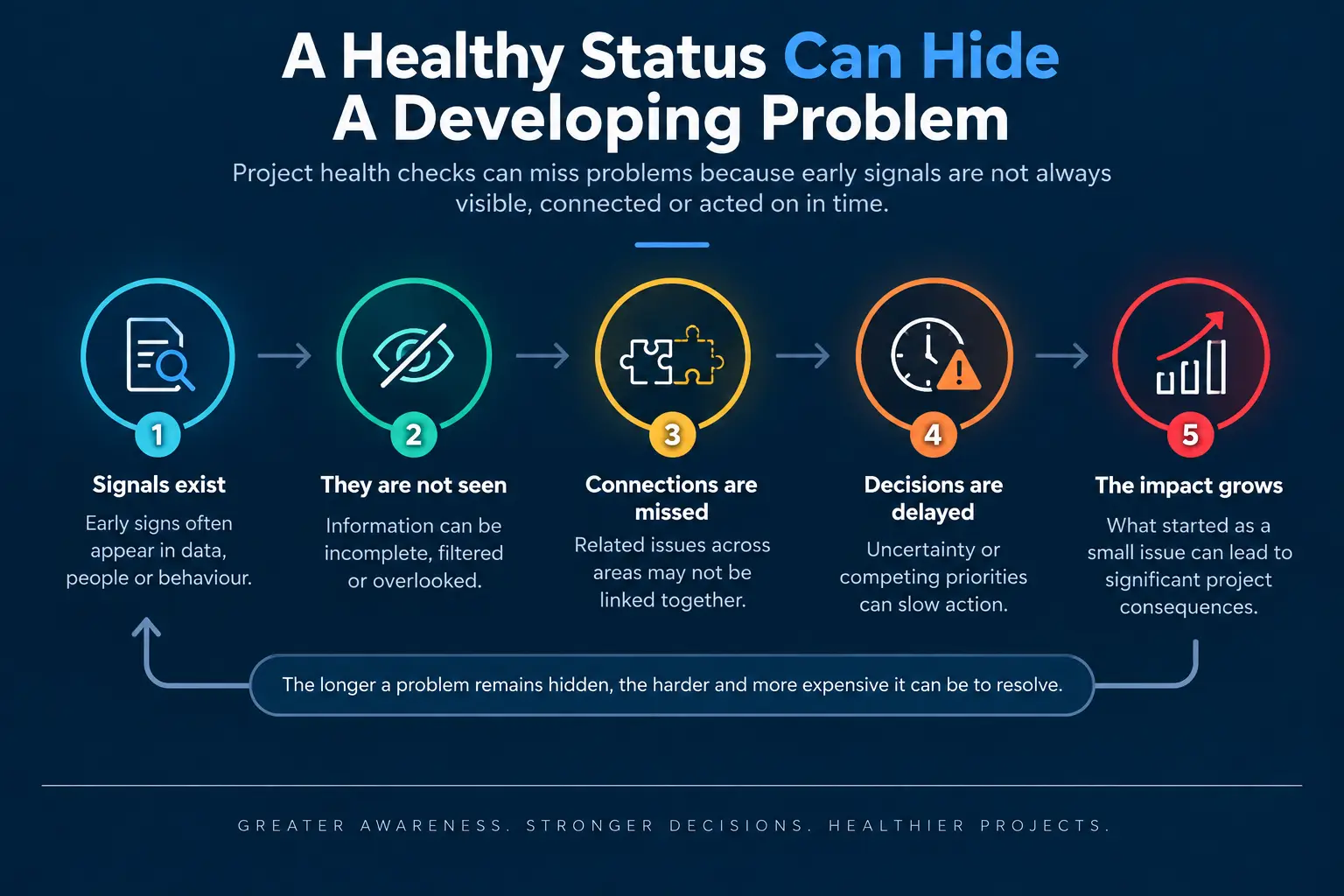
Why Do Professionals Miss the Problem?
Professionals Trust the Reported Status Too Quickly
Project professionals need reliable status information to make decisions. The difficulty begins when reported status is treated as a complete representation of project reality.
Reports are constructed from available evidence, assumptions, judgements, and reporting conventions. A credible status report can therefore still provide only a partial view of the conditions affecting the project.
When the reported position is accepted without sufficient challenge, emerging conditions may remain outside management attention.
RAG Ratings Become the Conversation
RAG ratings make complex information easier to communicate. They can also become the primary subject of the discussion.
Once attention centres on whether an area is green, amber, or red, the reasoning behind that rating may receive less scrutiny. A stable rating can then create an impression of stability even when the underlying evidence is changing.
The colour should prompt professional judgement rather than replace it. Questions about trajectory, assumptions, evidence quality, and emerging conditions remain important regardless of the current rating.
Lagging Indicators Receive More Attention Than Leading Conditions
Completed milestones, actual costs, defects, and schedule variance are tangible and relatively easy to report. Conditions that may influence future performance are often less certain.
That difference can make lagging indicators more influential in health discussions. Yet, by the time deterioration becomes measurable in outcomes, the conditions that created it may have existed for some time.
Professionals should therefore examine both what has happened and what is changing beneath the reported results.
Teams Look for Isolated Problems Instead of Interactions
Project reporting structures encourage issues to be assigned to categories such as schedule, cost, risk, quality, resources, or stakeholders. This makes information manageable, but it can obscure relationships between conditions.
A resource constraint may increase schedule pressure. Schedule pressure may accelerate decisions. Accelerated decisions may increase rework. Each issue can appear manageable when reviewed independently.
The combined effect may be considerably more important than any individual indicator. This is a key reason project health checks miss problems that are created through interaction.
Weak Signals Are Dismissed as Noise
Early signals rarely arrive with a clear label stating that something is wrong. They may appear as small changes, unusual behaviour, repeated exceptions, or isolated concerns.
Some signals will prove insignificant. Others may become meaningful when combined with additional evidence. The difficulty is deciding which is which.
When teams are under delivery pressure, ambiguous signals can be easier to dismiss than investigate. The absence of certainty can therefore become a reason not to explore a concern.
People Closest to the Problem Are Not Always Heard
Those working closest to delivery often encounter problems before they appear in formal reporting. Their knowledge may include practical observations about suppliers, interfaces, workload, technical uncertainty, stakeholder behaviour, or emerging constraints.
Formal reporting systems do not always capture this contextual knowledge. People may also hesitate to raise concerns when doing so creates interpersonal, political, or perceived career risk.
Human evidence is therefore an important complement to formal project data. A health assessment that overlooks it may lose information that cannot be recovered from dashboards alone.
Repeated Exceptions Stop Feeling Exceptional
Repeated deviations can gradually become accepted as normal project behaviour. A missed commitment becomes expected, a temporary workaround becomes permanent, or an unresolved issue becomes part of the operating environment.
Once this happens, the same condition may attract less attention than it originally did. Familiarity can reduce the perceived urgency of a problem without reducing its actual effect.
Professionals should therefore distinguish between a condition becoming familiar and a condition becoming healthy.
Reviewers Become Familiar With the Project’s Narrative
Repeated reviews create valuable project knowledge, but familiarity can introduce another risk. Reviewers may gradually become accustomed to the explanations, assumptions, and narratives used to describe recurring issues.
A familiar explanation can begin to feel sufficiently convincing simply because it has been repeated. Effective challenge requires the willingness to reconsider established interpretations when new evidence appears.
Review Activity Becomes the Evidence of Assurance
A completed review, documented finding, or management response can create a sense that assurance has been performed successfully. Yet activity is not the same as insight.
The more important question is whether the assessment changed understanding or exposed something that would otherwise have remained hidden. Assurance should be judged partly by what it reveals, not simply by whether the review occurred.
Completed Actions Are Mistaken for Resolved Problems
Once an action is assigned, tracked, and marked complete, the related finding can disappear from active attention. That administrative closure does not necessarily demonstrate that the underlying condition has improved.
A corrective action may address a symptom, reduce an immediate exposure, or satisfy a recommendation without removing the cause. Completion is evidence that an action occurred; it is not automatically evidence that the project became healthier.
The deeper issue is that professionals can become confident in the assessment process itself while overlooking the limitations of the evidence, interpretation, and response. This is how project health checks miss problems without the health-check process necessarily being poorly designed.
What Happens If It Continues?
Problems Become Visible Only After Performance Deteriorates
When emerging conditions remain outside management attention, they eventually become more visible through measurable performance problems. Schedule variance, cost pressure, quality failures, missed milestones, or stakeholder escalation may provide clearer evidence.
By that stage, however, the project may have been responding to the underlying condition for some time. Visibility can arrive after the opportunity for inexpensive intervention has already passed.
Recovery Options Become More Limited
Early intervention usually provides more choices. Teams may still have time to change sequencing, adjust resources, revisit assumptions, resolve dependencies, or engage stakeholders before commitments become difficult to alter.
As conditions deteriorate, those options can narrow. Time, contractual commitments, stakeholder expectations, and completed work can progressively constrain the available response.
A project may therefore reach a point where management is choosing between increasingly unattractive alternatives rather than selecting from a broad range of recovery options.
Problems Begin to Interact
Unrecognized conditions rarely remain isolated. A resource constraint can increase schedule pressure, while schedule pressure can accelerate decisions and increase rework. Additional rework may then consume capacity that was already limited.
These feedback effects can make the project increasingly difficult to diagnose. Several manageable issues can combine into a condition that is much harder to control than any individual issue suggested.
Corrective Action Becomes More Expensive
The later a problem becomes visible, the greater the amount of work that may already depend on the affected condition. Corrective action can then involve redesign, rework, replanning, additional resources, commercial negotiation, or changes to commitments.
The cost of correction is influenced not only by the problem itself, but by how long the project has operated around it.
Management Decisions Become More Reactive
When emerging conditions are not recognized early, management attention tends to shift toward immediate consequences. Leaders may spend more time resolving escalations, protecting milestones, reallocating resources, and explaining deteriorating performance.
This reactive environment can reduce the capacity available for deeper diagnosis. Management becomes increasingly focused on restoring short-term control while the underlying system continues to generate pressure.
Stakeholder Confidence Can Decline
Stakeholders often respond not only to poor outcomes but also to inconsistencies between reported conditions and what they experience. Repeated surprises, changing explanations, missed commitments, or unresolved concerns can weaken confidence in project reporting.
Once confidence declines, communication can become more difficult. Stakeholders may seek additional information, escalate concerns more frequently, or become less willing to accept project assurances.
The Project Starts Managing Symptoms Instead of Causes
Visible consequences naturally attract attention. A delayed activity may receive additional resources, for example, while the decision backlog or dependency that contributed to the delay receives less scrutiny.
Repeated symptom management can keep the project moving temporarily without improving the underlying condition. The project may become better at absorbing problems rather than reducing the conditions that create them.
Assurance Activity Can Increase Without Increasing Insight
As concerns increase, organizations may respond with additional reviews, reporting requirements, meetings, or assurance activity. These actions can be appropriate, but more oversight does not automatically produce better understanding.
If each additional review relies on the same information, assumptions, and project narrative, the assessment may become more frequent without becoming more insightful. More assurance activity is valuable only when it improves visibility, interpretation, challenge, or response.
The Project Can Drift Into Normalized Underperformance
Persistent exceptions can eventually become accepted as normal operating conditions. Missed dates may be routinely reforecast, unresolved risks may remain open for long periods, and workarounds may become embedded in delivery practices.
This creates a dangerous shift in reference points. The project may judge its current condition against an already deteriorated baseline rather than against the conditions originally required for successful delivery.
The Cost of Being Wrong Increases
Every assessment contains uncertainty. The concern is not that professionals must eliminate uncertainty, but that they should understand the consequences of missing an important condition.
A false sense of health can delay intervention while the project continues to change. As time passes, the consequences of an incorrect assessment can become larger, more interconnected, and harder to reverse.
This is the deeper consequence when project health checks miss problems: the project does not simply remain unaware. It continues making decisions, allocating resources, accepting assumptions, and changing its options based on an incomplete understanding of its own condition.
What Should Project Professionals Reconsider?
Health Is More Than a Snapshot
A health check provides a useful point-in-time view of a project. The project itself does not stop changing when the assessment ends.
Risks evolve, resources change, decisions accumulate, and stakeholder expectations shift. A project can therefore appear healthy during an assessment while its underlying trajectory is becoming less favourable.
Current health and future direction are related, but they are not the same thing. Looking at trends and changing conditions can reveal information that a single assessment cannot.
What Does a Green Rating Really Mean?
A green rating can usefully indicate that current conditions remain within an accepted range. The difficulty arises when that colour is interpreted as evidence that no meaningful concern exists.
A stronger interpretation examines the assumptions behind the rating, the evidence supporting it, and the conditions that could cause it to change. Green should provide confidence appropriate to the evidence, rather than confidence beyond it.
The rating remains useful as a summary. It simply should not become a substitute for professional judgement.
Leading Conditions Can Reveal What Results Cannot
Lagging indicators show what has already happened. Actual costs, completed milestones, defects, and schedule variance are important evidence, but they describe outcomes after conditions have developed.
Leading conditions offer another perspective by highlighting changes that may influence future performance. These might include growing decision backlogs, increasing dependencies, recurring exceptions, declining capacity, or changes in stakeholder behaviour.
Leading information does not predict failure automatically. Its value is that it can prompt investigation before deterioration becomes obvious in lagging measures.
Conflicting Evidence Can Be a Valuable Signal
Different sources will sometimes tell different stories. A dashboard may show stable performance while delivery teams report increasing pressure. A formal risk rating may remain unchanged while interviews reveal growing concern.
Such inconsistencies should not automatically be dismissed as poor data quality. Conflicting evidence can indicate that different parts of the project are experiencing the same condition differently.
It may also reveal reporting delays, information asymmetry, hidden dependencies, or concerns that have not yet reached formal thresholds. This is one reason project health checks miss problems even when the available information appears consistent. The disagreement itself can warrant investigation.
Every Assessment Has Blind Spots
No assessment can observe everything. Some information is unavailable, some conditions are difficult to quantify, and some evidence exists outside formal reporting structures.
Professionals should consider what the assessment cannot currently see. Informal stakeholder concerns, emerging technical uncertainty, fragile dependencies, team capacity, and changes in behaviour may not appear clearly in standard reporting.
Knowing where visibility is weak can be more useful than assuming that available information is complete. Without that awareness, project health checks miss problems because the assessment may be measuring the most visible conditions rather than the most consequential ones.
Professional Judgement Still Matters
Metrics provide structure and comparability, but project health cannot always be reduced to measurable variables. Experienced professionals may notice changes in behaviour, relationships, workarounds, or decision patterns before those conditions appear in formal performance data.
Judgement should not override evidence without reason. Its value lies in identifying where evidence requires deeper examination.
Good professional judgement does not compete with data; it helps determine what the data may not yet explain.
The Project Narrative Needs Constructive Challenge
Projects develop narratives about their progress: what is working, what is difficult, why problems occurred, and what is expected to happen next. These explanations help coordinate action, but they can also become resistant to challenge.
A familiar explanation may feel convincing simply because it has been repeated across several reporting cycles. Constructive challenge becomes important when established explanations no longer fully account for emerging evidence.
The objective is not to create unnecessary doubt. It is to ensure that confidence remains connected to current evidence rather than historical assumptions.
Recurring Problems Deserve Attention
A single exception may have a reasonable explanation. Repeated exceptions tell a different story.
Missed commitments, recurring workarounds, repeatedly reopened issues, or persistent dependencies may indicate that the project has adapted to an underlying condition without resolving it.
Familiarity should not be confused with resolution. A condition can become normal to the project while remaining harmful to its performance.
A Finding Is Not the Same as Improvement
Identifying a problem creates visibility, but visibility alone does not change the underlying condition. An action can be assigned, tracked, and marked complete without producing the intended improvement.
The response may address a symptom, reduce an immediate exposure, or satisfy a recommendation while leaving the original cause largely intact.
Action completion demonstrates that something was done; it does not automatically demonstrate that project health improved. The more meaningful test is whether exposure, behaviour, performance, understanding, or decision quality changed.
Complexity Changes What Health Assessment Needs to See
An assessment approach that works well in a relatively stable project may provide less visibility when dependencies, stakeholders, technologies, interfaces, or external conditions become more complex.
Greater complexity does not make formal assessment less valuable. It changes the type of insight required. As interdependencies increase, connecting signals, challenging assumptions, and understanding interactions become increasingly important.
The deeper question is therefore not simply whether the assessment examined the project thoroughly. It is whether the assessment made important conditions visible, challenged the project’s assumptions, and contributed to meaningful change.
A Practical Professional Lens
A useful health assessment is not only about collecting more information. It is about understanding whether the available evidence provides a sufficiently reliable view of the project’s current condition, direction, and ability to respond.
The following lens can help professionals examine the quality of that visibility without creating another health-check framework. It is intended to complement an existing assessment by asking what the assessment can actually tell us.
Visibility
Start with the basic question: what can the assessment actually see?
Consider whether important evidence exists outside formal reports, dashboards, risk registers, or review documentation. Project health checks miss problems when the assessment has limited visibility into conditions that are difficult to measure, informally communicated, or distributed across different parts of the project.
The objective is not complete visibility, which is rarely possible. It is to understand where meaningful blind spots may exist.
Trajectory
Next, consider where the project is heading, rather than only where it stands today.
A stable metric can conceal a deteriorating trend. Conversely, a temporary negative result may not indicate a fundamental decline. Looking across changes, patterns, and emerging conditions can provide a more useful understanding of direction than a single status point.
Signal Quality
Not every unusual observation represents a problem, but neither should unusual information be dismissed automatically.
Professionals should consider the strength, reliability, consistency, and context of signals. A recurring exception may deserve more attention than an isolated event. Conflicting information may also indicate that further investigation is needed rather than simply reflecting poor reporting.
System Interaction
Project conditions rarely operate independently. Schedule pressure can affect resources, resource constraints can influence quality, and stakeholder disagreement can slow decisions.
The practical question is therefore what is connected to what? Examining interactions can reveal conditions that remain invisible when every issue is assessed within a separate category.
Human Evidence
Formal data is essential, but people working within the project often possess contextual information that is difficult to capture quantitatively.
Changes in behaviour, confidence, cooperation, workload, stakeholder relationships, or willingness to raise concerns may provide important evidence about emerging conditions. Human judgement should complement formal measures rather than be treated as an alternative to evidence.
The quality of that evidence also depends on whether people feel able to communicate concerns honestly and whether those concerns receive constructive attention.
Response
The final question is perhaps the most important: what actually changed because the assessment took place?
A finding may create awareness without changing behaviour. An action may be completed without resolving the underlying condition. Additional reporting may increase visibility without improving the project’s ability to respond.
Professionals should therefore look beyond the existence of findings and actions. The stronger test is whether the assessment influenced decisions, reduced exposure, changed behaviour, improved performance, or altered the project’s understanding of its own condition.
Taken together, these six perspectives create a simple chain of professional enquiry:
- Visibility — What can we see?
- Trajectory — Where is it heading?
- Signal Quality — What deserves investigation?
- System Interaction — What is connected?
- Human Evidence — What are people seeing?
- Response — What actually changed?
The value of this lens is not that it replaces a health check. It helps professionals question the quality of the picture produced by the health check and recognize where confidence may exceed what the evidence can support.
Key Takeaways
Project health checks miss problems for reasons that extend beyond the quality of the checklist or assessment process. The deeper issue is whether the project makes important conditions visible, interprets them correctly, and responds before they become harder to change.
- A health rating is a snapshot, not a complete representation of project health. Professionals should consider both the current condition and the direction of travel.
- Green, amber, and red ratings are useful summaries, but they require interpretation. The evidence and assumptions behind a rating matter as much as the rating itself.
- Leading signals can reveal changing conditions before lagging measures confirm deterioration. However, early signals require context and should support investigation rather than automatic conclusions.
- Important evidence can exist outside formal reporting. Human observations, conflicting perspectives, recurring workarounds, and informal concerns can expose conditions that structured data does not capture.
- Problems can become significant through interaction. Several individually manageable conditions can combine into a system-level problem as dependencies and feedback effects develop.
- Repeated exceptions deserve attention even when individual events appear manageable. Recurrence can indicate that the project is adapting around an unresolved systemic condition.
- A finding is not the same as a resolved problem. Assessment creates value when its findings change understanding, decisions, behaviour, controls, or actual project conditions.
- Assessment should evolve with project complexity. As relationships and dependencies increase, professionals may need greater attention to interactions, uncertainty, context, and system behaviour.
The most useful question is therefore not simply whether the project passed its health check. Instead, professionals should ask what the assessment was capable of seeing, what it may have missed, and what changed because the assessment took place.
A strong health assessment does more than confirm that current indicators remain acceptable. It helps professionals challenge assumptions, recognize meaningful change, investigate weak signals, and understand whether the project is becoming healthier or merely continuing to appear healthy.
References
- Jaafari, A. (2007). Project and program diagnostics: A systemic approach. International Journal of Project Management, 25(8), 781–790.
- Williams, T., Klakegg, O. J., Walker, D. H. T., Andersen, B., & Magnussen, O. M. (2012). Identifying and Acting on Early Warning Signs in Complex Projects. Project Management Journal, 43(2), 37–53.
- Haji-Kazemi, S., Andersen, B., & Krane, H. P. (2013). A Review on Possible Approaches for Detecting Early Warning Signs in Projects. Project Management Journal, 44(5), 55–69.
- Zheng, L., Baron, C., Esteban, P., Xue, R., Zhang, Q., & Yang, S. (2019). Using Leading Indicators to Improve Project Performance Measurement. Journal of Systems Science and Systems Engineering, 28(5), 529–554.
- He, Q., Tian, Z., & Wang, T. (2022). Performance measurement methods in megaprojects: An analytical review. International Journal of Project Management, 40(6), 634–645.
- Kaufmann, C., & Kock, A. (2023). The performance effects of optimistic and pessimistic project status reporting behavior. International Journal of Project Management, 41(7), 102514.
- Edmondson, A. (1999). Psychological Safety and Learning Behavior in Work Teams. Administrative Science Quarterly, 44(2), 350–383.
- Pinto, J. K. (2014). Project management, governance, and the normalization of deviance. International Journal of Project Management, 32(3), 376–387.
- Vo, H., Kirkham, R. J., & Williams, T. M. (2021). An empirical study of assurance in the UK government major projects portfolio: from data to recommendations, to action or inaction. International Journal of Managing Projects in Business, 14(4), 865–897.
- National Infrastructure and Service Transformation Authority. (2026). NISTA Major Projects Annual Report 2025–26. UK Government.
Related Kleios Resources
This insight examines why a project can appear healthy while important problems remain outside effective visibility. The following Kleios resources explore related project management practices in greater practical depth.
Project Health Check Guide
For a practical approach to planning and conducting a project health assessment, see How to Conduct a Project Health Check. The guide explains how to structure an assessment, examine different dimensions of project health, identify underlying causes, and translate findings into action.
Project Health Check Template
To support practical application, use the Project Health Check Template. It provides a structured working format for reviewing project conditions and documenting findings, observations, and actions.
Related Project Management Insight
The broader Project Management Insights collection examines deeper issues that influence project decisions, performance, behaviour, and outcomes beyond formal project management practices.
Use the guide and template to perform the assessment; use this insight to question what the assessment may not reveal.
FEATURED PROJECT MANAGEMENT INSIGHTS
Professional Perspectives on the Challenges Projects Face
Our featured Project Management Insights examine recurring challenges, decision gaps, hidden causes, and assumptions that influence project outcomes. Moreover, they encourage professionals to look beyond surface-level problems and consider what may be happening underneath.
Why Do Early Project Warning Signs Get Ignored?
Explore the signals and patterns that often appear before significant project problems emerge. Moreover, examine why teams sometimes overlook these indicators and what that reveals about project management practices.
Why Do Project Recovery Plans Fail?
Examine why well-structured recovery plans can struggle during execution. Ultimately, consider how ownership, leadership, resources, stakeholder alignment, and execution discipline influence recovery outcomes.
Why Do Clear Project Objectives Fail?
Explore why clearly stated objectives can still produce weak outcomes when teams interpret priorities, success criteria, or responsibilities differently. Therefore, examine the factors that can weaken alignment despite having documented objectives.
MORE PROJECT MANAGEMENT RESOURCESE TYPES
Continue Your Project Management Learning
Project management knowledge becomes more valuable when you can apply it, see it in practice, and continue developing your capabilities. Explore our other resources to complement the practical guidance provided in these guides.
Guides
Explore clear guidance to understand common challenges, evaluate situations, and apply effective approaches throughout project delivery.
Downloads
Access useful project management materials and reference resources to support your learning and day-to-day project work.
Career Roadmaps
Follow structured learning paths to develop project management knowledge, practical skills, and capabilities for your professional growth.
Templates
Use practical project management templates to structure planning, management, reporting, and other project activities.
Case Studies
Explore realistic project situations, decisions, challenges, and outcomes to understand how project management practices work in practice.
Glossary
Find clear explanations of project management terminology, concepts, abbreviations, and commonly used professional language.
Looking for more project management resources? Explore the Kleios Technologies Resources Hub to discover our complete collection of guides, templates, downloads, career roadmaps, case studies, glossary resources, and insights.
RELATED KNOWLEDGE DOMAINS
Continue Your Learning Across Related Knowledge Domains
Project management connects with specialized disciplines, tools, and professional practices that support successful project delivery. Explore related knowledge domains to expand your expertise, develop complementary skills, and discover deeper resources beyond the Project Management Guides.
Expand your expertise one domain at a time and build a well-rounded project management skill set.
Why Explore Related Domains?
- Develop cross-functional project management expertise
- Discover specialized knowledge beyond core project management
- Access practical resources across interconnected disciplines
- Build a well-rounded professional learning pathway
- Strengthen your ability to address real-world project challenges
Each knowledge domain complements the practical guidance in our Project Management Guides, helping you build broader capabilities and address real-world project challenges with greater confidence.
Project Planning & Scheduling
Planning techniques, scheduling methods, and timeline management resources.
Project Controls
Performance measurement, forecasting, and project control best practices.
PMO
Governance, portfolio management, and organizational project excellence.
Risk Management
Risk identification, assessment, mitigation, and monitoring resources.
Primavera P6
Professional planning, scheduling, resource management, and reporting.
Microsoft Project
Project scheduling, tracking, reporting, and collaboration resources.
Power BI
Interactive dashboards, reporting, visualization, and project analytics.
PMI Certifications
Certification guidance, exam preparation, and professional development resources.