
PROJECT MANAGEMENT INSIGHT
Why Do Project Recovery Plans Fail?
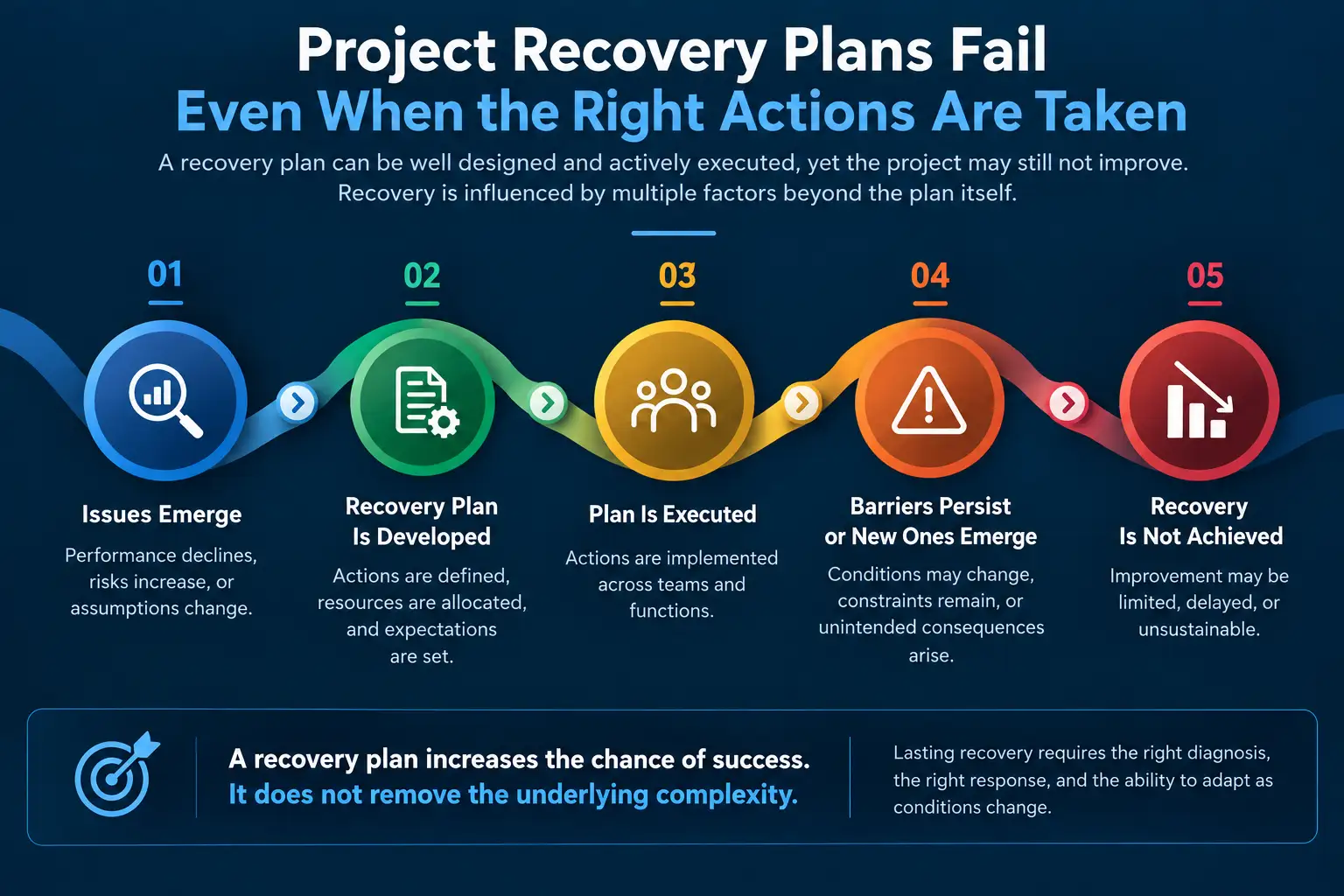
Project Recovery Plans Fail when recovery actions do not address the conditions keeping the project from recovering. However, a plan may define clear actions and targets while underlying assumptions, constraints, dependencies, or business needs have changed. As a result, the project can appear to be recovering without becoming more viable. This insight examines why recovery efforts can fail to change project trajectories and what professionals should reconsider when recovery is not producing the expected results.
Professional Insight · Project Management
Introduction
A troubled project often triggers a recovery plan. The response usually includes diagnosis, corrective actions, new targets, stronger governance, and closer monitoring.
However, these actions do not guarantee recovery. Project Recovery Plans Fail when they focus on visible performance problems without changing the conditions producing them. Those conditions may include unstable assumptions, limited capacity, unresolved dependencies, weak decision-making, stakeholder pressures, or changing business needs.
Moreover, the project itself changes while recovery takes place. Previous decisions create commitments, recovery actions consume resources, and new information can challenge the original recovery strategy. Therefore, a plan that looked appropriate at the beginning may become less effective as circumstances evolve.
Recovery also involves more than restoring schedule, cost, or scope performance. A project can improve its metrics while losing expected benefits, stakeholder confidence, quality, or strategic relevance.
This insight examines why recovery plans can fail despite disciplined execution. It also explores how professionals can distinguish recovery activity from recovery effect, test whether the project remains viable, and adapt the recovery approach as evidence changes.
The Common Assumption
A Good Recovery Plan Should Be Enough
A well-designed recovery plan creates structure when a project faces serious difficulty. It can clarify causes, priorities, actions, responsibilities, targets, and governance.
However, structure does not prove that the intervention will work. Project Recovery Plans Fail when professionals treat plan completeness as evidence of recovery.
Recovery Means Returning to the Original Plan
The original baseline provides an important reference. Yet, a troubled project has already accumulated new information, commitments, costs, dependencies, and stakeholder expectations.
Therefore, returning to the original baseline may not represent the best future state. Recovery should consider whether the original destination still creates sufficient value.
More Management Attention Will Fix the Project
Troubled projects often receive additional reviews, reporting, governance, and senior attention. These measures can improve visibility and support decisions.
However, visibility does not automatically remove technical constraints, capability gaps, supplier problems, or conflicting objectives. Governance intensity and governance effectiveness are therefore different.
Accelerating the Work Will Recover the Project
Schedule pressure often encourages teams to add resources or compress activities. These actions can help when capacity represents the main constraint.
However, acceleration cannot resolve every cause of poor performance. Project Recovery Plans Fail when acceleration replaces proper understanding of the conditions producing the problem.
Completed Actions Mean the Project Has Recovered
Completing recovery actions shows that planned activity occurred. Nevertheless, it does not prove that the underlying condition improved.
A revised schedule may be approved without improving delivery confidence. Likewise, a governance change may occur without improving decision quality. Recovery should therefore focus on effects, not activity alone.
The Original Business Case Still Justifies Recovery
A project can become harder to deliver while its expected benefits become less attractive. Costs may increase, priorities may change, or better alternatives may emerge.
Therefore, recovery should periodically test whether the future investment case remains credible, rather than assuming the original justification still applies.
The Existing Project Structure Can Deliver Recovery
Recovery often operates through the same governance structures, incentives, decision rights, and information flows that existed before the project became troubled.
Consequently, the recovery effort can strengthen management discipline without changing the conditions that created the difficulty. A project can become better controlled without becoming more recoverable.
What Is Really Happening?
The Project Being Recovered Is Not the Same Project That Was Originally Planned
A troubled project carries history. It has accumulated decisions, commitments, expenditures, technical choices, stakeholder expectations, and adaptations.
Therefore, recovery starts from a changed system, not from the original baseline. The recovery strategy must account for what the project has become.
Recovery Plans Can Target Symptoms Instead of Conditions
A visible schedule delay may attract immediate attention. However, the delay may result from unstable requirements, unresolved decisions, rework, supplier constraints, or limited capability.
If recovery targets the visible symptom, teams may improve the metric without removing the underlying constraint. Project Recovery Plans Fail when the intervention changes what the project reports but not what the project experiences.
The Recovery Plan Can Become a Second Layer of Work
Troubled projects already operate under pressure. Recovery then introduces additional reviews, reporting, analysis, meetings, decisions, and actions.
These activities can consume the same limited people and management capacity needed for delivery. Consequently, recovery itself can become another constraint.
Recovery Changes the Trade-Offs
Recovery actions rarely improve every project dimension at the same time. Faster delivery may increase cost or technical risk. Scope reduction may protect schedule while reducing expected benefits.
Similarly, adding resources may increase coordination demands. Effective recovery therefore requires professionals to understand where each intervention moves pressure rather than assuming it removes pressure.
Recovery Depends on Conditions Outside the Plan
A recovery plan cannot independently control every factor affecting the project. Suppliers, regulators, sponsors, customers, shared resources, funding decisions, and related projects can influence its outcome.
Therefore, recovery effectiveness depends partly on conditions beyond the project team’s direct authority. Professionals need to distinguish controllable actions from critical external dependencies.
The Project Can Recover Its Metrics While Losing Its Value
Schedule, cost, and scope provide important performance information. Nevertheless, they do not represent the entire value proposition.
A project may restore delivery performance while weakening quality, adoption, strategic relevance, stakeholder confidence, or expected benefits. Consequently, metric recovery should not automatically be treated as value recovery.
Stakeholder Confidence Is Both an Input and an Outcome
Troubled projects can lose stakeholder confidence before recovery begins. That loss can make decisions harder and reduce cooperation across organizational boundaries.
At the same time, credible recovery can rebuild confidence. Thus, stakeholder confidence can influence recovery while recovery influences stakeholder confidence.
Old Commitments Can Constrain New Decisions
Previous investment and decisions can influence how leaders evaluate recovery options. Sunk costs, public commitments, contractual expectations, and reputational concerns can make change uncomfortable.
As a result, the recovery strategy can become another commitment that organizations defend, even when new evidence challenges its assumptions.
Recovery Can Stabilize the Wrong System
Stronger reporting, tighter schedules, and more frequent governance can improve control. However, these mechanisms may leave the project’s underlying structure unchanged.
A project can therefore become better controlled without becoming more recoverable. Project Recovery Plans Fail when management strengthens the response system while the problem system remains intact.
Recovery Has a Moving Target
Recovery generates new evidence. Some assumptions prove correct, others fail, and previously hidden constraints can emerge.
Therefore, recovery should operate as a learning cycle: diagnose, intervene, observe, learn, and adapt. The strongest recovery effort does not simply execute its original plan. It changes that plan when evidence shows that a different response will produce a better future.
Why Do Professionals Miss the Problem?
The Recovery Plan Creates a Sense of Control
A recovery plan creates structure when uncertainty is high. It gives leaders actions to track, owners to challenge, and milestones to review.
However, structure can create confidence before evidence confirms improvement. Project Recovery Plans Fail when professionals confuse the presence of a recovery system with evidence that recovery is working.
Visible Actions Are Easier to Manage Than Invisible Conditions
Actions are easy to record. Teams can report completed reviews, approved changes, new resources, revised schedules, and additional meetings.
By contrast, conditions such as decision friction, declining trust, capability gaps, or unstable assumptions require deeper judgement. Consequently, recovery reporting can become activity-focused rather than condition-focused.
Organizations Want Evidence That Recovery Is Working
Recovery creates pressure to demonstrate progress. Leaders, sponsors, customers, and teams often need confidence that intervention is producing results.
That pressure can influence how evidence gets interpreted. Therefore, professionals may give greater weight to improving indicators while overlooking evidence that challenges the recovery narrative.
Recovery Targets Can Become New Political Commitments
Once recovery targets become visible commitments, changing them can carry reputational or organizational consequences. Teams may therefore continue defending targets that no longer reflect current conditions.
As a result, the recovery plan can shift from a decision tool into something the organization feels compelled to protect.
The Team Becomes Invested in Its Own Recovery Strategy
Recovery requires effort, judgement, credibility, and organizational capital. Consequently, teams can become psychologically and professionally invested in the strategy they selected.
New evidence may then challenge more than the plan. It can challenge the decisions and judgement of the people responsible for it.
Existing Governance Structures May Reinforce the Original Problem
Recovery often uses existing reporting lines, decision rights, incentives, and information channels. However, those structures may have contributed to the original difficulty.
Therefore, increasing governance within the same structure may strengthen oversight without changing how critical decisions actually occur.
Bad News Becomes Harder to Reintroduce
Once stakeholders believe that recovery is underway, new negative evidence can become uncomfortable to present. People may fear reopening difficult discussions or undermining confidence.
This matters because Project Recovery Plans Fail when emerging evidence receives less attention simply because it conflicts with an established recovery narrative.
Short-Term Improvement Can Mask Long-Term Deterioration
Recovery actions can produce genuine short-term improvement. Yet, the underlying condition may remain unstable.
For example, intensive management attention may temporarily improve delivery while increasing dependence on exceptional effort. Therefore, professionals need to distinguish temporary performance improvement from sustainable recovery.
Professionals Can Confuse Persistence With Resilience
A project that continues despite disruption can appear resilient. However, persistence alone does not demonstrate the ability to anticipate, cope, adapt, and improve.
Research on project resilience highlights adaptation as an important capability. Consequently, continuing the same recovery approach despite changing evidence may indicate persistence rather than resilience.
The Project Becomes Better at Managing Recovery Than Questioning It
Over time, recovery governance can become highly disciplined. Reports become regular, actions receive owners, and progress receives formal review.
Yet, disciplined recovery management can still protect an ineffective strategy. The deeper professional challenge is therefore to keep asking whether the recovery approach remains valid, rather than simply whether it remains active.
What Happens If It Continues?
Recovery Effort Becomes More Expensive
When recovery actions produce limited effect, the project often requires additional intervention. More management attention, resources, analysis, and corrective work can follow.
However, these additional efforts consume resources that the project already needs. Project Recovery Plans Fail when continued effort substitutes for questioning whether the recovery strategy still makes sense.
The Project Consumes More Resources Without Becoming More Viable
A recovery effort can increase staffing, management attention, funding, and specialist support. Yet, greater resource consumption does not necessarily improve the project’s future prospects.
Therefore, professionals should distinguish between additional effort and increased viability. A project can work harder while remaining constrained by the same underlying conditions.
Recovery Commitments Begin Compounding Existing Commitments
The original project already contains commitments involving investment, scope, contracts, stakeholders, technology, and strategic expectations. Recovery introduces another layer of commitments.
As a result, changing direction can become progressively harder. The organization must reconsider not only the project but also the recovery decisions already made.
Trade-Offs Become Harder to Reverse
Recovery decisions can protect one objective while weakening another. Scope reductions may affect benefits, acceleration may increase risk, and cost containment may reduce capability.
Initially, these trade-offs may remain manageable. However, repeated decisions can narrow future options and make reversal increasingly expensive.
Quality and Benefits Can Be Sacrificed to Protect Delivery Metrics
Schedule and cost targets provide visible evidence of progress. Consequently, recovery teams may prioritize these measures when pressure increases.
Yet, protecting delivery metrics can reduce quality, adoption, functionality, or expected benefits. Project Recovery Plans Fail when metric improvement becomes the definition of recovery itself.
Stakeholder Trust Can Decline Further
Repeated recovery promises create expectations. If those promises produce limited improvement, stakeholders may become less confident in forecasts, commitments, and management decisions.
Furthermore, declining confidence can reduce cooperation and increase scrutiny. The recovery effort then faces both the original project problem and a weakened relationship environment.
The Recovery Team Can Become Locked Into Its Own Assumptions
A recovery strategy reflects beliefs about causes, constraints, priorities, and expected responses. Over time, teams can become committed to those beliefs.
Therefore, contradictory evidence may receive less attention. Project Recovery Plans Fail when teams defend the recovery hypothesis instead of testing whether it remains valid.
Escalation of Commitment Becomes Harder to Break
Additional investment can make withdrawal increasingly uncomfortable. Leaders may feel pressure to justify previous decisions and protect earlier commitments.
However, past investment does not determine future value. A rational recovery decision should focus on future costs, risks, alternatives, and benefits rather than investment already lost.
The Organization Learns to Manage Symptoms Instead of Conditions
Repeated corrective actions can create a cycle of response. Teams become skilled at resolving immediate issues without changing the conditions that repeatedly produce them.
Consequently, recovery can become continuous firefighting. The project appears active and controlled, yet its underlying problems remain persistent.
Termination Becomes More Difficult Even When Recovery Is No Longer Rational
The longer recovery continues, the harder termination can become. Emotional investment, sunk costs, stakeholder expectations, and reputational concerns can all influence the decision.
Nevertheless, continuing a project is not the same as preserving its value. A responsible recovery process must remain open to redefining, redirecting, reducing, or stopping the project when evidence shows that the current trajectory no longer offers a credible future.
What Should Project Professionals Reconsider?
Define What “Recovery” Actually Means
Recovery should mean more than improving schedule, cost, or scope performance. Professionals should first define what the project needs to recover and what future state it should reach.
That future state may involve:
- restoring delivery feasibility;
- protecting expected benefits and strategic value;
- rebuilding stakeholder confidence; or
- creating a project that can remain viable under changing conditions.
Project Recovery Plans Fail when professionals define recovery too narrowly around visible performance measures.
Treat the Original Baseline as a Reference, Not a Destination
The baseline helps professionals understand how far the project has moved from its original expectations. However, it reflects decisions made under earlier conditions.
The project may now face different costs, risks, technologies, stakeholder expectations, or strategic priorities. Therefore, recovery should test whether the original destination still represents the best available outcome.
Test Whether the Recovery Strategy Still Holds
Every recovery strategy contains assumptions about causes, constraints, and interventions. Professionals should make those assumptions explicit and test them against emerging evidence.
A useful recovery hypothesis connects:
- Condition: what is preventing recovery;
- Intervention: what should change that condition; and
- Expected effect: what should improve if the intervention works.
If the expected effect does not appear, the strategy may need to change rather than simply receive more effort.
Separate Action Completion From Recovery Effect
Completing an action shows that someone performed the planned activity. It does not show that the targeted condition improved.
Consequently, professionals should ask what changed after significant interventions. Project Recovery Plans Fail when action completion becomes the main evidence of recovery.
Question Whether the Recovery Is Optimizing the Right Metric
Metrics help focus attention, but they can also become targets. A project may improve schedule performance while weakening quality, benefits, risk exposure, or stakeholder outcomes.
Therefore, professionals should examine relationships between performance measures rather than optimize one measure in isolation. Recovery should improve the project’s overall prospects, not simply produce better numbers.
Determine Whether More Resources Increase Recovery Capacity
Additional resources can remove genuine capacity constraints. However, they can also increase coordination, communication, onboarding, and management demands.
Before adding resources, professionals should identify the constraint those resources should remove. Otherwise, the project may gain activity without gaining meaningful recovery capacity.
Challenge Recovery When It Becomes Another Commitment
Recovery strategies require investment and create expectations. Over time, those commitments can make it harder to accept evidence that challenges the chosen approach.
A useful question is: If the organization were making this decision today, knowing what it knows now, would it choose the same recovery strategy?
This question separates future value from past investment. It can also expose escalation of commitment before it becomes harder to reverse.
Turn Recovery Experience Into Project Learning
Recovery generates evidence about assumptions, dependencies, capabilities, stakeholders, and constraints. That evidence should influence subsequent decisions.
If new evidence appears but the recovery strategy never changes, the project may be recording lessons without learning from them. Project Recovery Plans Fail when learning remains separate from adaptation.
Consider Whether the Project Needs a Different Trajectory
Recovery does not always mean restoring the existing trajectory. Sometimes the stronger response involves changing the direction itself.
- reduce or redefine scope;
- change sequencing or delivery strategy;
- redirect expected benefits;
- change governance or delivery arrangements; or
- stop the project when future value no longer justifies continued investment.
The important point is that recovery can involve choosing a better trajectory, not simply restoring the previous one.
Treat Recovery as an Adaptive Process
Recovery should not end when the recovery plan receives approval. Conditions continue to change, and interventions generate new evidence.
A stronger recovery cycle is:
Diagnose → Intervene → Observe → Learn → Adapt
The purpose is not to prove that the recovery plan was correct. Instead, the purpose is to improve the project’s future prospects as knowledge develops.
A Practical Professional Lens
A recovery plan needs more than actions, dates, and targets. Professionals also need a way to judge whether the project is becoming more viable as recovery progresses.
The following lens is not a scoring model or another recovery checklist. Instead, it provides a mental model for examining how recovery is working and whether the project should continue along its current trajectory.
Viability — Is the Project Still Worth Recovering?
Recovery should begin with the future, not only the problems already experienced. Ask whether the expected benefits, strategic value, cost, risk, and available alternatives still support continued investment.
Past expenditure matters for accountability, but it should not determine future investment. Project Recovery Plans Fail when past commitment becomes stronger than the current case for continuing.
Condition — What Is Actually Preventing Recovery?
A project can experience several interacting constraints. These may involve capability, technology, suppliers, decisions, stakeholders, governance, resources, dependencies, or organizational conditions.
Therefore, professionals should examine whether the recovery intervention addresses the condition itself or only its visible symptoms.
Hypothesis — What Do We Believe Will Change the Situation?
Every recovery strategy contains a causal belief. If a particular condition changes, the project expects a particular effect to follow.
Make that logic visible:
Condition → Intervention → Expected Effect
This creates a basis for testing the recovery strategy rather than simply reporting its activities.
Evidence — What Changed After the Intervention?
Recovery needs evidence at more than one level. Professionals should distinguish between what the team completed, what condition changed, and what outcome improved.
- Activity: Was the recovery action completed?
- Condition: Did the targeted constraint improve?
- Outcome: Did the project become more viable or valuable?
Project Recovery Plans Fail when activity evidence receives more attention than evidence of changed conditions and outcomes.
Adaptation — What Should Change Because of What We Learned?
Recovery generates new information. Some assumptions become stronger, while others become less credible.
Consequently, professionals should allow evidence to change assumptions, actions, priorities, and even the recovery strategy. A recovery process that cannot adapt can become another form of commitment.
Trajectory — Is the Project Becoming More Recoverable?
The final question concerns direction. A project may show isolated improvements without becoming structurally healthier.
Look for evidence that the project is developing:
- fewer structural constraints;
- stronger decision capacity;
- more stable assumptions;
- greater stakeholder confidence;
- lower dependency pressure; and
- greater ability to adapt when conditions change.
The underlying mental model is therefore:
VIABILITY → CONDITION → HYPOTHESIS → EVIDENCE → ADAPTATION → TRAJECTORY ↺
This creates three levels of recovery assessment: activity, effect, and adaptation. A project can perform strongly at the first level while remaining weak at the other two.
A strong recovery effort does more than bring performance back under control. It improves the project’s ability to reach a credible and valuable future state. The professional test is therefore not simply whether the recovery plan is being executed, but whether the evidence shows that the project is becoming more viable, more capable, and better able to adapt.
Key Takeaways
Project Recovery Plans Fail for reasons that extend beyond poorly defined actions or weak execution. Recovery operates within a changing system of assumptions, constraints, commitments, stakeholders, governance, and competing objectives.
- A recovery plan is a hypothesis, not a guarantee. Its effectiveness depends on whether the intervention actually changes the conditions affecting the project.
- Recovery does not always mean returning to the original baseline. The best future state may differ from what the project originally intended.
- Activity is not the same as effect. Completed recovery actions provide evidence of execution, but they do not prove that the project has improved.
- Metric improvement does not automatically mean value recovery. Schedule or cost performance can improve while benefits, quality, strategic value, or stakeholder confidence deteriorate.
- More resources and governance do not automatically create recovery. Professionals must identify the constraint they expect each intervention to remove.
- Recovery generates new evidence. That evidence should change assumptions, decisions, priorities, or the recovery strategy when necessary.
- Persistence should not be confused with resilience. Continuing despite difficulty matters, but genuine resilience also involves adaptation and improved future capability.
- Termination or redirection can be legitimate recovery decisions. Continuing a project is not always the best way to protect future value.
The deeper lesson is that Project Recovery Plans Fail when recovery becomes an exercise in defending the plan rather than improving the project’s future prospects.
When evaluating recovery, professionals should therefore ask three questions: Is the project still viable? Is the intervention changing the underlying conditions? Is the project becoming better able to reach a credible future state?
References
The following research and professional publications informed the analysis of project recovery, troubled projects, project success, resilience, governance, strategic value, and escalation of commitment.
- Aiyer, J., Rajkumar, T. M., & Havelka, D. (2005). A Staged Framework for the Recovery and Rehabilitation of Troubled IS Development Projects. Project Management Journal, 36(4), 32–43.
- Kerzner, H. (2014). Techniques for Recovering Failing Projects. In Project Recovery. Wiley.
- van den Berg, H. (2012). Project Recovery: Don’t Always Recover the Project—Rethink the Business Case. PMI Global Congress.
- Keil, M., & Robey, D. (1999). Turning Around Troubled Software Projects: An Exploratory Study of the Deescalation of Commitment to Failing Courses of Action. Journal of Management Information Systems, 15(4), 63–87.
- Pinto, J. K., & Mantel, S. J. (1990). The Causes of Project Failure. IEEE Transactions on Engineering Management, 37(4), 269–276.
- Sauser, B. J., Reilly, R. R., & Shenhar, A. J. (2009). Why Projects Fail? How Contingency Theory Can Provide New Insights. International Journal of Project Management, 27(7), 665–679.
- Shenhar, A. J., Dvir, D., Levy, O., & Maltz, A. C. (2001). Project Success: A Multidimensional Strategic Concept. Long Range Planning, 34(6), 699–725.
- Serra, C. E. M., & Kunc, M. (2015). Benefits Realisation Management and Its Influence on Project Success and on the Execution of Business Strategies. International Journal of Project Management, 33(1), 53–66.
- Zhang, S., Zhang, F., Xue, B., Wang, D., & Liu, B. (2023). Unpacking Resilience of Project Organizations: A Capability-Based Conceptualization and Measurement of Project Resilience. International Journal of Project Management, 41(8), 102541.
- Piperca, S., & Floricel, S. (2023). Understanding Project Resilience: Designed, Cultivated or Emergent?. International Journal of Project Management, 41(3), 102453.
Together, these sources support the Insight’s central argument that effective recovery requires more than executing corrective actions. It requires continued assessment of viability, assumptions, value, evidence, resilience, and the project’s ability to adapt.
Related Kleios Resources
This Insight examines why recovery efforts can fail even when projects have structured recovery plans, governance, and corrective actions in place. The following Kleios resources provide practical methods and tools for assessing project deterioration and structuring recovery.
- How to Take Control of a Project That Is Falling Behind A practical guide to understanding why a project is falling behind, identifying the conditions driving deterioration, prioritising responses, aligning stakeholders, and restoring project control.
- Project Recovery Plan Template A structured tool for assessing project recovery needs, documenting root causes and findings, defining recovery strategies and actions, setting targets, monitoring progress, and evaluating recovery outcomes.
- Project Management Insights Explore the wider collection of Kleios Insights examining the deeper assumptions, behaviours, decisions, and systems that influence project performance.
Together, these resources connect the Insight’s analytical perspective with practical project management activities. The Insight asks why recovery efforts can fail; the related guide and template help professionals assess the situation, structure recovery, and manage the response in practice.
FEATURED PROJECT MANAGEMENT INSIGHTS
Professional Perspectives on the Challenges Projects Face
Our featured Project Management Insights examine recurring challenges, decision gaps, hidden causes, and assumptions that influence project outcomes. Moreover, they encourage professionals to look beyond surface-level problems and consider what may be happening underneath.
Why Do Clear Project Objectives Fail?
Explore why clearly stated objectives can still produce weak outcomes when teams interpret priorities, success criteria, or responsibilities differently. Therefore, examine the factors that can weaken alignment despite having documented objectives.
Why Do Stakeholder Management Problems Affect Projects?
Examine how conflicting expectations, communication gaps, and unresolved stakeholder concerns can affect project performance. Furthermore, understand why relationship issues can eventually influence decisions, delivery, and project outcomes.
Why Does Project Decision Making Get Delayed?
Explore why teams delay important project decisions despite having available information. As a result, examine how accountability, competing priorities, escalation, and organizational factors can create decision bottlenecks.
MORE PROJECT MANAGEMENT RESOURCESE TYPES
Continue Your Project Management Learning
Project management knowledge becomes more valuable when you can apply it, see it in practice, and continue developing your capabilities. Explore our other resources to complement the practical guidance provided in these guides.
Guides
Explore clear guidance to understand common challenges, evaluate situations, and apply effective approaches throughout project delivery.
Downloads
Access useful project management materials and reference resources to support your learning and day-to-day project work.
Career Roadmaps
Follow structured learning paths to develop project management knowledge, practical skills, and capabilities for your professional growth.
Templates
Use practical project management templates to structure planning, management, reporting, and other project activities.
Case Studies
Explore realistic project situations, decisions, challenges, and outcomes to understand how project management practices work in practice.
Glossary
Find clear explanations of project management terminology, concepts, abbreviations, and commonly used professional language.
Looking for more project management resources? Explore the Kleios Technologies Resources Hub to discover our complete collection of guides, templates, downloads, career roadmaps, case studies, glossary resources, and insights.
RELATED KNOWLEDGE DOMAINS
Continue Your Learning Across Related Knowledge Domains
Project management connects with specialized disciplines, tools, and professional practices that support successful project delivery. Explore related knowledge domains to expand your expertise, develop complementary skills, and discover deeper resources beyond the Project Management Guides.
Expand your expertise one domain at a time and build a well-rounded project management skill set.
Why Explore Related Domains?
- Develop cross-functional project management expertise
- Discover specialized knowledge beyond core project management
- Access practical resources across interconnected disciplines
- Build a well-rounded professional learning pathway
- Strengthen your ability to address real-world project challenges
Each knowledge domain complements the practical guidance in our Project Management Guides, helping you build broader capabilities and address real-world project challenges with greater confidence.
Project Planning & Scheduling
Planning techniques, scheduling methods, and timeline management resources.
Project Controls
Performance measurement, forecasting, and project control best practices.
PMO
Governance, portfolio management, and organizational project excellence.
Risk Management
Risk identification, assessment, mitigation, and monitoring resources.
Primavera P6
Professional planning, scheduling, resource management, and reporting.
Microsoft Project
Project scheduling, tracking, reporting, and collaboration resources.
Power BI
Interactive dashboards, reporting, visualization, and project analytics.
PMI Certifications
Certification guidance, exam preparation, and professional development resources.