
PROJECT MANAGEMENT INSIGHT
Why Do Clear Project Objectives Fail?
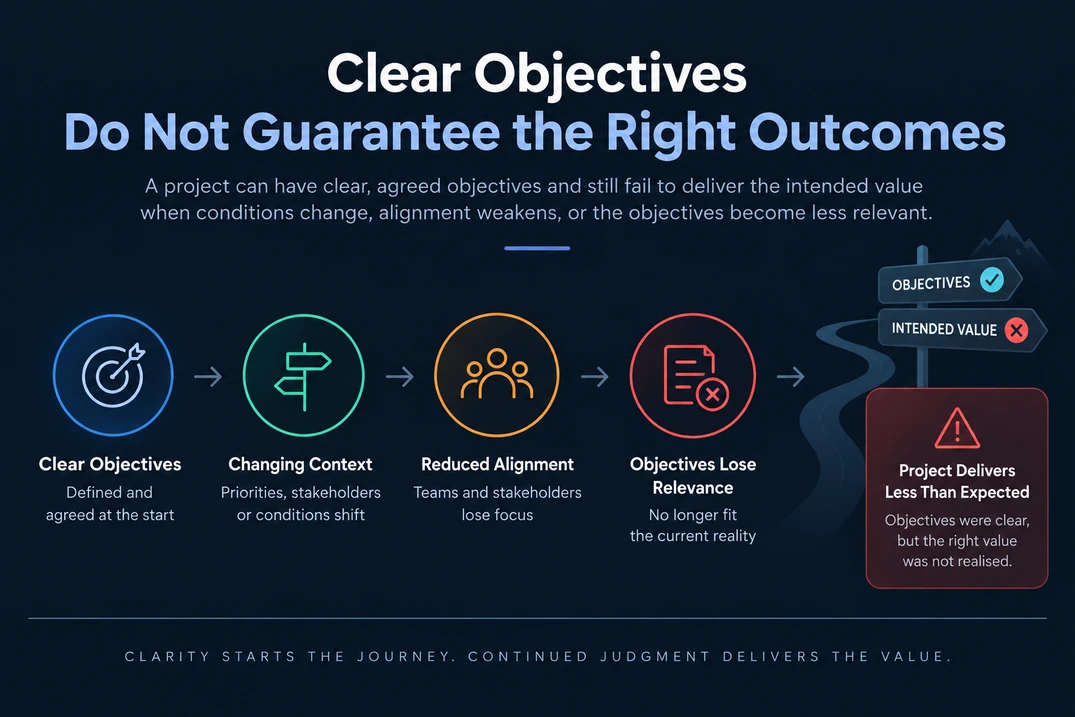
Clear project objectives can improve direction, focus, and accountability. However, clarity alone does not guarantee alignment, meaningful outcomes, or project value. This insight examines why clear project objectives fail, what hidden factors weaken their effectiveness, and what project professionals should reconsider when an objective appears clear but the project still moves away from its intended outcome.
Professional Insight · Project Management
Introduction
Clear project objectives should give a project direction, focus, and a basis for measuring progress. Yet, clear project objectives fail more often than their wording suggests. A project can have specific targets, agreed success criteria, and regular performance reviews while still moving away from the outcome the organization actually needs.
The problem often lies deeper than objective clarity. An objective can remain clear while its strategic relevance weakens, stakeholders interpret success differently, or expected benefits fail to materialize. Similarly, changing assumptions can make a once-valid objective less useful without making the objective itself any less precise.
Moreover, project teams naturally pay close attention to what they can measure. As a result, milestones, deliverables, schedule performance, and other visible indicators can receive more attention than the outcomes and benefits those measures are meant to support.
This creates an important distinction: clarity reduces ambiguity, but it does not guarantee that a project is pursuing the right result.
This insight examines why objectives can still fail, why professionals may overlook the warning signs, and what happens when an objective remains unquestioned. It also considers how project professionals can look beyond objective wording and examine relevance, alignment, assumptions, measurement, and intended value.
The Common Assumption
Why the Assumption Seems Reasonable
Project professionals often treat clear objectives as a fundamental condition for successful delivery. When people understand what a project must achieve, they can make better decisions about scope, priorities, resources, and performance.
Specific objectives also give teams a reference point for communication, coordination, accountability, and performance assessment. Research on goal setting supports the value of specific and challenging goals when people understand them and have the capability and commitment to pursue them. Project research also links clearer project definition with stronger performance through communication and project design.
Therefore, asking whether an objective is clear is essential. The problem begins when professionals treat clarity as evidence that the project is pursuing the right result.
Where the Assumption Falls Short
Clarity describes how well an objective is understood. It does not establish whether the objective remains strategically relevant, reflects a shared understanding of success, or will create the intended benefit.
A project can therefore deliver a defined system on time and within budget while users fail to adopt it, operational problems remain, or the underlying business need changes. Likewise, stakeholders can agree on the objective’s wording while expecting different outcomes or prioritizing different trade-offs.
Changing conditions create another risk. Customer needs, technology, regulations, market conditions, organizational priorities, or project assumptions can change without making the original objective any less precise. Measurement can compound the problem because strong performance against a defined target may create confidence while broader outcomes weaken.
Clarity reduces ambiguity. It does not guarantee strategic relevance, shared meaning, or project value.
This is the central limitation of the common assumption. A project needs clear objectives, but clear project objectives fail when professionals stop examining whether those objectives remain relevant, aligned, and connected to the value the organization expects.
The more important question, therefore, is what happens beneath the surface when a clear objective continues to guide a project away from its intended result.
What Is Really Happening?
A clear objective can create confidence because it gives people something concrete to pursue. However, a project can still lose connection with the problem, outcome, or value that justified the work. Several mechanisms explain why Clear Project Objectives Fail despite appearing well defined.
A Clear Objective Can Still Be the Wrong Objective
Clarity answers, What are we trying to achieve? It does not answer, Is this still the result we should pursue? Projects often translate broad business needs into specific delivery objectives. That translation creates focus, but it can also narrow attention. Teams may become effective at delivering the defined target while losing sight of the problem that created the need.
The Difference Between a Clear Target and the Right Target
- Clear: The team understands what it must achieve.
- Relevant: The objective addresses a problem that still matters.
- Valuable: Achievement contributes to the outcome the organization needs.
- Resilient: The objective remains appropriate as important conditions change.
A project can therefore deliver an output successfully without solving the underlying business or operational problem.
Agreement on the Objective Does Not Guarantee Shared Success
Stakeholders can agree on an objective while assigning different meanings to success. A sponsor may focus on business performance, the delivery team on scope, operations on reliability, and users on adoption or usability. These perspectives can coexist, but they may produce different expectations about priorities and trade-offs.
Where Stakeholder Interpretations Can Diverge
- Priority: Which result matters most when trade-offs arise?
- Success: What evidence would demonstrate success?
- Value: Who should benefit, and how?
- Trade-offs: Which constraints can change when priorities conflict?
Therefore, stakeholder approval provides evidence of agreement, but it does not necessarily prove alignment around the result that matters.
Objective Achievement Does Not Automatically Create Value
Project objectives often describe delivery, while organizational value emerges through what happens after delivery. A useful distinction is between outputs, outcomes, benefits, and strategic value.
From Delivery to Value
- Output: What the project delivers.
- Outcome: What changes because the output is used or adopted.
- Benefit: The measurable improvement created by that change.
- Strategic value: How those benefits support broader priorities.
A project can achieve its stated objective while producing a weaker outcome than expected. For example, a digital platform may be delivered exactly as approved, yet employees may continue using existing processes. The output exists, but the expected operational improvement does not materialize. This distinction is central to understanding why Clear Project Objectives Fail without necessarily producing obvious delivery problems.
Delivering the objective is not always the same as delivering the reason the project exists.
A Clear Objective Can Become Outdated Without Becoming Unclear
An objective can remain precise while the assumptions supporting it become less valid. Customer needs, technology, regulations, funding conditions, dependencies, and organizational priorities can change without changing the wording of the objective.
Conditions That Can Weaken an Objective’s Relevance
- Customer or user needs have changed.
- Strategic priorities have shifted.
- Technology or regulations have changed.
- Critical dependencies or operating conditions have changed.
- The original business-case assumptions no longer hold.
Teams may continue reviewing whether they are delivering the objective without asking whether the objective itself remains appropriate. This can produce strong delivery performance against a weakening business case.
Measurement Can Shift Attention From Purpose to Target
Measurement makes performance visible, but every measure captures only part of reality. Once a target becomes highly visible, teams may focus on achieving it even when broader outcomes receive less attention.
Questions Behind the Numbers
- What does the primary measure actually represent?
- What important result does it fail to capture?
- Could the target be achieved while weakening another outcome?
- Are people optimizing the measure or its underlying purpose?
This is related to Goodhart’s Law: when a measure becomes a target, its usefulness as a measure can weaken. Therefore, professionals should examine not only whether targets are being met, but what those targets represent and what they leave out.
Taken together, these mechanisms explain why clear project objectives fail without necessarily appearing defective. An objective may be precise, approved, measurable, and actively managed while its relevance, shared meaning, expected value, assumptions, or measurement system gradually weakens. This is why Clear Project Objectives Fail even when conventional project controls continue to show acceptable performance.
Why Do Professionals Miss the Problem?
The mechanisms behind objective failure can exist without creating an obvious project crisis. In fact, some can make a project appear more controlled. Professionals may therefore recognize delivery issues while missing the deeper question of why Clear Project Objectives Fail when the objective no longer serves the intended outcome.
Clarity Creates a Sense of Control
A documented and approved objective gives teams a stable direction. Once it becomes linked to plans, milestones, deliverables, and measures, it can feel settled. However, definition certainty is not the same as strategic certainty. Teams may know exactly what they must deliver while remaining uncertain about whether that delivery still addresses the most important organizational need.
What Creates the Illusion of Certainty?
- Formal approval of the objective.
- Documented success criteria.
- Measurable deliverables and targets.
- Regular reports showing progress.
These controls are useful, but they can make questioning the objective feel unnecessary once execution begins.
Delivery Evidence Is More Visible Than Value Evidence
Projects generate frequent evidence about activities, milestones, expenditure, schedule performance, defects, and actions. Outcomes and benefits often develop more slowly. User adoption, operational improvement, financial benefits, and strategic effects may depend on conditions beyond the project itself.
Signals That Can Receive Less Attention
- Declining user adoption or engagement.
- Operational resistance to the intended change.
- Benefits dependent on unresolved business changes.
- Changed stakeholder expectations or external conditions.
Consequently, delivery evidence can dominate governance simply because it arrives earlier and appears more precise. What is easiest to observe can receive more attention than what matters most.
Reopening an Approved Objective Can Feel Like Reversing a Decision
Approved objectives attract commitments. Funding, resources, contracts, schedules, and leadership expectations become connected to the planned result. As investment accumulates, reconsidering the objective can feel like admitting that earlier decisions were wrong.
This can contribute to escalation of commitment, where previous investment influences the willingness to continue despite new evidence. The pressure can become stronger near completion because changing direction appears to threaten work already completed.
Previous investment does not determine the value of future investment.
Disciplined reassessment does not necessarily represent failure. Sometimes, changing or stopping a project protects more value than continuing with an increasingly weak objective.
Different Functions See Different Parts of the Problem
Project problems rarely appear in the same form to everyone. The project team may see delivery constraints, finance may see rising costs, operations may see implementation risks, users may see declining usability, and leadership may see a weakening strategic case.
Different Stakeholders May See Different Signals
- Project team: Can the agreed scope still be delivered?
- Finance: Does expected value still justify the investment?
- Operations: Can the organization sustain the intended change?
- Users: Does the resulting capability solve the actual problem?
- Leadership: Does the project still support strategic priorities?
Without effective integration, these signals can remain separate. A project manager may correctly report achievable milestones while another function holds evidence that benefits or stakeholder value are weakening.
These factors reinforce one another: clarity creates confidence, delivery evidence dominates attention, commitment makes the objective harder to challenge, and fragmented information hides the wider picture. This combination helps explain why Clear Project Objectives Fail even when the objective remains clear, approved, and measurable.
What Happens If It Continues?
When professionals do not question a weakening objective, the consequences may develop gradually. A project can continue meeting milestones and reporting acceptable performance while the gap between delivery and intended value grows. Over time, that gap can make correction harder and distort what stakeholders learn from the project. This is one way Clear Project Objectives Fail without creating an immediate project crisis.
Teams Optimize the Objective Instead of the Intended Outcome
Once an objective becomes the accepted definition of success, teams naturally organize their work around achieving it. This creates focus, but it can also encourage local optimization. A team may improve schedule or cost performance while giving less attention to user adoption, operational readiness, or other outcomes outside the immediate measure.
How Local Optimization Can Appear
- A schedule target receives more attention than user readiness.
- Scope is delivered while adoption remains weak.
- A cost target is protected while capability is reduced.
- Different teams optimize measures that do not combine into the intended result.
These situations do not automatically indicate failure. However, they can show that project performance is being optimized around a narrower definition of success than the organization intended.
Problems Surface Later and Become Harder to Correct
A weakening objective becomes harder to challenge as decisions accumulate around it. Scope, contracts, technical architecture, resources, procurement, schedules, and stakeholder commitments can all become tied to the original direction.
Early reconsideration may require a difficult conversation. Later reconsideration may require redesign, renegotiation, resource reallocation, or project termination. Therefore, the absence of an early crisis does not prove that an objective remains valid.
Project Performance Can Look Healthy While Strategic Value Deteriorates
Project reporting provides important evidence about schedule, cost, scope, quality, risks, issues, and milestones. However, these measures do not necessarily show whether adoption, benefits, stakeholder value, or strategic relevance remain healthy. Consequently, Clear Project Objectives Fail when delivery evidence creates confidence while evidence about intended value receives less attention.
Three Different Questions
- Are we delivering the project as planned? Focuses on delivery performance.
- Are we producing the intended outcome? Focuses on the change created by the project.
- Are we creating the expected value? Focuses on benefits and strategic contribution.
These questions are related but not interchangeable. A project can perform well against delivery measures while weaker outcomes and benefits develop elsewhere.
A healthy delivery dashboard does not necessarily mean a healthy business case.
The Organization Can Learn the Wrong Lesson
If a team achieves the stated objective, the organization may conclude that the objective, approach, and governance decisions were successful. Yet, objective achievement does not necessarily validate the assumptions that shaped the project.
This can reinforce a narrow definition of success based on approved scope and delivery targets. Future projects may then repeat the same pattern while giving less attention to strategic relevance, changing assumptions, stakeholder alignment, and benefits realization.
The overall progression is therefore important:
- The objective remains unquestioned.
- Delivery is optimized against the defined target.
- The gap between delivery and intended value grows.
- Correction becomes harder as commitments accumulate.
- The organization may reinforce the same approach in future projects.
This progression does not occur in every project. However, it shows why professionals should not wait for obvious failure before reconsidering whether an objective still represents the result worth pursuing.
What Should Project Professionals Reconsider?
Professionals should not distrust clear objectives. Instead, they should reconsider what objective clarity actually proves. A clear objective supports delivery, but stronger project discipline also examines purpose, alignment, outcomes, benefits, assumptions, and changing conditions.
Treat Clarity as the Beginning of Validation
Once an objective is defined, ask whether it remains relevant and worthwhile. This is particularly important when Clear Project Objectives Fail because professionals focus on whether the target remains measurable rather than whether it remains appropriate.
- Does it still address an important problem?
- Does it still support organizational priorities?
- Would the organization approve the same objective today?
Separate Objective Achievement From Project Success
Achieving the stated objective does not automatically mean the project achieved its broader purpose. Professionals should distinguish between delivery, outcome, benefit, and strategic contribution.
- Achievement: Did we deliver what we committed to deliver?
- Outcome: Did the expected change occur?
- Benefit: Did stakeholders gain the expected improvement?
- Strategic contribution: Did the result support the project’s purpose?
Reconsider Agreement as Proof of Alignment
Stakeholder approval is important, but it does not prove that everyone shares the same understanding of success. Professionals should surface material differences in priorities, expected outcomes, and trade-offs before those differences affect delivery.
Reconsider the Assumptions Behind the Objective
Objectives depend on conditions that may change. Review whether demand, funding, technology, regulations, resources, dependencies, stakeholder behaviour, and organizational priorities still support the original direction.
Allow Evidence to Challenge the Objective
An approved objective deserves disciplined protection, but not automatic protection from new evidence. This matters because Clear Project Objectives Fail when teams continue protecting an objective after the evidence supporting it has materially changed. Review may lead to reaffirming, refining, reprioritizing, redesigning, or stopping the project, depending on what the evidence shows.
Protect the project’s intended value, not merely the wording of its original objective.
This does not weaken project discipline. It strengthens it by connecting delivery control with strategic judgment and ensuring that commitment remains tied to the result the project is meant to create.
A Practical Professional Lens
Professionals do not need to question every project objective continuously. Instead, they need a reliable way to recognize why Clear Project Objectives Fail and when an objective deserves closer examination. Use the following lens to identify gaps between objective clarity and project value.
Strategic Relevance
- What problem is the objective intended to solve?
- Is that problem still important?
- Would we approve the same objective today?
Shared Meaning
- What does success mean to the sponsor, users, and operations?
- Which trade-offs does each stakeholder consider acceptable?
- Where could different interpretations affect decisions?
Outcomes and Benefits
- What output will the project produce?
- What should change after it is used?
- Who should receive the expected benefit?
- Could the objective be achieved without producing that benefit?
Assumptions and Change
- Which assumptions are essential?
- Which assumptions have changed?
- Have external conditions altered the expected result?
- What evidence would justify reconsideration?
Measurement and Behaviour
- What does the primary measure represent?
- What important result does it fail to capture?
- Could achieving the measure weaken another outcome?
- Are teams optimizing the measure or its purpose?
Continuing Commitment
- Does the objective still justify continued investment?
- Are previous investments influencing the decision disproportionately?
- What evidence would trigger formal reconsideration?
- If the project had not started, would we choose the same direction today?
Together, these questions shift the review from “Is the objective clear?” to “Is the objective still relevant, aligned, and capable of supporting the value the project was created to deliver?”
Key Takeaways
Clear project objectives remain essential, but clarity alone cannot guarantee the outcome or value an organization needs. The key lesson is to treat objective clarity as a foundation for continued judgment.
- Clarity is necessary, but not sufficient. A precise objective can still become strategically wrong or outdated.
- Agreement does not always mean alignment. Stakeholders can interpret success, value, and trade-offs differently.
- Achievement does not automatically create value. Delivery must connect to outcomes, benefits, and strategic purpose.
- Changing conditions can weaken relevance. An objective can remain precise while its supporting assumptions change.
- Measures can influence behaviour. Teams may optimize visible targets while overlooking broader outcomes.
- Evidence should be allowed to challenge established objectives. Reaffirming, refining, redesigning, or stopping a project can be responsible when circumstances warrant it.
The strongest project discipline does not protect an objective at all costs. It protects the value the objective was meant to create.
Ultimately, professionals should ask more than whether the project is achieving its objective. They should also ask why Clear Project Objectives Fail when clarity is mistaken for continued relevance, alignment, and value.
References
- Xia, B., Xiong, B., Skitmore, M., Wu, P., & Hu, F. (2016). Project Definition Clarity and Project Performance . Journal of Management in Engineering, 32(1), 4015022.
- Shenhar, A. J., Dvir, D., Levy, O., & Maltz, A. C. (2001). Project Success: A Multidimensional Strategic Concept . Long Range Planning, 34(6), 699–725.
- Serra, C. E. M., & Kunc, M. (2015). Benefits Realisation Management and Project Success . International Journal of Project Management, 33(1), 53–66.
- Musawir, A. U., Serra, C. E. M., Zwikael, O., & Ali, I. (2017). Project Governance, Benefit Management, and Project Success . International Journal of Project Management, 35(8), 1658–1672.
- Locke, E. A., & Latham, G. P. (2006). New Directions in Goal-Setting Theory . Current Directions in Psychological Science, 15(5), 265–268.
Related Kleios Resources
This insight examines why clear project objectives can still lose relevance or fail to create the intended value. The following Kleios resources help you move from understanding the issue to applying stronger project practices.
-
Related Guide:
How to Set Clear Project Objectives
Learn how to define meaningful project objectives, establish measurable outcomes, set priorities, and maintain alignment throughout delivery. -
Related Template:
Project Objectives & Success Criteria Template
Structure project objectives and success criteria in a practical format that supports alignment, measurement, and ongoing review. -
Continue Exploring:
Project Management Insights
Explore more professional perspectives on project management challenges, decisions, performance, and delivery.
Use the Guide to strengthen how objectives are defined. Use the Template to structure that work. Then use this Insight to challenge whether those objectives remain relevant as the project evolves.
FEATURED PROJECT MANAGEMENT INSIGHTS
Professional Perspectives on the Challenges Projects Face
Our featured Project Management Insights examine recurring challenges, decision gaps, hidden causes, and assumptions that influence project outcomes. Moreover, they encourage professionals to look beyond surface-level problems and consider what may be happening underneath.
Why Do Stakeholder Management Problems Affect Projects?
Examine how conflicting expectations, communication gaps, and unresolved stakeholder concerns can affect project performance. Furthermore, understand why relationship issues can eventually influence decisions, delivery, and project outcomes.
Why Does Project Decision Making Get Delayed?
Explore why teams delay important project decisions despite having available information. As a result, examine how accountability, competing priorities, escalation, and organizational factors can create decision bottlenecks.
Why Do Project Health Checks Miss Problems?
Examine why project health checks can indicate acceptable performance while deeper concerns continue developing. Instead, look beyond reported status and consider the conditions that influence actual project health.
MORE PROJECT MANAGEMENT RESOURCESE TYPES
Continue Your Project Management Learning
Project management knowledge becomes more valuable when you can apply it, see it in practice, and continue developing your capabilities. Explore our other resources to complement the practical guidance provided in these guides.
Guides
Explore clear guidance to understand common challenges, evaluate situations, and apply effective approaches throughout project delivery.
Downloads
Access useful project management materials and reference resources to support your learning and day-to-day project work.
Career Roadmaps
Follow structured learning paths to develop project management knowledge, practical skills, and capabilities for your professional growth.
Templates
Use practical project management templates to structure planning, management, reporting, and other project activities.
Case Studies
Explore realistic project situations, decisions, challenges, and outcomes to understand how project management practices work in practice.
Glossary
Find clear explanations of project management terminology, concepts, abbreviations, and commonly used professional language.
Looking for more project management resources? Explore the Kleios Technologies Resources Hub to discover our complete collection of guides, templates, downloads, career roadmaps, case studies, glossary resources, and insights.
RELATED KNOWLEDGE DOMAINS
Continue Your Learning Across Related Knowledge Domains
Project management connects with specialized disciplines, tools, and professional practices that support successful project delivery. Explore related knowledge domains to expand your expertise, develop complementary skills, and discover deeper resources beyond the Project Management Guides.
Expand your expertise one domain at a time and build a well-rounded project management skill set.
Why Explore Related Domains?
- Develop cross-functional project management expertise
- Discover specialized knowledge beyond core project management
- Access practical resources across interconnected disciplines
- Build a well-rounded professional learning pathway
- Strengthen your ability to address real-world project challenges
Each knowledge domain complements the practical guidance in our Project Management Guides, helping you build broader capabilities and address real-world project challenges with greater confidence.
Project Planning & Scheduling
Planning techniques, scheduling methods, and timeline management resources.
Project Controls
Performance measurement, forecasting, and project control best practices.
PMO
Governance, portfolio management, and organizational project excellence.
Risk Management
Risk identification, assessment, mitigation, and monitoring resources.
Primavera P6
Professional planning, scheduling, resource management, and reporting.
Microsoft Project
Project scheduling, tracking, reporting, and collaboration resources.
Power BI
Interactive dashboards, reporting, visualization, and project analytics.
PMI Certifications
Certification guidance, exam preparation, and professional development resources.