
PROJECT CONTROLS INSIGHT
Why Do Project Controls Miss Early Warning Signals?
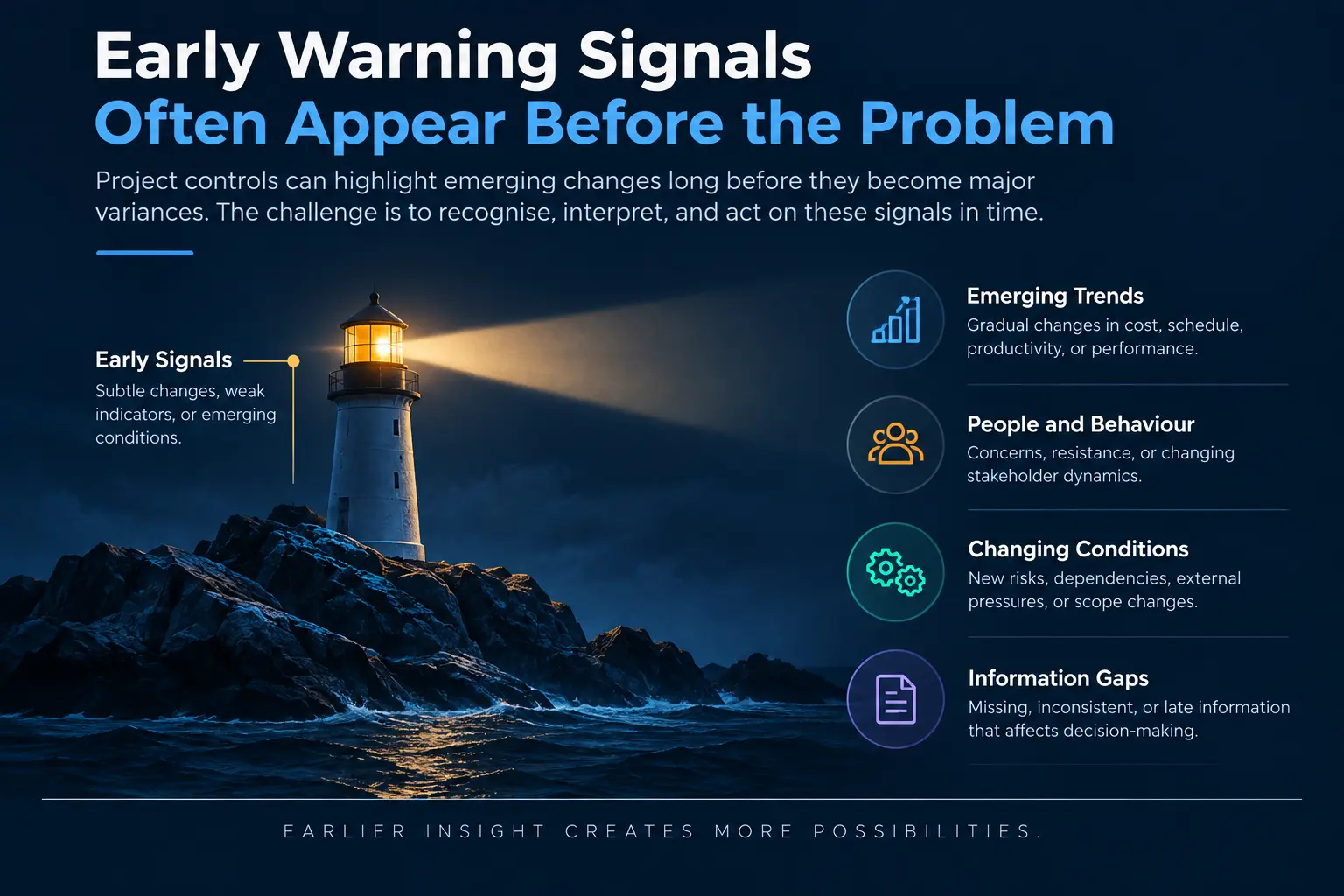
Project controls provide valuable information about cost, schedule, progress, forecasts, and performance. However, accurate reporting does not always reveal emerging project problems early enough. Weak signals can remain isolated, become filtered through reporting, or lose meaning without the right context.
This Insight examines why project controls can miss early warning signals, how separate signals can form wider patterns, and what professionals should reconsider when project information starts changing.
Professional Insight · Project Controls · 14–18 min read
Introduction
Project controls help professionals understand cost, schedule, progress, forecasts, and changing project conditions. However, having reliable project information does not guarantee that emerging problems will receive attention early enough.
Early warning signals can appear as small changes in performance, delayed decisions, shifting assumptions, recurring rework, unusual trends, or growing uncertainty. Individually, these signals may appear insignificant. Together, they can indicate that project conditions are moving away from expectations.
Project controls can miss early warning signals when professionals focus mainly on reported variances, formal thresholds, or established reporting cycles. Moreover, information can lose meaning when teams examine each measure separately rather than connecting related changes.
This is why project controls miss early warning signals deserves closer professional attention. The issue is not necessarily a lack of data. Instead, the challenge often involves how teams identify, interpret, connect, and act on information.
Research on project failure and early warning indicators highlights the importance of recognising weak signals before problems become more visible and difficult to influence. Therefore, effective project control requires more than measuring current performance.
Professionals also need to recognise what changing information may be signalling about future project conditions. This Insight examines why those signals can remain unnoticed, what happens when they continue, and how professionals can strengthen their response.
The Common Assumption
Project controls are expected to reveal problems early through cost, schedule, progress, risk, and performance information.
That expectation is reasonable. However, having a controls system does not guarantee that emerging signals will receive timely attention.
Teams often focus on reported variances, formal thresholds, and established reporting cycles. As a result, weaker signals can remain outside immediate management attention.
Accurate reporting does not automatically produce early detection or timely intervention.
The Assumption That Control Means Early Detection
Many professionals assume regular reporting will naturally expose emerging problems. Yet reporting reflects selected measures, defined periods, available data, and established reporting structures.
These structures can identify a variance after its effects become measurable. However, they may provide less visibility into the conditions developing before the variance becomes significant.
For example, spending may remain within an approved range while productivity declines, commitments increase, changes remain unresolved, or quantities begin moving beyond expectations.
Likewise, schedule performance may appear acceptable while procurement delays, incomplete information, or declining productivity begin affecting future work.
Early warning often emerges from relationships between indicators rather than from one measure alone.
Therefore, Why do Project Controls Miss Early Warning Signals? Professionals need to examine trends, dependencies, assumptions, and emerging conditions alongside formal performance measures.
Why Conventional Signals May Arrive Too Late
Formal controls often depend on information becoming reliable enough for measurement and reporting. That creates an important timing issue.
A problem can develop gradually before it crosses a reporting threshold. Meanwhile, teams may continue using the approved plan because available evidence does not yet show a material deviation.
This creates a gap between when a condition begins changing and when the control system formally recognizes its effect.
Project controls therefore need more than retrospective variance reporting. They also require attention to leading indicators, trend movement, emerging constraints, assumption changes, and unusual patterns.
The issue is not that formal controls lack value. Instead, professionals should recognize that different signals answer different management questions.
A variance can show what has already changed. A trend can show where performance may be moving. An emerging condition can indicate what could change next.
Why do Project Controls Miss Early Warning Signals? The answer often lies in the gap between producing information, interpreting its meaning, and acting before the impact becomes material.
What Is Really Happening?
Early warning signals rarely appear as clear and isolated events. Instead, they often emerge as small changes across different parts of the project.
A delayed approval, declining productivity, repeated design queries, unresolved changes, or slower procurement activity may appear manageable individually. However, several such conditions can develop together and indicate growing project exposure.
The important signal may not be the size of one deviation, but the direction and relationship between several changes.
Signals Can Appear Before Formal Variances
Formal variance measures usually describe a difference between planned and actual performance. However, the conditions creating that variance can appear much earlier.
For example, a project may remain within its approved cost range while productivity begins declining. At the same time, unresolved changes may increase future work and resource pressure.
Similarly, schedule performance may remain acceptable while procurement actions slow down or design information remains incomplete.
These conditions may not immediately trigger a formal threshold. Nevertheless, they can influence future cost, schedule, productivity, or delivery performance.
Project controls therefore need to identify developing conditions, not only confirmed deviations.
This distinction helps explain why do Project Controls Miss Early Warning Signals? The answer often begins with the timing of the information itself.
Warning Signals Can Sit Between Control Areas
Project controls often organize information into separate areas such as cost, schedule, progress, procurement, risk, resources, and change.
This structure creates useful accountability. However, it can also make relationships between signals harder to recognize.
A procurement delay may not immediately create a cost variance. A design issue may not immediately affect the critical path. A productivity decline may remain hidden within an acceptable progress measure.
Yet these conditions can interact. A delayed approval can affect procurement. Procurement delays can affect resources. Resource disruption can then affect schedule performance.
The warning signal may therefore exist in the connection between control measures rather than inside one report.
Professionals need to connect related information and consider whether several apparently minor changes point towards the same underlying condition.
Data Quality Can Delay Recognition
Early detection also depends on the quality, timing, consistency, and completeness of project information.
When data arrives late or contains unresolved inconsistencies, professionals may hesitate to treat an emerging signal as meaningful. Consequently, attention may remain focused on information that already meets established reporting requirements.
However, uncertainty does not necessarily make a signal irrelevant. A developing condition can deserve attention even when its final impact remains unclear.
Professionals can therefore distinguish between uncertain information and information with no management value. The first may require investigation, while the second may require no further action.
This distinction becomes important when potential consequences are significant and response options may reduce future exposure.
Interpretation Determines Whether a Signal Matters
A signal becomes useful when professionals interpret what it could mean for the project. Therefore, project controls depend on professional judgement as well as reliable data.
However, judgement should not replace evidence. Instead, it should help professionals connect evidence that individual measures cannot explain on their own.
For example, a single productivity decline may have limited significance. Repeated productivity declines combined with increasing rework and delayed decisions may indicate a different level of concern.
The same principle applies across cost and schedule information. A small variance may have limited significance when isolated, but its meaning can change when related trends move in the same direction.
Why do Project Controls Miss Early Warning Signals? Often, the challenge lies between producing information, recognizing its significance, and acting while meaningful response options remain available.
Effective early warning therefore requires more than additional reports or more indicators. It requires professionals to examine patterns, relationships, timing, uncertainty, and potential consequences.
Why Do Professionals Miss the Problem?
Professionals rarely miss an early warning signal because they lack project information. More often, the challenge comes from how people interpret, prioritize, communicate, and act on that information.
A signal can exist in the data and still fail to influence a decision. Therefore, understanding the human and organizational side of project controls is essential when examining why early warnings do not receive timely attention.
Attention Often Follows Thresholds
Project teams commonly establish thresholds for cost, schedule, progress, and other performance measures. These thresholds provide structure and help teams focus management attention.
However, thresholds can also influence attention in unintended ways. A condition that remains below a defined limit may receive less attention, even when its direction or persistence suggests growing exposure.
For example, a small recurring schedule variance may appear acceptable during several reporting periods. Yet repeated movement in the same direction can provide more useful information than a single large deviation.
A threshold can support decision-making, but it should not become the only definition of a warning.
This is one reason why do Project Controls Miss Early Warning Signals? Professionals can have clearly defined escalation rules while still overlooking developing patterns that have not crossed those rules.
Teams Can Normalize Small Deviations
Projects rarely move perfectly according to their original plans. Small deviations therefore become familiar during execution.
When teams repeatedly encounter minor delays, productivity changes, late information, or small cost movements, they may begin treating those conditions as normal project noise.
That response can become problematic when the underlying condition changes but the team’s interpretation does not.
A delay that was previously isolated may become recurring. A productivity issue may spread across several work areas. A minor design change may generate increasing rework.
The risk lies not in accepting every deviation as a crisis, but in failing to recognize when a familiar deviation has changed meaning.
Information Can Become Fragmented
Early warnings often cross functional boundaries. Schedule teams may see changing logic, procurement teams may see supplier pressure, cost teams may see commitments moving, and field teams may see productivity problems.
Each observation may appear reasonable within its own context. However, the combined pattern may indicate a larger project condition.
When teams review information separately, they can miss these relationships. Moreover, different reporting cycles can make the signals appear unrelated because they do not emerge at the same time.
This creates an important professional requirement: project controls should support cross-functional interpretation rather than only functional reporting.
The question should move from “What does this report show?” to “What does the combined evidence suggest?”
Teams May Wait for Better Evidence
Professionals often want stronger evidence before escalating an emerging concern. That instinct can protect teams from unnecessary reactions to incomplete information.
However, waiting for certainty can reduce the time available for effective intervention. Early warning information is often incomplete because the condition itself is still developing.
The professional response does not need to treat an uncertain signal as a confirmed problem. Instead, teams can classify it as an emerging condition that requires investigation, monitoring, or a defined follow-up.
This approach separates recognizing a signal from declaring a problem. Professionals can investigate an emerging condition without overstating its consequences.
Reporting Can Emphasize Status Over Meaning
Project reporting often needs to communicate current status quickly. Consequently, reports may emphasize numbers, trends, exceptions, and summary indicators.
These elements support efficient communication. However, numbers alone may not explain why a condition is changing or what could happen next.
A report can therefore be technically accurate while providing limited decision insight. Professionals need context around significant movements, relationships, assumptions, and potential consequences.
This does not mean turning every report into a lengthy narrative. Instead, the reporting process should highlight the few changes that require interpretation and management attention.
Good controls reporting should help decision-makers understand significance, not simply confirm status.
The Signal May Reach the Wrong Decision Point
Even when a warning reaches the project team, it may not reach the person who can influence the underlying condition.
A procurement concern may require commercial action. A design issue may require an engineering decision. A resource constraint may require management intervention.
If the signal remains within one reporting chain, the project may continue monitoring the symptom without addressing its cause.
Therefore, early warning processes need clear ownership and escalation routes. Professionals should know who needs to understand the signal, what decision may be required, and when the issue should move beyond routine monitoring.
Early warning becomes valuable only when the right people can interpret it and influence the conditions behind it.
Why do Project Controls Miss Early Warning Signals? The problem often sits between measurement and management. Data may exist, but attention, interpretation, communication, ownership, and response can still break the chain.
What Happens If It Continues?
An early warning signal does not automatically become a project problem. The greater concern is what happens when emerging signals remain unexplored, disconnected, or unresolved.
Research on project early warnings shows that emerging problems can begin with weak signals before their consequences become visible. Therefore, the time between the first signal and the measurable impact can become an important management window.
When that window closes, the project may have fewer practical options for controlling the eventual impact.
Small Conditions Can Become Larger Problems
An unresolved condition can influence other parts of the project as work progresses. A delayed decision can affect design, procurement, resources, and field execution. Likewise, incomplete information can generate rework and disrupt planned sequences.
The resulting impact may therefore exceed the original condition. However, the relationship may remain difficult to identify after several downstream effects have developed.
This creates a compounding effect. A small issue may initially require limited intervention, while the same issue later requires recovery planning, additional resources, resequencing, commercial decisions, or management escalation.
The cost of ignoring an early signal is often linked to how many downstream conditions develop before action begins.
Response Options Can Narrow Over Time
Early action does not guarantee a successful outcome. Nevertheless, earlier recognition generally gives professionals more opportunity to investigate alternatives before constraints become fixed.
For example, a developing procurement concern may allow time to review sequencing, supplier capacity, expediting, or alternative approaches. Once the delay affects field execution, those options may become more limited.
The same principle applies to resources, design decisions, productivity, and schedule recovery. As project commitments become fixed, the range of practical responses can decrease.
Early warning is valuable because it creates time for decision-making, not because it predicts the future with certainty.
Variances Can Become More Difficult to Explain
When emerging conditions remain unexamined, several effects can appear together. Consequently, later performance problems may have multiple contributing causes.
A cost increase may reflect productivity, scope changes, procurement conditions, rework, or schedule disruption. A schedule delay may similarly involve decisions, resources, design, access, or external constraints.
Once several conditions interact, separating cause from consequence becomes more difficult. Teams may then spend considerable effort explaining what happened rather than determining what can still be changed.
This does not mean every early signal has a predictable outcome. Instead, professionals should recognize that unresolved signals can increase causal complexity as the project progresses.
Forecast Confidence Can Decline
Forecasts depend on assumptions about future performance. When emerging conditions remain outside the forecast discussion, those assumptions can become increasingly difficult to defend.
For example, repeated productivity changes may affect future durations. Procurement uncertainty may affect planned expenditure. Unresolved changes may affect both cost and schedule expectations.
As these conditions accumulate, forecast movement can become more frequent. The issue is not necessarily that forecasting methods are wrong. Instead, the information supporting the forecast may be changing faster than the formal forecast cycle.
Research into project early warnings supports the need for approaches that help professionals anticipate developing conditions rather than relying only on historical performance. :contentReference[oaicite:0]{index=0}
A changing forecast can therefore be a management signal in its own right when repeated movement reflects unresolved project conditions.
Management Attention Can Shift From Prevention to Recovery
Once an emerging problem becomes material, management attention often shifts toward containment and recovery.
Teams may need to resequence work, increase resources, accelerate procurement, renegotiate commitments, revise forecasts, or develop recovery actions.
These responses can remain necessary even when the original problem was relatively small. However, they usually require more coordination than an earlier investigation would have required.
Research on early warning responses identifies the ability to react sufficiently quickly as a significant challenge. It also highlights barriers that can prevent organizations from responding effectively after a signal has been identified. :contentReference[oaicite:1]{index=1}
Therefore, Why do Project Controls Miss Early Warning Signals? matters beyond detection itself. The real consequence can be the gradual movement from manageable intervention toward increasingly constrained recovery.
The Project May Lose Learning Opportunities
Early signals also provide an opportunity to learn about how the project is actually behaving.
Repeated warning patterns can reveal weaknesses in assumptions, interfaces, planning logic, resource expectations, procurement strategies, or decision processes.
If teams only examine the problem after it becomes a major variance, they may lose useful information about how the condition developed.
Early warning should therefore support learning as well as intervention.
Professionals can ask what the signal reveals about the project’s assumptions and control environment. They can then use that learning to improve future monitoring and decision-making.
The objective is not to create a system that reacts to every unusual movement. Instead, it is to recognize meaningful patterns early enough to investigate them, understand their potential consequences, and preserve practical response options.
That is the central implication of Why do Project Controls Miss Early Warning Signals? The value of an early signal lies in the time and understanding it creates before the project has fewer choices.
What Should Project Professionals Reconsider?
Project controls become more valuable when professionals use them to detect changing conditions, not simply document current performance. Therefore, the question is not whether the project has enough reports, metrics, or dashboards. The better question is whether those mechanisms help the team recognize meaningful change early enough to respond.
Research on early warning signs consistently shows that detection depends on more than formal monitoring. Context, communication, experience, organizational culture, project complexity, and the ability to interpret weak signals all influence whether concerns become visible. Moreover, research on leading indicators suggests that useful indicators should connect observable conditions with potential future outcomes rather than simply describe historical performance. :contentReference[oaicite:0]{index=0}
Move Beyond Variance-Only Thinking
A variance tells professionals that actual performance differs from a reference point. However, the variance may appear only after the underlying condition has existed for some time. Therefore, project controls should examine the conditions developing before a significant variance becomes visible.
- Look for deterioration in trends, not only threshold breaches. A gradual decline can matter before a formal limit is exceeded.
- Examine the direction of movement. A small variance that keeps worsening may deserve more attention than a larger isolated variance.
- Connect related measures. Cost, progress, schedule, productivity, procurement, and risk information can reveal stronger signals when interpreted together.
- Investigate persistent exceptions. Repeated explanations, delayed actions, or recurring corrections can indicate an underlying control problem.
This does not mean abandoning traditional project controls. Cost and schedule variances remain important. Instead, professionals should place them within a broader evidence set that helps explain what may happen next.
Treat Weak Signals as Evidence, Not Conclusions
An early warning signal does not automatically mean that a project will experience failure. It indicates that something deserves examination. Research on early warning signs emphasizes that signals can differ by project type, environment, complexity, and organizational context. :contentReference[oaicite:1]{index=1}
Professionals should therefore avoid turning every unusual movement into an escalation. Instead, they should ask what the signal means, what evidence supports it, and whether other information confirms or contradicts it.
- Separate signal from noise. Determine whether the change is temporary, isolated, recurring, or part of a wider pattern.
- Test the explanation. Ask whether the stated cause explains the evidence or simply describes the symptom.
- Seek corroborating evidence. Compare the signal with progress, schedule logic, commitments, resources, procurement, quality, and risk information.
- Record uncertainty honestly. Where evidence remains incomplete, distinguish an emerging concern from an established problem.
The purpose of an early warning signal is to trigger informed investigation, not premature certainty. This distinction helps project controls remain analytical rather than alarmist.
Connect Controls With Project Context
A metric rarely explains the whole situation. For example, declining productivity may reflect resource availability, design changes, access restrictions, learning effects, sequencing problems, or measurement differences. Therefore, project controls professionals need enough operational context to interpret what the numbers represent.
This becomes particularly important in complex projects. Research indicates that formal assessments can become less sufficient as complexity increases, while experience, communication, and informal information become increasingly important for detecting emerging concerns. :contentReference[oaicite:2]{index=2}
- Talk to the people closest to the work. Field observations can explain changes that reports cannot.
- Understand dependencies. A local issue may have consequences across several work packages.
- Consider project phase. The same indicator can have different meanings during design, procurement, construction, testing, or closeout.
- Consider external conditions. Market changes, approvals, regulations, supply constraints, and stakeholder decisions can alter project exposure.
Make Indicators Forward-Looking
Project controls often rely heavily on historical performance. That information remains essential, but it does not always provide enough warning about future conditions. Leading indicators can complement lagging measures by tracking conditions that may influence future performance. Research in construction, for example, has examined leading indicators across operational, organizational, and behavioural dimensions rather than relying only on outcome measures. :contentReference[oaicite:3]{index=3}
Professionals should therefore ask whether each important control measure helps answer a forward-looking question.
- What condition could influence future performance?
- Can we observe that condition before the outcome occurs?
- Who can provide reliable information about it?
- What change would justify investigation?
- What decision could the information support?
The answer should not always be another KPI. Sometimes the most useful early warning mechanism involves structured conversations, field observations, trend reviews, risk discussions, or cross-functional validation.
Strengthen the Link Between Signal and Action
Detection creates little value if nobody knows what happens next. Early warning research emphasizes the importance of acting on signals, not merely identifying them. :contentReference[oaicite:4]{index=4} Therefore, project controls should establish a practical connection between observation, interpretation, escalation, decision, and follow-up.
- Define ownership. Someone should be responsible for investigating significant signals.
- Define escalation logic. Teams should understand when an observation requires wider management attention.
- Track response effectiveness. A warning remains relevant until the underlying condition is understood or controlled.
- Capture recurring patterns. Repeated signals can reveal systemic weaknesses in planning, execution, or governance.
A strong control environment therefore creates a short path between information and action. The objective is not faster reporting. It is faster recognition and better-informed intervention.
Reconsider What “Good Control” Means
A project controls system can produce accurate reports and still provide weak early warning capability. Conversely, a smaller set of well-chosen indicators can provide stronger insight when professionals understand their context and act on them consistently.
This suggests a broader definition of control effectiveness. A mature control environment should support visibility, interpretation, challenge, communication, and timely action. Research on project performance also shows that performance extends beyond traditional cost and schedule measures into areas such as productivity, quality, communication, stakeholder satisfaction, and safety. :contentReference[oaicite:5]{index=5}
For project controls professionals, this means reviewing not only what the system measures but also what it may fail to reveal.
- Are we measuring outcomes without monitoring their drivers?
- Are repeated small exceptions receiving enough attention?
- Do teams feel able to raise concerns before the data becomes conclusive?
- Does management review challenge the reported position?
- Can the control system distinguish normal variation from emerging exposure?
These questions help shift project controls from retrospective reporting toward active project sensing. They also recognize an important limitation: no indicator system can eliminate uncertainty. Instead, the system should help professionals reduce avoidable surprise and create more time for informed response.
Early warning capability depends on the interaction between data, professional judgement, project context, and management action. Improving one element alone may not produce better control.
The practical objective is therefore not to build an ever-larger monitoring system. It is to create a control environment that notices meaningful change, investigates it proportionately, communicates its implications, and supports timely decisions.
A Practical Professional Lens
Project controls professionals need a practical way to distinguish useful early warning signals from normal project variation. Therefore, the objective is not to create more alerts or another scoring system. It is to create a disciplined way to notice change, understand its context, and decide whether it deserves attention.
The following lens brings together the principles discussed throughout this Insight. It provides a practical sequence for reviewing project information before a weak signal becomes a more significant concern.
The Kleios Early Warning Lens
Kleios Technologies proposes the following analytical sequence: NOTICE → CONNECT → TEST → ASSESS → ACT → LEARN.
This is a Kleios analytical lens, not a formal framework published by PMI, AACE, ISO, APM, or another professional institution. Instead, it translates established thinking around early warning signals, leading indicators, project controls, risk management, and professional judgement into a practical review approach.
- Notice: Identify unusual movements, recurring exceptions, deteriorating trends, or emerging project conditions.
- Connect: Examine how the signal relates to cost, schedule, progress, resources, risks, dependencies, or other project conditions.
- Test: Check whether the signal represents meaningful change rather than temporary variation, poor data, or an isolated event.
- Assess: Consider potential consequences, uncertainty, urgency, and the time available for response.
- Act: Determine whether investigation, escalation, mitigation, or another management response is appropriate.
- Learn: Capture recurring patterns and use them to improve future monitoring and project decision-making.
Use Context Before Escalation
Not every unusual movement requires immediate escalation. Instead, professionals should establish enough context to understand what changed, why it changed, and whether it matters.
A useful review can ask: What changed? What caused the change? Is it recurring? What else does it affect? How much response time remains?
These questions help prevent two common weaknesses. Teams can avoid overlooking meaningful signals, while also avoiding excessive reactions to normal project variation.
This context matters because Project Controls Miss Early Warning signals when teams focus only on isolated measurements instead of interpreting what those measurements reveal about changing project conditions.
Judge Signals by Decision Value
A useful early warning signal should support better professional judgement. Therefore, professionals should consider what decision the information could influence and whether earlier recognition creates meaningful response options.
- Does the signal require further investigation?
- Does it change the project’s exposure?
- Does someone need to make a decision?
- Would earlier action preserve better response options?
If the answer remains unclear, the signal may need further interpretation before escalation. However, repeated uncertainty can itself indicate insufficient information, unclear ownership, or weak connections between project data and management decisions.
The practical principle is straightforward: project controls should help professionals recognize meaningful change early, understand its implications, and create better conditions for timely action.
A mature control environment does not attempt to eliminate uncertainty or predict every problem. Instead, it improves the organization’s ability to notice developing conditions before they become harder or more expensive to address.
When Project Controls Miss Early Warning signals, the issue may not be the absence of data. The deeper problem may involve how teams interpret, connect, communicate, and act on available information.
The value of early warning signals lies not in how many a project can identify, but in whether the right signals lead to better decisions at the right time.
Key Takeaways
Early warning signals rarely appear as one dramatic event. Instead, they often emerge through small changes in performance, behaviour, assumptions, trends, and project conditions.
Project Controls Miss Early Warning when teams focus on individual measurements without interpreting how those measurements connect. Therefore, professionals need to examine signals within the wider project context.
- Early warning signals can appear before major variances. Small changes in trends, productivity, commitments, progress, or forecasts can provide useful context.
- Project controls should support interpretation, not just reporting. Numbers become more useful when professionals understand what changed and why.
- Single indicators rarely explain the full situation. Professionals should connect cost, schedule, progress, resources, risks, commitments, and operational conditions.
- Repeated exceptions deserve attention. A pattern of small deviations can indicate developing exposure even when individual variances remain manageable.
- Context matters when interpreting project controls information. A variance may reflect a temporary condition, an incorrect assumption, or a deeper performance problem.
- Reporting frequency should support timely action. Information that reaches decision-makers after the response window has passed provides limited preventive value.
- Human judgement remains essential. Dashboards and analytical tools can identify patterns, but professionals must determine their significance and implications.
- Effective project controls should support earlier action. The objective is not to eliminate uncertainty but to improve visibility, interpretation, and response.
Ultimately, project controls become more valuable when they help professionals recognize developing conditions before those conditions become difficult to manage. Therefore, the focus should move from producing more information toward producing information that supports timely professional judgement and action.
References
The analysis of early warning signals draws on research covering project performance, risk, schedule health, cost control, leading indicators, and decision-making. These sources helped distinguish early signals from visible performance symptoms and informed the practical perspective presented in this Insight.
- Identifying and Acting on Early Warning Signs in Complex Projects — Examines why professionals can miss emerging warning signs and the challenges of acting before problems become more visible.
- A Review on Possible Approaches for Detecting Early Warning Signs in Projects — Reviews approaches for identifying early warning signs and supporting timely project intervention.
- Early Warning Signs in Complex Projects — Explores how warning signals can emerge before major project problems become visible.
- Indicators Your Project Is Leaping Off the Tracks — Discusses indicators associated with emerging project problems and their potential consequences.
- Performance Measurement as an Early Warning System — Examines how performance measurement can provide earlier visibility into emerging project problems.
- Developing Leading Indicators to Monitor Construction Projects — Presents an approach for developing leading indicators that support project information and decision-making.
- GAO Schedule Assessment Guide — Provides schedule assessment practices that help identify weaknesses affecting schedule reliability and project control.
- Cost Estimating and Assessment Guide — Covers cost estimation, risk analysis, estimate updates, and performance practices relevant to project controls.
- Earned Value Management Implementation Handbook — Explains how integrated cost, schedule, and progress information can improve visibility into emerging performance issues.
- Early Detection of Construction Project Risks — Examines warning signs and mitigation approaches for construction project risks using recent empirical research.
Together, these references provide an evidence base for understanding why early warning signals can remain unnoticed within project controls. They also support the distinction between collecting performance information and interpreting that information early enough to influence project decisions.
Related Kleios Resources
If you want to apply these ideas to a real project, the following Kleios resources provide practical guidance and tools for identifying, interpreting, and responding to project control signals.
- How to Monitor Project Cost and Schedule A practical guide for monitoring cost and schedule performance, identifying emerging deviations, and understanding what project controls information may indicate.
- How to Prepare Effective Project Controls Reports A practical guide for turning project controls information into clear reports that support analysis, communication, and management decisions.
- Project Controls Reporting Template A structured Excel framework for organizing project controls information, reporting performance, highlighting variances, and supporting management review.
- Project Controls Setup Template A structured framework for establishing project controls processes, responsibilities, information requirements, and reporting foundations.
- Project Controls Resources Explore the wider collection of project controls guides, templates, and practical resources for project performance management.
FEATURED PROJECT CONTROLS INSIGHTS
Professional Perspectives on the Challenges Project Controls Face
Our featured Project Controls Insights examine recurring challenges involving early warning signals, cost variances, progress measurement, forecasting, reporting, and integrated performance. Moreover, they encourage professionals to look beyond reported figures and consider the conditions influencing them.
Why do Project Cost Variances Keep Growing
Explore why Cost Variances Keep Growing despite established budgets, monitoring, and corrective actions. However, changing scope, productivity, commitments, assumptions, and execution conditions can influence variance behaviour.
When do Progress Measurements Mislead Project Decisions
Examine when Progress Measurements Mislead project decisions despite established measurement methods. Therefore, consider whether reported progress accurately represents completed work and supports effective management action.
Why do Project Cost Forecasts Lose Reliability
Examine why Cost Forecasts Lose Reliability despite established forecasting processes and available project data. Moreover, consider how actual costs, commitments, accruals, assumptions, and performance trends can affect forecast quality.
MORE PROJECT CONTROLS RESOURCE TYPES
Continue Your Project Controls Learning
Project controls knowledge becomes more valuable when professionals can understand concepts, apply structured tools, and examine their practical use. Explore our other Project Controls resources to complement the analytical perspectives provided by these Insights.
Guides
Explore clear guidance to understand project controls concepts, evaluate performance, and apply effective approaches throughout project delivery.
Downloads
Access useful project controls materials and reference resources to support learning, analysis, and day-to-day project work.
Career Roadmaps
Follow structured learning paths to develop project controls knowledge, practical skills, tools, and capabilities for professional growth.
Templates
Use structured Project Controls templates to support setup, progress measurement, cost analysis, forecasting, performance monitoring, and reporting.
Case Studies
Explore realistic project controls situations, decisions, challenges, and outcomes to understand how control practices work during project delivery.
Glossary
Find clear explanations of project controls, cost management, progress measurement, forecasting, performance analysis, reporting, and related terminology.
Looking for more project management resources? Explore the Kleios Technologies Resources Hub to discover our complete collection of guides, templates, downloads, career roadmaps, case studies, glossary resources, and insights.
RELATED KNOWLEDGE DOMAINS
Continue Your Learning Across Related Knowledge Domains
Project Management is closely connected with specialized disciplines that support successful planning, execution, governance, performance measurement, and professional growth. Explore related knowledge domains to expand your expertise, develop complementary skills, and access practical resources across the complete project management ecosystem.
Expand your expertise one domain at a time and build a well-rounded project management skill set.
Why Explore Related Domains?
- Develop cross-functional project management expertise
- Discover specialized knowledge beyond core project management
- Access practical resources across interconnected disciplines
- Build a complete professional learning pathway
- Strengthen career readiness through continuous learning
Project Management
Practical project management knowledge, practices, and professional resources.
Project Planning & Scheduling
Planning techniques, scheduling methods, and timeline management resources.
PMO
Governance, portfolio management, and organizational project excellence.
Risk Management
Risk identification, assessment, mitigation, and monitoring resources.
Primavera P6
Professional planning, scheduling, resource management, and reporting.
Microsoft Project
Project scheduling, tracking, reporting, and collaboration resources.
Power BI
Interactive dashboards, reporting, visualization, and project analytics.
PMI Certifications
Certification guidance, exam preparation, and professional development resources.