
PROJECT CONTROLS GUIDE
How to Measure Project Progress Accurately
Measuring project progress accurately requires more than collecting percentages and updating a progress report. This guide provides a practical approach to define measurable progress, structure work for measurement, establish clear measurement rules, validate actual accomplishment, integrate progress with project performance, and take informed corrective action throughout project delivery.
Practical Guide · Project Controls
The Project Progress Measurement Challenge
Progress percentages do not tell the whole story
Consider a project reporting:Overall progress: 70%The number looks useful. However, it does not tell management:
- Which work has actually been completed?
- Which work remains?
- Is the remaining work more difficult than the completed work?
- Are critical activities progressing as planned?
- Are major milestones still achievable?
- Does the progress position agree with the schedule?
The wider project performance problem is significant
PMI research covering more than 22,000 projects reported that only around 0.5% delivered on budget, on time, and with the intended benefits. This figure does not mean that poor progress measurement causes project failure. Nevertheless, it illustrates the broader difficulty organizations face in maintaining reliable project performance across cost, schedule, scope, and benefits.Schedule performance adds another dimension
GAO identifies four characteristics of a reliable schedule:- Comprehensive
- Well-constructed
- Credible
- Controlled
A high progress percentage can still hide risk
Imagine that a project has achieved:85% overall progressYet the remaining 15% includes:
- Final commissioning
- System integration
- Regulatory approvals
- Performance testing
- Critical equipment installation
Progress information comes from many sources
Project teams frequently collect information from:- Engineering
- Procurement
- Construction
- Contractors
- Subcontractors
- Commissioning
- Cost control
- Project management
The cost dimension can create another misleading signal
Spending does not automatically represent accomplishment. A project may have spent significantly more money than planned while achieving less physical work than expected. For this reason, established earned value practices distinguish between: Planned Value — the work planned. Earned Value — the value of work actually accomplished. Actual Cost — the cost incurred. NASA’s EVM guidance uses these measures to integrate scope, schedule, and cost performance rather than treating expenditure as a substitute for progress.The real challenge is confidence
More project data does not automatically create better control. A project may have:- More reports
- More percentages
- More dashboards
- More spreadsheets
“How much progress has been reported?”It is:
“How confidently can the project demonstrate what has actually been accomplished?”That distinction sets the foundation for the next part of this guide: understanding why project progress measurement goes wrong and what weaknesses prevent teams from turning progress data into reliable project information.
Why Project Progress Measurement Goes Wrong
Accurate progress measurement rarely fails because a project team lacks data. More often, the problem comes from how the project defines, structures, collects, and interprets progress information.
The following causes represent the major weaknesses that can make reported progress unreliable.
1. Progress has no clear measurement definition
Teams often use “percentage complete” without defining exactly what that percentage represents.
For one activity, 70% may mean that 70% of the physical quantity is complete. For another, it may represent hours spent, documents issued, or a person’s judgement.
This creates inconsistent reporting across the project.
A reliable measurement system needs clear rules for what constitutes progress and completion. It should also establish how teams will calculate, record, and verify progress.
Without these rules, project participants can report different percentages for similar work. Consequently, management may receive a consolidated progress figure that looks precise but does not have a consistent meaning.
2. The measurement method does not match the work
Different types of project work require different measurement techniques.
For example, construction activities may support quantity-based measurement, while engineering deliverables may require weighted milestones or deliverable-based measurement. Procurement may require measurable stages such as purchase order placement, manufacturing, inspection, and delivery.
Problems arise when teams apply one generic percentage method to every type of work.
The method should reflect how the work progresses and how the team can objectively demonstrate accomplishment.
Therefore, selecting an appropriate measurement method becomes essential for producing meaningful progress information rather than simply assigning percentages to activities.
3. The work structure does not support meaningful measurement
The quality of progress measurement depends heavily on how the project work is structured.
If a schedule contains large activities covering several different deliverables, the team may struggle to determine how much work has actually been completed.
For example, combining engineering, procurement, installation, testing, and commissioning into one activity creates limited visibility.
A better measurement structure separates work into logical components that can be planned, performed, measured, and verified.
Therefore, the WBS and schedule should provide enough detail to capture meaningful accomplishment without creating unnecessary administrative complexity.
4. Progress relies too heavily on subjective judgement
Subjective percentage estimates can create significant uncertainty.
Statements such as “the activity is approximately 80% complete” may appear straightforward. However, without defined measurement rules, different people can assign different percentages to the same work.
This problem becomes more significant with long-duration activities where progress does not increase evenly.
Subjective judgement still has a role in project management, particularly where direct measurement is difficult. However, teams should support judgement with measurable indicators wherever possible.
Consequently, progress should represent demonstrated accomplishment, not simply an individual’s perception of how much work remains.
5. Actual progress information arrives late
Project progress measurement depends on timely information from the people performing and supervising the work.
However, field measurements, contractor updates, inspection records, testing results, and deliverable status may reach the project controls team after the reporting cut-off.
As a result, the reported position can already be outdated when management receives it.
This creates a particularly important problem for fast-moving projects, where conditions can change significantly between reporting periods.
Therefore, project teams need clearly defined status dates, reporting cut-offs, responsibilities, and submission timelines so that progress information reaches decision-makers while it remains useful.
6. Reported progress lacks supporting evidence
A percentage becomes considerably more reliable when the project can demonstrate how the team calculated it.
For example, construction progress may require verified quantities, inspection records, photographs, or approved work records. Engineering progress may require approved documents or completed deliverables.
Without supporting evidence, management may have difficulty determining whether reported progress reflects actual accomplishment.
This also makes contractor and subcontractor progress claims harder to review consistently.
Therefore, every significant progress figure should have an appropriate evidence trail that allows the project team to understand, validate, and defend the reported position when required.
7. Different teams use different reporting rules
Large projects involve many disciplines and organizations.
Engineering may measure progress through deliverables. Procurement may use milestone stages. Construction may use installed quantities. Contractors may use their own internal weighting systems.
Each approach can be reasonable individually.
However, combining them without common rules can produce inconsistent project-level information.
The project therefore needs a common measurement framework that establishes how each work package will report progress while still allowing methods appropriate to the work.
Otherwise, the final project percentage may combine fundamentally different measurement concepts and provide management with a misleading sense of consistency.
8. Progress is separated from schedule and cost information
Progress becomes more valuable when the project connects it with scope, schedule, and cost performance.
However, some organizations maintain separate reporting processes for physical progress, schedule performance, and expenditure.
This separation can make important relationships difficult to identify.
For example, spending may increase significantly while physical accomplishment remains below expectations. Similarly, reported progress may appear healthy while critical schedule activities continue to slip.
When these information streams remain disconnected, management receives separate numbers rather than an integrated performance picture.
Consequently, project teams need to examine progress alongside the baseline, schedule position, and relevant cost information.
9. Baseline changes are not reflected consistently
Projects rarely remain completely unchanged after the original baseline.
Approved scope changes, variations, design development, revised execution strategies, and other authorized changes can alter the work that teams need to measure.
Problems occur when the project updates one part of its control system but leaves related measurement structures unchanged.
For example, an approved scope change may affect the schedule and budget but not the progress measurement framework.
Consequently, current performance may be compared against an outdated representation of planned work.
Maintaining alignment between approved changes, baselines, schedules, budgets, and measurement rules is therefore essential for meaningful performance analysis.
10. Teams focus on the overall percentage instead of the work behind it
A single project-level progress percentage provides a convenient headline for management reporting.
However, it can hide significant differences between work packages.
A project could report 75% overall progress while a critical equipment package, commissioning activity, or regulatory milestone remains substantially behind plan.
The overall percentage therefore needs context.
Project teams should examine progress at appropriate levels, particularly for critical, high-value, or schedule-sensitive work.
This allows management to understand not only how much work has been completed, but also which remaining work could influence project outcomes.
11. Data validation is weak
Progress information often passes through several reporting layers before it reaches project management.
Field teams provide information to supervisors. Contractors submit updates to project teams. Project controls then consolidate the information into reports and dashboards.
Each transfer creates an opportunity for errors, inconsistencies, or interpretation differences.
Without appropriate validation, these issues can enter the project’s official performance records.
Over time, inaccurate data can distort trends and affect forecasts.
Therefore, project teams should establish proportionate validation checks that compare reported progress with supporting evidence, quantities, deliverables, schedule status, and other relevant information before publishing important performance figures.
12. Progress reporting measures activity rather than accomplishment
Being busy does not necessarily mean that the project has achieved planned work.
Teams may report:
- Hours worked
- Resources mobilized
- Materials purchased
- Meetings completed
- Documents prepared
These indicators can provide useful information. However, they do not automatically demonstrate completed project scope.
For example, purchasing materials represents an activity, but it does not necessarily demonstrate installation or operational readiness.
Therefore, teams need to distinguish between effort expended and work accomplished.
This distinction becomes particularly important when management uses reported progress to assess project performance, forecast completion, or determine whether corrective action may be necessary.
What Should You Do?
To measure project progress accurately, project teams need a consistent process. The approach should connect planned work, actual accomplishment, and performance information.
The following seven steps provide a practical framework for doing this. Each step builds on the previous one. Therefore, the process moves from defining measurable work to validating progress and taking informed management action.
This approach helps teams reduce subjectivity, improve reporting confidence, and identify performance gaps earlier.
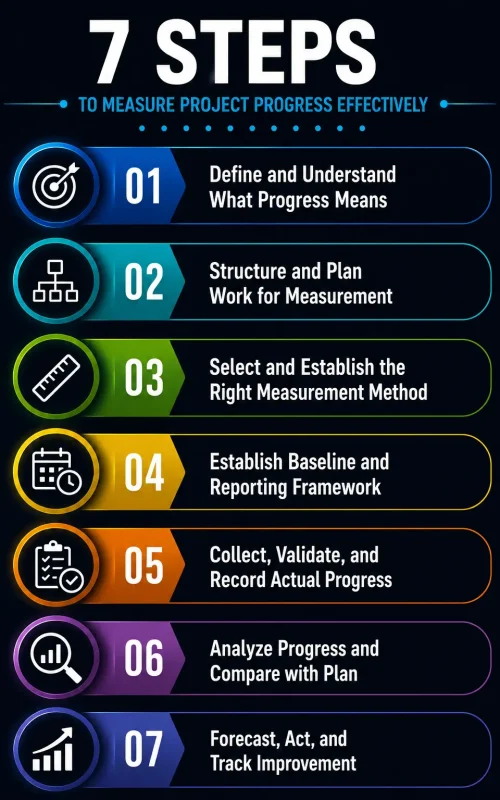
Step 1: Define What Progress Means
Before a project team can measure project progress accurately, it must first establish what progress actually means for the work being delivered.
A percentage without a clear definition creates room for interpretation. Therefore, the first step is to define measurable accomplishment at the appropriate level of the project.
Define what “progress” means
Start by identifying what evidence will demonstrate that work has been accomplished. The definition should reflect the actual nature of the work rather than simply the time or effort spent.
For example, progress may relate to:
- Physical quantities completed
- Engineering deliverables approved
- Equipment manufactured or delivered
- Construction work installed and verified
- Testing or commissioning milestones achieved
- Contractual deliverables accepted
This distinction is important because effort does not automatically equal accomplishment.
Establish measurable rules
Next, establish clear rules for assigning progress. Define how the team will recognize the start, intermediate stages, and completion of measurable work.
For instance, an equipment procurement activity might use defined stages such as purchase order placement, manufacturing completion, inspection, shipment, and delivery. Each stage can carry an agreed weighting based on its contribution to the work.
Consequently, two people reviewing the same evidence should reach broadly the same progress conclusion.
Define the measurement boundary
The team should also establish exactly what the measurement includes and excludes.
For example, “equipment installation complete” should not automatically mean that the equipment has been tested, commissioned, and accepted. Each stage should have a clear boundary.
This prevents teams from claiming progress for work that has not yet reached the agreed measurement point.
Align the definition with project objectives
Finally, review whether the measurement approach highlights the work that matters most to project delivery.
Critical milestones, major deliverables, contractual commitments, and schedule-sensitive work should receive appropriate visibility. Otherwise, a strong overall percentage could conceal delays in work that has a greater impact on the final outcome.
The output of Step 1 should be a clear definition of what counts as progress, how the team will recognize it, and what evidence will support the measurement.
Once the project establishes this foundation, the next step is to structure the work so that the defined progress can be measured consistently across activities, work packages, and deliverables.
Step 2: Structure the Work for Measurement
Once the project defines what progress means, the next step is to structure the work so that the team can measure that progress consistently. The measurement approach should connect the WBS, work packages, schedule activities, deliverables, and measurable outputs.
A well-structured measurement system makes progress visible at the right level without creating unnecessary reporting effort.
Break the scope into measurable work
Start with the approved scope and divide it into logical components that the project team can plan, execute, and measure.
Each work package should represent a meaningful portion of the project scope and should have a clear relationship with its expected deliverables or physical outputs.
For example, a construction package could separate:
- Material procurement
- Foundation works
- Structural installation
- Equipment installation
- Testing and commissioning
This structure allows the team to see where progress actually occurs instead of relying on one broad percentage for the entire package.
Connect work packages to schedule activities
Next, establish a clear connection between the WBS and the project schedule.
Schedule activities should represent identifiable work that the team can status and measure. At the same time, avoid breaking the schedule into excessive detail simply to create more progress points.
The right level of detail should allow the project team to answer a practical question:
What specific work has been accomplished against what was planned?
Therefore, each measurable activity should have a clear scope, planned output, responsible owner, and logical relationship with related work.
Choose measurable outputs
Where practical, connect work to tangible outputs such as quantities, deliverables, milestones, or completed stages.
For example, instead of measuring an installation activity only through elapsed time, the team could measure installed units, completed sections, tested systems, or accepted deliverables.
This creates a stronger relationship between the reported percentage and the work actually produced.
Assign ownership and reporting responsibility
Every measurable work package should have a clear owner responsible for providing progress information and supporting evidence.
Define who will:
- Report actual accomplishment
- Provide supporting evidence
- Validate submitted information
- Update the relevant schedule or progress record
Clear ownership reduces gaps between field execution and project controls.
The output of Step 2 should be a structured measurement hierarchy that connects project scope to measurable work, schedule activities, outputs, and accountable owners.
With that structure established, the project can move to Step 3: selecting the right progress measurement method for each type of work.
Step 3: Select the Right Progress Measurement Method
Once the work has been structured for measurement, the project team must decide how each type of work will be measured. The method should reflect the nature of the work, the way accomplishment can be demonstrated, and the level of control required.
Using one measurement method across every discipline may appear simple. However, it can produce misleading progress when different types of work behave differently.
Match the method to the work
Start by identifying how the team can objectively demonstrate accomplishment for each work package.
Common approaches include:
- Quantity-based measurement — measure completed physical quantities against the total planned quantity.
- Milestone-based measurement — recognize progress when defined milestones are achieved.
- Weighted milestone measurement — assign predetermined weights to measurable stages of a deliverable.
- Start/finish measurement — recognize progress at defined completion points where intermediate measurement adds limited value.
- Earned value techniques — use an established method to assign earned value to completed work where appropriate.
The objective is not to use the most sophisticated method. Instead, select a method that provides credible and repeatable evidence of accomplishment.
Use objective measures where possible
Physical quantities often provide strong measurement evidence when the work produces measurable outputs.
For example, a project installing 1,000 metres of cable can measure progress against verified metres installed. Similarly, a civil project can measure concrete placement, excavation, or structural quantities where appropriate.
However, not every activity has a directly measurable physical quantity. Engineering, design, management, and certain procurement activities may require deliverable or milestone-based approaches.
Therefore, the team should select the most objective practical measure available rather than forcing every activity into a quantity-based system.
Avoid methods that create false precision
A measurement method should not create an appearance of accuracy without providing meaningful evidence.
For example, assigning 37% completion to a long-duration activity may appear precise, but the number has limited value if the team cannot explain how it calculated the percentage.
Instead, define measurable stages or outputs that justify the reported value.
As a result, the project can distinguish between a percentage that is mathematically calculated and one that is simply estimated.
Document the selected method
Record the measurement technique for each major work package before regular progress reporting begins.
The documentation should identify:
- The selected measurement method
- The measurement unit or milestone structure
- Any weighting applied
- The evidence required
- The person responsible for reporting and validation
This creates a common reference for project teams, contractors, and project controls personnel.
The output of Step 3 should be an agreed measurement method for each significant work package, supported by clear rules and objective evidence.
Once the project knows how progress will be measured, the next step is to establish the baseline and rules against which actual progress will be assessed.
Step 4: Establish the Baseline and Progress Rules
After selecting the appropriate measurement methods, the project team needs a stable reference against which actual accomplishment can be assessed. Therefore, this step establishes the baseline, status date, measurement rules, and reporting conventions that will govern progress measurement throughout project delivery.
Establish the approved baseline
Start with the approved project baseline that represents the planned scope, schedule, and, where applicable, budget against which performance will be assessed.
The baseline should provide a clear reference for understanding:
- What work the project planned to complete
- When the work was planned to occur
- Which milestones and deliverables were expected
- What planned quantities or outputs support the measurement
Without a controlled baseline, the project may report current progress without establishing whether that progress meets the original or approved plan.
Set a consistent status date
Every progress measurement should relate to a defined status date. This establishes the point in time at which the project measures actual accomplishment and compares it with planned performance.
For example, if the reporting period ends on 31 August, progress information should represent the work actually accomplished up to that date.
Consistent status dates make period-to-period comparisons more meaningful. They also help the project distinguish between work completed during the current period and progress carried forward from earlier periods.
Define progress cut-off rules
Next, establish clear rules for when the team can recognize progress.
For example, determine whether an activity receives progress when work begins, when a defined quantity is completed, when an inspection is passed, or when a deliverable receives formal acceptance.
These rules should also address partial progress, completed work, rejected work, rework, and activities that span multiple reporting periods.
Consequently, the project avoids changing measurement practices from one reporting period to another.
Control changes to the measurement baseline
Projects can change after the baseline has been established. Approved scope changes, variations, resequencing, and other authorized modifications may affect planned work and its measurement.
Therefore, the team should process these changes through the project’s established change-control process and maintain traceability between the original baseline, approved changes, and current measurement position.
The output of Step 4 should be a controlled baseline with consistent status dates and clearly documented rules for recognizing and reporting progress.
With this reference established, the project is ready to move from planning the measurement system to collecting and validating actual project progress.
Step 5: Collect and Validate Actual Progress
Once the project has established its measurement rules and baseline, the next task is to determine what work has actually been accomplished. This step converts field and functional information into verified progress data that project controls can confidently use for reporting and analysis.
Collect progress from the source
Start by obtaining progress information from the people closest to the work.
Depending on the project, this may include:
- Site engineers and supervisors
- Engineering discipline leads
- Procurement teams
- Contractors and subcontractors
- Commissioning teams
- Quantity surveyors or cost engineers
However, do not rely solely on a reported percentage. Ask the responsible team to provide the measurable accomplishment and supporting evidence behind the reported figure.
Check the evidence
Validation should focus on whether the reported progress satisfies the measurement rules established earlier.
Depending on the work, supporting evidence may include:
- Verified physical quantities
- Approved engineering deliverables
- Inspection and test records
- Material delivery records
- Site records and photographs
- Completed milestone documentation
The evidence does not need to be excessive. Instead, it should be appropriate to the value and risk of the work being measured.
Reconcile conflicting information
Progress information from different sources may not always agree.
For example, a contractor may report 80% installation progress while the site team has verified only 70% of the planned quantity.
Do not simply average the numbers or select the more favorable figure. Instead, identify the reason for the difference and establish which information satisfies the agreed measurement rules.
Consequently, the project maintains a defensible progress position rather than creating a number to satisfy the reporting cycle.
Record the actual position
After validation, record the approved progress against the correct activity, work package, deliverable, or measurement unit.
Maintain the status date and retain sufficient information to explain how the reported value was established. Where progress cannot be verified, clearly identify it rather than treating an estimate as confirmed accomplishment.
The output of Step 5 should be validated actual progress supported by appropriate evidence and traceable to the project’s agreed measurement rules.
With reliable actual progress established, the project can now compare what was planned with what has actually been achieved. That comparison forms the foundation for Step 6.
Step 6: Compare Actual Progress With the Plan
Once actual progress has been collected and validated, the project team can determine whether the work is performing as planned. This step converts progress data into performance information by comparing actual accomplishment with the approved plan and identifying meaningful deviations.
Compare planned and actual accomplishment
Start by comparing what the project expected to accomplish by the status date with what has actually been achieved.
Depending on the measurement method, this comparison may include:
- Planned versus actual quantities
- Planned versus completed deliverables
- Planned versus achieved milestones
- Planned versus actual activity status
- Planned value versus earned value, where EVM is used
The objective is not simply to calculate a variance. It is to understand where the project stands against its approved plan.
Identify significant variances
Not every difference requires management intervention. A small deviation may have little effect on the project, while a seemingly small delay on a critical activity could have a major impact.
Therefore, assess variances based on their potential effect on:
- Critical activities
- Key milestones
- Major deliverables
- Project completion dates
- Cost and schedule performance
This helps the team focus attention on deviations that genuinely matter rather than spending time investigating every minor difference.
Look beyond the percentage
A progress variance should always be interpreted in context.
For example, a project may report 60% actual progress against 65% planned progress. That five-percentage-point difference is useful information, but it does not explain whether the project can still achieve its required completion date.
Review the underlying activities, remaining work, schedule logic, constraints, and critical path to understand the significance of the variance.
Consequently, progress measurement becomes a basis for analysis rather than simply a reporting exercise.
Analyze the trend
One reporting period provides only a snapshot. Comparing successive reporting periods can reveal whether performance is improving, deteriorating, or remaining stable.
Track indicators such as:
- Planned versus actual progress over time
- Recurring progress shortfalls
- Delayed milestones
- Changes in productivity
- Movement in critical work packages
Trend analysis can therefore help the team identify developing problems before they become major project issues.
Connect the variance to project impact
Finally, determine what the identified variance means for the project’s expected outcome.
Ask:
- Does the variance affect a critical milestone?
- Is the remaining work still achievable?
- Does the current trend indicate further deterioration?
- Is management action required?
The output of Step 6 should be a clear understanding of where actual progress differs from the plan, which variances matter, and what those variances could mean for project outcomes.
Once the project understands the performance gap and its potential impact, the final step is to use that information to forecast, communicate, and act before the gap becomes more difficult to recover.
Step 7: Forecast, Act, and Keep Measuring
Measuring progress has limited value if the project only records what has already happened. The final step is to use verified progress and performance trends to forecast the likely outcome, decide what action is required, and continue measuring the results.
This closes the loop between measurement and project control.
Assess the likely outcome
Start by considering what the current progress position means for the remaining work.
Review:
- Current progress against the baseline
- Remaining work and its complexity
- Critical activities and milestones
- Current productivity and performance trends
- Known constraints, risks, and dependencies
The objective is to determine whether the existing performance trend is likely to support the planned completion date or whether the forecast needs to change.
Develop a realistic forecast
A forecast should reflect the project’s current evidence and remaining work, rather than simply repeating the original plan.
For example, if productivity has consistently declined and several critical activities are behind schedule, maintaining the original completion forecast without supporting evidence may provide a false sense of confidence.
Where appropriate, use schedule forecasting techniques, productivity trends, earned value indicators, or other established project controls methods to understand the potential outcome.
Most importantly, clearly distinguish between the baseline date and the current forecast date.
Define corrective action
When the analysis indicates that performance is moving away from the plan, identify specific actions to address the gap.
Possible actions may include:
- Reallocating resources
- Removing identified constraints
- Improving work sequencing
- Increasing productivity
- Accelerating critical activities
- Escalating decisions requiring management intervention
Each action should have a clear owner, target date, and expected result. Otherwise, corrective action can become another item on a project meeting agenda without producing measurable improvement.
Communicate the position clearly
Management reporting should present more than a single progress percentage.
A useful progress report should explain:
- What was planned
- What has actually been achieved
- Where the significant gaps are
- What the current trend indicates
- What action is being taken
- What management decision or support is required
This allows stakeholders to understand both the current position and the decisions needed to influence the outcome.
Measure whether the action worked
Corrective action should not be considered successful simply because it has been completed.
Continue measuring the affected work and compare subsequent performance with the expected improvement.
If the gap continues, reassess the forecast and determine whether additional action is required.
The output of Step 7 should be a current performance forecast, clearly assigned corrective actions, and a feedback loop that measures whether those actions actually improve project performance.
This completes the seven-step approach. The project has moved from defining progress to structuring the work, selecting measurement methods, establishing the baseline, validating actual accomplishment, analyzing performance, and finally using that information to forecast and act.
Practical Example
Putting the Approach Into Practice
Consider a commercial building project where the project team needs to determine whether construction is progressing in line with the approved plan. Instead of relying on a single subjective percentage, the team applies the seven-step approach to create a more reliable progress position.
Step 1: Define what progress means
The team first defines progress as verified physical work completed. For structural works, progress will be measured using quantities such as concrete placed, reinforcement installed, and structural elements completed.
This prevents hours worked or resources deployed from being treated automatically as completed work.
Step 2: Structure the work for measurement
The structural scope is divided into measurable work packages, such as foundations, columns, beams, slabs, and associated activities. Each package is linked to the project schedule and assigned to the responsible construction team.
Now the project controls team can trace reported progress back to specific work rather than relying on one overall construction percentage.
Step 3: Select the right measurement method
The team selects quantity-based measurement for major construction activities because physical quantities can be verified.
For example, if 1,000 cubic metres of concrete are planned and 650 cubic metres have been verified as completed, the measured progress for that quantity is 65%.
Other work, such as engineering approvals or commissioning, uses appropriate milestone or deliverable-based measures instead.
Step 4: Establish the baseline and progress rules
The project establishes the approved schedule baseline and a common reporting status date. It also defines when progress can be recognized.
For example, concrete placement may count only after the quantity has been verified through approved site records. This creates a consistent rule for every reporting period.
Step 5: Collect and validate actual progress
At the reporting cut-off, the construction team submits completed quantities and supporting records. The project controls team reviews the information against site records and other available evidence.
Suppose the contractor reports 720 m³ of concrete completed, but verified records support only 680 m³. The project records the validated quantity rather than automatically accepting the contractor’s reported figure.
Step 6: Compare actual progress with the plan
The validated progress is then compared with the baseline.
If the plan expected 750 m³ by the status date but only 680 m³ has been verified, the project has identified a measurable gap. The team then examines the affected activities, upcoming milestones, productivity, and schedule position to determine the significance of the variance.
Step 7: Forecast, act, and keep measuring
The team reviews whether the current production rate can support the planned completion dates. If the trend indicates a potential delay, the project manager and construction team identify corrective actions such as resolving constraints, improving sequencing, or reallocating resources.
The following reporting periods then measure whether those actions improve actual production.
The result: The project does not simply report that construction is “around 90% complete.” It can demonstrate what work has been completed, how the progress was measured, where performance differs from the plan, and what action is being taken.
This is the purpose of the seven-step approach: turn progress measurement from a reporting exercise into a reliable project control process.
Common Mistakes to Avoid
Using subjective percentage estimates
Avoid assigning progress based only on personal judgement. Statements such as “the activity is approximately 80% complete” can vary between individuals. Wherever practical, support the percentage with measurable quantities, defined milestones, deliverables, or other objective evidence. This makes reported progress more consistent, comparable, and easier to validate.
Using the same measurement method everywhere
Do not force engineering, procurement, construction, testing, and commissioning activities into one measurement technique. Different work produces different types of evidence. Select methods that reflect the nature of each work package. A suitable combination of quantity, milestone, deliverable, or weighted methods can provide a more credible representation of actual accomplishment.
Measuring effort instead of accomplishment
Hours worked, resources mobilized, meetings completed, or money spent do not automatically represent completed scope. These indicators may provide useful supporting information, but they should not replace accomplishment measures. Always distinguish between the effort invested and the work actually produced, accepted, or verified against the project’s defined measurement rules.
Creating oversized activities
Avoid combining too much work into a single activity simply to keep the schedule short. Large activities make partial progress difficult to measure and can hide delays within the work. Break significant scope into logical, measurable components while maintaining an appropriate level of schedule detail for effective planning and control.
Reporting progress without evidence
Do not treat a submitted percentage as sufficient evidence of accomplishment. Depending on the work, retain quantities, approved deliverables, inspection records, test results, photographs, or milestone documentation. The evidence should be proportionate to the work’s importance and risk. Without traceability, progress becomes difficult to verify or defend.
Accepting contractor progress without validation
Contractor-reported progress should not automatically become the project’s official progress position. Compare submitted information with agreed measurement rules and available evidence. Where differences exist, investigate them before consolidation. This does not mean rejecting contractor information; instead, it ensures that accepted progress represents verified accomplishment under the project’s agreed reporting framework.
Ignoring the status date
Progress should always relate to a clearly defined status date. Mixing information from different dates can create misleading comparisons between planned and actual performance. Establish a consistent reporting cut-off and ensure that submitted progress represents work accomplished up to that point. This creates a reliable basis for period-to-period performance analysis.
Focusing only on overall project progress
A project-level percentage can hide problems within critical work packages. Always examine progress at appropriate levels, particularly for critical activities, major deliverables, and schedule-sensitive work. A healthy overall percentage does not necessarily mean the project is healthy. Understanding where the remaining work sits is essential for meaningful performance assessment.
Separating progress from schedule performance
Do not analyze physical progress independently from the project schedule. A project can achieve substantial physical accomplishment while still approaching a critical milestone late. Compare actual accomplishment with planned work and examine the effect on activities, milestones, and completion dates. This provides context that a standalone progress percentage cannot provide.
Changing measurement rules during delivery
Avoid changing the way progress is calculated simply because the existing method produces an unfavorable result. Changes to measurement rules can distort trends and reduce confidence in reported performance. If the method genuinely needs revision, document the reason, obtain appropriate approval, and maintain sufficient traceability between the previous and revised approach.
Treating the forecast as the baseline
Do not replace the approved baseline with the latest forecast when reporting performance. The baseline represents the approved plan, while the forecast represents the team’s current expectation based on available information. Keeping these concepts separate allows management to see both the original performance commitment and the likely current outcome.
Measuring progress without taking action
Progress measurement should support decisions, not simply produce reports. When validated data shows a meaningful performance gap, determine its potential impact and identify appropriate action. Assign responsibility, establish target dates, and measure the subsequent result. Otherwise, the project may repeatedly report the same variance without improving its actual performance.
Key Takeaways
Accurate project progress measurement is more than reporting a percentage complete. A strong measurement process connects clearly defined work with objective accomplishment, verified evidence, performance analysis, forecasting, and timely action. This enables project teams to understand the real project position and respond before performance gaps become more difficult to recover.
- Define what progress means. Establish what constitutes measurable accomplishment for each type of work and clearly distinguish completed work from effort, time spent, or resources used.
- Structure the work for measurement. Connect the project scope, WBS, work packages, schedule activities, deliverables, and measurable outputs so that progress can be traced to specific work.
- Select the right measurement method. Use quantity-based, milestone-based, weighted, deliverable-based, or other appropriate methods according to the nature of the work.
- Establish a controlled baseline. Use an approved baseline and consistent status dates so that actual accomplishment can be compared with a defined plan.
- Set clear progress rules. Define when progress can be recognized, what evidence is required, how partial completion is treated, and how changes are incorporated through appropriate control processes.
- Collect progress from reliable sources. Obtain information from the people responsible for executing the work and ensure that reported progress reflects the agreed measurement method.
- Validate actual accomplishment. Support significant progress figures with appropriate evidence such as verified quantities, approved deliverables, inspection records, test results, or completed milestones.
- Compare actual progress with the plan. Look beyond the overall percentage and identify meaningful gaps across work packages, critical activities, milestones, and other schedule-sensitive areas.
- Analyze trends, not just snapshots. Review progress across reporting periods to determine whether performance is improving, deteriorating, or remaining stable.
- Connect progress with project performance. Consider progress alongside schedule, cost, productivity, risks, constraints, and remaining work to understand its potential impact on project outcomes.
- Forecast using current performance. Use verified progress, remaining work, productivity trends, and current project conditions to develop a realistic forecast rather than simply repeating the original plan.
- Turn findings into action. When significant gaps are identified, assign corrective actions with clear ownership, target dates, and expected outcomes.
- Measure whether corrective actions work. Continue monitoring the affected work after action is taken. Completion of an action does not automatically mean that project performance has improved.
Accurate project progress measurement does not simply tell you how much work has been completed. It helps you understand what has actually been achieved, how that compares with the plan, what the trend indicates, and what the project team needs to do next.
References
References
- Project Management Institute. The Standard for Earned Value Management . 2019/2020.
- Project Management Institute. Project Performance Domains – Measurement Performance Domain . 2021.
- Salapatas, J. N. Performance Measurement for Projects and Project Management . Project Management Journal, 16(3), 29–33.
- Shouche, S., Borthakur, A., & Mate, N. Quantitative Project Management — Use of Metrics for Effective Project Management . PMI Global Congress, 2006.
- Rollins, S., & Kaiser, D. Metrics and Methods Involved in Tracking Project Progress . Project Management Institute.
- Cioffi, D. F. Designing Project Management: A Scientific Notation and an Improved Formalism for Earned Value Calculations . PMI Research Conference, 2004.
- U.S. Government Accountability Office. GAO Schedule Assessment Guide: Best Practices for Project Schedules . GAO-16-89G, 2015.
- U.S. Government Accountability Office. Cost Estimating and Assessment Guide: Best Practices for Developing and Managing Program Costs . GAO-20-195G, 2020.
- National Aeronautics and Space Administration. Earned Value Management Implementation Handbook . NASA/SP-2018-599.
- National Aeronautics and Space Administration. Program Planning & Control and Schedule Management Guidance . NASA.
- Elsaid, M., Nassar, K., Alqahtani, F. K., et al. Comparative Analysis of Earned Value Management Techniques in Construction Projects . Scientific Reports, 15, Article 23606, 2025.
- Navon, R. Integrating Automated Data Acquisition Technologies for Progress Reporting of Construction Projects . Automation in Construction.
FEATURED PROJECT CONTROLS GUIDES
Practical Guidance for Measuring, Analyzing, and Controlling Project Performance
Effective project controls requires more than collecting project data and preparing reports. Teams need to measure progress, understand cost and schedule performance, identify variances, investigate their causes, and develop realistic forecasts.
How to Analyze Project Cost Variances
Understand how to identify project cost variances, investigate their underlying causes, assess financial impacts, evaluate trends, and determine appropriate corrective actions.
How to Build Reliable Project Cost Forecasts
Learn how to develop realistic cost forecasts, evaluate current cost trends, review forecast assumptions, estimate completion costs, and improve confidence in projected outcomes.
How to Prepare Effective Project Controls Reports
Understand how to organize project performance information, present key variances, explain underlying issues, highlight emerging risks, and provide management with actionable information.
MORE PROJECT CONTROLS RESOURCE TYPES
Continue Your Project Controls Learning
Project controls knowledge becomes more valuable when you can understand performance, apply structured methods, and develop practical skills. Explore the other resources within the Project Controls collection to complement the guidance provided in these guides.
Templates
Use practical templates and checklists to establish controls, measure progress, analyze variances, develop forecasts, prepare reports, and support project performance management.
Downloads
Access useful project controls materials and reference resources to support learning and day-to-day activities involving cost, progress, forecasting, reporting, and project performance.
Career Roadmaps
Follow structured learning paths to develop project controls knowledge, practical skills, analytical capabilities, and professional competencies for project controls career development.
Case Studies
Explore project controls situations, decisions, challenges, and outcomes to understand how cost, progress, forecasting, reporting, and performance practices are applied in real projects.
Glossary
Find clear explanations of project controls, cost control, progress measurement, forecasting, performance management, reporting, and related terminology used across project environments.
Insights & Articles
Explore professional perspectives, insights, emerging practices, and discussions relevant to project controls, cost management, performance measurement, forecasting, and reporting.
Looking for more project management resources? Explore the Kleios Technologies Resources Hub to discover our complete collection of guides, templates, downloads, career roadmaps, case studies, glossary resources, and insights.
RELATED KNOWLEDGE DOMAINS
Continue Your Learning Across Related Knowledge Domains
Project Management is closely connected with specialized disciplines that support successful planning, execution, governance, performance measurement, and professional growth. Explore related knowledge domains to expand your expertise, develop complementary skills, and access practical resources across the complete project management ecosystem.
Expand your expertise one domain at a time and build a well-rounded project management skill set.
Why Explore Related Domains?
- Develop cross-functional project management expertise
- Discover specialized knowledge beyond core project management
- Access practical resources across interconnected disciplines
- Build a complete professional learning pathway
- Strengthen career readiness through continuous learning
Each knowledge domain complements your Project Management expertise, helping you build broader capabilities and solve real-world project challenges with greater confidence.
Project Management
Practical project management knowledge, practices, and professional resources.
Project Planning & Scheduling
Planning techniques, scheduling methods, and timeline management resources.
PMO
Governance, portfolio management, and organizational project excellence.
Risk Management
Risk identification, assessment, mitigation, and monitoring resources.
Primavera P6
Professional planning, scheduling, resource management, and reporting.
Microsoft Project
Project scheduling, tracking, reporting, and collaboration resources.
Power BI
Interactive dashboards, reporting, visualization, and project analytics.
PMI Certifications
Certification guidance, exam preparation, and professional development resources.