
PROJECT CONTROLS GUIDE
How to Set Up Effective Project Controls
Setting up effective project controls requires more than collecting project data and preparing reports. This guide provides a practical approach to establish the control framework, define baselines and performance measures, analyze variances, forecast outcomes, manage corrective actions, monitor performance, and continuously improve project controls throughout delivery.
Practical Guide · Project Controls
The Effective Project Controls Challenge
Project controls plays a central role in helping organizations understand project performance across scope, schedule, cost, resources, progress, risk, and change. However, projects continue to experience significant cost and schedule difficulties even when organizations establish planning, reporting, and control processes.
The scale of the challenge is visible across industries. Large capital projects frequently experience cost overruns and schedule delays. Moreover, research across major projects shows persistent performance problems across infrastructure, energy, construction, and other capital-intensive sectors.
Project performance remains difficult to predict
Project performance can change considerably between the approved baseline and final outcome. A project may begin with an approved schedule, budget, resource plan, and set of performance targets. However, the delivery environment continues to evolve throughout execution.
Consequently, complex projects with long execution periods and multiple interfaces can create substantial differences between planned outcomes and actual results.
Cost and schedule are closely connected
Project controls teams cannot treat schedule and cost as completely separate performance measures. In practice, changes in one area can quickly influence the other.
For example, a delayed activity can affect resource utilization, procurement, overheads, contractual commitments, productivity, and subsequent work packages. Likewise, cost pressures can influence resources, sequencing, procurement decisions, and execution strategies.
Therefore, these connections make project performance more difficult to understand through isolated reports.
Projects generate large volumes of data
Modern projects generate information from numerous sources, including:
- Project schedules
- Cost systems
- Progress measurements
- Procurement records
- Engineering deliverables
- Risk registers
- Change registers
- Contracts
- Resource records
- Field reporting
In addition, different functions may maintain their own information, definitions, reporting cycles, and data structures.
As a result, the challenge for project teams increasingly involves understanding and interpreting information rather than simply producing it.
Current performance does not always represent future performance
A project can report acceptable performance during a particular period while its future position becomes increasingly uncertain. Therefore, project teams should avoid treating current performance as a guarantee of future results.
For example, milestones may still appear achievable while float reduces. Similarly, reported progress may remain close to plan while productivity trends weaken. At the same time, costs may remain within current-period expectations while commitments and emerging changes increase future exposure.
Consequently, project teams must continue monitoring performance throughout the project lifecycle rather than relying on individual reporting periods.
Control becomes more complex as projects grow
Large projects often involve multiple contractors, suppliers, disciplines, locations, contractual arrangements, and reporting structures. As project complexity increases, teams must coordinate information across more interfaces.
Therefore, project teams must interpret information across organizational and functional boundaries.
For example, a project controls team may need to reconcile information from engineering, procurement, construction, commercial, finance, planning, and risk functions. Only then can the team develop a coherent view of project performance.
The challenge facing project teams
The fundamental challenge is not simply whether a project has a schedule, budget, progress report, or risk register. Instead, project teams need to determine whether these control mechanisms provide useful and reliable information.
Ultimately, the real question is whether the available project information provides a reliable and timely picture of actual performance and the project’s developing position.
Therefore, project teams need to look more closely at how project controls operate across the project lifecycle and where the control environment can become difficult to manage. This provides the foundation for examining the underlying factors that make effective project control challenging.
Why project controls setup goes wrong
Setting up project controls is not simply about creating a schedule, budget, progress report, or risk register. The control environment needs to provide a consistent and reliable view of project performance.
When the underlying control structure is unclear or inconsistent, project teams may have plenty of information but still struggle to understand the true position of the project.
1. Project control requirements are not clearly defined
Project teams may begin execution without clearly defining what needs to be controlled and how control information will be used.
This can create uncertainty around:
- What performance areas should be measured
- Which indicators are important
- What information is required
- Who owns each control activity
- How frequently information should be updated
- What level of deviation requires management attention
As a result, different functions may develop their own reporting practices. The project can then have multiple reports covering similar information without a consistent control structure.
2. Baselines do not provide a reliable reference
Project performance is normally assessed against approved baselines for schedule, cost, progress, and other control measures.
If those baselines do not adequately represent the approved scope and execution strategy, subsequent performance measurement becomes less meaningful.
Common weaknesses may include:
- Incomplete scope representation
- Unrealistic activity durations
- Weak schedule logic
- Inadequate resource planning
- Unclear cost allocation
- Missing milestones
- Poorly defined progress measurement
The baseline may therefore be formally approved while still providing an unreliable reference for measuring actual project performance.
3. Performance measurement is inconsistent
Project controls depends on consistent definitions of progress and performance.
However, different functions may measure completion differently. Engineering may measure document issuance, procurement may measure purchase or delivery milestones, while construction may measure physical quantities.
Differences can occur in:
- Progress measurement rules
- Reporting periods
- Completion criteria
- Weighting methods
- Status dates
- Performance calculations
When these measures are not aligned, combining information into an overall project performance picture becomes difficult.
4. Project information remains fragmented
Project performance information is often distributed across multiple systems, reports, registers, spreadsheets, and teams.
For example:
- Schedule information may sit with planning
- Actual costs may come from finance
- Commitments may sit with commercial
- Procurement status may come from purchasing
- Risks may be maintained separately
- Progress may come from field teams
Each information source may be useful independently, but relationships between them can become difficult to establish. This fragmentation can make it harder to understand how one developing issue may affect other areas of project performance.
5. Data quality is inconsistent
Project controls relies heavily on information generated by project teams, contractors, suppliers, and other stakeholders.
The quality of this information can vary because of:
- Late updates
- Missing information
- Incorrect status
- Different coding structures
- Manual data entry
- Unclear ownership
- Different interpretation of completion
Poor-quality information can affect schedules, cost reports, progress calculations, forecasts, and management reporting.
The resulting reports may appear precise even when the underlying project information contains significant uncertainty.
6. Reporting focuses on status rather than performance
Project reporting can become heavily focused on what happened during the reporting period.
Reports may contain:
- Activities completed
- Costs incurred
- Progress achieved
- Meetings conducted
- Documents issued
- Current issues
However, these individual status indicators may not clearly show the developing project position.
A project may report reasonable current-period performance while:
- Float is reducing
- Forecast dates are moving
- Productivity is declining
- Risks are increasing
- Recovery opportunities are narrowing
This can make emerging performance deterioration harder to recognize.
7. Control responsibilities are unclear
Project controls involves several functions, and important information often crosses organizational boundaries.
Planning, cost, commercial, risk, engineering, procurement, construction, and project management may each own different information.
Problems can occur when it is unclear:
- Who provides the information
- Who validates it
- Who analyzes it
- Who approves it
- Who acts on it
- Who escalates unresolved issues
This can lead to duplicated effort, delayed information, conflicting reports, or gaps in accountability.
8. Changes disrupt the performance picture
Projects continuously experience changes in scope, design, procurement, execution strategy, contracts, resources, and planned dates.
Each significant change can affect the original project baseline and future expectations.
The control challenge becomes distinguishing between:
- Original baseline performance
- Approved changes
- Current project position
- Emerging deviations
- Forecast changes
When these elements are not clearly distinguishable, project teams can find it difficult to determine whether a change represents an approved adjustment or an actual deterioration in project performance.
9. Forecasts rely on outdated assumptions
Project forecasts are based on expectations about remaining work and future conditions.
As execution progresses, the assumptions supporting those forecasts can change.
Examples include:
- Actual productivity differs from planned productivity
- Procurement takes longer than expected
- Engineering deliverables are delayed
- Resources become constrained
- Workfront conditions change
- New risks emerge
If forecasts continue to rely heavily on earlier assumptions, they may gradually become disconnected from the project’s current circumstances.
10. Project controls becomes reporting-driven
When project controls is primarily treated as a reporting activity, the focus can shift toward producing reports on time rather than maintaining a reliable control environment.
This can result in significant effort being spent on:
- Collecting data
- Formatting reports
- Updating dashboards
- Preparing presentations
- Meeting reporting deadlines
while less attention may be given to the quality, consistency, relationships, and meaning of the information being reported.
The project may therefore have extensive reporting without achieving the level of control expected from the system.
What Should You Do?
Effective project controls requires more than periodic reporting. It needs a structured approach that connects planning, performance measurement, variance analysis, forecasting, corrective action, monitoring, and continuous improvement.
The following seven-step approach provides project teams with a practical framework for establishing control requirements, measuring actual performance, understanding deviations, assessing future outcomes, managing actions, escalating significant issues, and applying project experience to strengthen controls throughout the project lifecycle.
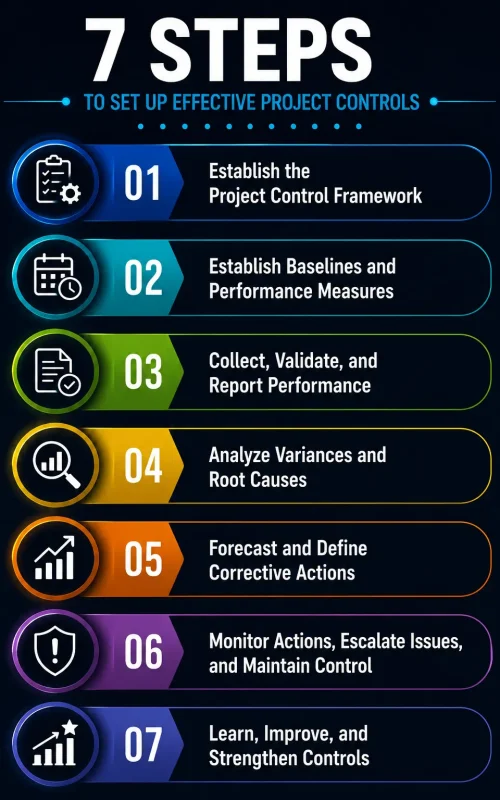
Step 1 — Establish the project control framework
Before measuring project performance, the project team needs to establish a clear framework for what the team will control, how the team will control it, and who will take responsibility.
Project controls should reflect the way the project will actually operate. Therefore, the framework should consider the project’s scope, contract structure, execution strategy, reporting requirements, and management needs.
Define the control areas
First, identify the areas that require structured control throughout project delivery:
- Scope — approved work and changes
- Schedule — activities, milestones, logic, and completion dates
- Cost — budget, commitments, actuals, and forecasts
- Progress — physical and measurable work completion
- Resources — labour, equipment, and other critical resources
- Risk — threats and opportunities affecting objectives
- Changes — approved and emerging changes
- Procurement — critical purchases, commitments, and deliveries
- Contracts — commercial and contractual performance
However, not every project needs the same level of control across every area. Instead, tailor the control framework to project size, complexity, risk, contract requirements, and stakeholder expectations.
Define how control information will work
Next, establish how the project team will collect, validate, update, and use information for each major control area. Define:
- What information the team needs
- Where the information will come from
- Who owns the information
- Who validates the information
- How frequently the team updates it
- How the team will report it
- Which systems or records the team will use
As a result, different functions can work from consistent information instead of developing disconnected control practices.
Establish responsibilities and interfaces
Then, clearly define the responsibilities of project controls, planning, cost, commercial, risk, engineering, procurement, construction, and project management teams.
In particular, pay close attention to interfaces between functions. Important control information often moves across organizational boundaries, so unclear ownership can create gaps, delays, or inconsistent reporting.
Define governance and reporting expectations
Finally, establish the reporting cycle, review forums, escalation routes, approval responsibilities, and management thresholds for the project.
Furthermore, the framework should clearly explain when information must be available, who reviews it, and what the team should do when performance moves outside acceptable limits.
Key outcome
At the end of Step 1, the project should have a clearly defined project controls framework. This framework should establish the control areas, information requirements, responsibilities, interfaces, reporting structure, and governance arrangements.
With these elements in place, the project team can move into the next step and establish the baselines and performance measures needed to measure project performance consistently.
Step 2 — Establish the baseline and performance measures
Once the project controls framework is defined, the next step is to establish the reference point against which the project team will measure performance.
Without a reliable baseline and consistent performance measures, project teams may know what has happened but cannot accurately determine whether the project is performing as expected.
Establish the approved project baseline
First, establish a baseline that represents the approved project scope and planned execution approach.
Depending on the project, the baseline may include:
- Scope baseline — approved deliverables, work packages, and boundaries
- Schedule baseline — activities, relationships, milestones, dates, and planned sequence
- Cost baseline — approved budget distributed across appropriate control structures
- Resource baseline — planned labour, equipment, and other significant resources
- Progress baseline — planned quantities, weighted activities, milestones, or other agreed measurement methods
Moreover, these elements should align sufficiently so that the project team can evaluate schedule, cost, and progress information together.
Define how progress will be measured
Next, establish objective rules that explain when the project team can recognize work as complete.
Depending on the nature of the work, the team may use:
- Physical quantities
- Milestones
- Weighted activities
- Installed quantities
- Deliverable completion
- Earned value techniques
- Other contractually agreed measures
Where measurable completion criteria exist, use them instead of relying primarily on subjective estimates. As a result, different project teams can apply the same measurement rules more consistently.
Define meaningful performance indicators
Then, select indicators that provide useful information about project performance.
These may include:
- Schedule variance
- Cost variance
- Milestone performance
- Productivity
- Forecast completion
- Cost performance
- Schedule performance
- Critical and near-critical path exposure
- Resource performance
However, the objective is not to create as many indicators as possible. Instead, select measures that help management understand whether the project is moving toward its objectives and where intervention may become necessary.
Establish the control rules
In addition, document the rules that govern how the project team will maintain the baseline and performance measures.
Define:
- Status dates
- Update frequency
- Data sources
- Calculation methods
- Performance tolerances
- Baseline change requirements
- Approval responsibilities
These rules create consistency across reporting periods. Furthermore, they help the project team distinguish genuine performance changes from differences caused by inconsistent data or measurement practices.
Key outcome
At the end of Step 2, the project should have a controlled performance reference with clearly defined baselines, measurement rules, indicators, and control parameters.
With this reference in place, the project team can move to Step 3 and establish how to collect and validate actual project progress against the agreed measurement framework.
Step 3 — Collect, validate, and report performance
Once the baseline and performance measures are established, the next step is to build a reliable picture of what is actually happening on the project.
Project controls depends on information from multiple functions. Therefore, if actual progress, cost, schedule, procurement, resources, and other performance information remains incomplete or inconsistent, subsequent analysis and forecasting may also become unreliable.
Establish the data collection cycle
First, define when and how the project team will collect actual project information. The collection process should follow a consistent cycle that supports the project’s reporting requirements.
Depending on the project, information may come from:
- Project schedules
- Cost systems
- Site progress records
- Quantity measurements
- Engineering deliverables
- Procurement records
- Contractor reports
- Resource records
- Risk and change registers
In addition, align the collection cycle with the project’s status date and reporting calendar. This allows different functions to provide information for the same reporting period.
Assign information ownership
Next, assign a clear owner to every important performance measure. Ownership should extend beyond simply providing data; the responsible person should understand the source, quality, and meaning of the information.
Define:
- Who provides the information
- Who validates it
- Who enters or updates it
- Who reviews exceptions
- Who remains accountable for its accuracy
As a result, the team can respond more quickly when different functions provide conflicting information or when important data remains unavailable.
Validate the information before reporting
Before using project information for performance reporting, check its completeness, consistency, accuracy, and reasonableness.
Useful validation checks include:
- Are all required updates received?
- Does reported progress match supporting evidence?
- Are schedule activities properly statused?
- Are actual costs correctly recorded?
- Are procurement dates current?
- Are approved and emerging changes reflected appropriately?
- Are unusual movements explained?
Furthermore, investigate significant inconsistencies before consolidating the information. This prevents unreliable data from moving into performance analysis and management reporting.
Reconcile information across functions
Do not review performance information in isolation. Instead, compare related information across functions to determine whether the overall project position makes sense.
For example, consider a reported increase in construction progress alongside:
- Material availability
- Engineering completion
- Labour deployment
- Procurement status
- Schedule progress
- Cost incurred
This cross-functional review can reveal inconsistencies that an individual report may not show. Consequently, reconciliation strengthens confidence in the overall project performance position.
Report the current performance position
Once the team validates the information, present the current project position clearly and consistently.
Depending on the project’s reporting requirements, show relevant:
- Actual performance
- Planned performance
- Variances
- Performance trends
- Key milestones
- Current issues
- Significant changes
Moreover, distinguish verified information from assumptions, estimates, or information that still requires confirmation. This helps management understand the level of confidence behind the reported position.
Key outcome
At the end of Step 3, the project should have validated and consistently reported performance information that provides a dependable basis for understanding what is happening.
With a reliable current position established, the project team can move into Step 4 and compare actual performance with the baseline, identify significant variances, and determine where deeper analysis is required.
Step 4 — Analyze variances and root causes
Once the project team has collected and validated actual performance, the next step is to determine where performance differs from the baseline and why those differences have occurred.
A variance by itself does not explain the project problem. Therefore, effective project controls requires the team to move from “what changed?” to “why did it change?”
Identify significant variances
First, compare actual performance with the approved baseline and identify deviations that require attention.
Review areas such as:
- Schedule and milestone performance
- Cost performance
- Physical progress
- Productivity
- Resource performance
- Procurement status
- Engineering progress
- Risk exposure
- Approved and pending changes
However, not every variance requires the same level of investigation. Instead, apply the project’s agreed thresholds and tolerances to focus attention on material deviations.
Separate symptoms from causes
A delayed activity may represent the visible symptom rather than the underlying problem. Therefore, the project team should continue investigating until it understands the factors that created the deviation.
For example:
Late installation → Material unavailable → Procurement delay → Late technical approval
This approach helps the team move beyond the immediate symptom and identify a cause that the project can manage, correct, or monitor.
Analyze the underlying causes
Next, use an appropriate analysis technique to investigate significant deviations. The choice should depend on the nature and complexity of the problem.
- 5 Whys — for straightforward or recurring problems
- Cause-and-effect analysis — for problems with multiple contributing factors
- Trend analysis — for developing performance issues
- Schedule analysis — for sequencing, logic, and timing problems
- Cost analysis — for spending and productivity deviations
- Risk analysis — for emerging threats and potential impacts
Furthermore, distinguish between direct causes, contributing factors, and underlying systemic causes. This distinction helps the team avoid treating a temporary symptom as the root problem.
Connect information across control areas
A variance in one control area may originate from another. Consequently, the team should examine relationships across schedule, cost, progress, resources, procurement, risk, and change.
For example:
- Procurement delays may affect schedule performance.
- Design changes may affect cost and progress.
- Low productivity may affect both cost and completion dates.
- Resource shortages may affect critical activities.
- Emerging risks may affect forecast outcomes.
By connecting these relationships, the project team can develop a more complete understanding of what drives performance changes.
Document the analysis
For significant variances, document the analysis in a consistent format. At a minimum, record:
- What happened
- Where it occurred
- Magnitude of the variance
- Root cause
- Contributing factors
- Current impact
- Potential future impact
- Responsible owner
In addition, retain sufficient supporting evidence so that the analysis remains traceable and stakeholders can understand how the team reached its conclusions.
Key outcome
At the end of Step 4, the project team should have a clear understanding of significant performance deviations and their underlying causes.
With the causes and potential impacts understood, the team can move into Step 5 and assess what those performance trends mean for the project’s future outcome and develop a realistic forecast.
Step 5 — Forecast future performance and define corrective action
After understanding current variances and their causes, the project team needs to determine where the project is heading and what the team can still influence.
A project controls system should not stop at explaining past performance. Instead, the team should use reliable evidence to develop realistic forecasts and define actions before problems become more difficult or expensive to correct.
Update the project outlook
First, use current project information and the findings from Step 4 to reassess the expected outcome.
Consider:
- Actual progress achieved
- Remaining work
- Current productivity
- Schedule trends
- Cost performance
- Resource availability
- Procurement position
- Outstanding risks
- Approved and potential changes
- Existing commitments
Therefore, the forecast should reflect current project conditions rather than simply extending the original plan.
Develop realistic forecasts
Next, forecast the outcomes that matter most to project management and decision-making.
Depending on the project, these may include:
- Expected completion dates
- Key milestone dates
- Estimate at completion
- Remaining cost
- Resource requirements
- Potential schedule exposure
- Recovery requirements
Furthermore, when uncertainty remains significant, document the assumptions that support the forecast. This gives stakeholders the context they need to understand both the forecast and its level of confidence.
Identify what the team can influence
Not every variance can be eliminated. Therefore, distinguish between conditions that the team can still influence and events that have already occurred.
For each significant issue, consider:
- What action can the team take?
- What outcome should the action achieve?
- How quickly must the team begin?
- What resources or approvals does the action require?
- What risks could the action create?
As a result, the team can focus its attention on actions that have a realistic opportunity to influence the project outcome rather than actions that simply appear appropriate on paper.
Develop corrective actions
Corrective actions should be specific, measurable, and practical. For each significant issue, define:
- Action — what needs to be done
- Owner — who is accountable
- Due date — when the action must be completed
- Expected impact — what should improve
- Required support — decisions, resources, or approvals needed
For schedule problems, the team may need to resequence work, increase resources, remove constraints, improve productivity, or develop a recovery strategy.
However, each action should connect directly to the identified cause and expected outcome. Otherwise, the team may complete actions without materially improving project performance.
Challenge the forecast
Before communicating the forecast, test whether current evidence supports the expected outcome.
Ask:
- Are the assumptions realistic?
- Does the remaining work support the forecast?
- Have the identified risks been considered?
- Can the proposed recovery actually achieve its target?
- Does the forecast align with current project performance?
Moreover, challenge optimistic assumptions before management relies on them for important decisions. A credible forecast should explain both the expected outcome and the evidence supporting it.
Key outcome
At the end of Step 5, the project should have a credible forward-looking forecast and clearly owned corrective actions.
With the expected outcome and corrective actions established, the project team can move into Step 6 and monitor the effectiveness of those actions and determine whether project performance is actually improving.
Step 6 — Monitor actions, escalate issues, and maintain control
Defining corrective actions does not mean the project team has solved the problem. Instead, the team needs to continuously determine whether people complete the actions, whether those actions produce the expected results, and whether the project position is improving or deteriorating.
Therefore, this step turns project controls from a reporting activity into an active management process.
Track corrective actions
First, maintain clear visibility of every significant action that arises from project performance analysis.
Track:
- Action and required outcome
- Responsible owner
- Target completion date
- Current status
- Dependencies
- Required decisions or support
- Actual impact achieved
However, do not close an action simply because someone has completed the assigned task. Keep the action visible until the team assesses whether it has produced the intended improvement.
Measure whether actions are working
Next, distinguish between completing an action and achieving its intended result.
For example, the project team may add resources to a delayed activity. Although the team may complete that action, it should still determine whether:
- Productivity has improved
- Planned progress is recovering
- Forecast dates are improving
- Additional cost remains acceptable
Therefore, use measurable indicators wherever possible to determine whether an intervention produces the expected outcome.
Monitor project trends
Continue reviewing the indicators that the team established earlier in the control cycle. In particular, look beyond individual reporting periods and examine whether performance is improving, remaining stable, or deteriorating.
Pay particular attention to:
- Repeated variances
- Deteriorating trends
- Milestone movement
- Increasing cost exposure
- Productivity changes
- Critical path movement
- Growing risk exposure
- Forecast deterioration
While a single adverse result may require investigation, a consistent negative trend can indicate a deeper problem that requires management intervention.
Apply escalation thresholds
Not every issue requires immediate escalation to senior management. Instead, use predefined thresholds to determine when an issue requires higher-level attention.
Escalation may become appropriate when:
- The impact exceeds the agreed tolerance
- Recovery requires additional authority
- Multiple control areas are affected
- The issue threatens key milestones
- The corrective action is ineffective
- The risk increases beyond acceptable levels
Furthermore, escalation should provide management with enough information to understand the issue, its impact, actions already taken, and decisions or support that the project team needs.
Maintain an active control cycle
Finally, feed monitoring results back into the project’s performance measurement and analysis process.
If an action does not produce the expected result, reassess the underlying cause, update the forecast, and determine whether the team needs a different response.
Similarly, when an action produces the expected improvement, capture the result and use the experience to strengthen future project decisions and control practices.
Key outcome
At the end of Step 6, significant project issues should have active ownership, measurable follow-up, appropriate escalation, and ongoing performance visibility.
With the control cycle actively monitoring results and corrective actions, the project team can move into Step 7 and use the lessons, trends, and performance evidence to strengthen project controls and improve future decision-making.
Step 7 — Learn, improve, and strengthen project controls
Project controls should not remain unchanged throughout the project lifecycle. As the project progresses, the team gains valuable information about the accuracy of its assumptions, the effectiveness of its processes, the quality of its data, and the reliability of its forecasts.
Therefore, Step 7 closes the control cycle by converting this experience into practical improvements.
Review what the project has learned
First, periodically assess whether the existing control processes continue to produce the information and outcomes the project needs.
Review:
- Planning assumptions
- Baseline quality
- Progress measurement methods
- Forecast accuracy
- Data quality
- Reporting effectiveness
- Variance trends
- Corrective-action results
- Recurring project issues
However, focus on evidence rather than simply collecting lessons for documentation. Look for information that shows what worked, what did not work, and where the project can improve.
Identify recurring weaknesses
Next, look for problems that repeatedly appear across reporting periods, work packages, or project functions.
Examples include:
- Repeated schedule slippage
- Consistently inaccurate forecasts
- Recurring data-quality problems
- Repeated procurement delays
- Persistent productivity issues
- Frequent baseline adjustments
- Corrective actions that produce limited improvement
Moreover, recurring issues may indicate that the underlying control process needs attention rather than another temporary corrective action.
Improve control methods
Once the team identifies a weakness, determine what needs to change and why the change should improve project performance.
This could involve:
- Refining progress measurement rules
- Improving data collection
- Revising reporting requirements
- Strengthening validation checks
- Updating control thresholds
- Clarifying responsibilities
- Improving forecasting methods
- Strengthening coordination between functions
Furthermore, make changes practical and proportionate to the issue. A control improvement should solve a genuine problem without creating unnecessary administrative work.
Update knowledge and standards
In addition, incorporate useful project experience into future planning and control activities.
Relevant information may include:
- Actual productivity rates
- Duration performance
- Resource requirements
- Forecast accuracy
- Risk outcomes
- Change patterns
- Procurement performance
- Recovery effectiveness
As a result, the project organization can use this evidence to improve future estimates, assumptions, procedures, benchmarks, and control practices.
Keep improvement connected to project objectives
Not every observation requires a process change. Instead, prioritize improvements that can strengthen cost, schedule, scope, quality, risk, predictability, or decision-making.
For example, if a new reporting requirement adds significant effort but provides little decision-making value, the team should reconsider whether the requirement belongs in the control process.
Ultimately, continuous improvement should create measurable value rather than simply increase the amount of project administration.
Key outcome
At the end of Step 7, the project controls environment should become stronger, more reliable, and better informed by actual project experience.
More importantly, the project team has now completed the full control cycle: establish the framework, set the baseline, collect reliable information, analyze variances, forecast outcomes, monitor actions, and improve the control system.
Practical Example
Putting the Approach Into Practice
Consider a large industrial construction project involving engineering, procurement, equipment delivery, civil works, installation, commissioning, and multiple contractors. The project has an approved completion date and budget. However, management wants stronger visibility into schedule, cost, progress, risks, and emerging issues.
The seven-step approach can therefore operate as one connected control cycle, with each step providing the information needed for the next.
Step 1 — Establish the project control framework
First, the project team defines how it will control project performance. The framework covers schedule, cost, progress, procurement, resources, risk, change, and reporting.
Next, the team assigns responsibilities to planning, cost, commercial, procurement, engineering, construction, and project management functions. It also establishes reporting dates, information requirements, review meetings, and escalation thresholds.
As a result, the project has a clear control structure that supports the next step.
Step 2 — Establish the baseline and performance measures
With the control framework in place, the team validates the approved scope, schedule, cost plan, and progress measurement methodology.
Major engineering deliverables, equipment deliveries, construction work packages, and commissioning milestones connect to the project schedule. In addition, the team establishes progress measurement rules so that reported completion represents measurable work rather than subjective estimates.
The project now has a defined reference against which the team can measure actual performance.
Step 3 — Collect, validate, and report performance
At each reporting cycle, the project team collects actual information from the relevant functions.
For example, the team compares construction quantities with reported progress and checks procurement information against planned delivery dates. Meanwhile, engineering status is reconciled with schedule activities, while actual and committed costs are reviewed against the cost structure.
After completing these checks, the project controls team produces a consolidated performance position. This gives management a more reliable view of current project conditions.
Step 4 — Analyze variances and root causes
The analysis shows that several critical installation activities are behind plan. However, the team does not immediately treat the installation delay as the root problem.
Further investigation shows that equipment deliveries are late. The team then traces the issue to delayed engineering approvals, which prevented procurement from releasing certain purchase orders on time.
Therefore, the team identifies a connected cause rather than treating the construction delay as an isolated schedule problem.
Step 5 — Forecast future performance and define corrective action
Once the cause becomes clear, the team assesses the delay against remaining work and upcoming milestones.
The forecast indicates that the original commissioning milestone faces a significant risk. Therefore, the team evaluates recovery options and identifies actions such as prioritizing outstanding engineering approvals, expediting critical equipment, and resequencing selected installation activities.
Each action receives a clear owner, target date, and expected outcome. Consequently, the project moves from identifying the problem to actively managing its potential impact.
Step 6 — Monitor actions, escalate issues, and maintain control
During subsequent reporting cycles, the project controls team tracks whether the corrective actions produce measurable improvement.
Engineering approvals begin to recover. However, one critical equipment package remains delayed. Because the impact exceeds the agreed escalation threshold, the team escalates the issue to project management for intervention.
At the same time, the team updates the forecast using the latest evidence rather than retaining the previous assumption. This keeps management decisions aligned with current project conditions.
Step 7 — Learn, improve, and strengthen project controls
After stabilizing the immediate issue, the team reviews what happened and examines the effectiveness of the control process.
The analysis shows that the project did not connect engineering approval status closely enough with procurement control. Therefore, the project strengthens the interface between engineering, procurement, and planning and introduces an earlier warning indicator for approval delays.
Furthermore, the team incorporates the experience into future planning and control practices so that similar issues can receive earlier attention.
The result
The seven steps operate as a connected cycle rather than seven separate activities:
Establish → Measure → Analyze → Forecast → Act → Monitor → Improve
Therefore, the project controls team does not simply report that the project is delayed. Instead, it identifies the deviation, understands its cause, forecasts its consequence, coordinates corrective action, monitors the result, and strengthens the control system based on what the project has learned.
Common Mistakes to Avoid
Effective project controls can weaken when teams focus on producing information rather than using it to manage project performance. The following mistakes are particularly important because they can reduce visibility, delay corrective action, and create misleading performance information.
Starting controls after project execution begins
Waiting until project execution is underway to establish project controls can create gaps in baselines, responsibilities, data structures, and reporting processes. Early project decisions may already have been made without proper control information, making subsequent performance measurement more difficult and reducing the team’s ability to establish a reliable starting position.
Treating project controls as reporting
Project controls should support planning, measurement, analysis, forecasting, and decision-making—not simply produce periodic reports. When the function becomes report-focused, teams may spend significant effort collecting and formatting information without investigating what the information means or identifying actions required to protect project objectives.
Using unreliable baselines
A baseline should represent the approved project scope and realistic execution strategy. Establishing a baseline with incomplete scope, weak schedule logic, unrealistic durations, or poorly distributed costs can create misleading variance information. The project may appear to have precise controls while measuring performance against an unreliable reference.
Measuring progress subjectively
Subjective progress percentages can create significant uncertainty when completion criteria are unclear. Project teams should establish measurable rules appropriate to the work being performed. Without consistent measurement methods, reported progress can differ between teams, making schedule performance, earned value, forecasting, and management decisions less reliable.
Collecting data without validating it
Project controls information should not automatically be accepted simply because it has been submitted. Missing updates, inconsistent dates, incorrect quantities, duplicate information, and unexplained movements can affect performance analysis. Validation should occur before information is incorporated into reports, forecasts, or management decisions.
Reviewing control areas separately
Schedule, cost, progress, risk, procurement, resources, and changes are interconnected. Reviewing each area independently can hide relationships between problems. For example, a procurement delay may create schedule exposure and additional cost. Effective controls should connect relevant information so the project team can understand the wider impact.
Focusing only on current variances
A current variance does not always show the full project situation. Teams should also examine trends, recurring deviations, forecast movement, and developing risks. Focusing exclusively on the current reporting period can cause management to overlook deterioration that has been developing gradually across several reporting cycles.
Reporting problems without identifying causes
Simply reporting that an activity is late, costs have increased, or progress is below plan does not provide enough information for effective management. Significant variances should be investigated to understand their causes, contributing factors, consequences, and potential future effects before corrective actions are determined.
Creating corrective actions without ownership
A corrective action without clear accountability can easily remain unresolved. Significant actions should have an identified owner, target date, expected outcome, and required support. Responsibility should be visible to the appropriate management level so that actions can be followed up and escalated when progress is insufficient.
Closing actions without checking effectiveness
An action being completed does not necessarily mean the underlying problem has been resolved. The project team should verify whether the expected improvement actually occurred. For example, additional resources may have been deployed, but the team should still confirm whether productivity, progress, or forecast performance subsequently improved.
Ignoring forecast uncertainty
Forecasts are estimates of future outcomes and depend on assumptions about remaining work and project conditions. Presenting forecasts without identifying significant assumptions or uncertainties can create false confidence. Teams should regularly challenge forecast assumptions against actual performance, emerging risks, remaining work, and current execution conditions.
Failing to learn from project performance
Project controls should become stronger as the project generates new information and experience. Repeated problems, inaccurate forecasts, poor data quality, and ineffective corrective actions should be reviewed. If lessons are simply documented without improving processes, assumptions, measurement methods, or controls, the same weaknesses may continue throughout the project.
Key Takeaways
Effective project controls is more than producing schedules, cost reports, dashboards, and progress updates. A strong control environment connects reliable information with measurement, analysis, forecasting, action, and continuous improvement so that project teams can understand performance and respond before problems become more difficult to manage.
- Establish controls early. Define the control requirements, responsibilities, information flows, reporting cycles, governance, and escalation arrangements before performance monitoring begins.
- Build reliable baselines. Ensure scope, schedule, cost, progress, and other relevant baselines represent the approved project and provide a credible reference for performance measurement.
- Define consistent measurements. Establish clear and objective methods for measuring progress, cost, schedule performance, productivity, milestones, and other important indicators.
- Use reliable project information. Collect information from appropriate sources and validate its completeness, accuracy, consistency, and relevance before using it for reporting or analysis.
- Connect the control areas. Review schedule, cost, progress, risk, procurement, resources, and changes together where their relationships can influence project performance.
- Analyze the causes behind variances. Do not stop at identifying that performance is different from plan. Investigate the underlying causes and contributing factors behind significant deviations.
- Forecast using current evidence. Base forecasts on actual performance, remaining work, productivity, risks, commitments, and current project conditions rather than relying only on the original plan.
- Turn analysis into action. Corrective actions should address identified causes and have clear ownership, target dates, expected outcomes, and appropriate management support.
- Monitor whether actions work. Track both action completion and actual performance improvement. An action should not be considered effective simply because it has been completed.
- Escalate significant issues. Use agreed thresholds to ensure issues exceeding project tolerances receive timely management attention and appropriate decisions.
- Continuously strengthen controls. Use recurring problems, forecast accuracy, data-quality issues, and project experience to improve control processes, assumptions, measurements, and reporting.
Effective project controls does not simply tell you what happened. It helps you understand what is happening, why it is happening, where the project is heading, and what needs to happen next.
References
- Project Management Institute — Practice Standard for Scheduling, Third Edition — Guidance on schedule development, maintenance, communication, reporting, schedule models, critical path, and schedule quality.
- Project Management Institute — The Standard for Earned Value Management — Guidance on integrating scope, schedule, resources, performance measurement, progress assessment, and forecasting.
- Project Management Institute — Risk Management in Portfolios, Programs, and Projects — Guidance on identifying, assessing, responding to, and monitoring risks affecting project objectives.
- Project Management Institute — Navigating Complexity: A Practice Guide — Guidance for managing complexity, uncertainty, changing conditions, and appropriate project management approaches.
- AACE International — Total Cost Management (TCM) Framework — A structured framework connecting estimating, planning, scheduling, cost control, performance measurement, forecasting, and change management.
- U.S. Government Accountability Office — Schedule Assessment Guide — Best practices for developing, maintaining, assessing, and controlling reliable project schedules.
- U.S. Government Accountability Office — Cost Estimating and Assessment Guide — Best practices for reliable cost estimating, data collection, risk analysis, validation, earned value management, and updating estimates using actual performance.
- NASA — Reference Guide for Project-Control Account Managers — Guidance on integrating technical scope, schedule, budget, earned value management, performance analysis, and predictive project control.
- NASA — Program Planning & Control Guidance Documents — Guidance covering project planning and control, cost estimating, schedule management, earned value management, risk management, and assessment.
- UK Government — Government Functional Standard GovS 002: Project Delivery — Government-wide expectations for project governance, management, assurance, performance, and continuous improvement.
- Determining Project Control System Effectiveness in Construction Project Delivery — Systematic research identifying organizational, human, technological, and operational determinants affecting project control system effectiveness.
- AACE International — Recommended Practices — Professional practices supporting cost engineering, estimating, scheduling, earned value, risk, project controls, and performance management.
FEATURED PROJECT CONTROLS GUIDES
Practical Guidance for Measuring, Analyzing, and Controlling Project Performance
Effective project controls requires more than collecting project data and preparing reports. Teams need to measure progress, understand cost and schedule performance, identify variances, investigate their causes, and develop realistic forecasts.
How to Measure Project Progress Accurately
Learn how to establish reliable progress measurement methods, validate reported progress, evaluate actual performance, identify deviations, and maintain consistent project performance information.
How to Analyze Project Cost Variances
Understand how to identify project cost variances, investigate their underlying causes, assess financial impacts, evaluate trends, and determine appropriate corrective actions.
How to Build Reliable Project Cost Forecasts
Learn how to develop realistic cost forecasts, evaluate current cost trends, review forecast assumptions, estimate completion costs, and improve confidence in projected outcomes.
MORE PROJECT CONTROLS RESOURCE TYPES
Continue Your Project Controls Learning
Project controls knowledge becomes more valuable when you can understand performance, apply structured methods, and develop practical skills. Explore the other resources within the Project Controls collection to complement the guidance provided in these guides.
Templates
Use practical templates and checklists to establish controls, measure progress, analyze variances, develop forecasts, prepare reports, and support project performance management.
Downloads
Access useful project controls materials and reference resources to support learning and day-to-day activities involving cost, progress, forecasting, reporting, and project performance.
Career Roadmaps
Follow structured learning paths to develop project controls knowledge, practical skills, analytical capabilities, and professional competencies for project controls career development.
Case Studies
Explore project controls situations, decisions, challenges, and outcomes to understand how cost, progress, forecasting, reporting, and performance practices are applied in real projects.
Glossary
Find clear explanations of project controls, cost control, progress measurement, forecasting, performance management, reporting, and related terminology used across project environments.
Insights & Articles
Explore professional perspectives, insights, emerging practices, and discussions relevant to project controls, cost management, performance measurement, forecasting, and reporting.
Looking for more project management resources? Explore the Kleios Technologies Resources Hub to discover our complete collection of guides, templates, downloads, career roadmaps, case studies, glossary resources, and insights.
RELATED KNOWLEDGE DOMAINS
Continue Your Learning Across Related Knowledge Domains
Project Management is closely connected with specialized disciplines that support successful planning, execution, governance, performance measurement, and professional growth. Explore related knowledge domains to expand your expertise, develop complementary skills, and access practical resources across the complete project management ecosystem.
Expand your expertise one domain at a time and build a well-rounded project management skill set.
Why Explore Related Domains?
- Develop cross-functional project management expertise
- Discover specialized knowledge beyond core project management
- Access practical resources across interconnected disciplines
- Build a complete professional learning pathway
- Strengthen career readiness through continuous learning
Each knowledge domain complements your Project Management expertise, helping you build broader capabilities and solve real-world project challenges with greater confidence.
Project Management
Practical project management knowledge, practices, and professional resources.
Project Planning & Scheduling
Planning techniques, scheduling methods, and timeline management resources.
PMO
Governance, portfolio management, and organizational project excellence.
Risk Management
Risk identification, assessment, mitigation, and monitoring resources.
Primavera P6
Professional planning, scheduling, resource management, and reporting.
Microsoft Project
Project scheduling, tracking, reporting, and collaboration resources.
Power BI
Interactive dashboards, reporting, visualization, and project analytics.
PMI Certifications
Certification guidance, exam preparation, and professional development resources.