
PROJECT PLANNING & SCHEDULING GUIDE
How to Develop a Work Breakdown Structure (WBS)
Developing a Work Breakdown Structure requires more than breaking a project into smaller pieces of work. This guide provides a practical approach to define project scope, identify deliverables, decompose the work to the right level, manage interfaces, validate completeness, and create a WBS that supports effective project planning and control.
Practical Guide · Project Management
The WBS Development Challenge
Developing a Work Breakdown Structure means turning the project’s scope and intended deliverables into a structured representation of the work required to deliver them. In real projects, this is rarely as simple as dividing the project into smaller pieces.
Planning teams must work with developing requirements, multiple technical disciplines, different organizational perspectives, contractual boundaries, interfaces, and varying levels of project information. The challenge is to create a structure that is complete enough to represent the project, detailed enough to support control, and practical enough to maintain.
Turning Project Scope Into a Clear Structure
Projects often begin with high-level objectives, requirements, contracts, and expected deliverables rather than a fully defined view of everything that must be delivered.
The planning team must progressively translate this information into a logical hierarchy of deliverables and manageable components without overlooking important work or introducing unnecessary detail.
Knowing What Belongs in the WBS
A WBS can become difficult to manage when teams mix deliverables, activities, processes, functions, and organizational responsibilities within the same hierarchy.
For example, a team may begin with a deliverable-oriented structure and gradually start adding activities such as design, procure, install, and inspect. The WBS then begins to resemble a schedule rather than a structured representation of project scope.
The challenge is determining what the WBS should represent and where the boundaries of the structure should be drawn.
Finding the Right Level of Decomposition
A WBS needs sufficient detail to support estimating, responsibility, scheduling, progress measurement, and control. However, breaking every deliverable into increasingly smaller elements can make the structure difficult and expensive to maintain.
Too little decomposition can hide important work. Too much decomposition can create unnecessary complexity.
The planning team therefore needs to determine how far each branch should be broken down based on the project’s complexity, control requirements, and the nature of the work.
Aligning Different Project Perspectives
Different teams naturally see the same project differently.
Engineering may organize work around disciplines and technical systems. Procurement may focus on packages and suppliers. Construction may focus on locations and work fronts. Commercial teams may focus on contracts and cost structures.
These perspectives are all useful, but they do not automatically produce one consistent WBS.
The challenge is developing a structure that provides a common project view while still supporting the needs of different disciplines and functions.
Managing Interfaces and Boundaries
Complex projects contain interfaces between teams, contractors, systems, locations, and phases of delivery.
When these interfaces are not clearly considered during WBS development, work can be missed, duplicated, or assigned ambiguously.
This is particularly important in EPC, infrastructure, manufacturing, aerospace, software, and other projects involving multiple organizations or delivery environments.
A useful WBS should make the boundaries of responsibility and the relationship between major deliverables easier to understand.
Making Sure the WBS Is Complete
Teams naturally focus on major visible deliverables and can overlook supporting work required to complete them.
Permits, testing, inspections, documentation, commissioning, training, handover, approvals, configuration management, and closeout activities may receive less attention during initial WBS development.
The challenge is therefore not simply creating a logical hierarchy. It is checking whether the structure represents the complete scope of work required to achieve the project’s objectives.
Making the WBS Useful for Project Control
A WBS should provide more than a neat hierarchy on paper.
It may become the foundation for connecting scope, responsibility, cost, schedule, progress, and reporting. If the structure does not support these downstream requirements, the project may later need to create additional structures or mappings to manage the work effectively.
The challenge is therefore to consider how the WBS will actually be used before finalizing its structure.
Keeping the WBS Relevant as the Project Develops
Project information becomes clearer as design develops, contracts are finalized, procurement decisions are made, and execution planning progresses.
Legitimate changes may therefore require controlled refinement of the WBS.
The difficulty is maintaining enough flexibility to reflect the project accurately without allowing uncontrolled changes that disrupt established responsibilities, cost structures, schedules, or reporting.
The Core Challenge
The challenge is therefore not simply breaking a project into smaller pieces.
It is developing a WBS that provides a complete, logical, appropriately detailed, and commonly understood representation of the project scope, while remaining useful for planning, execution, and control as the project evolves.
Why WBS Development Goes Wrong
WBS development rarely goes wrong because of one isolated mistake. An ineffective WBS is often the result of unclear scope, inconsistent decomposition, competing organizational perspectives, poorly defined interfaces, inappropriate levels of detail, and insufficient validation.
Understanding these underlying causes helps the project team identify where the WBS is becoming unreliable before it is used as a foundation for planning, estimating, scheduling, and project control.
1. The WBS Is Started Before the Scope Is Sufficiently Understood
A planning team may be asked to develop a WBS while project objectives, requirements, deliverables, contractual boundaries, or execution approaches are still being defined.
This creates a difficult situation: the team is expected to produce a structured breakdown while the information needed to create that structure is still changing.
The result can be repeated restructuring, missing deliverables, duplicated work, and increasing numbers of assumptions.
A WBS should progressively develop from an increasingly understood project scope rather than attempt to compensate for an undefined project.
2. The Team Starts With Activities Instead of Deliverables
One of the most common weaknesses is beginning with the question:
“What activities do we need to perform?”
rather than:
“What does the project need to deliver?”
This can produce structures based on activities such as design, procurement, installation, inspection, and testing without clearly showing the deliverables those activities are intended to produce.
When activities become the primary structure, the WBS can begin to overlap with the project schedule and lose its value as a stable scope framework.
3. The Scope Is Not Properly Decomposed
A high-level project scope does not provide enough detail for effective planning and control.
If major deliverables are not progressively broken into manageable components, important work can remain hidden. The team may then struggle to estimate costs, assign responsibility, develop the schedule, measure progress, or determine whether the entire scope has been covered.
The WBS should therefore provide a logical bridge between high-level project scope and the work that must ultimately be planned and controlled.
4. The Level of Detail Is Chosen Arbitrarily
Teams sometimes decide that every WBS should contain a certain number of levels or follow the same depth as a previous project.
This can produce branches that are excessively detailed in some areas and insufficiently detailed in others.
The appropriate level of decomposition depends on factors such as project complexity, deliverable characteristics, management requirements, reporting needs, responsibility, estimating requirements, and the intended use of the WBS.
The objective is not maximum detail. It is useful detail.
5. Different Teams Use Different Ways of Viewing the Project
Engineering, procurement, construction, commercial, operations, and project controls teams may each have a different way of organizing the same project.
For example, engineering may think in terms of technical disciplines, procurement in terms of packages and suppliers, and construction in terms of locations or work fronts.
If these perspectives are not reconciled, the project can end up with a WBS that works well for one function but poorly represents the overall project.
A useful WBS needs to provide a common project structure without ignoring the information needs of the individual disciplines.
6. Previous WBS Structures Are Reused Without Proper Review
Organizations often reuse WBS structures from similar projects to save time and maintain consistency.
The risk is assuming that a previous WBS is automatically suitable for the current project.
Changes in scope, contract strategy, technology, execution method, interfaces, regulatory requirements, or organizational responsibilities may require significant changes to the structure.
A previous WBS should therefore be treated as a reference and starting point—not as evidence that the current project has been completely decomposed.
7. Interfaces Are Not Properly Defined
Many WBS problems occur at the boundaries between different teams, contractors, systems, locations, or project phases.
One team may assume that another team owns a particular piece of work. Alternatively, the same work may appear under two different branches.
This can create gaps, duplication, unclear responsibility, and problems later when the WBS is connected to the schedule and cost structure.
Interfaces therefore need to be considered deliberately during WBS development rather than discovered during execution.
8. Supporting and Enabling Work Is Forgotten
Teams naturally focus on major technical deliverables and can overlook work required to actually complete and hand over those deliverables.
Examples include:
- Permits and approvals
- Inspections and testing
- Documentation
- Commissioning
- Training
- Handover
- Configuration management
- Quality activities
- Closeout
These items may not appear significant during initial decomposition, but their omission can create real gaps in project scope and control.
The WBS needs to represent the total work required to achieve the intended project outcome, including necessary supporting work.
9. The WBS Is Designed Without Considering Its Use for Project Control
A WBS can look logically organized while still being difficult to use for estimating, scheduling, progress measurement, cost control, and reporting.
If these downstream requirements are considered only after the WBS is finalized, the project may need additional mappings and structures to make the information usable.
The WBS should therefore be developed with a clear understanding of how it will support:
Scope → Responsibility → Cost → Schedule → Progress → Reporting
10. The WBS Is Not Properly Validated With the People Doing the Work
A planning team may understand WBS methodology but not have complete knowledge of how every part of the project will actually be delivered.
Engineers, procurement specialists, construction teams, subcontractors, suppliers, operations personnel, and other subject-matter experts may identify practical work, interfaces, constraints, and deliverables that are not obvious from project documentation.
Without their input, the WBS may look complete but still fail to represent the execution reality.
Validation should therefore involve the people who understand, manage, and perform the work.
11. The WBS Is Treated as a One-Time Document
A WBS is sometimes considered finished once it has been approved.
Projects, however, become better defined as they progress. Requirements develop, designs mature, contracts are awarded, interfaces are clarified, and approved scope changes occur.
A WBS may therefore require controlled refinement.
The objective is not to prevent change. It is to ensure that changes to the WBS are deliberate, traceable, and consistent with project change control.
12. The WBS Is Judged by Its Appearance Rather Than Its Usefulness
A WBS can look professional, contain multiple levels, and use consistent numbering while still failing to help the project team understand and control the work.
The real test is whether the structure helps answer practical questions:
- Is the complete project scope represented?
- Can each element be understood?
- Is the decomposition appropriate?
- Are boundaries clear?
- Are interfaces visible?
- Can responsibility be assigned?
- Can cost and schedule information be connected?
- Can progress be meaningfully measured?
- Can the structure support project reporting and control?
A WBS should therefore be evaluated by how well it represents and supports management of the project, not simply by how detailed or visually organized it appears.
The Underlying Problem
Most WBS problems can ultimately be traced to one fundamental issue:
“The team focuses on creating a hierarchy instead of creating a useful representation of the project’s scope.”
An effective WBS is not simply a list of smaller pieces of work. It is a common framework for understanding what the project must deliver and organizing that scope so it can be planned, estimated, assigned, scheduled, monitored, and controlled.
What Should You Do?
Developing a Work Breakdown Structure is not simply a matter of dividing the project into smaller pieces of work. A useful WBS should provide a clear and logical representation of the complete project scope and the deliverables required to achieve the project objectives.
A practical WBS development process helps you understand the project scope, identify and structure the major deliverables, progressively decompose the work to an appropriate level, clarify boundaries and interfaces, involve the right people, and validate whether the resulting structure is complete and practical for project planning and control.
Use the following 8-step approach when developing a Work Breakdown Structure:
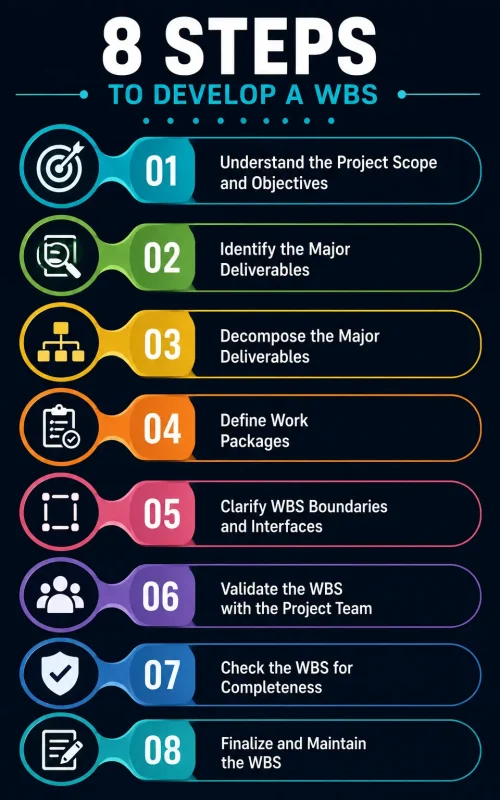
1. Understand the Project Scope
Before creating the WBS, establish a clear understanding of what the project is expected to deliver. The WBS should be developed from the approved project scope rather than from a list of activities or assumptions about how the work will be performed.
Start by reviewing the project objectives, scope statement, requirements, contract documents, business case, technical information, and known deliverables. Identify what is inside the project scope and what is outside it.
Start With the Expected Outcome
Ask:
- What is the project expected to deliver?
- What are the major deliverables?
- What requirements must be satisfied?
- What work is explicitly included?
- What work is excluded?
- Are there any scope boundaries or contractual interfaces?
At this stage, do not try to create detailed activities. Focus on understanding the end result and the major outputs the project must produce.
A clear scope provides the foundation for decomposition. If the scope is incomplete or still changing, document the uncertainty and confirm the available information before developing detailed WBS elements.
The objective of this step is simple: understand what the project must deliver before deciding how the work should be structured.
2. Identify the Major Deliverables
Once the project scope is understood, identify the major deliverables that the project must produce. These deliverables form the main building blocks of the WBS and provide a clearer starting point than individual activities.
Review the project requirements, scope documentation, contract, design information, business objectives, and expected outcomes. Group the work around what the project must deliver, rather than around the sequence in which people expect to perform the work.
Focus on What Must Be Delivered
Ask:
- What are the major outputs of the project?
- What physical, technical, business, or operational deliverables are required?
- What major components make up the final project outcome?
- Are there contractual or client-specific deliverables?
- Are supporting deliverables such as testing, documentation, commissioning, or handover required?
For example, an industrial project may have major deliverables such as Civil Works, Structural Works, Mechanical Systems, Electrical Systems, Instrumentation, and Commissioning.
Do not decompose these into detailed activities yet. First establish a logical set of major deliverables that collectively represent the project’s intended outcome.
The objective of this step is to establish the major building blocks of the project before progressively breaking them into smaller, manageable components.
3. Decompose the Major Deliverables
Once the major deliverables have been identified, progressively break them into smaller, manageable components until the work can be planned and controlled effectively. This is the core of WBS development.
Start with each major deliverable and ask:
“What smaller deliverables or components are required to produce this?”
Continue decomposing each branch until the elements are clear enough to support estimating, responsibility assignment, scheduling, cost control, and progress measurement.
Decompose From Deliverables
For example, a major deliverable such as Electrical Systems may be broken into:
- Power Distribution
- Lighting System
- Earthing System
- Cable Installation
- Testing & Commissioning
These can be decomposed further where necessary.
The level of decomposition does not need to be identical across every branch. Some deliverables may require several levels, while others may be sufficiently defined at a higher level.
Avoid decomposing simply to create more levels. Stop when further breakdown no longer provides meaningful improvement in planning, estimating, responsibility, or control.
The objective of this step is to create a logical hierarchy in which the project’s major deliverables are progressively broken down into manageable components without losing sight of the overall project scope.
4. Define Work Packages
After decomposing the major deliverables into manageable components, identify the work packages that will form the practical control points within the WBS. A work package should represent a clearly defined portion of project scope that can be assigned, estimated, scheduled, monitored, and controlled.
Make Each Work Package Meaningful
For each potential work package, consider:
- Is the scope clearly understood?
- Can responsibility be assigned to one accountable party?
- Can the work be reasonably estimated?
- Can its progress be measured?
- Can its cost and resources be identified?
- Does it have a clear beginning and end?
- Can it be managed without repeatedly changing its definition?
For example, Electrical Systems could be decomposed into Power Distribution, Lighting, Earthing, and Cable Installation, with each becoming a work package where the level of detail is appropriate for project control.
Do not make every WBS element a work package automatically. Some elements may still need further decomposition, while others may already be sufficiently defined.
The objective is to establish manageable units of scope that provide a practical foundation for estimating, scheduling, assigning responsibility, measuring progress, and controlling the project.
5. Clarify WBS Boundaries and Interfaces
Once the work packages are defined, review how they connect with each other and with other parts of the project. Clear boundaries help prevent scope gaps, duplicated work, and unclear ownership, particularly when multiple disciplines, contractors, or organizations are involved.
Check What Belongs Where
For each work package, consider:
- What work is included?
- What work is specifically excluded?
- Who is responsible for delivering it?
- What other work must be completed before it can proceed?
- Which teams, contractors, or suppliers interact with it?
- Are any activities or deliverables appearing in more than one location?
For example, responsibility for equipment installation may sit with a construction contractor, while equipment supply belongs to procurement. If the boundary is unclear, both teams may assume the other is responsible for part of the scope.
Pay particular attention to interfaces between engineering, procurement, construction, testing, commissioning, operations, and external contractors.
The WBS does not need to describe every interface in detail, but important boundaries should be clear enough that the project team understands who owns each part of the scope and where one work package connects with another.
The objective of this step is to make the scope boundaries and interfaces clear before the WBS is finalized and used for project planning and control.
6. Validate the WBS With the Project Team
Once the WBS structure and boundaries are established, review it with the people who understand the project scope and will be responsible for delivering the work. A WBS developed only by the planning team can appear complete while still missing practical work, interfaces, or execution requirements.
Challenge the Structure
Ask the relevant project team members:
- Does the WBS represent the complete project scope?
- Are any deliverables or work packages missing?
- Is any work duplicated?
- Are the boundaries between work packages clear?
- Are the work packages understandable to the people responsible for them?
- Is the level of decomposition appropriate?
- Can the structure support estimating, scheduling, cost control, and progress measurement?
Include appropriate engineering, procurement, construction, commercial, project controls, operations, contractors, and subject-matter experts depending on the project.
Do not treat the review as simply an approval exercise. Ask the team to challenge the structure and identify what may have been overlooked.
Resolve identified gaps, overlaps, and ambiguities before baselining the WBS.
The objective of this step is to test the WBS against the knowledge and experience of the people who will actually plan, manage, and deliver the project.
7. Check the WBS for Completeness
After the project team has reviewed the WBS, perform a structured completeness check before using it as the foundation for further planning. The purpose is to confirm that the WBS represents the entire project scope without unnecessary duplication or unrelated work.
Test the WBS Against the Project Scope
Review each major branch and ask:
- Does every major project deliverable appear in the WBS?
- Can every work package be traced back to an approved scope requirement or deliverable?
- Is any required work missing?
- Is any work included that does not belong to the project?
- Are supporting deliverables such as testing, documentation, commissioning, handover, and closeout covered where applicable?
- Are there overlapping work packages or duplicated scope?
- Can the complete project outcome be understood by looking at the WBS?
A useful test is to work from the top down and from the bottom up. Start with the project objectives and confirm that they are represented through the hierarchy. Then review the lowest-level elements and confirm that, collectively, they account for the higher-level deliverables.
This review should also confirm that the WBS is deliverable-oriented and sufficiently stable before it is connected to cost, schedule, and other project control structures.
The objective of this step is to establish confidence that the WBS represents the complete project scope and provides a reliable foundation for the next stages of project planning and control.
8. Finalize and Maintain the WBS
Once the WBS has been reviewed and its completeness confirmed, finalize the structure so it can become a consistent reference for project planning and control. The approved WBS should have clear numbering, naming, ownership, scope boundaries, and appropriate levels of decomposition.
Establish the WBS as a Project Reference
Before finalizing, confirm that:
- WBS elements have consistent names and identification codes.
- Each work package has a clear scope boundary.
- Responsibility can be assigned to the appropriate team or organization.
- The structure can support cost, schedule, progress, and reporting requirements.
- Changes identified during validation have been incorporated and agreed.
- The WBS is aligned with the approved project scope and applicable governance requirements.
Once approved, control changes to the WBS through the project’s change management process. The WBS should not be changed informally simply because a planning or execution team wants to reorganize the structure.
At the same time, do not treat the WBS as permanently frozen. As project scope is formally changed or progressively clarified, the WBS may need controlled refinement.
The objective of this step is to establish a reliable, controlled WBS that can serve as a common foundation for scheduling, estimating, responsibility assignment, progress measurement, cost control, and project reporting.
Practical Example
Putting the Approach Into Practice
A construction project is preparing to execute a major building package. The project team has defined the overall scope, but the initial project scope is still expressed mainly in broad terms such as structural works, architectural works, MEP services, testing, and handover.
The project manager asks the planning team to develop a Work Breakdown Structure (WBS) that can provide a clear foundation for estimating, scheduling, assigning responsibilities, and controlling the work.
1. Understand the Project Scope and Objectives
The team first reviews the project objectives, contractual requirements, deliverables, drawings, specifications, and acceptance requirements.
They confirm what the project is expected to deliver and what is included within the project scope.
Rather than immediately listing activities, the team starts by understanding the end deliverables that the project must produce.
2. Identify the Major Deliverables
The team identifies the major deliverables required to complete the building package.
For example, these may include:
- Engineering and design
- Procurement
- Civil and structural works
- Architectural works
- MEP systems
- Testing and commissioning
- Handover and closeout
These become the major branches of the WBS.
3. Decompose the Deliverables
The team progressively breaks each major deliverable into smaller components.
For example, Civil and Structural Works may be decomposed into:
- Site preparation
- Excavation
- Foundations
- Structural frame
- Roofing
- External works
The team continues decomposition until the work is sufficiently defined to support planning, estimating, responsibility assignment, and progress measurement.
4. Define Work Packages
The planning team identifies appropriate work packages at the level where the work can be reasonably estimated, assigned, scheduled, and controlled.
For example, “Foundations” may be divided into work packages such as:
- Excavation and formation
- Reinforcement
- Formwork
- Concrete works
- Waterproofing
The objective is not to create the maximum possible number of WBS elements. The team stops when further decomposition no longer provides useful control.
5. Clarify Boundaries and Interfaces
The team reviews each WBS element to determine what is included and where responsibility passes to another deliverable or discipline.
For example, the team clarifies whether embedded MEP items are included within structural works or MEP works and identifies the interface between equipment procurement and installation.
This prevents gaps, overlaps, and unclear ownership.
6. Validate the WBS With the Project Team
The draft WBS is reviewed with engineering, procurement, construction, commercial, quality, commissioning, and subcontractor representatives.
During the review, the team identifies that temporary works and testing activities were not adequately represented in the initial structure.
These elements are added before the WBS is finalized.
7. Check the WBS for Completeness
The team checks whether the WBS represents all the project scope required to deliver the intended outcome.
They review:
- Scope coverage
- Deliverables
- Work packages
- Interfaces
- Responsibility boundaries
- Testing and commissioning
- Handover and closeout
The team also checks for duplicated or overlapping work.
8. Finalize and Maintain the WBS
Once reviewed and agreed, the WBS is formally established as a reference structure for the project.
The planning team can then use it to develop activities, assign responsibilities, estimate resources and costs, and build the project schedule using Primavera P6, while also supporting progress measurement and project control.
If approved scope changes later occur, the WBS is reviewed and updated through the project’s change-control process.
The Lesson
A useful WBS is not simply a list of project activities.
It provides a structured decomposition of the project scope into manageable deliverables and work packages that can support planning, execution, responsibility assignment, estimating, scheduling, and control.
The strength of the WBS comes from complete scope coverage, logical decomposition, clear boundaries, appropriate detail, and validation by the people responsible for delivering the work.
Common Mistakes to Avoid
Developing a WBS may seem straightforward, but small weaknesses can create problems in estimating, scheduling, assigning responsibilities, measuring progress, and controlling the project.
Starting With Activities Instead of Deliverables
A WBS is intended to structure the project scope, not simply provide a list of activities.
Starting with activities can cause the team to focus on how the work will be performed before establishing what the project needs to deliver.
Start with the project objectives, scope, and major deliverables. Then progressively decompose those deliverables into smaller components.
Building the WBS From an Unclear Scope
If the scope is incomplete or poorly understood, important work may be missed or unnecessary work may be included. Confirm the project objectives, scope, deliverables, and boundaries before developing the WBS.
A WBS cannot reliably compensate for an undefined project scope.
Decomposing Too Much or Too Little
A WBS with too little detail may not support effective planning or control. Excessive decomposition can make the structure difficult to maintain.
Continue decomposition until the work is sufficiently defined to estimate, assign, schedule, monitor, and control.
Missing or Overlapping Scope
Required work can easily be overlooked, particularly supporting activities such as engineering, procurement, testing, commissioning, handover, and closeout.
At the same time, unclear boundaries can cause the same work to appear under multiple WBS elements.
Check for both gaps and duplication.
Developing the WBS Without the Execution Team
Planners may not see practical requirements, interfaces, or execution constraints that are obvious to engineers, contractors, procurement teams, or construction personnel.
Involve the people responsible for delivering the work and validate the WBS with them.
Confusing the WBS With the Schedule
The WBS defines what the project needs to deliver. The schedule defines when and how the work will be performed.
Avoid turning the WBS into an unnecessarily detailed activity list.
Ignoring Interfaces and Boundaries
Work can fall between disciplines, contractors, or organizational responsibilities when interfaces are not clearly considered.
Identify important handoffs, responsibility boundaries, and shared deliverables during WBS development.
Failing to Validate the WBS
A WBS should be challenged before it becomes the basis for downstream planning:
- Is all project scope represented?
- Is any work duplicated?
- Are the boundaries clear?
- Are the work packages manageable?
- Can the structure support estimating, scheduling, and progress measurement?
Treating the WBS as a One-Time Document
The WBS is established early, but project scope can change.
Approved scope changes, design development, contract modifications, and other changes may require the WBS to be reviewed and updated.
Changes should be managed through the project’s change-control process so that the WBS remains aligned with the approved scope and continues to provide a reliable foundation for planning and control.
Focusing on the WBS Structure Rather Than Its Purpose
A visually impressive WBS does not necessarily represent good scope decomposition.
The real test is whether the WBS provides a clear, complete, and manageable representation of the project scope that can support estimating, scheduling, responsibility assignment, progress measurement, and project control.
The objective is not to create the most detailed WBS possible. It is to create a structure that helps the project team understand what must be delivered and how the scope can be effectively managed.
Key Takeaways
A strong WBS is more than a hierarchy of project elements. It provides a clear and manageable structure for understanding, planning, assigning, and controlling the project scope. Its value depends on complete scope coverage, logical decomposition, clear boundaries, and validation by the people responsible for delivery.
- Start with the project scope. Understand the objectives, requirements, deliverables, and boundaries before decomposing the work.
- Focus on deliverables. Structure the WBS around what the project must deliver rather than simply listing activities.
- Decompose the work logically. Break major deliverables into smaller components until they can be effectively estimated, assigned, scheduled, and controlled.
- Choose the right level of detail. Avoid both overly broad elements and unnecessary decomposition.
- Define clear boundaries. Make sure each WBS element has a clear scope and does not overlap with another element.
- Cover the complete project scope. Include supporting work such as engineering, procurement, testing, commissioning, handover, and closeout where applicable.
- Involve the people who will deliver the work. Their practical knowledge can identify missing scope, interfaces, and execution requirements.
- Validate the WBS before using it. Check for gaps, duplication, unclear ownership, and inappropriate levels of decomposition.
- Use the WBS as a foundation. A well-developed WBS can support schedule development, estimating, responsibility assignment, progress measurement, and project control.
- Maintain the WBS when scope changes. Approved changes should be reflected through the project’s change-control process.
A good WBS is not the most detailed structure. It is a complete, logical, and manageable representation of project scope that gives the team a reliable foundation for planning and control.
References
- U.S. GAO — Schedule Assessment Guide: Best Practices for Project Schedules
- NASA — Work Breakdown Structure Handbook and Program Planning & Control Guidance
- APM — How to Create a Work Breakdown Structure
- APM — Use of Product Breakdown Structures and Work Breakdown Structures
- INCOSE — The Work Breakdown Structure: It’s Much More Than a Cost Reporting Structure
- INCOSE — Towards a Work Breakdown Structure for Net-Centric System of Systems Engineering and Management
- Globerson — Impact of Various Work-Breakdown Structures on Project Conceptualization
- Siami-Irdemoosa, Dindarloo & Sharifzadeh — Work Breakdown Structure Development for Underground Construction
- Makarfi Ibrahim, Kaka, Aouad & Kagioglou — Framework for a Generic Work Breakdown Structure for Building Projects
- Journal of Systems and Software — The Work Breakdown Structure in Software Project Management
- NASA — Work Breakdown Structure Definition and Project Management Glossary
- U.S. GAO — Cost Estimating and Assessment Guide: Best Practices for Developing and Managing Program Costs
FEATURED PROJECT PLANNING & SCHEDULING GUIDES
Practical Guidance for Planning, Scheduling, and Schedule Control
Effective project planning and scheduling requires more than creating activities and assigning dates. Our featured guides focus on practical planning and scheduling activities, helping professionals structure projects, establish sound planning foundations, review schedules, and maintain schedule control.
How to Manage Schedule Baseline Changes
Understand how to assess proposed changes to an approved schedule baseline, evaluate their impacts, obtain appropriate approval, and maintain proper baseline control.
How to Review and Validate a Project Schedule
Learn how to assess schedule structure, logic, durations, constraints, milestones, float, and other schedule characteristics to determine whether a schedule is complete, logical, and fit for purpose.
How to Develop a Project Schedule Basis
Understand how to establish the assumptions, methodologies, calendars, durations, relationships, constraints, and other considerations that form the basis of a reliable project schedule.
MORE PROJECT PLANNING & SCHEDULING RESOURCE TYPES
Continue Your Project Planning & Scheduling Learning
Project planning and scheduling knowledge becomes more valuable when you can understand the concepts, apply structured approaches, and develop practical skills. Explore the other resources within the Project Planning & Scheduling collection to complement the guidance provided in these guides.
Templates
Use practical templates and checklists to organize planning information, document scheduling decisions, review schedules, and support schedule control activities.
Downloads
Access useful planning and scheduling materials and reference resources to support learning and day-to-day project planning and controls activities.
Career Roadmaps
Follow structured learning paths to develop project planning, scheduling, and project controls knowledge, practical skills, and professional capabilities.
Case Studies
Explore planning and scheduling situations, decisions, challenges, and outcomes to understand how planning and scheduling practices are applied in real projects.
Glossary
Find clear explanations of project planning, scheduling, project controls, schedule management, and related professional terminology.
Insights & Articles
Explore professional perspectives, practical insights, emerging practices, and deeper discussions relevant to project planning, scheduling, and project controls.
Looking for more project management resources? Explore the Kleios Technologies Resources Hub to discover our complete collection of guides, templates, downloads, career roadmaps, case studies, glossary resources, and insights.
RELATED KNOWLEDGE DOMAINS
Continue Your Learning Across Related Knowledge Domains
Project Management is closely connected with specialized disciplines that support successful planning, execution, governance, performance measurement, and professional growth. Explore related knowledge domains to expand your expertise, develop complementary skills, and access practical resources across the complete project management ecosystem.
Expand your expertise one domain at a time and build a well-rounded project management skill set.
Why Explore Related Domains?
- Develop cross-functional project management expertise
- Discover specialized knowledge beyond core project management
- Access practical resources across interconnected disciplines
- Build a complete professional learning pathway
- Strengthen career readiness through continuous learning
Each knowledge domain complements your Project Management expertise, helping you build broader capabilities and solve real-world project challenges with greater confidence.
Project Management
Practical project management knowledge, practices, and professional resources.
Project Controls
Performance measurement, forecasting, and project control best practices.
PMO
Governance, portfolio management, and organizational project excellence.
Risk Management
Risk identification, assessment, mitigation, and monitoring resources.
Primavera P6
Professional planning, scheduling, resource management, and reporting.
Microsoft Project
Project scheduling, tracking, reporting, and collaboration resources.
Power BI
Interactive dashboards, reporting, visualization, and project analytics.
PMI Certifications
Certification guidance, exam preparation, and professional development resources.