
PROJECT PLANNING & SCHEDULING GUIDE
How to Develop a Project Plan
Developing a project plan requires more than listing activities and assigning dates. This guide provides a practical approach to define scope, organize deliverables, identify work, establish dependencies, plan resources, address risks and assumptions, and build a realistic basis for project delivery.
Practical Guide · Project Management
The Project Planning Challenge
Developing a project plan means turning project objectives, scope, deliverables, and expectations into a practical basis for execution. In real projects, this is rarely a straightforward exercise. Planning teams must work with information that is still developing, involve people with different perspectives, and make decisions about work that has not yet started.
Research across different project environments has identified planning quality, scope and requirements definition, activity definition, stakeholder involvement, and schedule development as important factors influencing project planning and project outcomes. The challenge is to develop enough structure to guide execution without creating unrealistic certainty.
Turning Project Scope Into Executable Work
A project may begin with high-level objectives, requirements, and deliverables rather than a complete definition of the work. The planning team must progressively translate these into manageable work packages and activities that can be assigned, sequenced, estimated, and monitored.
Planning With Incomplete Information
Planning often begins while requirements, designs, technical information, quantities, resource requirements, or execution details are still developing. The team must therefore build the plan using the best available information while clearly recognizing what is still uncertain.
Bringing the Right People Into Planning
A realistic plan requires knowledge from the people who will define, design, procure, construct, manage, and operate the project’s deliverables. When important execution knowledge is missing from the planning process, activities, durations, dependencies, and responsibilities may not reflect actual project conditions.
Balancing Planning Detail With Planning Effort
A plan needs enough detail to support coordination, execution, and control, but excessive detail can consume significant planning effort without necessarily improving project outcomes. The appropriate level of planning depends on the project’s size, complexity, uncertainty, and management needs.
Establishing Realistic Work and Relationships
The plan must represent how the work is expected to happen in practice. Activities need realistic durations, logical relationships, responsibilities, and sequencing. Missing or incorrectly connected work can make an otherwise complete plan difficult to execute.
Dealing With Uncertainty and Changing Conditions
A project plan describes future work, but future conditions cannot be known with complete certainty. Requirements may change, resources may become unavailable, suppliers may face delays, and project risks may materialize. The plan must therefore provide structure while remaining capable of being managed as conditions change.
Making the Plan Reliable for Execution
A project plan can be complete as a document without being reliable as an execution tool. It needs to be reviewed against actual project conditions, challenged by the people responsible for delivery, and sufficiently realistic to support decisions throughout the project.
The Core Challenge
The challenge is therefore not simply producing a project plan.
It is developing a plan that provides a credible and practical basis for execution despite incomplete information, different stakeholder perspectives, uncertainty, and changing project conditions.
Why Project Planning Goes Wrong
Project planning rarely goes wrong because of one isolated mistake. Weak project plans are often the result of unclear scope, incomplete information, limited stakeholder involvement, unrealistic expectations, weak planning practices, and inadequate validation.
Understanding these underlying causes helps the planning team identify where the planning process is becoming unreliable before the plan is approved and used for execution.
1. Planning Starts Before the Project Is Properly Defined
A planning team may be asked to develop a detailed plan before the project’s objectives, scope, deliverables, requirements, or execution approach are sufficiently understood.
This creates a difficult situation: the team has to produce detailed planning information while the information needed to support that detail is still changing.
The result can be repeated replanning, unstable activities, changing dates, and an increasing number of assumptions.
A project plan should develop from a sufficiently understood project scope, not attempt to compensate for an undefined project.
2. The Scope Is Not Properly Decomposed
A high-level scope statement does not provide enough information to plan the actual work.
If major deliverables are not broken down into manageable work packages and activities, important work can remain hidden. The team may also struggle to estimate durations, assign responsibilities, establish dependencies, and measure progress.
This is why the relationship between scope, WBS, work packages, activities, and schedule is fundamental to project planning.
3. Planning Is Based on Incomplete or Unreliable Information
Planning decisions are only as useful as the information behind them.
Design information may still be developing. Requirements may change. Quantities may be uncertain. Resource availability may not be confirmed. Procurement information may be incomplete.
When planners treat preliminary information as final information, the resulting plan can appear more reliable than it actually is.
The better approach is to distinguish between confirmed information, assumptions, estimates, and information still requiring validation.
4. The People Who Will Execute the Work Are Not Involved Enough
Planning teams may have strong planning knowledge but limited visibility into how the work will actually be performed.
Engineers, procurement specialists, construction teams, contractors, subcontractors, operations personnel, and other subject-matter experts may hold important information about sequencing, productivity, resources, access, interfaces, and constraints.
When their knowledge is not incorporated early enough, the plan may be technically structured but practically difficult to execute.
5. The Plan Is Built Around Dates Instead of the Work
A common planning weakness occurs when a required completion date is established first and the work is then forced into that timeframe.
This can lead to unrealistic activity durations, excessive resource assumptions, compressed sequences, or insufficient allowance for procurement and approvals.
The planning process should instead establish what needs to be done and how it can realistically be performed before determining whether the required completion date is achievable.
6. Estimates Depend Too Much on Individual Judgement
Professional experience is valuable, but relying entirely on personal judgement can make planning estimates inconsistent.
Where available, planners should consider:
- Historical project data
- Productivity information
- Previous project performance
- Specialist estimates
- Lessons learned
- Supplier information
- Actual resource availability
A plan becomes more defensible when important estimates can be explained rather than simply attributed to experience.
7. Assumptions Are Not Properly Managed
Every project plan contains assumptions, particularly when information is incomplete.
Problems arise when assumptions are:
- Not documented
- Not reviewed
- Not assigned an owner
- Not validated
- Treated as confirmed facts
An assumption about resource availability, procurement duration, approval timing, productivity, or design release can eventually become a significant planning issue if it proves incorrect.
Important assumptions should be visible and actively managed rather than hidden inside the plan.
8. Dependencies and Interfaces Are Not Fully Identified
Project work is interconnected.
Engineering may need to complete information before procurement can proceed. Procurement may need to deliver materials before construction can begin. Construction may need to complete installation before testing can start.
When these interfaces are not properly identified, the plan can contain individually reasonable activities but still fail to represent the actual execution sequence.
9. Risks and Constraints Are Kept Separate From Planning
Risk registers, constraint logs, assumptions, and project schedules are sometimes maintained as separate management activities.
The problem is that identifying a risk does not automatically show how it could affect project execution.
For example, identifying a risk that critical equipment may be delivered late is not enough. The planning team also needs to understand which activities, milestones, resources, and completion dates could be affected.
Planning becomes stronger when risks and constraints are connected to the work they can influence.
10. The Plan Is Made More Detailed Than Necessary—or Not Detailed Enough
There is no single level of detail that is appropriate for every project.
A plan with insufficient detail may not provide enough control over important work. A plan with excessive detail can become difficult to maintain and consume significant planning effort without improving decision-making.
The appropriate level of detail should reflect the project’s size, complexity, uncertainty, contractual requirements, execution environment, and management needs.
11. The Plan Is Not Properly Challenged Before Approval
A plan can look complete while still containing unrealistic assumptions or execution problems.
If the planning team only checks whether activities, dates, and responsibilities have been entered, important weaknesses can remain undiscovered.
A stronger review asks:
- Can the work actually be performed in this sequence?
- Are the durations achievable?
- Are the required resources available?
- Are the dependencies realistic?
- What assumptions are critical?
- What could prevent the planned milestones from being achieved?
The objective is to test the plan before the project tests it for us.
12. The Project Plan Is Treated as a One-Time Document
A project plan is sometimes considered complete once it has been approved.
In reality, projects evolve. Scope changes, risks emerge, resources change, procurement conditions shift, and execution experience provides new information.
If the plan is not reviewed and maintained as the project develops, it can quickly become disconnected from actual project conditions.
A good planning process therefore includes regular review, controlled updates, forecasting, and change management.
What Should You Do?
Developing a project plan is not simply a matter of listing activities, assigning dates, and documenting responsibilities. A useful project plan should translate the project’s objectives and scope into a realistic approach for delivering the work.
A practical planning process helps you establish what needs to be delivered, understand the work required, involve the right people, identify assumptions and constraints, determine how the work will be sequenced and resourced, and validate whether the resulting plan is achievable.
Use the following 8-step approach when developing a project plan:
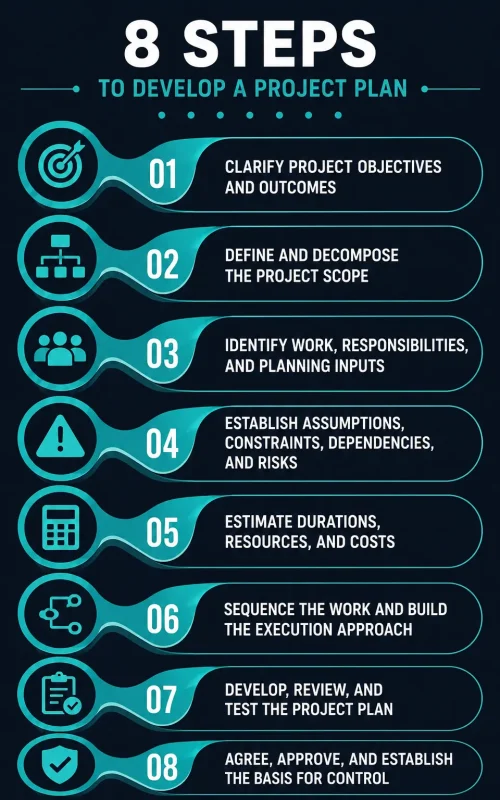
1. Clarify the Project Objectives and Expected Outcomes
Before planning the work, establish what the project is expected to achieve.
A project plan cannot be considered reliable if the team has different interpretations of the project’s purpose, expected outcomes, or definition of success.
Start With the Project Objectives
Ask:
- What is the project expected to achieve?
- What problem or business need is the project addressing?
- What are the key deliverables?
- What does successful completion look like?
- What are the major acceptance requirements?
- What outcomes are most important to the sponsor, client, or organization?
The objective should be specific enough to guide planning decisions.
For example, “Implement a new system” provides limited planning direction. A stronger definition would identify the system, intended users, major capabilities, implementation boundaries, and expected outcome.
Establish Planning Boundaries
Clarify what is included in the project and what is outside its responsibility.
This helps prevent the planning team from developing work that does not belong to the project while overlooking work that does.
Start planning from a shared understanding of the outcome—not from a blank activity list.
2. Define and Decompose the Project Scope
Once the project objectives are clear, translate the expected outcomes into manageable deliverables and work.
The planning team needs to understand what must be produced before deciding how and when the work will be performed.
Identify the Major Deliverables
Break the project into its major deliverables, phases, or work areas.
Depending on the project, these could include:
- Engineering and design
- Procurement
- Construction
- Testing and commissioning
- Training
- Deployment
- Handover
The exact structure will depend on the project environment.
Develop the Work Breakdown Structure
Decompose major deliverables into progressively smaller components until the work can be reasonably estimated, assigned, scheduled, and controlled.
The objective is not to create the maximum possible number of WBS elements.
The objective is to reach a level where the team can answer:
- What work has to be performed?
- Who is responsible?
- What resources are required?
- How long could it take?
- What does it depend on?
- How will progress be measured?
Check Scope Completeness
Before moving forward, ask:
“If this plan is executed exactly as written, will everything required to deliver the agreed project outcome actually be completed?”
This question can expose missing work that may otherwise appear later during execution.
3. Identify the Work, Responsibilities, and Planning Inputs
After defining the scope, identify the work required to produce the deliverables and determine who needs to contribute to planning it.
A planner should not be expected to know every execution detail independently.
Define the Required Work
Translate work packages into activities or tasks that can be planned and managed.
Each activity should represent a meaningful piece of work rather than an unnecessarily small action.
Consider:
- What needs to happen?
- What is the expected output?
- Who will perform the work?
- What information is required?
- What resources are needed?
- What must happen before the work can start?
Involve the People Who Know the Work
Engage the people responsible for execution and specialist areas where appropriate.
This may include:
- Project managers
- Engineers
- Design teams
- Procurement teams
- Construction managers
- Contractors
- Subcontractors
- Commercial teams
- Quality teams
- Operations representatives
Their input can improve estimates, sequencing, resource assumptions, interfaces, and execution logic.
The planning team develops the plan, but the people who execute the work help make the plan realistic.
4. Establish Assumptions, Constraints, Dependencies, and Risks
A project plan describes future work, so uncertainty is unavoidable.
Rather than hiding uncertainty inside dates and estimates, identify the conditions that influence the plan.
Document Important Assumptions
Record assumptions that materially influence planning.
Examples include:
- A resource will be available by a particular date.
- Design information will be released on time.
- A supplier will meet the expected delivery period.
- Required approvals will be obtained within the planned timeframe.
An assumption should not be treated as a confirmed fact simply because it has been included in the plan.
Identify Constraints
Determine what limits the project’s ability to execute the work.
Constraints may relate to:
- Required completion dates
- Resource availability
- Budget
- Site access
- Procurement lead times
- Regulatory requirements
- Contractual obligations
- Working hours
- Shutdown windows
Identify Dependencies and Interfaces
Understand how different parts of the project depend on one another.
For example:
Design → Procurement → Delivery → Installation → Testing → Commissioning
The actual relationship may be more complex, but the principle is important: the plan should reflect how the work will actually flow.
Connect Risks to the Plan
Identify risks that could materially affect planned activities, milestones, resources, or completion dates.
This creates a stronger connection between risk management and project planning.
5. Estimate Durations, Resources, and Costs
Once the work is understood, determine what will be required to perform it.
This is where the plan begins moving from a description of the project toward a realistic execution model.
Estimate Activity Durations
Estimate how long each activity is reasonably expected to take.
Where possible, use:
- Historical project data
- Productivity information
- Specialist input
- Supplier information
- Previous project experience
- Quantity and productivity calculations
- Three-point estimates where uncertainty is significant
Avoid simply selecting dates because they fit the required completion date.
Determine Resource Requirements
Identify the resources needed to perform the work, such as:
- People
- Equipment
- Materials
- Facilities
- Specialist services
Then consider whether those resources are actually available when required.
Consider Cost Implications
Where the project planning process requires cost integration, connect planned work with relevant cost information.
This creates a stronger foundation for:
- Cost planning
- Resource planning
- Cash-flow forecasting
- Progress measurement
- Earned Value Management
A plan is only as achievable as the resources and conditions assumed behind it.
6. Sequence the Work and Build the Execution Approach
Now determine how the identified work is expected to happen.
The objective is to develop a logical execution sequence rather than simply assigning dates to activities.
Establish Activity Relationships
Determine which activities need to occur before, after, or alongside other activities.
Consider:
- Mandatory dependencies
- Technical dependencies
- Contractual dependencies
- Resource dependencies
- External dependencies
- Interfaces between teams or organizations
Identify the Major Milestones
Establish important points such as:
- Design completion
- Procurement milestones
- Construction starts
- Major deliveries
- Testing
- Commissioning
- Client approvals
- Handover
Milestones provide important reference points for monitoring project progress.
Build the Overall Execution Logic
At this stage, the planner should be able to explain:
“This is how we currently expect the project to move from start to completion.”
If the sequence cannot be explained clearly, the plan probably requires further development.
7. Develop, Review, and Test the Project Plan
Once the planning information has been assembled, bring it together into an integrated project plan.
Depending on the project, this may include:
- Scope and WBS
- Activities
- Milestones
- Dependencies
- Durations
- Resources
- Costs
- Assumptions
- Constraints
- Risks
- Responsibilities
- Key dates
- Reporting and control requirements
The objective is to create one coherent representation of how the project is expected to be delivered.
Once the planning information has been assembled, bring it together into an integrated project plan.
Test the Plan
Do not approve the plan simply because all required fields have been completed.
Challenge it.
Ask:
- Is the scope complete?
- Are the activities realistic?
- Are durations achievable?
- Are dependencies logical?
- Are resources available?
- Are important assumptions documented?
- Are constraints reflected?
- Are risks adequately considered?
- Are key milestones achievable?
- Does the sequence reflect the actual execution approach?
Conduct a Cross-Functional Review
Ask the people who will execute the project to review the plan.
A planner may identify a logical dependency that looks correct on paper, while an experienced execution team may identify a practical constraint that makes the sequence unrealistic.
The purpose of review is not to prove that the plan is correct. It is to discover where the plan may be wrong before execution exposes the problem.
8. Agree, Approve, and Establish the Basis for Control
A project plan becomes useful when the relevant stakeholders agree on what it represents and how it will be used.
Confirm the Planning Basis
Document the important basis behind the plan, including:
- Scope assumptions
- Major constraints
- Key milestones
- Resource assumptions
- Important dependencies
- Risk considerations
- Planning methodologies
- Estimation basis
- Key exclusions
This provides context when the plan is reviewed later.
Obtain Appropriate Approval
Ensure the appropriate project authority reviews and approves the plan according to the project’s governance requirements.
Approval should not mean that the plan will never change.
It means there is an agreed basis from which the project can be executed, monitored, and controlled.
Establish How the Plan Will Be Managed
Define how the plan will be:
- Monitored
- Updated
- Reported
- Forecast
- Changed
- Reviewed
This is particularly important when the project moves from planning into execution and control.
A project plan should become a management baseline and working reference—not a document that is filed away after approval.
Practical Example
Putting the Approach Into Practice
A construction project is preparing to start the execution phase of a major building package. The project has defined completion requirements, but the planning team is facing several uncertainties around design releases, procurement lead times, subcontractor availability, site access, and required approvals.
The project manager asks the planning team to develop a project plan that can be used as the basis for execution and project control.
1. Clarify the Project Objectives and Expected Outcomes
The team first confirms what the project must achieve, including the required deliverables, contractual milestones, completion requirements, quality expectations, and key acceptance criteria.
Rather than starting with an activity list, the team establishes a common understanding of what successful project delivery means.
2. Define and Decompose the Project Scope
The team breaks the project scope into major deliverables and develops a WBS covering engineering, procurement, construction, testing, commissioning, and handover.
The work is decomposed far enough to identify the activities, responsibilities, resources, and interfaces required for execution.
3. Identify the Work, Responsibilities, and Planning Inputs
The planning team works with engineering, procurement, construction, commercial, quality, and subcontractor representatives to identify the work required and clarify responsibilities.
This reveals several activities and interfaces that were not visible in the initial high-level scope.
4. Establish Assumptions, Constraints, Dependencies, and Risks
The team documents important planning assumptions, including expected design release dates, material delivery periods, resource availability, and approval timelines.
They also identify constraints such as limited site access and a fixed commissioning window, along with risks that could affect the planned sequence.
5. Estimate Durations, Resources, and Costs
The team develops realistic duration estimates using productivity information, historical project data, supplier information, and input from experienced personnel.
Resource requirements are reviewed against expected availability, while major cost implications are identified where relevant.
This prevents the plan from being built around dates that are achievable only if unrealistic resources or productivity levels are assumed.
6. Sequence the Work and Build the Execution Approach
The team establishes the relationships between engineering, procurement, construction, testing, and commissioning activities.
Key milestones and major interfaces are identified, allowing the team to develop a logical sequence for executing the project.
The resulting plan shows not only what needs to happen, but also how the project is expected to move from start to completion.
7. Develop, Review, and Test the Project Plan
The complete plan is reviewed with the project team and key execution stakeholders.
The review identifies an unrealistic assumption regarding equipment delivery and a resource conflict between two major work areas.
The team adjusts the plan before execution begins and confirms that the revised sequence is achievable with the available resources.
8. Agree, Approve, and Establish the Basis for Control
The project team documents the key planning assumptions, constraints, milestones, dependencies, and other important planning information.
The appropriate project authority reviews and approves the plan.
The team then establishes how progress will be measured, how the plan will be updated, how changes will be controlled, and how future performance will be compared against the agreed plan.
The Lesson
A useful project plan is not created by simply filling a schedule with activities and dates.
It is developed by progressively building an understanding of the objectives, scope, work, responsibilities, assumptions, constraints, resources, dependencies, risks, and execution approach, and then testing whether the resulting plan is actually achievable.
The strength of the plan comes from the quality of the planning process behind it, not simply from the document or software used to represent it.
Common Mistakes to Avoid
Developing a project plan can appear straightforward, but seemingly small planning weaknesses can create significant problems during execution. A plan may look complete while still being unrealistic, incomplete, or difficult to use for project control.
Avoiding these common mistakes can improve the quality, reliability, and usefulness of the project plan.
Starting With Activities Instead of Objectives
Jumping directly into activities and dates can cause the planning team to build a detailed plan without a clear understanding of what the project is actually expected to achieve.
Start with the project objectives, expected outcomes, deliverables, and success criteria before defining the work.
Planning Without Clearly Defining the Scope
If the project scope is unclear or incomplete, the plan may miss important work or include work that does not belong to the project.
Define the scope and major deliverables before decomposing the work into manageable components.
Creating an Overly Detailed or Incomplete Plan
Too little detail makes the plan difficult to manage. Excessive detail can make it difficult to maintain and may create unnecessary administrative effort.
The appropriate level of detail depends on the project’s size, complexity, phase, and control requirements.
The objective is sufficient detail to plan, execute, monitor, and control the work effectively.
Developing the Plan Without the People Who Execute the Work
A planning team working in isolation may make assumptions about durations, resources, sequencing, productivity, or execution methods that do not reflect actual conditions.
Involve relevant subject-matter experts, functional teams, contractors, and other people responsible for delivering the work.
Treating Assumptions as Facts
Planning inevitably involves assumptions. Problems arise when assumptions are not identified or are treated as confirmed information.
Document important assumptions and identify which ones could materially affect the plan if they prove incorrect.
Using Unrealistic Durations and Resource Estimates
A project plan can appear achievable when activity durations or resource requirements are based on optimism rather than evidence.
Use historical information, productivity data, specialist input, supplier information, and other relevant evidence when developing estimates.
Then check whether the assumed resources will actually be available when required.
Ignoring Dependencies, Constraints, and Interfaces
A plan can contain all the necessary activities and still fail to represent how the project will actually be delivered.
Consider technical dependencies, procurement lead times, approvals, resource limitations, site restrictions, contractual requirements, and interfaces between teams and organizations.
Building the Plan Around the Required Completion Date
Working backward from a fixed completion date can sometimes result in unrealistic durations, excessive resource assumptions, or hidden planning pressure.
A required completion date should be treated as an important constraint or target, not as proof that the underlying work can be completed within that timeframe.
The planning team should test whether the required date is actually achievable.
Failing to Review the Plan With the Execution Team
A plan may appear logically correct to the planner but contain practical problems that are obvious to the people performing the work.
Conduct a meaningful review before the plan is approved. Ask execution teams to challenge the sequence, durations, resources, assumptions, interfaces, and major milestones.
Treating the Approved Plan as a Fixed Document
Approval does not mean that the project plan will never change.
Project conditions can change because of scope changes, design development, procurement issues, risks, resource constraints, or external events.
The plan should have a defined process for monitoring, updating, reviewing, and controlling changes while maintaining a clear basis for measuring project performance.
Focusing on the Plan Rather Than the Planning Process
A professionally formatted plan does not necessarily represent good planning.
A plan can contain thousands of activities and still be based on incomplete scope, weak assumptions, unrealistic estimates, or poor execution logic.
The real measure of planning quality is whether the plan provides a credible and shared basis for executing, monitoring, forecasting, and controlling the project.
Key Takeaways
A strong project plan is not simply a collection of schedules, activities, costs, and documents. It is a coordinated plan for how the project will be delivered, controlled, and measured. The quality of the plan depends on how well the project team understands the work, connects the different planning elements, and validates the plan before execution begins.
- Start with clear project objectives. Make sure the intended outcomes, success criteria, and delivery expectations are understood before detailed planning begins.
- Define the project scope clearly. Establish what is included, what is excluded, and what the project must deliver to prevent gaps and uncontrolled expansion.
- Break the work into manageable components. Develop a practical work structure that provides enough detail to plan, assign, estimate, and control the work effectively.
- Build an achievable delivery approach. Connect activities, dependencies, milestones, resources, costs, and other planning elements so the plan reflects how the project will actually be delivered.
- Make assumptions and constraints visible. Identify the conditions on which the plan depends and understand how limitations could affect project delivery.
- Plan for uncertainty and risk. Consider potential threats and opportunities early rather than treating risk management as something separate from project planning.
- Involve the right people in developing the plan. Use the knowledge of delivery teams, technical specialists, suppliers, stakeholders, and other responsible parties to improve the realism of the plan.
- Validate the plan before execution. Test whether the planned scope, sequence, resources, durations, costs, risks, and commitments are achievable and internally consistent.
- Create one connected project plan. Avoid treating scope, schedule, cost, resources, risk, and other plans as isolated documents. They should work together to support the same project objectives.
- Treat the plan as a management tool, not a one-time document. As approved changes, new information, and actual project conditions emerge, update and control the plan appropriately.
A good project plan is not the plan with the most detail. It is a realistic, coordinated, and validated plan that gives the project team a clear basis for executing, monitoring, and controlling the work.
References
- Dvir, Raz & Shenhar — An Empirical Analysis of the Relationship Between Project Planning and Project Success
- Zwikael & Globerson — Evaluating the Quality of Project Planning: A Model and Field Results
- Serrador & Turner — The Planning Deficit: A Global Quantitative Study on the Planning Phase and Project Success
- Kolltveit & Grønhaug — The Importance of the Early Phase: The Case of Construction and Building Projects
- Heravi, Coffey & Trigunarsyah — Evaluating the Level of Stakeholder Involvement During the Project Planning Processes of Building Projects
- Al-Zwainy et al. — Diagnosing the Causes of Failure in the Construction Sector Using Root Cause Analysis Technique
- Project Management Research — Reviewing the International Journal of Project Management for WBS: The Search for Planning and Control
- Construction Project Research — Construction Project Planning and Scheduling as a Dynamic System
- U.S. GAO — Schedule Assessment Guide: Best Practices for Project Schedules
- Flyvbjerg — Top Ten Behavioral Biases in Project Management: An Overview
- Fossum et al. — Success Factors in Global Project Management: Organizational Support and Effects on Cost and Schedule
- Chou & Yang — Project Management Knowledge and Effects on Construction Project Outcomes: An Empirical Study
FEATURED PROJECT PLANNING & SCHEDULING GUIDES
Practical Guidance for Planning, Scheduling, and Schedule Control
Effective project planning and scheduling requires more than creating activities and assigning dates. Our featured guides focus on practical planning and scheduling activities, helping professionals structure projects, establish sound planning foundations, review schedules, and maintain schedule control.
How to Review and Validate a Project Schedule
Learn how to assess schedule structure, logic, durations, constraints, milestones, float, and other schedule characteristics to determine whether a schedule is complete, logical, and fit for purpose.
How to Develop a Work Breakdown Structure (WBS)
Learn how to break project scope into manageable deliverables and work packages, creating a structured foundation for activity planning and scheduling.
How to Develop a Project Schedule Basis
Understand how to establish the assumptions, methodologies, calendars, durations, relationships, constraints, and other considerations that form the basis of a reliable project schedule.
MORE PROJECT PLANNING & SCHEDULING RESOURCE TYPES
Continue Your Project Planning & Scheduling Learning
Project planning and scheduling knowledge becomes more valuable when you can understand the concepts, apply structured approaches, and develop practical skills. Explore the other resources within the Project Planning & Scheduling collection to complement the guidance provided in these guides.
Templates
Use practical templates and checklists to organize planning information, document scheduling decisions, review schedules, and support schedule control activities.
Downloads
Access useful planning and scheduling materials and reference resources to support learning and day-to-day project planning and controls activities.
Career Roadmaps
Follow structured learning paths to develop project planning, scheduling, and project controls knowledge, practical skills, and professional capabilities.
Case Studies
Explore planning and scheduling situations, decisions, challenges, and outcomes to understand how planning and scheduling practices are applied in real projects.
Glossary
Find clear explanations of project planning, scheduling, project controls, schedule management, and related professional terminology.
Insights & Articles
Explore professional perspectives, practical insights, emerging practices, and deeper discussions relevant to project planning, scheduling, and project controls.
Looking for more project management resources? Explore the Kleios Technologies Resources Hub to discover our complete collection of guides, templates, downloads, career roadmaps, case studies, glossary resources, and insights.
RELATED KNOWLEDGE DOMAINS
Continue Your Learning Across Related Knowledge Domains
Project Management is closely connected with specialized disciplines that support successful planning, execution, governance, performance measurement, and professional growth. Explore related knowledge domains to expand your expertise, develop complementary skills, and access practical resources across the complete project management ecosystem.
Expand your expertise one domain at a time and build a well-rounded project management skill set.
Why Explore Related Domains?
- Develop cross-functional project management expertise
- Discover specialized knowledge beyond core project management
- Access practical resources across interconnected disciplines
- Build a complete professional learning pathway
- Strengthen career readiness through continuous learning
Each knowledge domain complements your Project Management expertise, helping you build broader capabilities and solve real-world project challenges with greater confidence.
Project Management
Practical project management knowledge, practices, and professional resources.
Project Controls
Performance measurement, forecasting, and project control best practices.
PMO
Governance, portfolio management, and organizational project excellence.
Risk Management
Risk identification, assessment, mitigation, and monitoring resources.
Primavera P6
Professional planning, scheduling, resource management, and reporting.
Microsoft Project
Project scheduling, tracking, reporting, and collaboration resources.
Power BI
Interactive dashboards, reporting, visualization, and project analytics.
PMI Certifications
Certification guidance, exam preparation, and professional development resources.